
The Used Industrial Woodworking Equipment Market: Big Opportunity, Real Risk
If you're looking for industrial woodworking equipment for sale, here's a quick overview of what's available and what to expect:
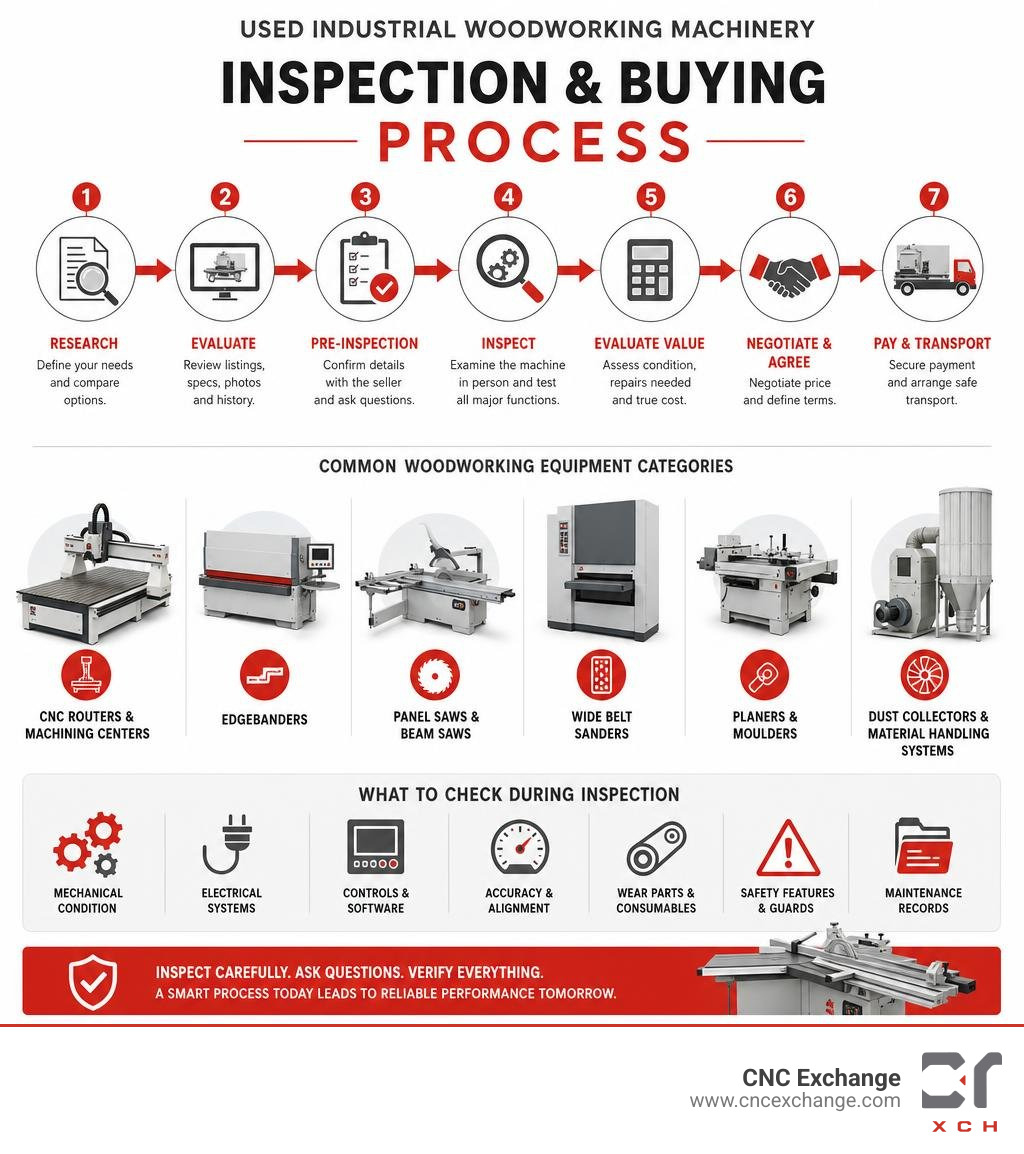
Common equipment categories available:
- CNC routers and machining centers
- Edgebanders
- Panel saws and beam saws
- Wide belt sanders
- Planers and moulders
- Dust collectors and material handling systems
Typical price ranges:
| Equipment Type | Used Price Range |
|---|---|
| Entry-level machines (face frame tables, clamps) | $1,200 – $5,000 |
| Edgebanders and sanders | $5,000 – $40,000 |
| Panel saws and CNC routers | $15,000 – $150,000 |
| Premium CNC systems and production lines | $150,000 – $460,000+ |
Where to find inventory: Marketplaces like Surplus Record list thousands of machines at any given time — over 3,400 woodworking machinery listings at last count — and dealer inventories turn over daily.
The market for industrial woodworking equipment for sale is large, active, and full of genuine bargains. It's also full of machines that have been run hard, poorly maintained, or misrepresented in listings.
For a manufacturing business owner, the stakes are high. A great used machine can dramatically cut costs compared to buying new. A bad one can cost you more in repairs, downtime, and lost production than if you'd bought new in the first place.
The difference between a smart buy and a costly mistake usually comes down to what you know before you wire the deposit.
This guide walks you through the major equipment categories, the brands worth chasing, how to inspect a machine properly, and how to protect your investment — so you can buy with confidence and not get burned.
Key Categories of Industrial Woodworking Equipment for Sale
When expanding your shop's capabilities, navigating the sheer volume of equipment on the market can feel overwhelming. Across major industrial listing networks, you will typically find dozens of high-quality machines available immediately in several core categories.
Understanding these primary categories helps you target the exact type of machinery your production line requires.
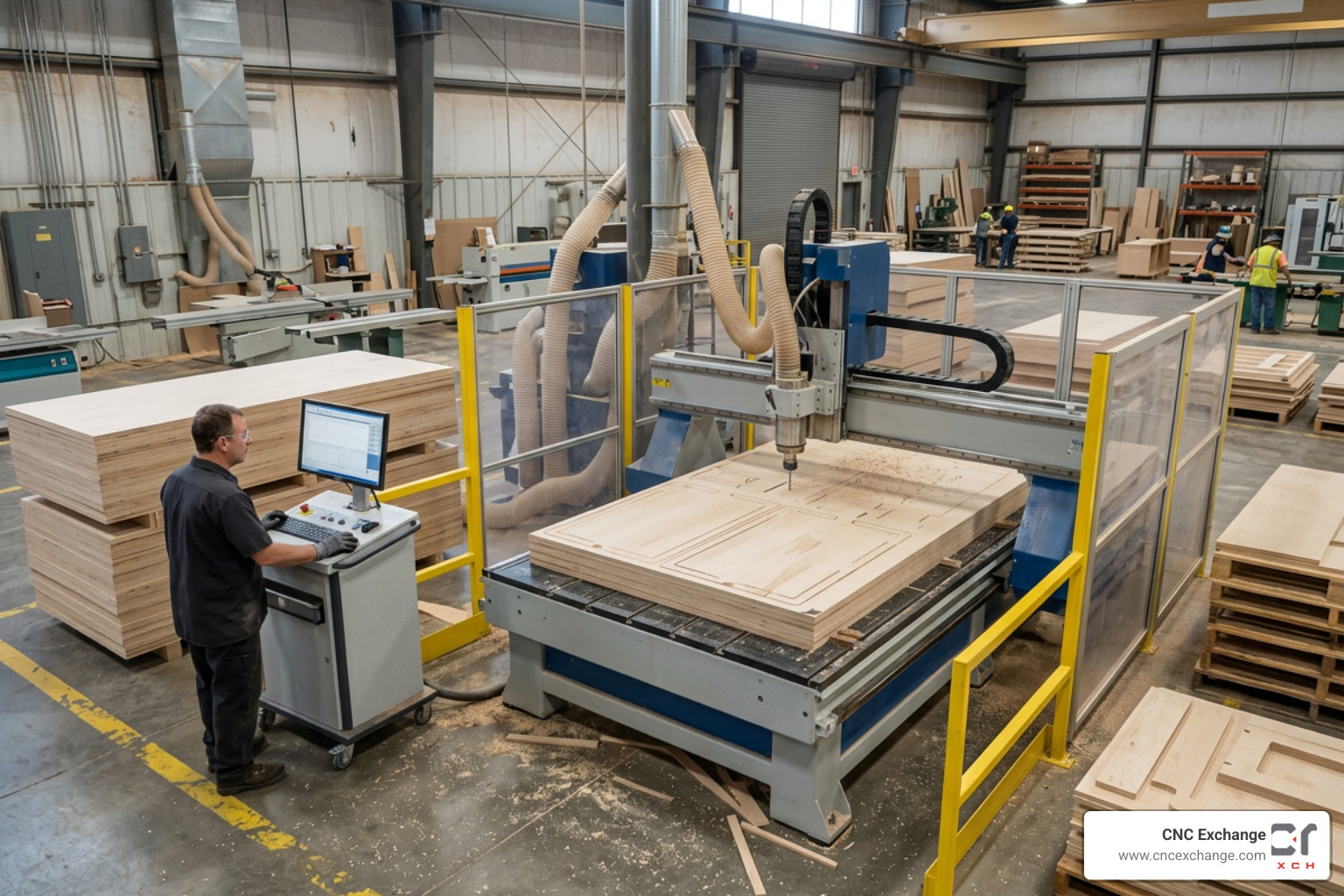
- CNC Routers & Machining Centers: The workhorses of modern custom cabinetry and furniture manufacturing. These machines automate cutting, boring, and routing. They range from compact 4x8 nesting machines to massive, automated multi-axis systems with automatic tool changers (ATC) and robust vacuum hold-down tables.
- Edgebanders: Essential for panel processing, these machines apply edge banding materials (PVC, ABS, veneer, or solid wood strips) to raw panel edges. High-end industrial edgebanders feature pre-milling stations, corner rounding, scrapers, and buffing units to deliver a flawless, retail-ready finish in a single pass.
- Panel Saws & Beam Saws: For sizing large sheet goods quickly and accurately, nothing beats an industrial panel saw. Front-loading automatic beam saws use computerized pusher fences and high-speed saw carriages to rip through multiple stacked sheets with absolute precision.
- Dust Collectors: Often overlooked but structurally vital, industrial dust collection systems keep your shop clean, protect your workers' lungs, and prevent abrasive wood dust from wearing out your expensive CNC electronics and linear guides.
Comparing Core Woodworking Machines
To help you evaluate your next major shop floor upgrade, we have outlined how these primary machine categories compare in terms of footprint, power requirements, and primary production roles:
| Machine Category | Typical Footprint | Power Requirements | Primary Production Role |
|---|---|---|---|
| CNC Router | Large (e.g., 10' x 15' or more) | High (3-Phase, often 30-50A+) | Automated nesting, complex shaping, boring, and routing of sheet goods. |
| Edgebander | Long & Narrow (e.g., 12' to 24' long) | Medium to High (3-Phase, 20-40A) | Applying, trimming, and finishing edge tape on panel edges. |
| Panel / Beam Saw | Very Large (e.g., 15' x 15' to 20' x 20') | High (3-Phase, 30-50A) | High-volume, straight-line sizing of stacked sheet goods. |
Sourcing Reliable Industrial Woodworking Equipment for Sale
In the used machinery world, the brand name on the chassis is about more than just prestige — it is your first line of defense against buying a lemon. Premium manufacturers build their frames with heavy cast iron or stress-relieved, monoblock welded steel. This superior construction ensures the machine holds its tolerances for decades rather than years.
Three global manufacturing groups dominate the high-end industrial woodworking landscape:
- SCM Group: Renowned for Italian engineering, SCM produces everything from traditional jointers to elite CNC nesting centers. Their machines are famous for holding tight tolerances even after decades of continuous shop use.
- HOMAG Group (including Weeke, Brandt, and Holzma): The gold standard for German-engineered panel processing. HOMAG machines are built like tanks and feature exceptionally advanced control integration.
- Biesse: Another Italian powerhouse, Biesse specializes in high-speed CNC routers and edgebanders that excel in high-volume, multi-shift production environments.
Buying from these trusted brands ensures excellent long-term value retention. Because these companies have massive global footprints, finding replacement parts, updated software, and qualified field technicians is significantly easier than sourcing support for obscure, budget-tier brands.
High-Capacity Saws and Planers
If your shop processes solid wood or raw timber rather than just sheet goods, your needs shift toward high-capacity saws, planers, and moulders.
For high-volume straight-line ripping, industrial gangsaws like the MR250 Double Arbor Multirip are engineered for serious throughput. This machine handles material up to 25.5 inches wide and utilizes dual arbors that can hold up to 16 blades each, allowing you to break down thick cants in a single pass with incredible speed and accuracy.
When it comes to surfacing, industrial planers must be robust enough to handle continuous feeding without introducing snipe. The SCM Nova S 520 X 20.5" Xylent Planer is a prime example of high-precision engineering. It features a monoblock welded base and a specialized segmented infeed roller. This clever mechanical design allows you to feed multiple boards of slightly varying thicknesses side-by-side simultaneously, as each segment is independently spring-tensioned.
For shops requiring extreme-duty, wide-capacity planing, the Grizzly G9961 24" Planer offers a 10 HP, 3-phase motor coupled with a 6-row spiral cutterhead containing 160 indexable carbide inserts. This setup delivers an ultra-smooth finish on wide slabs while running significantly quieter than traditional straight-knife planers.
If your production goals involve architectural mouldings, paneling, or complex solid wood profiles, a multi-spindle moulder is indispensable. We regularly see highly reliable, classic systems hit the market, such as this Weinig Profimat 23 Wood moulder or its sibling unit, another Weinig Profimat 23 Wood system. Weinig moulders are legendary for their quick-setup capabilities and cast-iron stability, making them highly sought-after assets on the secondary market.
How to Inspect Used Woodworking Machinery and Avoid Buying a Lemon
Buying used machinery is a fantastic way to save capital, but it requires a disciplined approach to inspection. You should never purchase an industrial machine "blind" unless you are dealing with a highly trusted seller who provides verified video runs and comprehensive guarantees.

When conducting a physical inspection, focus on the high-wear areas that are expensive to rebuild or replace:
- Spindle Runout: On CNC routers, use a dial indicator to measure the runout inside the spindle taper. Excessive runout (anything over a few ten-thousandths of an inch) indicates worn spindle bearings, which will ruin your cut quality and quickly destroy router bits.
- Vacuum Table Hold-Down: Turn on the vacuum pumps and check the pull across the entire table grid. Look for cracked gaskets, warped matrix boards, or leaking plumbing lines underneath the machine.
- Feed Chain Wear: On edgebanders, inspect the track pads and the drive chain. A slipping or unevenly worn feed chain will cause panels to drift, resulting in poor trimming and scraping quality.
- Glue Pot Condition: Check the edgebander's glue pot for charred, burnt adhesive buildup. If previous operators ran the machine hot without purging the glue, the heating elements and application rollers may be severely compromised.
Verifying Machine Condition and Maintenance History
A clean machine frame is nice, but the real story of a machine's life is written in its digital and physical logs. Always ask the seller for the machine's maintenance history. A shop that keeps meticulous records of lubrication intervals, belt replacements, and spindle rebuilds is a shop that cares about its assets.
Furthermore, pay close attention to the machine's controller and software compatibility. For instance, older HOMAG machines running early versions of woodWOP or SCM machines running legacy Xilog controllers may require older operating systems (like Windows XP or 7) to communicate with your modern CAD/CAM software. Ensure the control screen boots up properly, all axis drives enable without throwing faults, and the controller can successfully load and execute a test program.
If possible, always request a live test cut. Running a "dry run" in the air is fine for testing servo motors, but cutting actual material under load is the only way to verify structural rigidity, spindle power, and overall accuracy.
Essential Inspection Tool Checklist
When you go to inspect a machine in person, make sure you or your technician brings these essential diagnostic tools:
- Dial Indicator (with Magnetic Base): For measuring spindle runout and verifying table flatness.
- Digital Multimeter: To check voltage stability, phase balance, and identify electrical shorts.
- Precision Straightedge & Feeler Gauges: To inspect planer tables, jointer beds, and CNC beds for warping.
- Laser Tachometer: To verify that spindles and cutterheads are spinning at their rated RPMs.
- Infrared Thermal Camera: To scan electrical cabinets, motors, and gearboxes for abnormal hot spots under load.
Evaluating Certified Pre-Owned vs. Standard Used Equipment
As you browse the market, you will encounter two distinct classes of used machinery: "as-is" standard used equipment and certified pre-owned (CPO) machinery.
Standard used equipment is typically sold exactly as it sits on the previous owner's shop floor. While this option offers the lowest upfront purchase price, it carries the highest risk. You inherit all the hidden wear, deferred maintenance, and potential electrical gremlins.
Certified pre-owned machines, on the other hand, undergo a rigorous multi-point inspection and refurbishing process by qualified technicians. Wear items like belts, bearings, vacuum gaskets, and pneumatic lines are replaced. The software is updated, the calibration is verified, and the machine is often backed by a short-term parts warranty.
While CPO machines carry a premium price tag, they represent a massive reduction in risk, ensuring your machine is ready to produce revenue the moment it is wired to your shop floor.
Market Dynamics, Logistics, and Sourcing
The industrial woodworking machinery market moves incredibly fast. High-quality, late-model CNC routers, edgebanders, and panel saws rarely sit on the market for more than a few weeks.
To secure the right machine quickly, we recommend setting up automated inventory alerts with reputable machinery dealers and having your financing pre-approved. When the right machine appears, you must be ready to move fast.
However, buying the machine is only half the battle; getting it to your facility is the other. Industrial woodworking machinery is incredibly heavy, delicate, and sensitive to vibration.
- Rigging Services: Never attempt to move a CNC router or industrial planer with a standard forklift and a flatbed truck. You must hire professional machinery riggers who have the specialized cranes, heavy-duty forklifts, and air-ride transport trailers designed to move precision equipment safely.
- Shipping Logistics: Ensure the machine is properly prepped for transport. This includes locking the CNC bridge and spindle head in place to prevent them from slamming against the travel stops during transport, and wrapping sensitive electronics in moisture-barrier plastic.
- Installation Support: Before the machine arrives at your dock, verify your shop's electrical service can handle the load. Most industrial woodworking equipment requires 3-phase power (often 230V or 460V). You will also need to coordinate with an industrial electrician and a factory-trained technician to handle the final leveling, power connection, and software calibration.
Budgeting for Industrial Woodworking Equipment for Sale
When budgeting for your next machine, look beyond the initial purchase price. A true return on investment (ROI) analysis must factor in rigging, electrical upgrades, dust collection integration, software licensing, and operator training.
Fortunately, purchasing used equipment offers massive financial advantages. New machinery depreciates rapidly the moment it is installed — often losing 20% to 30% of its value in the first year. By buying a high-quality used machine, you let the original owner absorb that steep initial depreciation curve.
Additionally, under current tax laws, qualifying used equipment purchases may be eligible for immediate write-offs. Under the Section 179 tax deduction, businesses can deduct the full purchase price of qualifying new and used equipment in the tax year it is placed in service, providing a powerful incentive to upgrade your shop's capabilities right now.
Frequently Asked Questions About Industrial Woodworking Machinery
What are the main benefits of buying used woodworking machinery over new?
The primary benefit is massive cost savings, often allowing you to acquire a high-tier, industrial-grade machine for the price of a brand-new, entry-level model. Used machinery is also available immediately, bypassing the 4-to-6-month factory lead times common with new equipment orders. Finally, used machinery experiences much slower depreciation, allowing you to recoup a higher percentage of your investment if you decide to sell the machine down the road.
How often does the inventory of used woodworking machinery change?
Inventory changes daily. High-demand machines like edgebanders and CNC nesting lines move very quickly. Working with an active online marketplace ensures you get real-time access to fresh listings as soon as they become available.
What should I check first when inspecting a used CNC router or planer?
On a CNC router, always check the spindle runout and the condition of the linear guide rails and ball screws. On an industrial planer, inspect the cutterhead for nicked or worn knives, verify the feed roller alignment, and ensure the table elevation mechanism moves smoothly without slop. Always verify that your shop's electrical service (specifically 3-phase power availability) matches the machine's requirements.
Conclusion
Sourcing the right industrial woodworking equipment for sale doesn't have to be a gamble. By focusing on reputable brands, insisting on thorough physical and digital inspections, and partnering with a trusted machinery partner, you can upgrade your shop's production capacity while keeping your capital investment safe.
Remember this final checklist before signing any purchase agreement:
- Verify the electrical requirements match your facility.
- Inspect high-wear mechanical parts (spindles, chains, guides).
- Confirm software and controller compatibility with your current design software.
- Factor rigging, shipping, and installation support into your total budget.
At CNC Exchange, we make finding, buying, and selling industrial machinery simple and secure. Operating from our headquarters in Prospect Heights, Illinois, we help woodworking shops across the country upgrade their capabilities, navigate shipping logistics, and secure fair market value for their machinery assets.
Ready to find your next machine? Explore our current inventory of high-performance woodworking machinery or contact our team of equipment experts today to discuss your production goals.