
Why a 4x8 CNC Router for Sale Is the Smartest Production Upgrade You Can Make
If you're ready to buy a 4x8 CNC router for sale, here's a quick breakdown of what's available in 2026:
| Budget | Machine Type | Price Range | Best For |
|---|---|---|---|
| Entry-level | Import flatbed (stepper motors) | $1,500 – $5,500 | Startups, small shops |
| Mid-range | Prosumer (closed-loop steppers) | $5,500 – $10,000 | Growing cabinet/sign shops |
| Industrial | Servo drive, ATC spindle | $10,000 – $50,000+ | High-volume production |
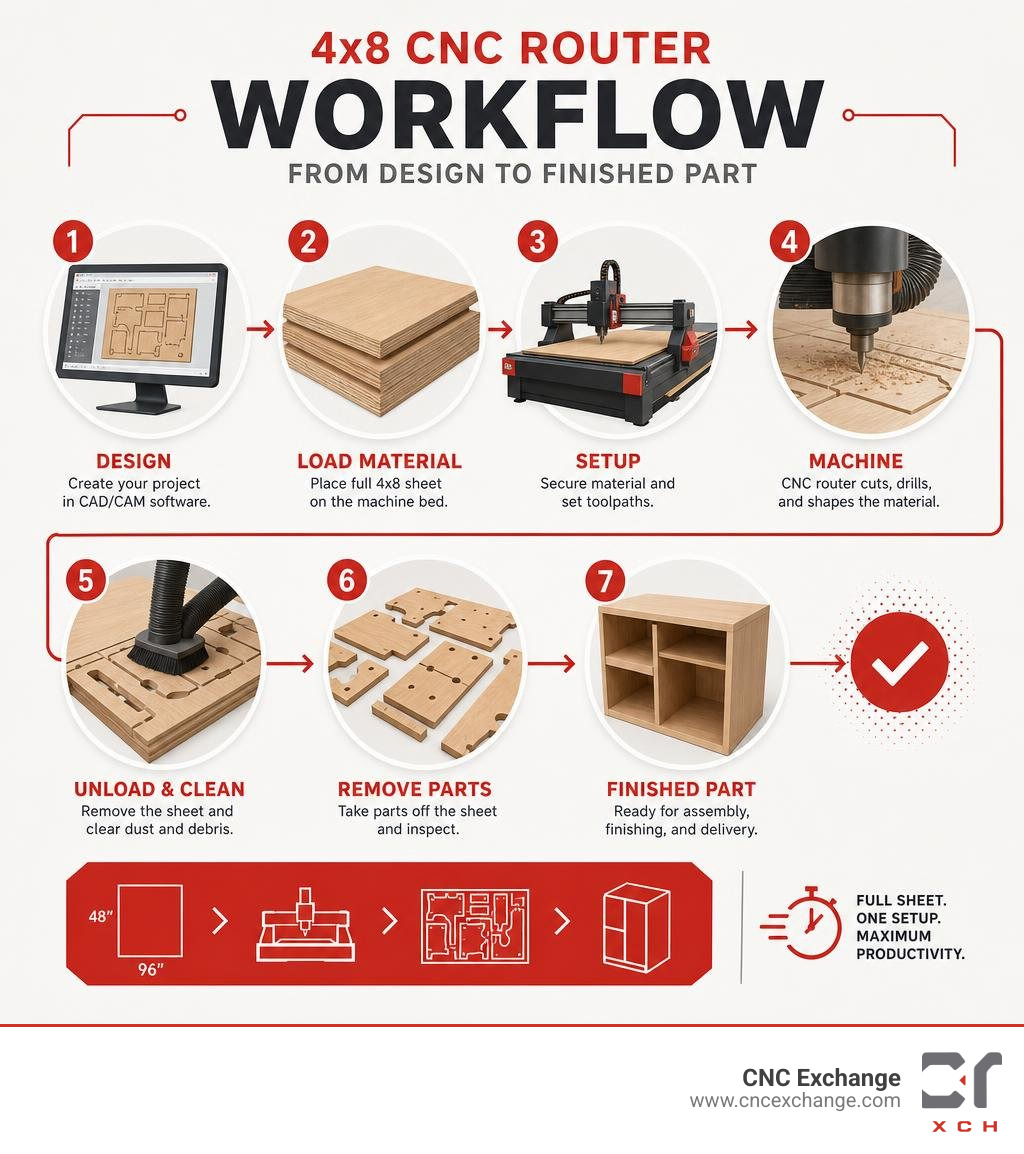
A 4x8 CNC router is built around one core idea: process a full 48" x 96" sheet in a single setup — no pre-cutting, no repositioning, no wasted time.
Cabinet shops, furniture makers, sign shops, and fabrication businesses all rely on these machines for the same reason. A full-sheet router eliminates the manual handling that slows production and introduces errors.
The market in June 2026 spans a wide range. You can spend $1,500 on a basic import machine or $10,000+ on a production-grade system with servo drives and smart spindles. The right choice depends entirely on your volume, materials, and budget.
This guide covers everything you need to know — specs, drive systems, workholding, upgrades, and how to evaluate used options — so you can buy with confidence.
Key Factors to Consider When Evaluating a 4x8 CNC Router for Sale

When you begin searching for a 4x8 CNC router for sale, it is easy to get overwhelmed by the sheer volume of technical specifications. However, evaluating these machines boils down to a few critical structural and mechanical elements that directly impact your shop's daily productivity.
First, look closely at the frame and gantry construction. A high-quality 4x8 machine requires an incredibly rigid foundation. The best industrial models feature an integral welded steel frame with static stiffness ratings exceeding 12,000 N/mm². Without a heavy, stress-relieved base, the gantry will vibrate during high-speed directional changes, leading to poor edge quality on your cuts and premature wear on your tooling.
Second, consider the Z-axis clearance and gantry height. While a standard 8-inch Z-axis is the industry baseline and provides the best overall stiffness for flat sheet goods, some production environments require 9 to 13 inches of clearance to accommodate thicker materials, vertical workholding, or rotary attachments.
Finally, spindle power determines how fast you can cut. Spindles generally range from 3.0kW (approx. 4 HP) manual tool change units up to 9.0kW (approx. 12 HP) high-performance automatic tool changer (ATC) systems. If you are primarily cutting thin plastics or doing light engraving, a smaller spindle is perfectly fine. But if you plan to nest cabinet parts out of heavy 3/4" Baltic birch plywood all day, a high-torque spindle is essential to maintain fast feed rates without stalling.
Finding the Best Entry-Level 4x8 CNC Router for Sale
For small shops, hobbyists transitioning to commercial work, or startups with tight budget constraints, the entry-level market offers highly capable machinery without the six-figure price tag. These machines typically utilize standard stepper motors and simplified control systems to keep costs low while still offering a full 4x8-foot working area.
In this class, machines like the STYLECNC STM1325 and the Forsun FS1325A are incredibly popular. The STM1325, typically priced between $4,380 and $5,500, offers a 1300mm x 2500mm working area, a 3.0kW spindle, and maximum working speeds of 15,000 mm/min. If you are on an ultra-tight budget, entry-level models like the FS1325A can start as low as $1,500, delivering respectable rapid travel rates of up to 20,000 mm/min.
While these machines may lack the lightning-fast acceleration of industrial servo-driven systems, they are perfect for processing custom signage, basic furniture parts, and architectural millwork. If you want to maximize your budget, exploring affordable used 4x8 CNC wood router tables is an excellent way to secure a heavier, more stable machine frame for the same price as a lightweight new kit.
Industrial-Grade 4x8 CNC Router for Sale Options
When your business scales to the point where the machine is running multiple hours per day, upgrading to an industrial-grade 4x8 CNC router for sale becomes a necessity. Industrial machines are designed for continuous, high-volume production and feature advanced technologies like Automatic Tool Changers (ATC), high-output AC servo motors, and high-flow vacuum hold-down tables.
A prime example of industrial excellence is a used Thermwood 4x8 CNC router. These heavy-duty workhorses are engineered with massive, stress-relieved steel frames and highly sophisticated controllers that manage complex tool paths with ease. Industrial machines also feature rapid traverse speeds of 60,000 mm/min (or faster) and 12-to-15-station rotary tool changers that swap tools in under 8 seconds.
By automating the tool-changing process and utilizing powerful vacuum systems to hold down parts instantly, an industrial 4x8 router can easily increase your shop's traditional operating efficiency by 3 to 5 times.
Technical Specifications, Drive Systems, and Workholding Options
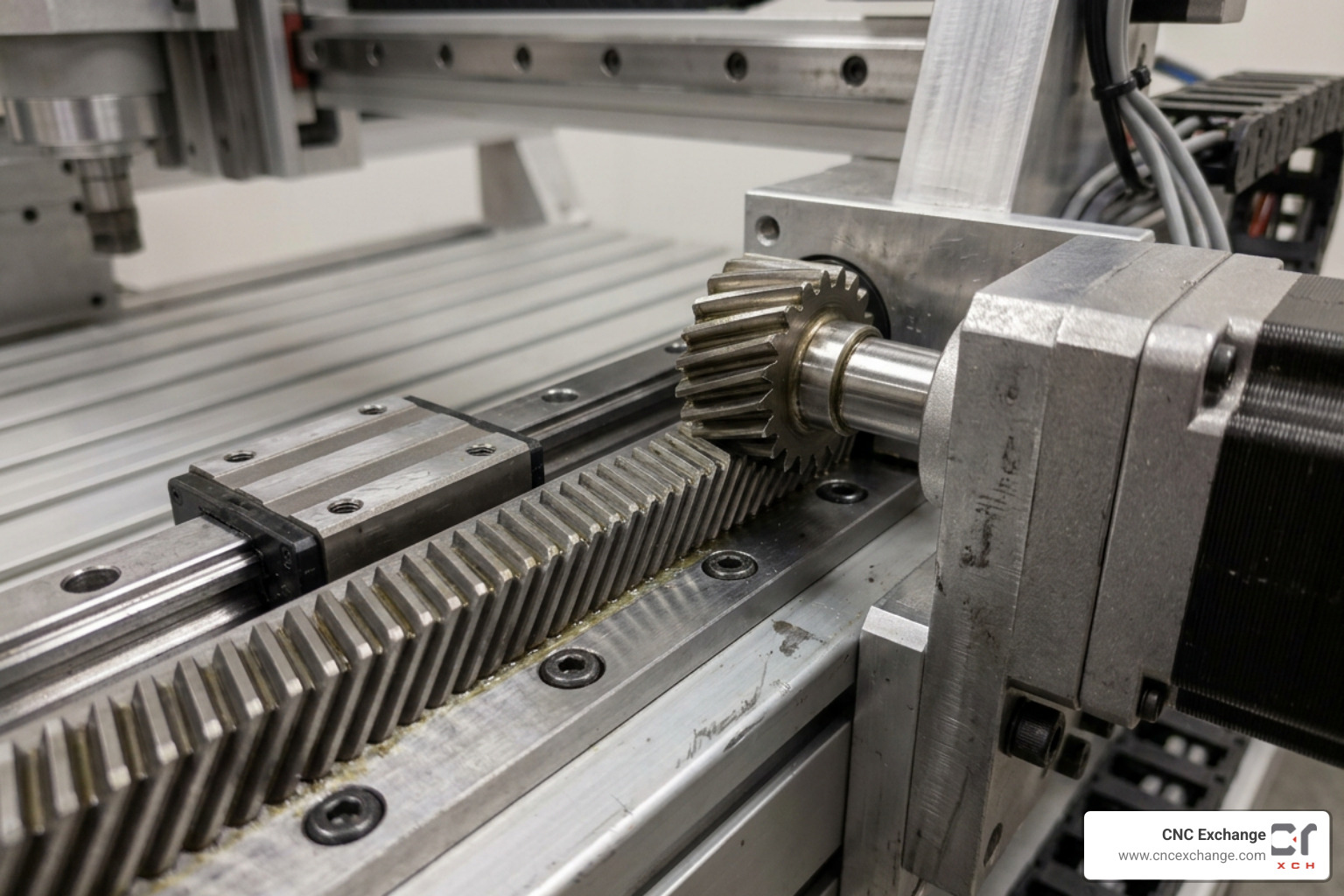
To truly understand what separates a budget machine from a production powerhouse, we have to look under the hood at the motion mechanics. The drive system is the heart of the router, translating digital commands into physical, high-precision movement.
For large-format machines like a 4x8 table, the industry standard for the X and Y axes is a high-speed helical rack and pinion system. Unlike straight rack and pinion setups, helical teeth remain in constant contact, which significantly reduces vibration, increases load capacity, and delivers smoother cuts. For the Z-axis, where vertical precision and lifting power are paramount, high-precision TBI ball screws are universally preferred.
When evaluating these systems, pay close attention to two key metrics:
- Positioning Accuracy: This represents how close the machine can get to a specific coordinate (typically ±0.03mm over 300mm on professional machines).
- Repeatability: This measures the machine's ability to return to the exact same spot multiple times (high-end models achieve ±0.02mm or better).
If you want industrial-grade precision and robust engineering, keeping an eye out for American-made CNC routers on the secondary market is a fantastic strategy to acquire premium motion components at a fraction of their original retail cost.
Drive Motors and Motion Control
The debate between stepper motors and servo motors is one of the most important considerations when looking at a 4x8 CNC router for sale.
Traditional stepper motors move in fixed increments (steps). While they are highly reliable and require virtually no regular maintenance, they run "open-loop," meaning the controller does not actually know if the motor missed a step due to a material knot or a heavy cut. This can occasionally lead to ruined workpieces.
To bridge this gap, many modern prosumer machines—such as the Sienci AltMill (which starts at $7,490) or the FoxAlien CL-4x4 (priced around $3,699)—use closed-loop stepper motors. These motors feature encoders that feed positional data back to the controller, allowing the machine to self-correct if it encounters resistance.
At the top tier of production, you will find AC Servo Drives and premium ClearPath systems. Servos operate on a continuous closed-loop system, offering up to 60% more torque, faster acceleration, and rapid speeds of over 1,200 inches per minute (IPM). If a servo motor encounters an error it cannot correct, it instantly halts the machine to protect your material and tooling, making them the gold standard for high-speed Z-axis precision and heavy-duty nesting.
Vacuum Tables vs. T-Slot Beds
Workholding is the unsung hero of CNC machining. If your material moves even a fraction of a millimeter during a cut, your part is ruined.
For high-volume sheet nesting, nothing compares to a multi-zone high-flow vacuum table. These tables use powerful vacuum pumps to pull down an entire 4x8 sheet with up to 25kPa of adsorption force. This allows you to cut intricate nested parts back-to-back without wasting time installing clamps or screws.
However, vacuum tables require a continuous source of high-phase electrical power to run the pumps. If your shop is limited to single-phase power, or if you regularly work with smaller, irregular workpieces, a traditional T-slot bed is a highly reliable alternative. T-slot tables use mechanical clamps to secure material to aluminum tracks.
For the ultimate in versatility, many shops opt for a hybrid table. Hybrid beds feature integrated vacuum zones alongside aluminum T-slot tracks, giving you the speed of vacuum hold-down for full sheets and the mechanical security of clamps for custom, thick, or non-porous workpieces. If you are looking to upgrade your shop's material yield and processing speed, checking our inventory for high-quality used CNC routers with hybrid tables is a great place to start.
Advanced Upgrades: Rotary 4th Axis and Laser Systems
One of the best ways to maximize the return on your investment is to choose a machine that can grow with your business. Many 4x8 CNC routers feature modular architectures that support advanced, bolt-on upgrades.
A rotary 4th axis is one of the most popular upgrades for woodworking shops. By mounting a chuck-type rotary axis recessed parallel to the X or Y axis, you can instantly transform your flatbed router into a 3D carving machine. This allows you to process cylindrical workpieces like custom table legs, stair balusters, columns, and intricate 3D sculptures without repeated manual setups. Machines like the CK-1325-R come pre-configured with a side-mounted rotary axis capable of handling parts up to 200mm in diameter and 2000mm in length.
Other powerful upgrades include:
- Deployable Laser Systems: Adding a 40W CO2 or diode laser to the gantry allows you to combine high-speed routing with precision laser engraving and marking on a single machine.
- Aggregate Heads: These specialized tool holders redirect the spindle angle, allowing you to perform horizontal drilling, side-routing, and lock-set mortising.
If you want to explore the absolute pinnacle of multi-process machining and complex geometry, reading about 5-axis CNC router capabilities will show you how industrial shops handle high-end aerospace, automotive, and advanced composite molds.
Frequently Asked Questions about 4x8 CNC Routers
How much space and power does a 4x8 CNC router require?
Operating a 4x8 CNC router requires significantly more space than the nominal 4' x 8' cutting area. The physical footprint of the machine itself is usually around 6.5 feet wide by 10 feet long (for example, the Sienci AltMill footprint is 66" x 114", while the Avid PRO4896 is 77" x 115.5"). To safely load full sheets of material and perform routine maintenance, you should plan for a minimum dedicated shop space of 10' x 12'.
Regarding electrical power, entry-level and prosumer machines can often run on standard 120VAC or 220V single-phase power. However, industrial spindles (especially those above 6HP) and high-flow vacuum pumps almost always require 3-phase power.
Additionally, you must factor in dust collection. Routing MDF and plywood generates massive volumes of fine dust. At a minimum, you will need a 3HP dual-bag dust collector connected via a 4-inch flexible hose to keep your linear rails clean and your shop air safe.
What software is compatible with a 4x8 CNC router?
Most modern 4x8 CNC routers run on standard G-code, which means they are compatible with all major CAD/CAM software packages. For design and toolpath creation, industry favorites include:
- Vectric (VCarve Pro / Aspire): Highly favored by cabinet makers and sign shops for its intuitive nesting and 3D carving tools.
- Fusion 360: Excellent for complex engineering, 3D modeling, and joint design.
- Carbide Create & Carveco: Great entry-level options for beginners.
On the machine control side, common systems include Mach3, DSP handheld controllers, Syntec, and NC Studio. These control systems read the G-code post-processed from your CAD/CAM software and translate it into physical machine movement.
Is a used 4x8 CNC router a reliable investment?
Absolutely. Because industrial CNC routers are built with heavy, welded steel frames and premium linear guide rails, they hold their mechanical integrity for decades. Buying a used machine from a reputable brand can save you 30% to 60% compared to buying new.
When inspecting a used 4x8 CNC router, we always recommend checking a few key areas:
- Gantry Squareness: Verify the gantry moves smoothly and remains perfectly square across the entire length of the bed.
- Spindle Runout: Use a dial indicator to check for any play or runout in the spindle shaft, which could indicate worn bearings.
- Linear Rails: Inspect the rails for any scoring, rust, or play in the bearings.
If you are looking for an industrial-grade machine with an outstanding track record for reliability, finding a used Thermwood 4x8 CNC router on our marketplace is a highly secure investment that will deliver precision cuts for years to come.
Conclusion
Investing in a 4x8 CNC router for sale is one of the most profitable decisions a growing fabrication or woodworking shop can make. By transitioning from manual layouts and pre-cutting to automated, full-sheet nesting, you instantly reduce material waste, eliminate human error, and free up valuable labor hours.
At CNC Exchange, we understand that navigating the machinery market can be complex. Whether you are looking to buy your first prosumer machine or sell a surplus industrial workhorse, we are here to simplify the process. Operating from our main office in Prospect Heights, Illinois, our team helps shop owners at every stage of the equipment lifecycle—offering accurate asset valuations, running professional auctions, and securing fair market value for your machinery.
Ready to take your production to the next level? Browse CNC Machinery for Sale on our online marketplace today, or contact our team to find the perfect router for your shop!