
What to Know Before Buying a CNC Plasma Cutting Table
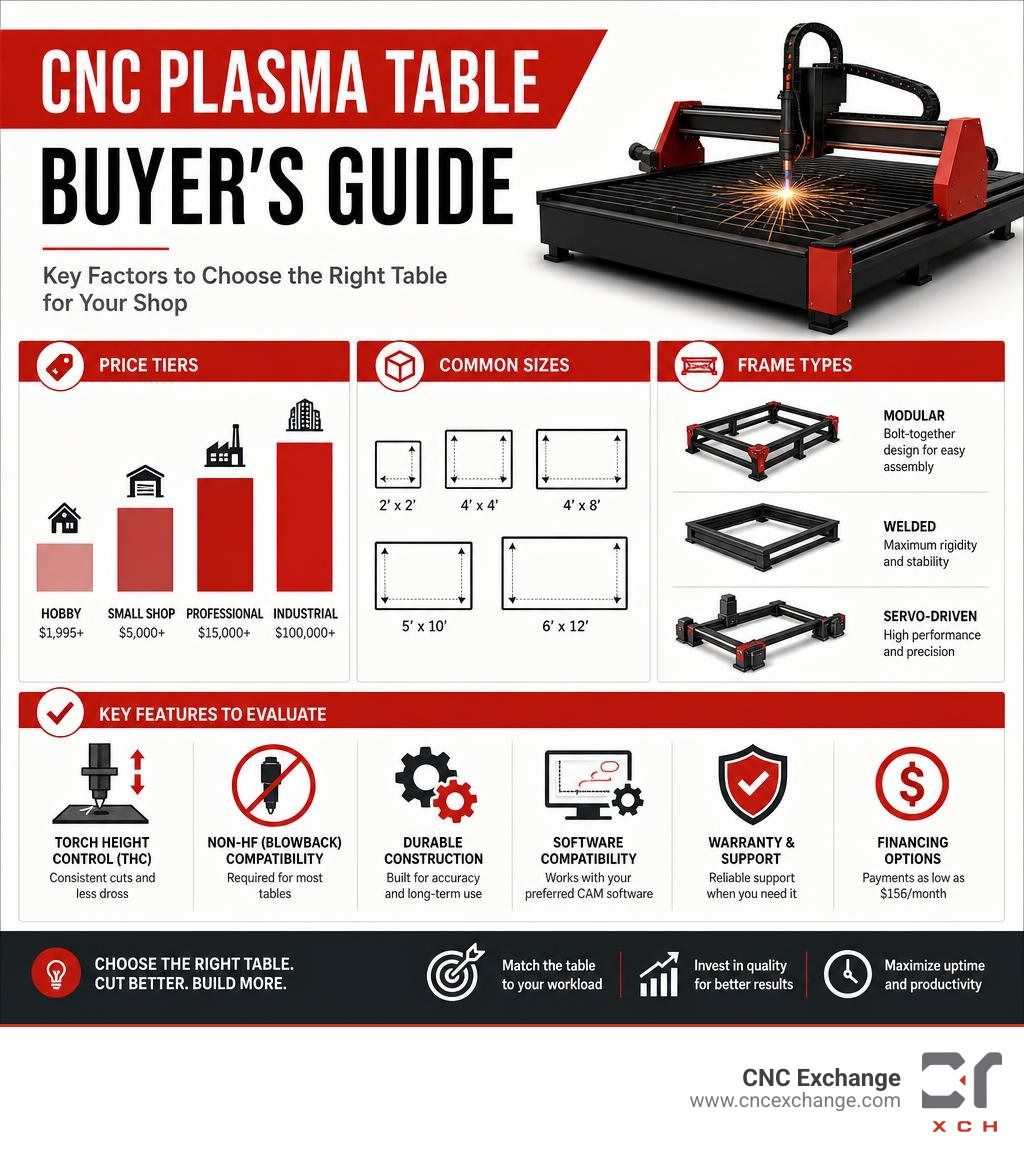
If you're looking at a plasma cutter table for sale, here's a quick summary to help you decide fast:
| Factor | What to Know |
|---|---|
| Price range | $1,995 (hobby) to $100,000+ (industrial) |
| Common sizes | 2x2, 4x4, 4x8, 5x10, 6x12 |
| Frame types | Modular (bolt-together), welded, or servo-driven |
| Must-have feature | Torch Height Control (THC) |
| Key compatibility check | Non-HF (blowback) start plasma cutters only for most tables |
| New vs. used | New = warranty + support; Used = lower cost, inspect carefully |
| Financing | Available from many manufacturers, starting as low as $156/month |
Buying a CNC plasma table is one of the biggest equipment decisions a metal fabrication shop can make. The market runs from compact hobby units under $2,000 all the way to full industrial systems topping $100,000. That's a wide range — and the wrong choice can cost you far more than money.
The problem most buyers face isn't a lack of options. It's knowing which options actually matter for their specific shop, budget, and workload.
Table size, frame construction, motion system, software compatibility, and ongoing support all affect your real-world results. A table that looks like a bargain on paper can become a bottleneck — or a liability — if it doesn't match your production needs.
This guide breaks it all down clearly, so you can evaluate any plasma table for sale with confidence.
Key Types of CNC Plasma Tables
When hunting for a plasma cutter table for sale, you will quickly realize that not all frames and motion systems are built the same way. The mechanical foundation of your machine dictates its structural rigidity, cutting speed, accuracy, and ease of setup.
To help you navigate your options, we can categorize CNC plasma tables into three primary design categories: modular frame systems, welded frame tables, and high-performance servo motor systems.
| Table Type | Assembly Required | Motion System | Typical Price Range | Best For |
|---|---|---|---|---|
| Modular Frame | Yes (DIY Bolt-Together) | Stepper Motors (Belt or Lead Screw) | $3,200 – $8,000 | Hobbyists, small garages, and light prototyping |
| Welded Frame | No (Ships 100% Assembled) | Stepper Motors (Rack & Pinion) | $8,500 – $14,000 | Job shops, small-to-medium fabricators |
| Servo Motor | No (Ships 100% Assembled) | Closed-Loop Servos (Planetary Gear) | $15,000 – $50,000+ | High-volume production, tight-tolerance cutting |
Modular Frame Systems
Modular CNC plasma tables are designed to lower the barrier to entry for small shops and dedicated hobbyists. These systems ship as a flat-pack of parts, requiring you to roll up your sleeves and bolt the frame together yourself.
The biggest advantage of a modular table is shipping ease and upfront cost. Because the components fit into standard boxes, you avoid the hefty flatbed freight charges associated with fully assembled machinery.
Brands like STVCNC offer their SparX Modular line starting at $5,499 for a 2x4 model, climbing to $7,999 for a 5x10 footprint. Premier Plasma CNC also provides highly customizable modular tables ranging from $3,200 for a compact 2x2 up to $13,460 for larger configurations.
While modular systems are incredibly cost-effective, they do require several hours (or days) of assembly. You must also pay close attention to squaring the frame during setup to ensure consistent cutting accuracy.
Welded Frame Tables
If the idea of spending your weekend assembling a giant metal puzzle doesn't appeal to you, a welded frame table is the logical step up. These tables feature a heavy-duty, fully welded tubular steel or powder-coated frame. They ship 100% assembled, factory-tested, and ready to cut almost immediately.
Welded frames provide exceptional structural rigidity, which is crucial for absorbing the vibrations generated during high-speed direction changes. This stability translates directly to smoother cut edges and tighter tolerances.
For example, the STVCNC SparX PRO 12 features an open tubular welded frame that can support steel plates up to 2 inches thick without breaking a sweat. Prices for these professional-grade welded tables typically range from $8,499 for a 4x4 configuration to $13,999 for a 6x12 footprint.
Servo Motor Systems
For high-volume production environments where speed and precision are paramount, closed-loop servo motor systems are the gold standard.
While entry-level and mid-range tables rely on open-loop stepper motors—which can occasionally "lose steps" if the torch encounters resistance—servo systems constantly communicate their exact position back to the controller. If an error or obstruction occurs, the system instantly self-corrects.
Industrial-grade servo tables, such as the STVCNC Optimum series (starting at $15,499 for a 4x4 and reaching $20,999 for a 6x12), feature planetary gear reduction and helical rack-and-pinion drive systems. This mechanical setup shifts physical strain away from the drive belts, resulting in ultra-smooth motion, rapid travel speeds up to 800 Inches Per Minute (IPM), and positional accuracy down to a fraction of a millimeter.
Finding the Right Plasma Cutter Table for Sale
Choosing the right machine involves balancing your physical workspace constraints with your production goals. Let's look at how to size your table and prepare your shop floor for its arrival.

If you are currently searching for the perfect machine to upgrade your shop's capabilities, you can explore our curated marketplace of CNC Plasma Cutting Tables for Sale.
Choosing the Right Cutting Area Size
The footprint of your CNC plasma table should match the raw material sheets you plan to purchase. Buying pre-cut metal sheets is significantly more expensive than buying full industrial sheets, so sizing your table correctly can save you thousands of dollars in material costs over time.
- 2x2 and 2x4 Tables: Ideal for home garages, artistic metalwork, brackets, and prototyping. The Eastwood Versa Cut 2x2 CNC Plasma Table is a highly compact, budget-friendly option starting at $2,299.97.
- 4x4 Tables: A highly popular "square" footprint for small fab shops. It accommodates half-sheets of steel easily. The Torchmate 4000 Series CNC Plasma Tables offer robust 4x4 options built for rapid deployment.
- 4x8 and 5x10 Tables: The industry workhorses. A 4x8 or 5x10 table allows you to load standard 4-foot or 5-foot industrial sheets directly onto the cutting bed. If you run a commercial fabrication business, a 4x8 CNC plasma cutting table is often the sweet spot for maximizing production.
- 6x12 and Larger Tables: Designed for heavy-duty industrial operations processing oversized plates or nesting massive quantities of parts in a single run.
Power and Space Requirements
Setting up a CNC plasma table involves more than just plugging it into a standard wall outlet. You need to plan for three primary utilities:
- Electrical Power: Most CNC tables themselves run on standard 110V AC power to run the controller, computer, and motors. However, the plasma cutter power source itself is a power-hungry beast. Smaller cutters require 240V single-phase power, while industrial-grade cutters (like a 125-amp system) frequently require 200V to 600V three-phase power.
- Compressed Air: Clean, dry air is the lifeblood of plasma cutting. Your air compressor must be able to deliver a high volume of air consistently—typically at least 6 to 9 Standard Cubic Feet per Minute (SCFM) at 90 PSI.
- Air Filtration and Dryers: Moisture is the ultimate enemy of plasma cutting. Wet air causes rapid consumable wear, ruins torch nozzles, and degrades cut quality. You must install a dedicated inline air dryer or desiccant system between your compressor and your plasma cutter.
Essential Features and Software Options
To get the cleanest cuts and the longest life out of your machine, you need to understand the key hardware and software features that separate basic tables from production-grade powerhouses.
Torch Height Control (THC)
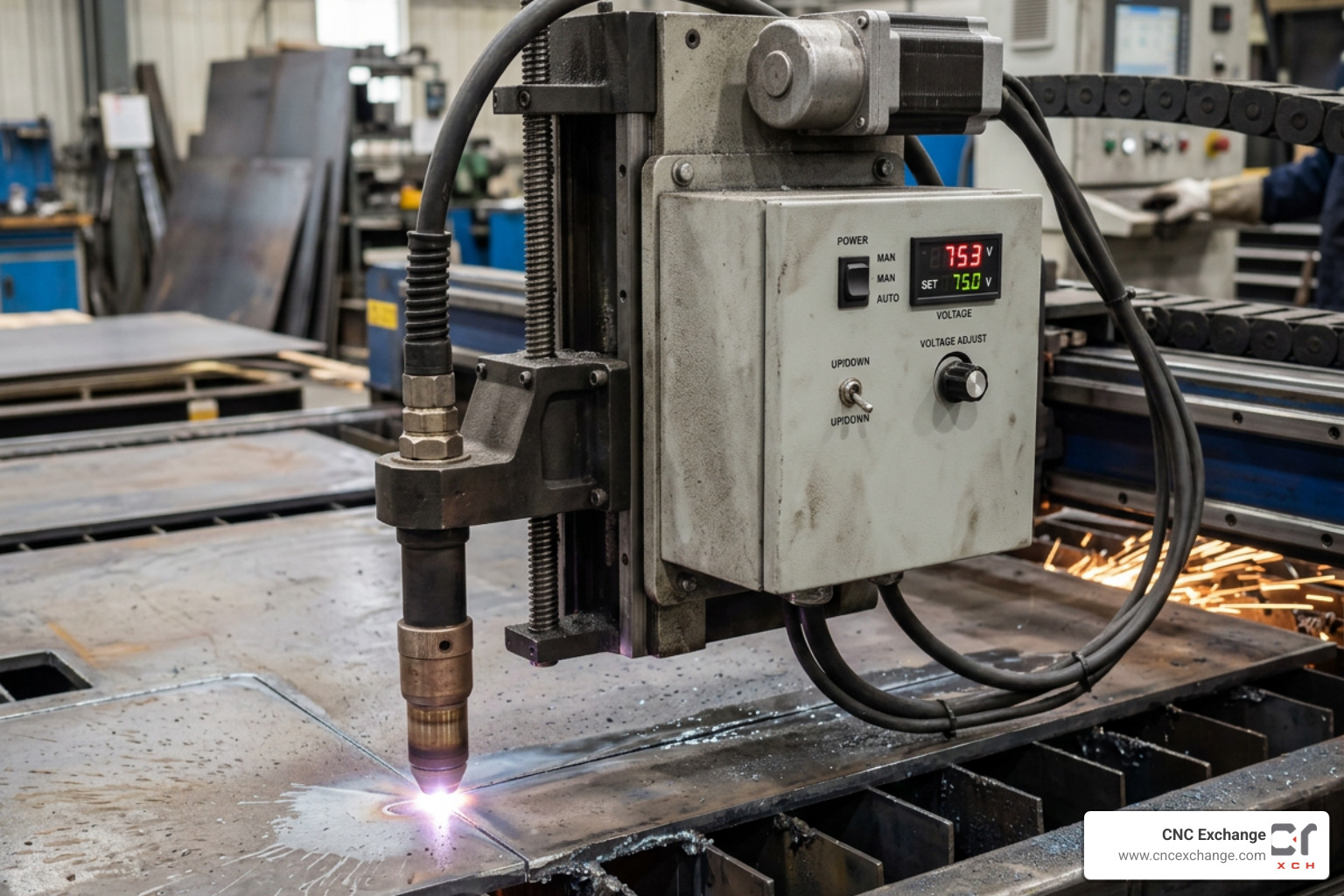
If you only take one piece of advice from this guide, let it be this: never buy a CNC plasma table without Torch Height Control (THC).
Metal sheets are rarely perfectly flat; they warp, bow, and flex—especially when subjected to the intense heat of a 40,000°F plasma arc. THC uses real-time arc voltage feedback to measure the physical distance between the torch tip and the metal plate.
As the torch moves across a warped piece of metal, the Z-axis motor automatically micro-adjusts up and down to maintain the exact pierce height and cut height. This prevents the torch from crashing into the plate (which ruins nozzles and can damage the gantry) and ensures consistent cut quality across the entire sheet.
Water Pan vs. Downdraft Systems
Plasma cutting generates an incredible amount of sparks, toxic smoke, and fine metal dust. You must have a system to capture these particulates.
- Water Pans (Waterbeds): The most common and affordable solution for small-to-mid-sized shops. The table's cutting slats sit directly over a shallow pool of water (frequently mixed with a rust inhibitor like Green Guard or Plasma Guard). The water captures sparks and dust instantly while cooling the metal plate to prevent thermal warping.
- Downdraft Systems: These systems use a high-powered exhaust fan to pull smoke and dust downward through the cutting slats, venting it outside or through a multi-stage filtration system. Downdraft systems keep parts dry (which is great if you need to paint or weld them immediately), but they require high-volume fans and complex ductwork.
Software and Controller Compatibility
Your CNC workflow relies on three software steps:
- CAD (Computer-Aided Design): Where you draw your part (e.g., Fusion 360, AutoCAD, or SolidWorks).
- CAM (Computer-Aided Manufacturing): Where you apply "toolpaths," lead-ins, lead-outs, and nesting.
- CNC Controller Software: The program that reads the G-code and physically moves the machine (e.g., MyPlasmCNC, FlashCut, or proprietary interfaces like MultiCam's EZ Control).
When evaluating a table, make sure the manufacturer provides robust CAM post-processors for common design suites. Systems like the iPlasma XTREME 5100 CNC Plasma Table come bundled with Windows 11-compatible MyPlasm CNC software, making the transition from design to finished cut incredibly smooth.
Cost Factors and New vs. Used Considerations
How much should you actually budget for your machine, and does it make sense to buy used?
Price Ranges for a Plasma Cutter Table for Sale
Your total investment depends on the tier of machine you choose:
- Entry-Level / Hobbyist ($2,000 – $8,000): Compact, often modular tables. These are fantastic for home shops, DIYers, and light-duty prototyping.
- Mid-Range / Commercial ($15,000 – $50,000): Rigid welded frames, high-precision stepper or servo drives, integrated water tables, and advanced software bundles. These are the workhorses of professional fabrication shops.
- Industrial / High-Definition ($50,000 – $100,000+): Heavy-duty gantry systems, multi-gas precision plasma power sources, and the ability to run multi-shift production schedules day in and day out.
If you are looking for an industrial-grade solution with standard premium features, the Arc Max Elite CNC Plasma Table by MegaFab is a prime example of a production-level system designed to handle heavy plate cutting with extreme precision.
Buying a Used Plasma Cutter Table for Sale
For many growing businesses, buying a high-quality used CNC plasma table is the smartest way to access premium industrial features without the premium price tag.
When buying used, keep these inspection tips in mind:
- Inspect the Gantry and Rails: Run the gantry back and forth manually. Check for any binding, rough spots, or play in the linear bearings. Look closely at the rack-and-pinion gears or lead screws for signs of excessive wear.
- Test the Electronics: Power on the controller and run a test program. Listen to the motors—unusual grinding or high-pitched whining can indicate failing bearings or drive issues.
- Verify Software Licensing: Ensure that any proprietary software licenses or control codes can be legally transferred to your business.
Ready to find a deal? Check out our current inventory of Used CNC Plasma Tables for Sale to see what high-quality industrial machines are available right now. You can also browse our broader selection of CNC Machinery for Sale to find other fabrication equipment to pair with your table.
Frequently Asked Questions About CNC Plasma Tables
What is the difference between conventional and precision plasma?
Conventional plasma systems (often called air plasma) use standard compressed shop air to create the plasma arc. They are highly cost-effective and can cut a wide variety of materials, but they produce a slight bevel (angle) on the cut edge.
Precision plasma (or high-definition plasma) uses specialized dual-gases (such as oxygen, nitrogen, or argon-hydrogen mixtures) and a highly constricted nozzle to focus the arc. This results in perfectly square cut edges, virtually no dross, and laser-like precision on thick plates.
What electrical and air requirements do I need?
At a minimum, you will need a dedicated 110V AC circuit for the table controller and computer, and a 240V single-phase circuit (typically 50 to 60 amps) for a commercial-grade plasma cutter.
For your air supply, aim for a compressor that can deliver at least 6 to 9 SCFM at 90 PSI, coupled with a high-quality refrigerated or desiccant air dryer to eliminate moisture.
Can I use a CNC plasma table for other materials like wood?
Technically, some tables can be converted into light-duty CNC routers by swapping the plasma torch for a spindle. However, this is generally not recommended.
Plasma cutting relies on water tables or downdrafts to capture conductive metal dust, which creates a highly wet or dirty environment. Wood dust mixed with water creates a sticky mess that can ruin linear guides, and wood dust in a dry plasma environment presents a severe fire hazard due to residual sparks. It is always safest to keep your plasma table dedicated to conductive metals like steel, stainless steel, and aluminum.
Conclusion
A CNC plasma table is a game-changing asset that can instantly elevate your shop's productivity, accuracy, and creative freedom. Whether you choose a compact modular setup to kickstart your garage business or a heavy-duty welded servo table to scale up commercial operations, understanding the mechanical and technical fundamentals is key to making a smart investment.
At CNC Exchange, we make the process of upgrading your shop simple and transparent. We auction, buy, and sell high-quality industrial machinery from our headquarters in Prospect Heights, Illinois. If you have an older machine to trade in, or if you are ready to find your next production-grade powerhouse, we are here to help you get fair market value and find the perfect fit.
Browse our complete inventory of CNC Machinery for Sale today, and let's get your shop cutting with precision!