
How Much Does a 4x8 CNC Router Cost? A Quick Answer

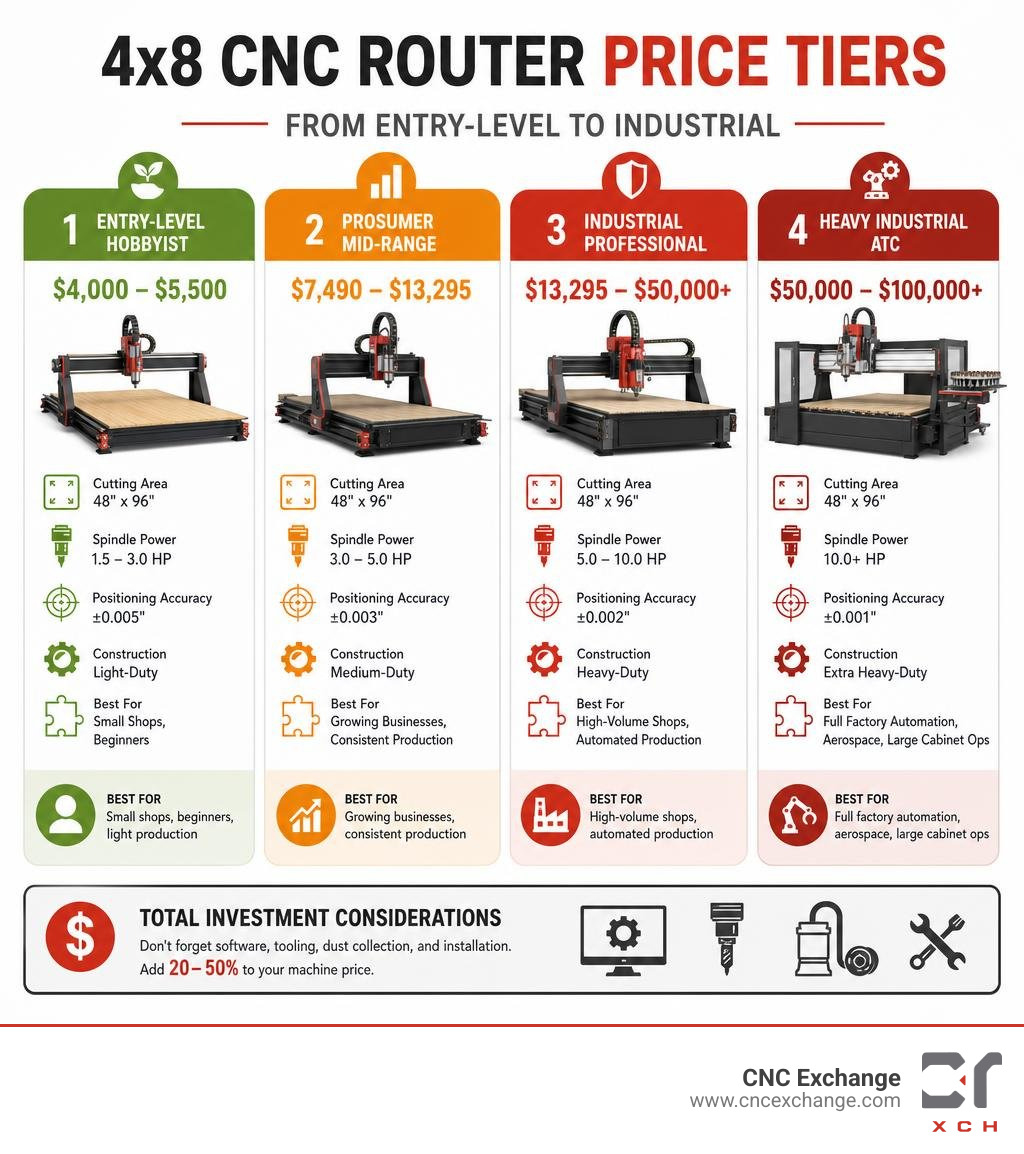
The 4x8 CNC router price varies widely depending on the machine's class and capabilities. Here's a fast breakdown:
| Category | Price Range | Best For |
|---|---|---|
| Entry-Level / Hobbyist | $4,000 – $5,500 | Small shops, beginners, light production |
| Prosumer / Mid-Range | $7,490 – $13,295 | Growing businesses, consistent production |
| Industrial / Professional | $13,295 – $50,000+ | High-volume shops, automated production |
| Heavy Industrial / ATC | $50,000 – $100,000+ | Full factory automation, aerospace, large cabinet ops |
So if you need a quick number: most buyers spend between $7,000 and $25,000 for a capable, production-ready 4x8 CNC router.
Buying a CNC router is one of the biggest equipment decisions a shop owner will make. The machine size is straightforward — a 4x8 table handles a standard 4-foot by 8-foot sheet of plywood or MDF without pre-cutting. That alone saves time and reduces waste.
But the price? That's where things get complicated fast.
A budget import kit might list for $4,000. A mid-range prosumer machine like the Sienci AltMill starts at $7,490. Step up to an Avid CNC PRO4896 and you're at $10,309 before add-ons. ShopSabre's lineup starts at $13,295 and climbs past $99,000 for their top automated series. And that's before you factor in software, tooling, dust collection, and installation — costs that can add 20–50% on top of the base machine price.
This guide cuts through the noise. Whether you're upgrading aging equipment or buying your first full-sheet router, you'll find clear comparisons across every price tier.
What Factors Determine the 4x8 CNC Router Price?
When you start shopping for a 4x8 CNC router, you will quickly notice that two machines with the exact same 48" x 96" cutting envelope can have a price difference of $40,000 or more. This isn't just brand markup. The structural design, automation, and component quality under the hood dictate the ultimate price tag.
Several primary factors drive the 4x8 cnc router price:
- Frame and Gantry Construction: Cheaper machines rely on aluminum extrusions or bolt-together frames. While they are lightweight and easier to ship, they lack the mass required to absorb heavy cutting vibrations. Industrial machines feature stress-relieved, fully welded steel frames and structural steel gantries that weigh thousands of pounds. Mass equals stiffness, and stiffness equals accuracy.
- Spindle Power and Type: A standard 3.2 kW (approx. 4 HP) manual-tool-change spindle is common on entry-tier units. Heavy-duty industrial setups use 8.7 HP to 16 HP Italian-made HSD spindles that can hog out material all day without overheating.
- Automatic Tool Changer (ATC): If you have to stop your machine, manual swap a bit, re-zero the Z-axis, and hit resume, you lose valuable production time. An ATC system automatically swaps tools mid-program. This convenience adds anywhere from $10,000 to $20,000 to the machine's base price.
- Drive Motors and Motion Systems: The choice between basic stepper motors, closed-loop steppers, and high-speed AC servo drives drastically alters both machine speed and price.
- Table Type: Simple T-slot tables require manual clamps. High-flow vacuum tables with multi-zone control hold full sheets down instantly but require expensive vacuum pumps to operate.
| Feature / Class | Entry-Level ($4,000 - $5,500) | Mid-Range ($7,500 - $25,000) | Industrial ($25,000 - $100,000+) |
|---|---|---|---|
| Frame | Aluminum / Bolt-on Steel | Welded Steel / Rigid Extrusion | Heavy Stress-Relieved Welded Steel |
| Spindle | 2.2 kW - 3.2 kW Manual | 3 kW - 4 HP Manual or Smart Spindle | 8.7 HP - 16 HP ATC (Italian HSD) |
| Motors | Open-Loop Stepper | Closed-Loop Stepper / ClearPath Servo | AC Brushless Servos (Yaskawa) |
| Hold-Down | T-Slot Aluminum | T-Slot or Hybrid Vacuum | Multi-Zone High-Flow Vacuum Table |
| Max Cut Speed | 150 - 250 IPM | 250 - 600 IPM | 1,000+ IPM |
Entry-Level and Hobbyist 4x8 CNC Router Price Ranges
If you are a hobbyist, a small-scale woodworker, or a startup looking to get your feet wet with full-sheet cutting, the entry-level tier is highly attractive. Prices here generally range from $4,000 to $5,500 for basic imports, and up to $7,490 for advanced prosumer options.
At the lowest end of this spectrum, you will find import kits like the Affordable 4x8 CNC Wood Router Kit for Beginners (such as the STYLECNC STM1325) or options from 4x8 CNC Router Table Cheap CNC Router Machine | BuyCNC . These machines typically retail between $4,000 and $5,500. They usually feature a basic 3.2 kW manual spindle, stepper motors, a simple Mach3 or DSP handheld controller, and a T-slot table. While they can cut full sheets of plywood, MDF, and plastics, they require a slower feed rate and more hands-on calibration.
For those who want a sturdier, North American-supported prosumer machine, the Sienci AltMill starts at $7,490 USD. It bridges the gap between hobby kits and industrial workhorses. The AltMill features a massive 49.8" x 104" working area, closed-loop motors, auto-squaring, and a rapid traverse speed of up to 1,000 inches per minute (IPM) on the Y-axis. It brings industrial-level technology down to a price point that small shops can easily justify.
Industrial and Production-Grade 4x8 CNC Router Price Expectations
For businesses where the CNC router is the heartbeat of the shop—such as cabinet makers, sign shops, and architectural millwork firms—an entry-level machine simply won't cut it. You need speed, repeatability, and heavy-duty reliability.
Industrial-grade 4x8 CNC routers start around $10,000 to $13,000 for base configurations and can easily exceed $100,000 for fully automated work cells.
A prime example of a modular, highly upgradeable professional platform is the PRO4896 4' x 8' CNC Router Machine | Avid CNC . Starting at a base price of $10,309.00, the PRO4896 is a favorite among small-to-midsize production shops. However, because it is modular, adding a high-performance spindle, NEMA 34 stepper systems or ClearPath closed-loop servos, and a steel stand will quickly push your real-world investment closer to $15,000 to $18,000. If you need a smaller footprint first, some shops opt for the PRO4848 4' x 4' CNC Router Machine | Avid CNC (starting at $8,429.00) and expand it later, but the 4x8 platform remains the gold standard for full sheets.
Moving further up the ladder, American-made industrial machines from brands like ShopSabre start at $13,295 for their entry-level series and scale up to $99,995+ for their automated industrial lines. These machines feature heavy-duty, stress-annealed welded steel frames and commercial-grade components designed to run 24/7.
Similarly, the Basic R4.8 CNC Router 4′ x 8′ w. Rotary Attachment | CWI Woodworking Technologies is priced at $29,399.95 USD ($27,999.95 CDN). This mid-range professional package includes a 3 kW (4 HP) Italian HSD spindle, a heavy-duty welded frame, and a side-mounted 4th-axis rotary attachment capable of turning columns up to 16 inches in diameter.
Key Technical Specifications to Compare
When evaluating different machines to determine if a specific 4x8 cnc router price is justified, you must look closely at the spec sheet.

Here are the critical metrics to compare:
- Positioning Accuracy & Repeatability: High-end machines offer a positioning accuracy of ±0.03mm (approx. ±0.001") and repeatability of ±0.02mm. Lower-tier kits might have double or triple this tolerance, which can lead to visible alignment issues in cabinet joinery.
- Gantry Clearance: This dictates the maximum material thickness you can slide under the gantry. While 8 inches is standard, some industrial setups offer 12 inches or more. However, be aware that higher gantries can reduce lateral stiffness unless the machine frame is substantially beefed up.
- Motion Transmission: Look for helical rack-and-pinion systems on the X and Y axes, paired with precision ball screws on the Z-axis. Helical racks provide smoother motion, quieter operation, and greater tooth engagement than straight racks.
Understanding these mechanics is easier when you familiarize yourself with the different CNC Router Types available on the market today.
Spindle Power and Drive Motors
The spindle and the drive motors are the muscle of your CNC router.
Spindles are rated by horsepower (HP) or kilowatts (kW). Entry-level machines use 2.2 kW to 3.2 kW spindles, which are perfect for light woodworking, plastics, and soft metals. If you are cutting thick hardwoods or nesting heavy plywood sheets all day, you will want a 4 HP to 9 HP spindle. Premium brands often feature air-cooled or liquid-cooled Italian HSD spindles, which are renowned for running cool and quiet under heavy loads.
Drive motors come in three main varieties:
- Standard Stepper Motors: Affordable and reliable, but they can lose synchronization (lose steps) if pushed too hard, ruining your workpiece.
- Closed-Loop Steppers: These motors feature encoders that constantly report their actual position back to the controller. If a step is missed, the system auto-corrects. The Sienci AltMill utilizes this technology to deliver high reliability at a prosumer price.
- AC Servo Drives: The gold standard for industrial routing. Servos offer closed-loop feedback, incredible torque across all speeds, and rapid traverse rates exceeding 1,200 IPM. Systems using ClearPath servos or Yaskawa drives represent a major step up in price but offer unmatched throughput.
Table Types: T-Slot vs. Vacuum Hold-Down
How you hold your material down is just as important as how you cut it.
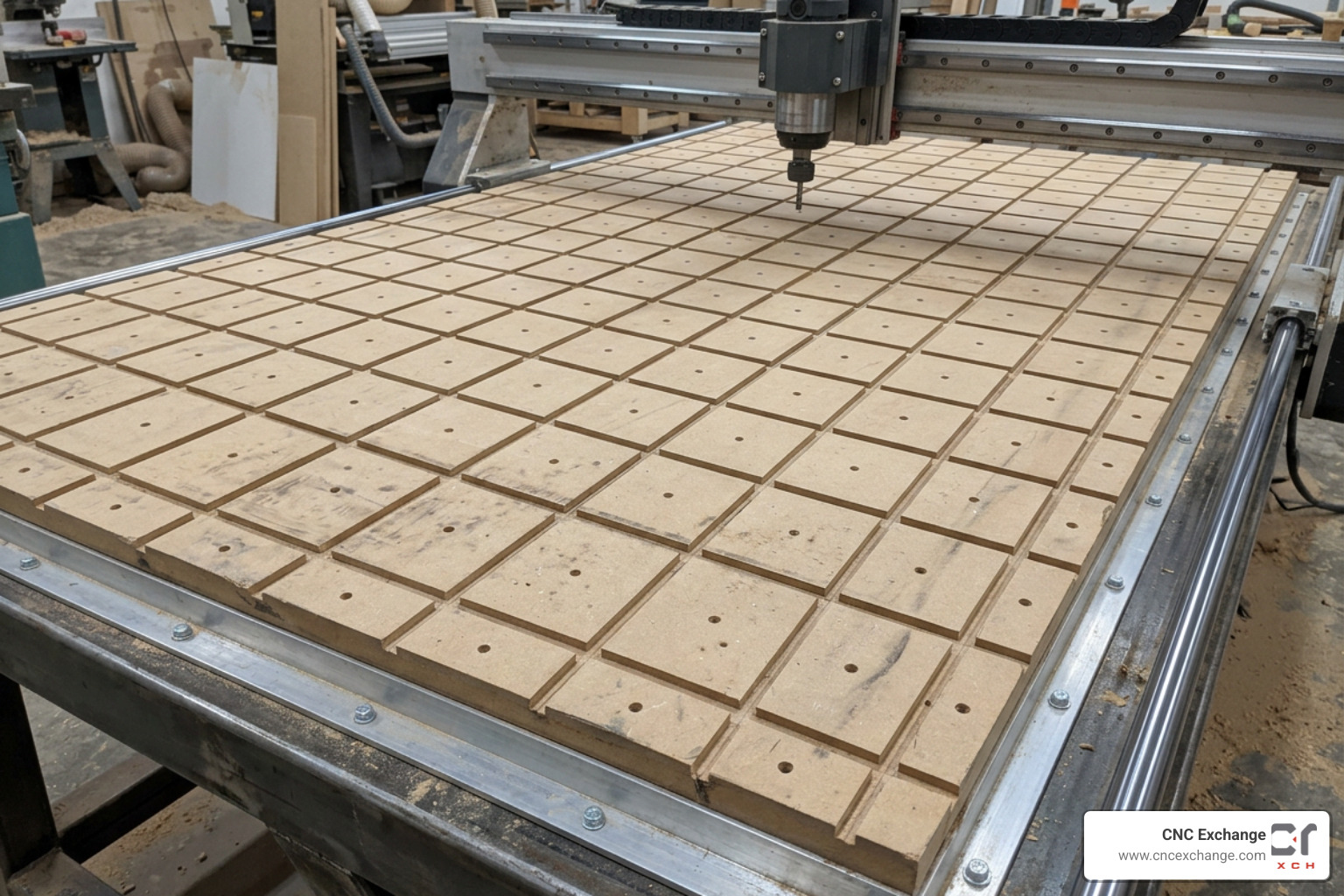
- T-Slot Tables: These tables feature aluminum or MDF slots where you slide in manual clamps, toggle clamps, or fixtures. They are highly affordable and versatile for thick blocks or odd-shaped parts. However, clamping a full 4x8 sheet of plywood with manual clamps is slow, and the middle of the sheet can still bow upward, ruining your depth accuracy.
- Vacuum Tables: A vacuum table uses a high-powered pump to pull air through a porous spoilboard (usually MDF), sucking the sheet flat against the table. Multi-zone vacuum tables allow you to direct the suction only to the area you are currently cutting. This is the ultimate setup for nesting cabinet parts, but it adds several thousand dollars to the machine price and requires a heavy electric supply for the vacuum pump.
- Hybrid Tables: Many modern prosumer and light-industrial machines feature a hybrid table that combines a vacuum grid with integrated T-slots, giving you the best of both worlds.
Hidden and Additional Costs of Ownership
When budgeting for a CNC router, the "sticker price" of the machine is rarely your final cost. First-time buyers are often surprised by the secondary expenses required to actually get the machine up, running, and making money.
Software and Tooling Licensing
You can't run a CNC machine without the digital instructions (G-code) to drive it. This requires CAD (Computer-Aided Design) and CAM (Computer-Aided Manufacturing) software.
- Design & Toolpath Software: Basic software like Carbide Create or Carbide VCarve Pro might cost a few hundred dollars or come bundled with hobby machines. However, professional nesting software like Vectric Aspire, Fusion 360, or Cabinet Vision can range from $500 to over $15,000 annually depending on your licensing and features.
- Tooling (Router Bits): You will need a library of high-quality carbide bits. Compression cutters (crucial for clean edges on plywood), down-cut spirals, V-bits, and spoilboard surfacing bits add up quickly. Expect to spend $500 to $1,500 on your initial tooling package.
Dust Collection and Power Requirements
A 4x8 CNC router running at full speed generates an incredible volume of wood dust and chips. If you don't capture it immediately, you will ruin your linear rails, clog your electronics, and create a serious health hazard.
- Dust Collection: A standard shop vac will not work. You need a dedicated, high-volume dust collector. For a 4x8 machine, we recommend a minimum of a 3 HP dual-bag or cyclonic dust collector connected via a 4-inch flexible hose. This will cost between $800 and $3,000.
- Electrical Power: Many hobbyist 4x8 machines can run on standard 110V or 220V single-phase power. However, industrial spindles and high-flow vacuum pumps almost always require 3-phase power. If your shop does not have 3-phase power, you will need to pay your utility company thousands of dollars to run a new line, or purchase a rotary phase converter for $1,500 to $4,000.
Frequently Asked Questions About 4x8 CNC Routers
Are cheap 4x8 CNC router kits worth buying?
Cheap 4x8 CNC router kits (in the $4,000 to $5,500 range) can be a fantastic entry point for hobbyists, makerspaces, or very light commercial shops. They allow you to process full sheets of plywood on a budget.
However, they come with clear trade-offs. The assembly process can take dozens of hours, and the instructions are often minimal. Structurally, they lack the rigidity of welded steel machines, meaning you must cut at slower speeds and take shallower passes to maintain accuracy. If your business relies on meeting tight daily deadlines, the downtime and slower speeds of a cheap kit may cost you more in the long run than investing in a sturdier mid-range machine.
What is the typical learning curve for a beginner?
The physical operation of the machine is relatively straightforward; most first-time owners can confidently load material, set their zeroes, and run basic parts within 2 to 3 days of setup.
The real learning curve lies in the CAD/CAM software. Designing parts, nesting them efficiently to minimize waste, choosing the correct spindle RPM and feed rates (feeds and speeds), and selecting the right router bits takes practice. Expect to spend a few weeks making "test cuts" in cheap insulation foam or scrap plywood before tackling high-end hardwoods or expensive acrylics.
Is it better to buy a new or used CNC router?
This is one of the most common dilemmas buyers face. Buying a new machine gives you a factory warranty, modern software compatibility, and direct technical support. But the depreciation is steep.
If you are looking to maximize your budget, buying a high-quality used machine from a reputable brand can save you 30% to 50% compared to buying new. Well-built industrial machines from legacy brands are engineered to last for decades. When considering this route, it is vital to research if Are Used CNC Machines Worth It for your specific shop setup, and learn how to protect yourself by Evaluating a CNC Auction before placing a bid.
Conclusion
Finding the right 4x8 cnc router price is all about matching the machine's capabilities to your actual production needs. If you are a hobbyist or starting a side hustle, a prosumer machine like the Sienci AltMill or a modular Avid PRO4896 offers a perfect blend of affordability and performance. If you are running a commercial cabinet or sign shop, stepping up to an industrial workhorse with a welded steel frame, vacuum table, and an automatic tool changer is an investment that will easily pay for itself in labor savings and throughput.
At CNC Exchange, we help shops of all sizes upgrade their capabilities. Based in Prospect Heights, Illinois, we are an online marketplace specializing in the industrial machinery sector. We auction, buy, and sell used CNC equipment, offering shop owners a simple, reliable way to transition to their next machine while receiving fair market value for their current gear.
If you are ready to bypass the steep depreciation of buying new, we invite you to browse our current inventory of premium, production-grade used CNC routers:
- Maximize high-volume nesting with a heavy-duty Thermwood 4x8 CNC Router.
- Experience industrial-grade speed and precision with a Komo VR1025 CNC Router.
- Add reliable, American-made versatility to your shop floor with a Haas GR510 CNC Router.
- Run heavy signage and plastic production on a rugged Multicam Pro302 CNC Router.
- Achieve world-class European engineering with an SCM Routech CNC Router.
- Streamline your cabinet nesting operations with an Onsrud Panel Pro 288G16D CNC Router.
- Process oversized sheets with ease using an Axyz 5018 CNC Router.
Ready to find the perfect machine for your budget? Explore our complete inventory of used CNC machinery for sale today, or reach out to our team to find the ideal match for your shop's production goals!