
Why Smart Manufacturers Are Choosing Pre-Owned CNC Equipment

Pre-owned CNC equipment gives manufacturers access to high-precision machining capability at a fraction of the cost of buying new. For a quick primer on the underlying technology, computer numerical control is explained in this overview of numerical control.
If you're weighing your options, here's what you need to know upfront:
Quick answers for buyers:
- Cost savings: Pre-owned CNC machines typically sell for 40-70% less than new equivalents
- Top brands available: Haas, Mazak, Okuma, DMG Mori, Doosan, Makino, and many more
- Machine types: Vertical machining centers (VMCs), CNC lathes, horizontal machining centers (HMCs), 5-axis machines, Swiss lathes, and CNC routers
- Who it's for: Job shops, aerospace, automotive, medical, and electronics manufacturers
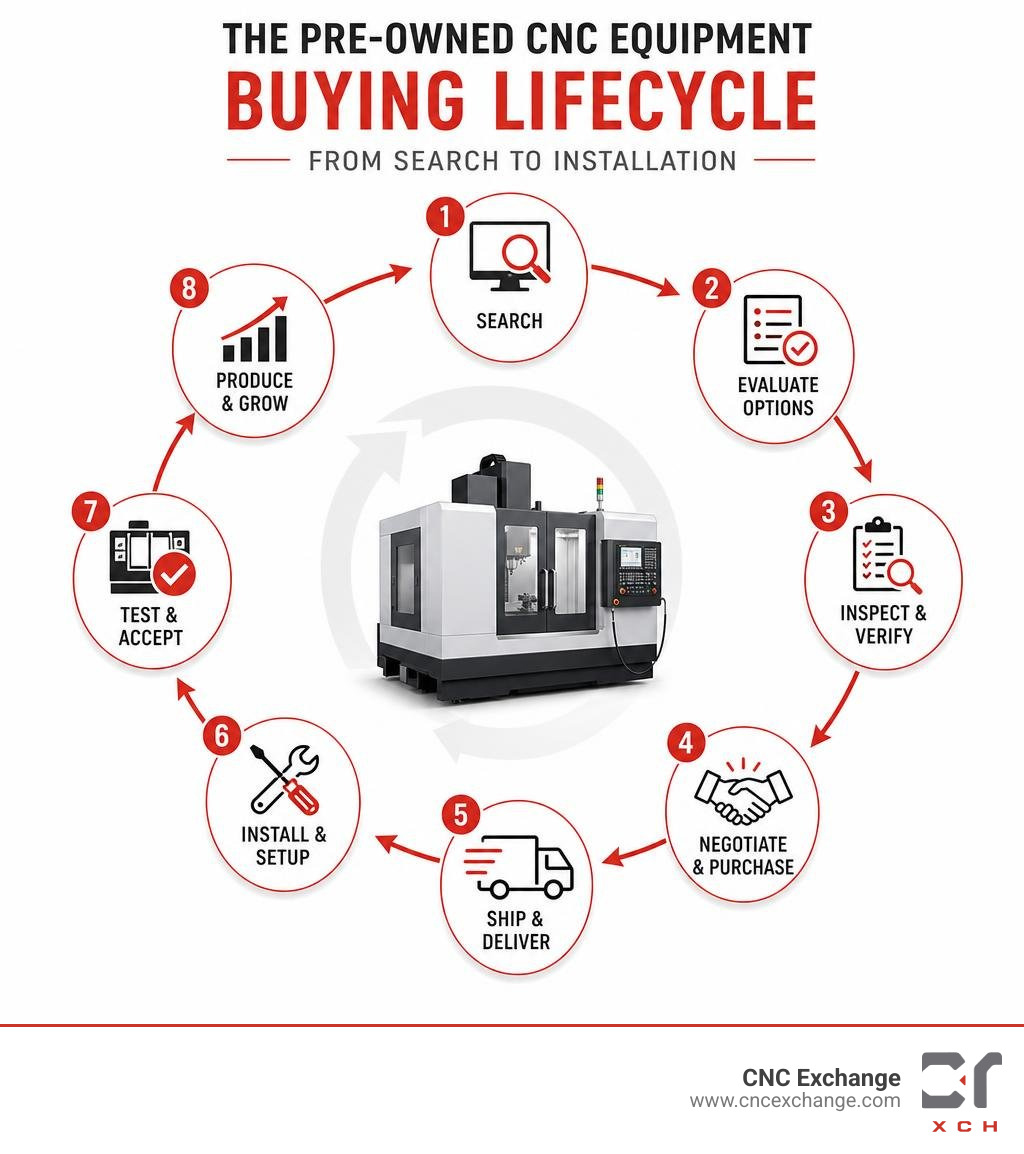
- Key buying steps: Verify cutting hours, inspect spindle condition, review maintenance history, and buy from a reputable dealer with in-house inventory
Running a manufacturing business means every dollar matters. New CNC machines carry steep price tags - and they depreciate the moment they leave the factory floor. Meanwhile, production demands don't wait.
That's exactly why thousands of manufacturers across the US turn to the pre-owned market. The global CNC machine market is projected to exceed $200 billion by 2034, and a thriving secondary market has grown alongside it - with platforms transacting hundreds of millions of dollars in used equipment and tens of thousands of machines listed at any given time.
Whether you're replacing aging equipment, adding capacity, or launching a new machining operation, the used CNC market has more quality options than ever before.
The Financial and Operational Benefits of Pre-Owned CNC Equipment
When you are looking to expand your shop's capabilities, the classic dilemma arises: do you buy brand new, or do you explore the secondary market? While the smell of a brand-new machine is tempting, the financial and operational realities of the modern manufacturing sector make a compelling case for pre-owned cnc equipment.
Capital Savings and Cash Flow Preservation
The most immediate benefit of purchasing used machinery is the dramatic reduction in capital expenditure. A new high-end vertical machining center or multi-axis turning center can easily run into hundreds of thousands of dollars. By choosing a pre-owned machine, you can acquire the exact same production capability for 40% to 70% less than the cost of a new model.
This capital preservation frees up vital cash flow. Instead of tying up your credit lines in a single, highly depreciating asset, you can allocate those funds toward tooling, raw materials, facility upgrades, or hiring skilled operators. For growing job shops, this financial flexibility is often the difference between taking on high-volume contracts or having to pass them by.
Avoiding the Depreciation Trap
Just like driving a new car off the dealership lot, new CNC machinery suffers its steepest depreciation during the first two to three years of operation. When you purchase new, you absorb that massive loss on your balance sheet.
By purchasing pre-owned cnc equipment, the previous owner has already taken that initial financial hit. Used machines hold their value remarkably well after this initial drop. If your production needs shift in a few years and you decide to resell the machine, you will likely recoup a much higher percentage of your original investment.
Immediate Availability vs. Factory Lead Times
In our industry, timing is everything. If you win a major contract that starts next month, you cannot afford to wait six, nine, or even twelve months for a machine tool builder to manufacture and ship a new unit from overseas.
The pre-owned market operates on a completely different timeline. The machines listed in our warehouse are sitting there right now, ready to be rigged, loaded, and shipped. This immediate availability allows you to scale up your capacity almost instantly, hitting the ground running to meet your customers' tight deadlines. To explore what is currently available on the market, you can look through the comprehensive inventory at Used CNC Machines & Equipment For Sale | CNC Exchange.
To help visualize these differences, let's look at how new and pre-owned machines stack up across key business metrics:
| Metric | New CNC Equipment | Pre-Owned CNC Equipment |
|---|---|---|
| Initial Purchase Cost | 100% (Full retail price) | 30% to 60% of retail price |
| Depreciation Rate | High (Steepest in years 1–3) | Low (Stablized asset value) |
| Lead Time | Weeks to months (or even over a year) | Days to weeks (Ready for immediate rigging) |
| Technology Access | Latest cutting-edge features | Proven, reliable control platforms |
| ROI Timeline | Longer (Due to high initial debt service) | Shorter (Lower overhead allows faster payback) |
While some shops require the absolute latest proprietary software features only found in brand-new releases, the vast majority of parts machined today can be produced with incredible precision on well-maintained, slightly older platforms. Extensive industry databases and specialized listings demonstrate just how many high-quality, late-model options are readily available for immediate deployment.
Top Brands and Models in the Used CNC Market
The pre-owned machinery market is incredibly diverse, offering everything from heavy-duty boring mills to high-speed Swiss-type turning centers. However, certain brands consistently stand out due to their build quality, part availability, and ease of service.
Popular Brands of Pre-Owned CNC Equipment
When searching for used machinery, choosing a widely recognized brand is a smart strategy. Brands with a large installed base in North America ensure that you won't struggle to find replacement parts, service technicians, or operators who already know how to run the controls.
- Haas Automation: As the holder of the largest installed CNC base in North America, Haas machines are a staple of the used market. Their user-friendly controls, affordable parts, and extensive support network make them incredibly popular for both entry-level shops and large-scale manufacturing facilities.
- Mazak Corporation: Renowned for their rigid construction and advanced Mazatrol conversational programming, Mazak machines are built to last. They handle heavy-duty cutting with ease and retain their accuracy over decades of operation.
- Okuma: Okuma is unique because they build their own machine tools, motors, drives, and OSP controls. This single-source integration leads to legendary reliability. Features like their Thermo-Friendly Concept allow these machines to hold tight tolerances even during long production runs in changing shop temperatures.
- DN Solutions (formerly Doosan): Following their rebranding in 2022, DN Solutions continues to be a dominant force. Their Puma and Lynx turning centers, along with their DNM vertical mills, are highly sought after for their excellent balance of rigidity, speed, and value.
For a deeper dive into the specific mechanics and configurations of turning centers, check out our CNC Lathes Overview.
Featured Machining Centers and Lathes
Let's take a look at some of the most reliable and high-performing models that frequently pass through our inventory at CNC Exchange. These machines are respected across the industry for their longevity and performance.
Horizontal Machining Centers (HMCs)
Horizontal mills are the workhorses of high-volume production, allowing for excellent chip evacuation and multi-tombstone setups.
- Mazak FH580/40 Horizontal Machining Centers CNC: This machine is celebrated for its robust spindle and rapid pallet changing system, making it perfect for high-speed, heavy-metal removal.
- Makino A51 Horizontal Machining Centers CNC: Makino is synonymous with thermal stability and extreme accuracy. The A51 is a legendary horizontal mill that delivers incredible speed and precision, particularly in aerospace and complex automotive parts production.
Vertical Machining Centers (VMCs)
Vertical mills are the most versatile machines in any shop, capable of handling everything from simple drilling to complex 3D surfacing.
- Hurco VM1 Vertical Machining Centers CNC: Known for its compact footprint and Hurco's famous conversational control, the VM1 is the ultimate job shop companion. It allows operators to program complex parts directly at the machine in minutes.
- Haas VF-7/50 Vertical Machining Centers CNC: When you need a massive work envelope and heavy-duty cutting power, this 50-taper VMC delivers. It provides the rigidity and table travel required for large mold work, weldments, and heavy steel machining.
CNC Lathes and Turning Centers
For cylindrical parts, a reliable lathe is indispensable.
- Mazak QTN-200 CNC Lathes: The Quick Turn Nexus series is one of the most popular turning center lines ever built. It offers fast cycle times, high torque, and the intuitive Mazatrol control interface.
- Haas ST-35 CNC Lathes: A mid-to-large bore lathe that provides excellent cutting capacity and rigidity, making it a favorite for oil field, agricultural, and heavy industrial applications.
CNC Routers
For non-ferrous metals, plastics, wood, and composites, CNC routers offer high-speed, large-format machining.
- Thermwood C42 CNC Router: A highly versatile, heavy-duty three-axis router designed for nesting, plastic fabrication, and wood machining.
- Thermwood C50 CNC Router: This model steps up the performance with advanced control capabilities, ideal for high-speed trimming of thermoformed plastics, composites, and aerospace patterns.
Verifying Quality and Mitigating Risks
Buying pre-owned cnc equipment is highly profitable, but it does require due diligence. Unlike buying a new machine backed by a factory bumper-to-bumper warranty, purchasing used gear means you must carefully evaluate what you are buying.
How to Inspect Pre-Owned CNC Equipment Before Purchase
To ensure you are getting a machine that will perform reliably for years to come, we recommend a systematic inspection process. If you aren't comfortable performing these checks yourself, you can hire a qualified third-party service technician to conduct them on your behalf.
- Verify the Cutting Hours: Just like a car's odometer, a CNC machine tracks its usage. Look at the control screen to check the 'Power On' hours, 'Spindle Run' hours, and 'Cutting Time.' Cutting time is the most accurate indicator of actual wear, as it only counts when the machine was actively machining parts.
- Examine the Way Covers and Ball Screws: Pull back the way covers to inspect the linear guides or box ways. Look for scoring, rust, or lack of lubrication. Feel the ball screws for backlash or excessive play, which can affect positioning accuracy.
- Run a Spindle Sweep and Check Runout: Use a dial indicator to measure the spindle runout. Excessive runout indicates worn spindle bearings, which will require an expensive rebuild. Listen to the spindle run at various RPMs; it should sound smooth and quiet without any whining, grinding, or vibration.
- Review the Maintenance Logs: A well-documented service history is gold. It proves the previous owner regularly changed the fluids, replaced filters, and addressed minor issues before they became catastrophic failures.
- Analyze the Backlash and Geometry: Perform a ballbar test if possible. This test measures the machine's circular contouring performance and reveals geometric errors, servo mismatch, and backlash.

By taking these precautions and working with a trusted partner, you can buy with confidence. To begin your search, you can Browse Used CNC Inventory | CNC Exchange to find machines that have been thoroughly vetted.
Industries and Applications Served
Because CNC technology is incredibly versatile, pre-owned machines find homes across a massive spectrum of manufacturing sectors. Different industries have different requirements, but the secondary market offers solutions for all of them:
- Aerospace: Requires extreme precision and documentation. High-end 5-axis machining centers and horizontal mills from brands like Makino and Mazak are commonly purchased used to machine turbine blades, structural ribs, and landing gear components.
- Medical Devices: This sector relies on Swiss-type lathes and high-speed VMCs to manufacture implants, bone screws, and surgical instruments from biocompatible materials like titanium and PEEK.
- Automotive: From job shops making custom aftermarket parts to tier-one suppliers producing engine blocks, rugged turning centers and high-speed vertical mills are the backbone of automotive manufacturing.
- General Job Shops: The ultimate generalists. A job shop never knows what drawing will walk through the door next, so they rely on highly versatile 3-axis VMCs and 2-axis lathes to handle whatever metalworking challenges arise.
For more details on how these machines fit into different sectors, explore our specialized Industries Served page.
Financing, Rigging, and Shipping Logistics
Once you've found the perfect machine, the transaction isn't quite finished. You still need to pay for it, move it out of its current location, transport it across the country, and install it on your shop floor. Managing these logistics smoothly is what separates a great buying experience from a stressful one.
Financing Options for Pre-Owned Machinery
Many buyers assume that financing is only available for brand-new equipment. Fortunately, that is a misconception. There are many specialized industrial lenders who understand the lasting value of CNC machine tools and are eager to write leases or loans for pre-owned equipment.
Depending on your credit profile and business history, you can secure equipment finance agreements (EFAs), $1 buy-out leases, or fair market value (FMV) leases. Financing allows you to keep your cash in the bank while the machine pays for itself through monthly production.
The Art of Heavy Rigging
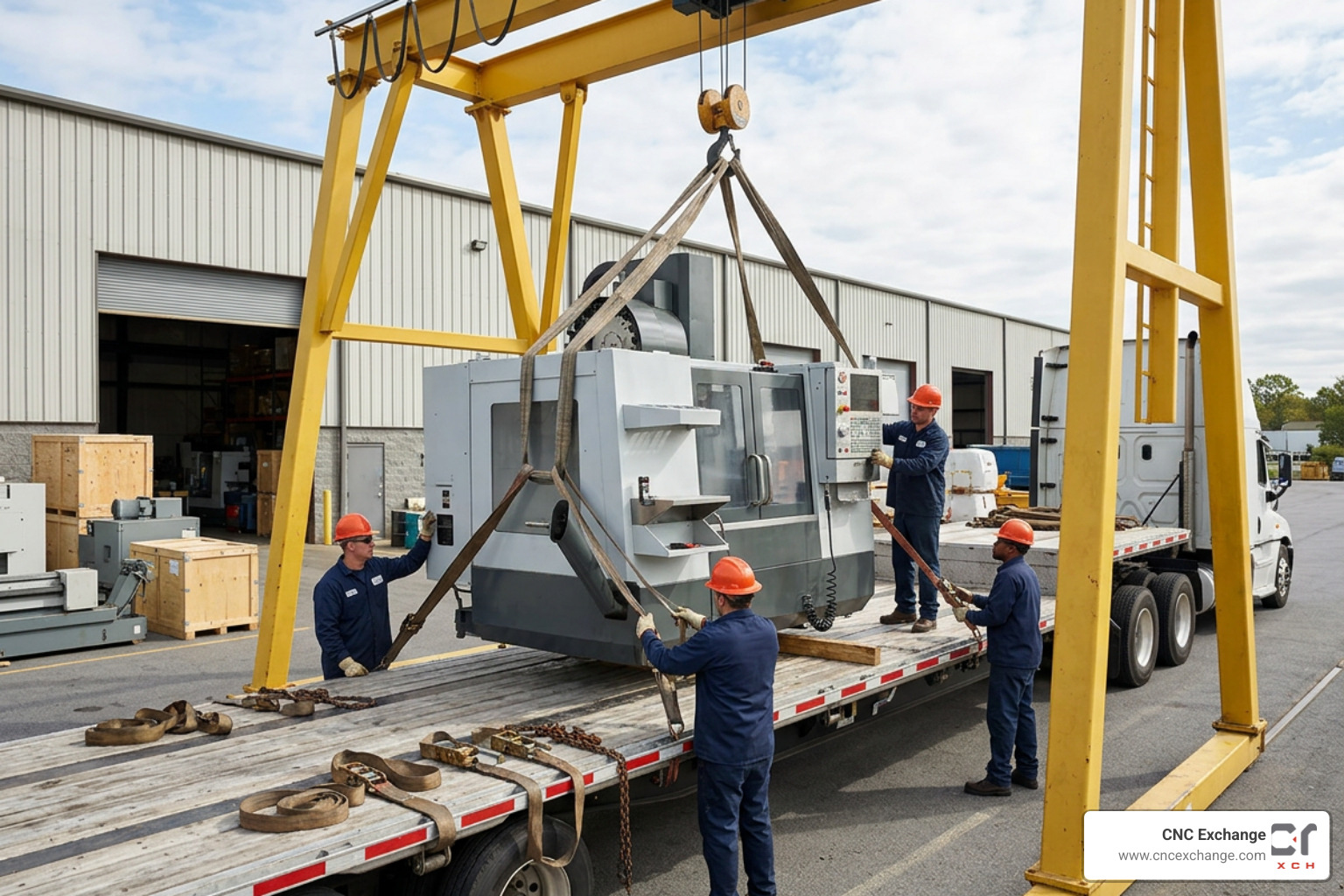
You cannot simply slide a 15,000-pound machining center onto a flatbed trailer with a standard forklift. CNC machines are incredibly heavy, top-heavy, and packed with sensitive electronics and high-precision glass scales that can easily be ruined by improper handling.
Professional riggers are essential. They use specialized equipment, such as heavy-duty gantry cranes, air skates, and high-capacity forklifts, to safely maneuver the machine out of tight factory spaces. They also ensure the machine's axes are properly secured and bracketed for transport so that the ball screws and linear guides aren't damaged by vibrations on the road.
Freight and Shipping across the Country
Shipping heavy industrial machinery requires specialized flatbed, step-deck, or double-drop trailers. The machine must be tarped to protect it from road grime, moisture, and salt, which can quickly cause rust on precision steel surfaces.
At CNC Exchange, we have spent decades building a trusted network of riggers and freight forwarders. Whether your machine is moving across town or across the continent, we help coordinate these complex logistics so that your investment arrives safely and on time. If you are looking to buy or sell a machine and want to know how we can handle the heavy lifting for you, visit Sell and Buy Used CNC Equipment | CNC Exchange.
Frequently Asked Questions about Used CNC Machinery
How do dealers verify the quality of used CNC machines?
Reputable dealers use a combination of technical inspection, geometric alignment checks, and functional testing. When a machine arrives at a professional warehouse, technicians will power it up, check the spindle runout, test the tool changer, and verify that all axes move smoothly without error codes. They will also inspect the electrical cabinet, check the cooling systems, and look for any signs of physical damage or excessive wear.
What are the risks of buying used CNC equipment?
The primary risks include hidden mechanical wear (such as worn ball screws or spindle bearings), obsolete control systems that are difficult to find parts for, and the lack of a factory warranty.
You can easily mitigate these risks by:
- Only buying from trusted dealers who own their inventory and house it in physical warehouses.
- Getting a comprehensive inspection report or visiting the machine to see it run under power.
- Sticking to major brands (like Haas or Mazak) that have excellent long-term parts support.
- Utilizing general market pricing guides and historical sales data to compare pricing and ensure you are paying a fair price.
How often is used CNC inventory updated?
The pre-owned CNC market moves incredibly fast. High-quality, priced-to-sell machines are often snatched up within days of listing. At CNC Exchange, our inventory is updated constantly as we buy, trade, and auction machines daily. If you are looking for a highly specific make and model, it pays to stay in touch with our team so we can alert you the moment a matching unit becomes available.
Conclusion
Navigating the secondary market for machine tools doesn't have to be daunting. By choosing pre-owned cnc equipment, your business can bypass long factory lead times, avoid steep initial depreciation, and secure premium, high-precision machining power at a fraction of the cost of new equipment.
At CNC Exchange, we are more than just an online listing site. Backed by our physical presence in Prospect Heights, Illinois, we are a full-service partner in your equipment lifecycle. Whether you are looking to buy your next workhorse, sell a surplus asset to free up floor space, or get a fair valuation of your equipment, we are here to simplify the process.
Ready to take your shop's production capacity to the next level without breaking the bank?
- Browse our current listings at https://cncexchange.com/cncmachineryfor_sale.
- Learn more about our company by visiting CNC Exchange.
- Ready to talk specifics? Talk to Our Machine Tool Experts Today and let us help you find the perfect machine for your business!