
The Machine Shop Workhorse: What You Need to Know About Horizontal Boring Mills
Horizontal boring mills are large, heavy-duty machine tools built to drill, bore, and mill oversized workpieces that simply won't fit on a standard machining center. If you're looking for a quick overview:
- What they do: Bore, drill, mill, and face large castings, weldments, and structural components — often without repositioning the part
- Who uses them: Aerospace, energy, heavy equipment, oil & gas, automotive, and defense manufacturers
- Key types: Floor-type, table-type (universal), and planer-type
- Typical capacity: Table loads up to 40,000 kg, with some floor-type machines handling parts up to 40 m long
- New or used: Both CNC and manual models are widely available on the secondary market at a range of price points
These machines have been a cornerstone of industrial manufacturing for a long time. The story goes all the way back to 1775, when John Wilkinson invented the first boring machine — a tool precise enough to bore the cylinders for James Watt's steam engine. That early demand for accuracy in large bores is exactly what still drives the category today.
For manufacturing business owners, a horizontal boring mill is often the answer when you're facing large, complex parts that demand high stability, long-travel accuracy, and serious spindle torque. Whether you're looking at a floor-type CNC model or a used manual machine to handle occasional heavy work, understanding what separates one machine from another will save you time and money.
Understanding Horizontal Boring Mills: Core Technology and Key Components
To appreciate why horizontal boring mills are so highly regarded in heavy industry, we need to look under the hood. Unlike standard milling machines, which generally move a cutting tool across the surface of a workpiece, a boring mill is specifically designed to work inside a part, creating deep, straight, and incredibly precise cylindrical passages.
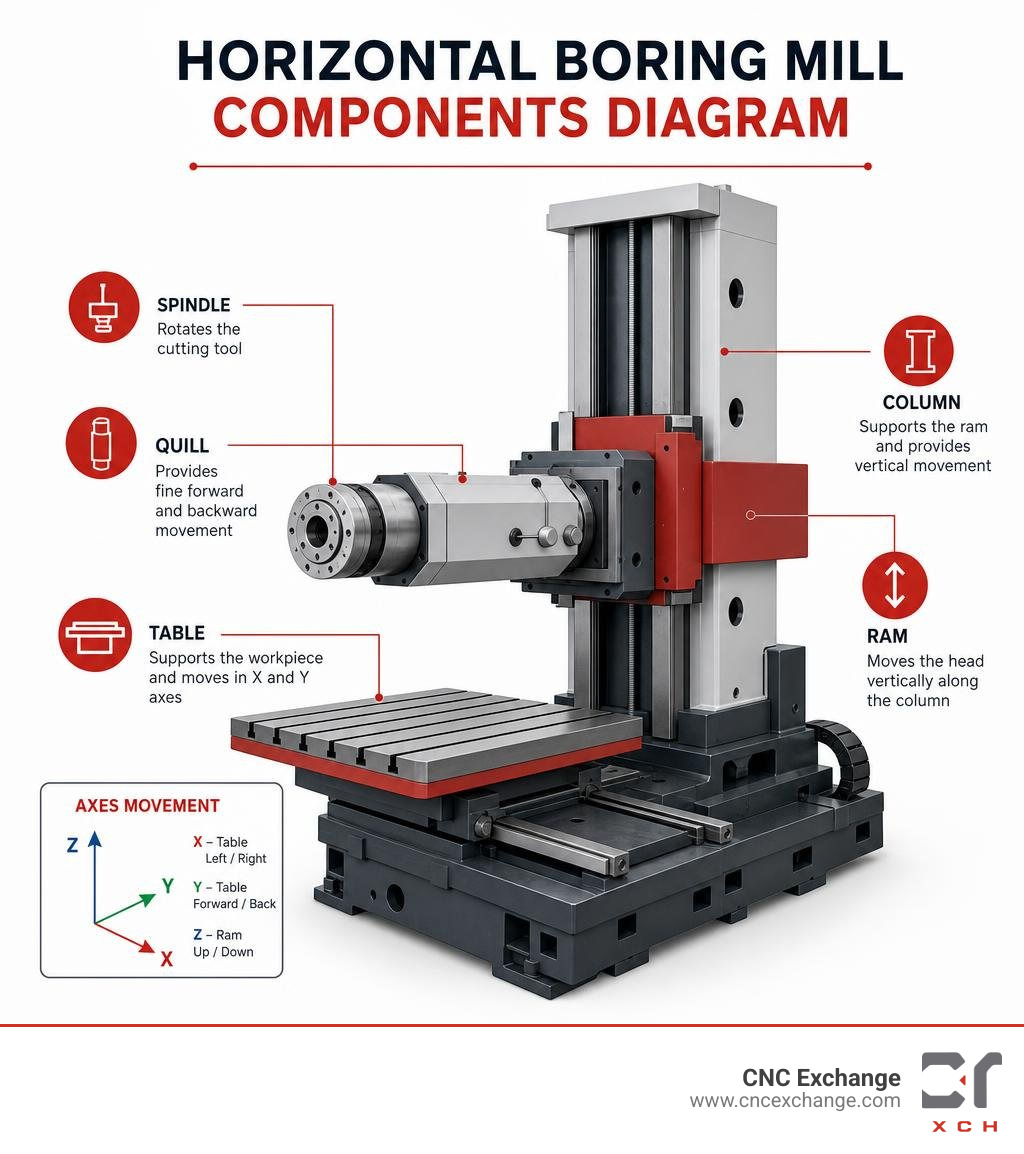
The structural rigidity of these machines is what allows them to maintain tolerances in the micrometer range, even when removing massive amounts of metal. This performance relies on five core components:
- The Spindle: This is the main rotating heart of the machine. In a boring mill, the spindle is designed to handle massive radial and axial loads. High-torque spindles on these machines can deliver up to 1,188 Nm of torque for heavy-duty cutting, allowing them to drive large-diameter boring heads through tough alloys without breaking a sweat.
- The Quill (W-Axis): This is the defining feature of a true boring mill. The quill is a sleeve that extends outward from the headstock along the spindle's axis. This extension allows the cutting tool to reach deep inside a workpiece while remaining rigidly supported.
- The Table: On table-type machines, the table holds the workpiece and moves along the X and Z axes. Many modern tables also incorporate a contouring 4th-axis rotary function, allowing the machine to rotate the part to exact angles for multi-face machining.
- The Column: The vertical tower that supports the headstock. Because the headstock moves up and down (the Y-axis) along this column, it must be incredibly rigid to prevent deflection. Heavy-duty Meehanite castings are frequently used here for their superior vibration-damping properties.
- The RAM: On larger planer or floor-type mills, the headstock is mounted on a rectangular RAM that extends horizontally. This provides additional reach and allows the machine to maintain its rigidity even when the spindle is extended deep into the machining envelope.
Boring vs. Milling: What Is the Difference?
While modern horizontal boring mills are fully capable of performing heavy milling operations, their primary engineering focus is different from a standard horizontal milling machine.
Milling is primarily a surface-removal process. The cutting forces are mostly radial (perpendicular to the spindle). Boring, on the other hand, is about enlarging, aligning, and finishing an existing hole. The forces are highly axial and require exceptional straightness over long distances. If you try to bore a deep, high-precision hole on a standard milling machine, tool deflection will often cause the hole to taper or drift. A boring mill’s quill extension solves this problem entirely.

| Feature / Capability | Horizontal Boring Mill (HBM) | Standard Horizontal Milling Machine |
|---|---|---|
| Primary Operation | Internal cylindrical boring and deep-hole finishing | Surface profiling, slotting, and pocket milling |
| Tool Reach Mechanism | Extending quill (W-axis) for deep internal access | Fixed spindle length; relies entirely on table/head travel |
| Workpiece Weight | Massive (often up to 40,000 kg or more) | Light to moderate (typically under 5,000 kg) |
| Spindle Torque | Extremely high (up to 1,188+ Nm) | Moderate to high (focused on higher RPMs) |
| Typical Tolerances | Micrometer-level over long axial distances | Standard machining tolerances |
Main Types of Boring Mills and Their Industrial Applications
Not all machine shops face the same challenges. A shop manufacturing landing gear for commercial aircraft needs a very different machine than a shop machining 30-ton engine blocks for marine vessels. To accommodate these diverse needs, horizontal boring mills are generally categorized into three main structural configurations.
Floor-Type Horizontal Boring Mills
Floor-type boring mills are the giants of the machining world. On these machines, the workpiece remains completely stationary, bolted directly to a massive floor plate (or T-slotted floor grid). The entire machine column moves along a runway (the X-axis) to bring the spindle to the workpiece.
This design is essential when the workpiece is simply too heavy or awkwardly shaped to be safely moved on a table. Floor-type horizontal boring mills can machine components up to 40 meters long and 10 meters high, making them indispensable for building ship hulls, large turbine housings, and heavy mining equipment.
If your shop handles oversized structural weldments, looking at a machine like the Schiess Moweg GmbH Rapid 2R / 25 Horizontal Boring Mills can give you the massive physical capacity required for these projects. For high-end Japanese engineering with an emphasis on structural rigidity, the PBT Series - Horizontal Boring - DMG MORI represents the cutting edge of heavy-duty floor-type design, utilizing three-point support trapezoidal bearings on the main spindle to maintain accuracy under extreme loads.
Table-Type and Planer-Type Horizontal Boring Mills
For mid-sized to large workpieces that can still be practically moved, table-type and planer-type mills are the industry standards.
- Table-Type (Universal) Mills: On these machines, the workpiece is mounted on a table that moves in both the longitudinal (Z-axis) and transverse (X-axis) directions, while the headstock moves vertically (Y-axis) on a fixed column. This is the most common configuration for general-purpose job shops because of its versatility and relatively compact footprint.
- Planer-Type (T-Bed) Mills: These machines utilize a "T" shaped bed configuration. The column moves longitudinally (Z-axis) while the table moves transversely (X-axis). This split-motion design distributes the weight of heavy workpieces more evenly, reducing stick-slip and maintaining high positioning accuracy even with off-center loads.
If you are looking to add a reliable table-type machine to your floor, the Kuraki brand is highly respected for its rugged box-way construction and thermal stability. Models like the Kuraki KBT 13DX ANP Horizontal Boring Mills and the Kuraki KBM 11A Horizontal Boring Mills are excellent examples of machines that balance heavy roughing power with fine finishing capabilities.
For shops seeking classic German engineering, the Wotan B 105M Horizontal Boring Mills offer a proven, highly rigid platform that remains a favorite in contract manufacturing. If you are looking for modern efficiency, the KBT 11EZ - Horizontal Boring - DMG MORI utilizes a high-torque, 3-step geared head that provides up to 8 times more torque than a standard machining center, while its advanced W-axis drilling cycle can cut energy consumption by up to one-third compared to traditional Z-axis machining.
Manual and Jig Boring Machines
While CNC technology dominates high-volume production, manual boring mills and jig borers still hold a vital place in the manufacturing ecosystem.
Manual boring mills are highly valued in repair shops, tool and die facilities, and prototype environments. When you need to quickly clean up a worn-out bore on a tractor axle or machine a single custom fixture, programming a complex CNC machine can take longer than simply setting up and manual-machining the part.
Jig boring machines, on the other hand, represent the absolute pinnacle of mechanical precision. Developed before the advent of modern electronics, these machines rely on hand-scraped ways, high-precision lead screws, and optical measuring systems to locate holes with incredible accuracy.
If your work demands this level of ultra-precise positioning, the SIP 6 Hydroptic Horizontal Boring Mills are legendary for their optical scale systems and thermal stability. Similarly, the Mitsui Seiki 4DN Horizontal Boring Mills provide an exceptional platform for jig-boring tolerances. For shops requiring general manual capacity without the high cost of a specialized jig borer, our selection of Misc J Horizontal Boring Mills offers robust mechanical solutions for everyday machining tasks.
CNC Advancements and Key Performance Features

The integration of CNC technology has completely transformed the capabilities of the modern horizontal boring mill. What once required a highly skilled manual operator hours of meticulous setup and constant manual adjustment can now be executed with incredible speed and repeatable accuracy.
Several key engineering advancements have driven this jump in productivity:
- Hydrostatic Guides: Rather than relying on traditional physical contact between the machine ways, hydrostatic systems pump a thin, continuous film of high-pressure oil between the moving components. This completely eliminates friction and wear, prevents "stick-slip" (the jerky motion that occurs when starting a heavy movement), and provides exceptional vibration damping. This technology allows massive machines to position heavy loads with sub-micron accuracy.
- Automatic Tool Changers (ATC): Heavy-duty machining often requires a wide variety of tools, from massive indexable face mills to delicate finishing boring bars. Modern ATCs can hold anywhere from 40 to over 90 tools, allowing the machine to transition seamlessly from roughing to finishing without operator intervention.
- Automatic Head Changers (AHC): For complex parts that require machining on multiple angles or inside tight cavities, automatic head changers allow the machine to swap out its standard spindle head for right-angle heads, universal heads, or facing heads mid-program.
- Simultaneous Multi-Axis Control: Advanced CNC controllers allow for simultaneous movement across 4, 5, or even 6 axes. This enables complex contouring, helical interpolation, and 5-sided machining in a single setup.
A prime example of these modern advancements in action is the STANDARD EHF-110 Precision CNC Horizontal Milling - Ø110mm Spindle - STANDARD Machine Tools. This machine features a 6-axis CNC control with 4-axis simultaneous cutting capability and an integrated facing head, allowing shops to tackle highly complex aerospace and energy components with minimal cycle times.
Selection Guide: Choosing the Right Mill for Your Shop
Investing in a horizontal boring mill is a major decision that will impact your shop's capabilities for years to come. To ensure you get the best return on your investment, keep these key factors in mind during your search:
- Rigidity and Construction: Look for heavy, single-piece cast iron beds (such as Meehanite castings) and wide box ways or preloaded roller guideways. These designs provide the vibration damping necessary for heavy roughing and deep-hole accuracy.
- Spindle and Quill Capabilities: Consider both the spindle diameter (typically ranging from 110 mm to 150+ mm) and the W-axis travel. A larger spindle diameter allows for deeper, heavier cuts, while a longer quill travel gives you the reach needed for deep internal cavities.
- Table Load Capacity: Always calculate the weight of your heaviest anticipated workpiece. Modern CNC tables can support workpieces up to 40,000 kg, but exceeding a table's rated capacity will accelerate wear and degrade machining accuracy.
- Footprint and Workspace: Boring mills are large machines. Be sure to account not only for the physical footprint of the machine itself but also for the full travel ranges of the X, Y, and Z axes to avoid interference with other equipment in your shop.
For shops looking for a high-performance, mid-sized platform, the HB Series | JTEKT Machinery North America offers an exceptional blend of finite element analysis (FEA) optimized castings, cylindrical roller guideways, and high-torque performance.
If your applications require extended travel ranges and heavy-duty table capacities in a highly versatile package, the Comprehensive Overview of HBM-110L Horizontal Boring & Milling Machine · Chung Sing Machinery provides a deep dive into how a 110 mm spindle machine can be configured with an extended Y-axis and a massive 5,000 kg table capacity to maximize your shop's operational flexibility.
Frequently Asked Questions about Boring Mills
What is the difference between a horizontal boring mill and a horizontal machining center?
While both machines feature a horizontal spindle, they are designed for different scales of work. A horizontal machining center (HMC) is built for high-speed, high-volume production of small to mid-sized parts. It typically features a fixed spindle and relies on rapid pallet changers.
In contrast, a horizontal boring mill (HBM) is built to handle much larger, heavier workpieces. The key mechanical difference is the extending quill (W-axis) on the HBM, which allows the cutting tool to reach deep inside large castings—a capability that standard HMCs do not possess.
What are the benefits of hydrostatic guides on a boring mill?
Hydrostatic guides use a pressurized film of oil to support the machine's moving components, meaning there is zero metal-on-metal contact. This offers three major benefits:
- Zero Wear: Because the components never touch, the guideways do not wear down over time, preserving the machine's accuracy for decades.
- No Stick-Slip: It eliminates the friction spike that occurs when a heavy table starts moving, allowing for incredibly smooth, micro-precise adjustments.
- Excellent Damping: The oil film acts as a natural shock absorber, damping cutting vibrations and improving surface finish.
How does the W-axis differ from the Z-axis on these machines?
On a horizontal boring mill, both axes move parallel to the spindle, but they do so using different parts of the machine:
- The Z-axis typically moves the entire table (and the workpiece) closer to or further from the column (or, on floor-type machines, moves the column toward the workpiece).
- The W-axis is the linear travel of the quill itself, extending directly out of the headstock.
Using the W-axis to reach deep inside a part keeps the massive table assembly stationary, which reduces energy consumption and maintains a higher level of rigidity during deep boring operations.
Conclusion

Whether you are machining massive turbine housings for the energy sector or performing high-precision repair work on heavy construction equipment, adding a horizontal boring mill to your shop floor opens up a world of heavy-capacity machining possibilities.
At CNC Exchange, we make it easy to find the right machinery for your business. Operating from our headquarters in Prospect Heights, Illinois, we serve as a trusted online marketplace for the industrial machinery sector. We specialize in helping shops auction, buy, and sell CNC and manual machines, offering a straightforward, transparent way to upgrade your equipment and achieve fair market value for your surplus assets.
Ready to expand your shop's capabilities? Explore our inventory of horizontal boring mills today, or reach out to our team of experts to discuss how we can help you find the perfect machine for your upcoming projects.