
What Electrical Discharge Machining Actually Is (And Why It Matters for Your Shop)
Electrical discharge machining — also called EDM, spark machining, or spark eroding — is a manufacturing process that cuts and shapes metal using controlled electrical sparks instead of physical cutting tools.
Here's the quick answer if you're short on time:
What is EDM?
- EDM removes material from a conductive metal workpiece using rapid electrical sparks
- The sparks jump across a tiny gap between an electrode and the workpiece, both submerged in a non-conductive fluid
- Each spark melts and vaporizes a microscopic amount of metal — repeated hundreds of thousands of times per second
- No physical contact happens between the tool and the part, so there's zero mechanical stress on the workpiece
- It can machine extremely hard materials (like hardened tool steel, titanium, and carbide) that would destroy a conventional cutting tool
Who uses it? Aerospace, automotive, medical device, and mold-and-die manufacturers all rely on EDM for parts that are too hard, too complex, or too precise for standard CNC milling.
The process has been around longer than most people realize. English physicist Joseph Priestley first observed the erosive effect of electrical discharges back in 1770. But it wasn't until the mid-20th century that engineers figured out how to harness that effect for controlled, repeatable manufacturing. Today, EDM machines can hold tolerances as tight as ±0.002 mm — a level of precision that's simply out of reach for many conventional machining methods.
If you run a shop that deals with hard materials, tight tolerances, or complex geometries, understanding EDM can open up work you couldn't take on before — or help you figure out whether a used EDM machine belongs in your facility.
What is Electrical Discharge Machining and How Does It Work?
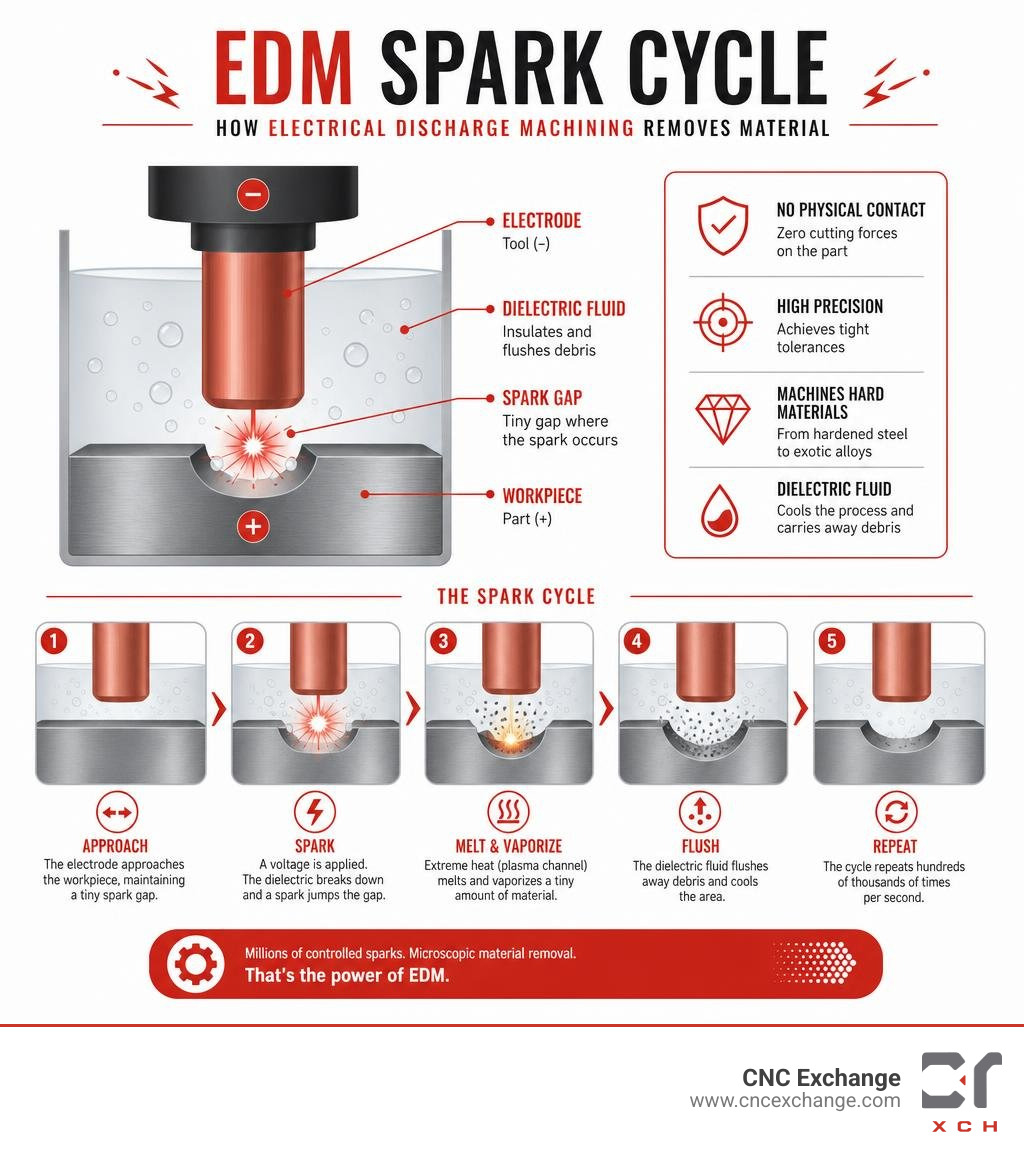
To understand Electrical discharge machining, forget everything you know about traditional machining. There are no sharp flutes, no spinning endmills, and no heavy mechanical cutting forces. Instead, EDM is a thermal erosion process.
The machine holds a shaped tool (called the electrode) and positions it incredibly close to the workpiece. This setup is submerged in a specialized dielectric fluid, which acts as both an electrical insulator and a cooling agent.
When the machine's power supply applies a high-frequency voltage, an intense electrical field builds up in the tiny space between the tool and the workpiece. Once this field becomes strong enough, the dielectric fluid breaks down, and a spark jumps across the gap.
At the microscopic point where the spark strikes, localized plasma temperatures skyrocket to between 8,000°C and 12,000°C. This extreme heat instantaneously melts and vaporizes a minuscule volume of the metal. When the spark turns off, the surrounding dielectric fluid rushes back in, instantly cooling the area and flushing away the microscopic vaporized metal debris. This cycle repeats several hundred thousand times per second, gradually eroding the metal to recreate the exact shape of your tool or path.
The Physics of the Spark Gap
The microscopic space between the electrode and the workpiece is known as the spark gap. Managing this gap is the secret to successful EDM.
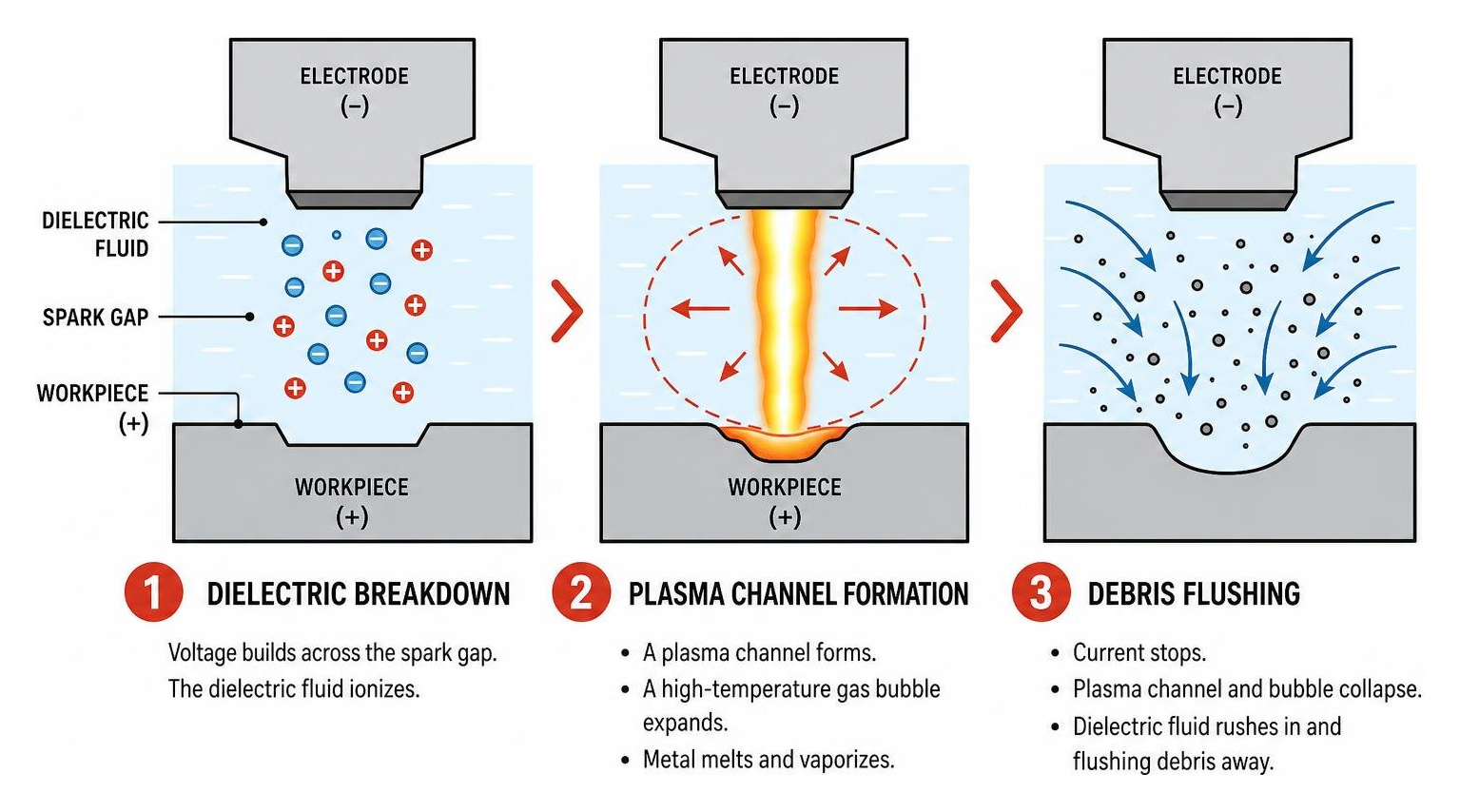
During operation, the process follows a strict sequence:
- Voltage Potential: The power supply charges the electrode, creating a voltage difference across the spark gap.
- Ionization Channel: The dielectric fluid ionizes, forming a narrow, highly conductive plasma channel.
- Bubble Formation: The extreme heat vaporizes the fluid directly surrounding the plasma channel, forming a high-pressure gas bubble.
- Debris Flushing: When the current is switched off, the plasma channel and gas bubble collapse. This sudden drop in pressure causes the molten metal to explode into the dielectric fluid, where it is washed away as tiny spheres of debris.
If the debris isn't flushed away properly, it can accumulate in the gap, causing "arcing"—a continuous electrical short that can damage both the electrode and your expensive workpiece. This is why high-pressure flushing is a core focus of any EDM setup.
The Three Main Types of EDM and Their Real-World Uses
While all EDM machines rely on spark erosion, they are configured differently depending on the geometry of the part you need to make. The three primary variants are wire EDM, sinker (or ram) EDM, and hole drilling EDM.
| Parameter | Wire EDM | Sinker EDM | Hole Drilling EDM |
|---|---|---|---|
| Electrode Type | Continuously fed thin wire (brass/copper) | Custom-shaped 3D tool (graphite/copper) | Hollow rotating tube (brass/copper) |
| Typical Tolerances | ±0.005 mm to ±0.02 mm (up to ±0.001 mm) | ±0.005 mm to ±0.02 mm | ±0.01 mm to ±0.05 mm |
| Dielectric Fluid | Deionized water | Hydrocarbon oil | Deionized water |
| Primary Geometry | Through-cuts, extrusions, 2D profiles | Blind cavities, complex 3D molds | Small, deep start holes and cooling channels |
Sinker EDM (Ram EDM)
Sinker EDM, also known as ram EDM or cavity-type EDM, is the go-to method for creating complex blind cavities.
In this process, we machine a custom 3D electrode—usually made of graphite or copper—that is the exact reverse image of the cavity we want to produce. The machine lowers this electrode (the "ram") into the workpiece. As sparks erode the metal, the electrode sinks deeper, replicating its exact geometry into the part.
Sinker EDM is highly valued in the mold-and-die industry for producing injection mold cavities, coinage dies, and blind keyways. A famous historical example of this technology in action was when NASA used sinker EDMs to manufacture 614 uniform, highly intricate injectors for the J-2 rocket engine during the Apollo program.
Wire EDM (Wire-Cut EDM)
Wire EDM acts like an ultra-precise, digital band saw. Instead of a solid 3D electrode, it uses a thin, single-strand wire (typically brass or coated copper) that is continuously fed from a spool through the workpiece.
The wire diameter can be as small as 20 μm (0.02 mm), allowing us to achieve geometry precision near ±1 μm and produce a cutting kerf as small as 0.021 mm. Because the wire is constantly moving off a spool, you always have a fresh, unworn electrode at the cutting zone. To put the scale of this process into perspective, a standard 8 kg (18 lb) spool of 0.25 mm wire is just over 19 km (12 miles) long!
Wire EDM is ideal for cutting thick plates (up to 300 mm or 12 inches thick), creating extrusion dies, and slicing intricate profiles with tight, internal radiuses that a traditional milling cutter could never reach.
Hole Drilling EDM (Fast Hole EDM)
Hole drilling EDM, or fast-hole EDM, is specialized for producing deep, small-diameter holes in hardened materials.
The process uses a hollow, rotating tube electrode (usually made of brass or copper) through which high-pressure dielectric fluid is pumped. This high-pressure flushing is crucial because it ejects debris from deep within the hole.
With this setup, small-hole drilling EDMs can drill through 100 mm of hardened steel in less than 10 seconds. It can reliably produce holes ranging from 0.3 mm to 6.1 mm in diameter, even at extreme depth-to-diameter ratios of 100:1. This is widely used to drill "start holes" for wire EDM operations and to create intricate cooling channels in aerospace turbine blades. To dive deeper into the micro-mechanics of this process, you can read A review on micro-drilling by electrochemical discharge machining - IOPscience.
Process Parameters and Material Compatibility
Controlling an EDM machine requires balancing several electrical and physical parameters. The main parameters managed by the machine's pulse generator include:
- Pulse On-Time: How long each spark lasts. Longer on-time increases the material removal rate (MRR) but results in a rougher surface finish and a larger heat-affected zone.
- Pulse Off-Time: The pause between sparks. This allows the dielectric fluid to cool the gap and flush out the eroded debris. If the off-time is too short, the debris will build up, leading to unstable machining or arcing.
- Peak Current: The maximum amperage of the discharge. Higher current packs more energy into each spark, speeding up the cut but accelerating electrode wear.
- Electrode Wear Rate (EWR): The ratio of tool material eroded compared to workpiece material removed. Modern CNC EDMs use digital generators that can reverse polarity mid-cut, redepositing eroded graphite back onto the tool to achieve "no-wear" settings during finishing passes.
Materials You Can Cut with Electrical Discharge Machining
The primary rule of EDM is simple: the workpiece must be electrically conductive. If a material can conduct electricity, it can be machined using EDM, regardless of how hard or brittle it is.

This makes EDM the ideal choice for:
- Hardened Tool Steels: Machining dies and molds after they have been heat-treated, avoiding the risk of distortion that occurs during post-machining heat treatment.
- Titanium Alloys & Nickel Superalloys (Inconel): Materials common in aerospace that rapidly wear out conventional carbide endmills.
- Tungsten Carbide: Extremely hard and brittle, making conventional milling almost impossible.
- Conductive Ceramics: Utilizing specialized assisting electrode methods, even some advanced non-conductive ceramics can be processed by applying a thin conductive layer to initiate the spark cycle.
EDM vs. Traditional Machining Methods
How does EDM compare to conventional manufacturing methods like CNC milling or plasma cutting? The differences lie in cutting forces, precision, and edge quality.
Traditional CNC milling relies on physical contact. The cutting tool must push against the metal to shear it away. This introduces mechanical stress, tool deflection, and heat buildup, which can warp thin-walled parts. Furthermore, milling always leaves a tiny burr that requires secondary deburring.
Plasma cutting is fast but lacks precision. It produces a massive heat-affected zone, leaves dross on the bottom edge, and cannot hold tight tolerances.
EDM, by contrast, exerts zero mechanical force on the workpiece. Because the tool never touches the metal, we can machine incredibly thin walls, delicate webs, and micro-features without fear of part distortion or tool breakage. The resulting surface is completely burr-free because the metal is vaporized rather than sheared.
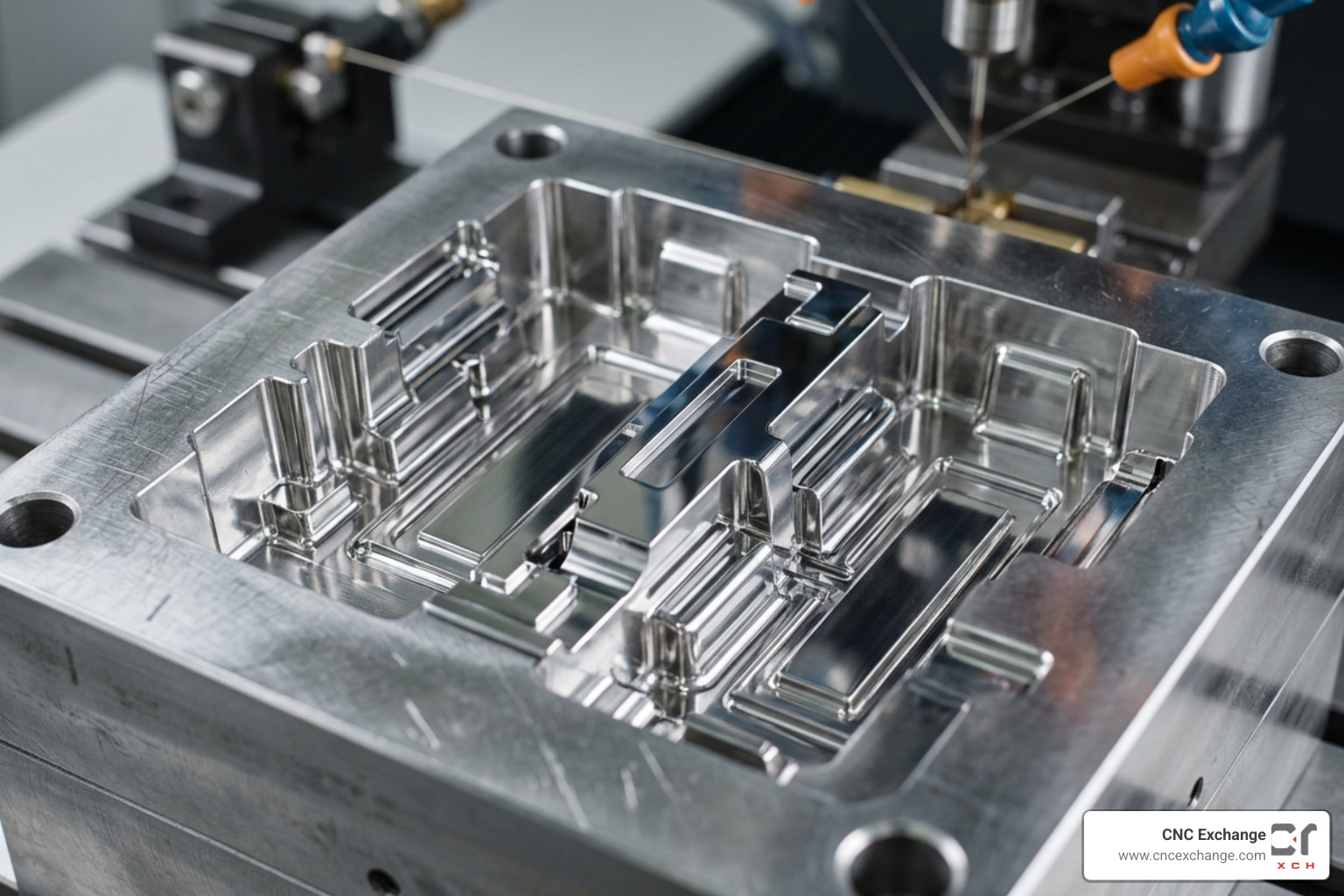
While EDM is highly precise, it is not a replacement for CNC milling. EDM is a relatively slow process. It is best used as a complementary technology—roughing out the bulk of a part on a CNC mill, then using EDM to cut the ultra-precise details, deep cavities, and hard-to-reach profiles.
Advanced Hybrid Processes and Sustainability
As manufacturing requirements advance, hybrid technologies have emerged to combine the benefits of different cutting methods. One of the most promising fields is the combination of electrochemical machining (ECM) and EDM. For a detailed academic breakdown of how these two fields intersect, see the Review of Electrochemical and Electrodischarge Machining.
The Environmental Impact of Electrical Discharge Machining
Historically, EDM had a reputation for being energy-intensive and generating hazardous waste, particularly when using hydrocarbon-based dielectric oils. However, the industry has made significant strides toward green manufacturing.
Recent research has focused on using eco-friendly, water-based dielectrics and biodegradable fluids to replace traditional oils. These green alternatives reduce toxic emissions and simplify waste disposal. Additionally, modern digital pulse generators are far more energy-efficient, optimizing spark delivery to reduce power consumption. To explore these sustainable advancements in micro-machining, read the Investigation on Wire Electrochemical Discharge Micro-Machining.
Eliminating the Recast Layer with ECDD
One of the historical drawbacks of traditional EDM is the creation of a "recast layer" (or white layer). Because EDM is a thermal process, a tiny amount of molten metal fails to eject and resolidifies on the surface of the part. This layer can contain micro-cracks and tensile residual stresses that compromise the fatigue life of critical aerospace or medical components.
To solve this, engineers developed Electrochemical Discharge Drilling (ECDD). This hybrid process combines spark erosion with electrochemical dissolution. By adjusting the working fluid's conductivity (for example, increasing it from 0.005 to 3.6 mS/cm), the residual stress on the machined surface shifts from tensile to compressive, and the surface roughness can be reduced to a smooth Ra = 1.69 μm. The electrochemical action dissolves the recast layer as it forms, leaving a pristine, stress-free surface. You can view the full research on this breakthrough in the paper on the Surface integrity of holes machined by electrochemical discharge drilling method.
Frequently Asked Questions
How accurate is EDM compared to CNC milling?
While high-end CNC mills can hold tolerances of ±0.005 mm under perfect conditions, ultra-precision EDM systems can routinely achieve tolerances approaching ±0.002 mm to ±0.005 mm. Because EDM does not suffer from tool deflection or spindle vibration, it is inherently more reliable for ultra-tight tolerances on complex, deep, or hard geometries.
Can EDM cut non-conductive materials?
Directly, no. However, engineers use an "assisting electrode" method to work around this. By placing a conductive material (like a thin metallic mesh or conductive paint) over a non-conductive ceramic, they can initiate the spark cycle. The heat from the initial discharges vaporizes the ceramic underneath, allowing the process to continue.
What is the recast layer in EDM?
The recast layer is a thin layer of metal (usually a few microns thick) that melts during the spark discharge but is not flushed away by the dielectric fluid. It resolidifies rapidly on the cold workpiece surface, altering the material's local microhardness and structure. In critical aerospace applications, this layer is typically removed via chemical etching or hybrid electrochemical processes.
Conclusion
Electrical discharge machining is a cornerstone of modern high-precision manufacturing. By replacing physical cutting forces with the thermal power of controlled electrical sparks, EDM allows us to push past the limits of traditional CNC milling, opening up new possibilities for working with extremely hard materials and complex shapes.
Whether you are looking to add wire EDM capabilities to your shop floor or need a reliable sinker EDM for mold-making, upgrading your equipment doesn't have to break the bank.
At CNC Exchange, we operate an online marketplace in the industrial machinery sector that auctions, buys, and sells CNC machines, offering a simple way to upgrade your equipment and achieve fair market value. Located in the heart of the Midwest at 75 E Palatine Rd, Prospect Heights, IL, our team of experts is ready to help you find the right machine for your shop's unique needs.
If you are ready to expand your production capabilities:
- Talk to Our Machine Tool Experts Today - CNC Exchange to discuss your machinery needs.
Ready to make a direct upgrade? Upgrade your shop with a Mitsubishi Midwest SX20P EDM and bring high-precision spark erosion to your production line today.