
EDM Machines: The Complete Guide for Manufacturers
EDM machines — short for Electrical Discharge Machining machines — are precision manufacturing tools that cut and shape electrically conductive metals using controlled electrical sparks, without any physical contact between the tool and the workpiece.
Quick answer: What are EDM machines?
| Feature | Details |
|---|---|
| What they do | Remove metal using spark erosion (no cutting tools) |
| Main types | Wire EDM, Sinker/Ram EDM, Hole Drilling EDM |
| Best materials | Hardened steels, titanium, carbides, superalloys |
| Key advantage | Extreme precision on hard materials that resist conventional machining |
| Typical tolerance | ±0.005 mm to ±0.02 mm |
| Common industries | Aerospace, medical, automotive, die/mold, semiconductor |
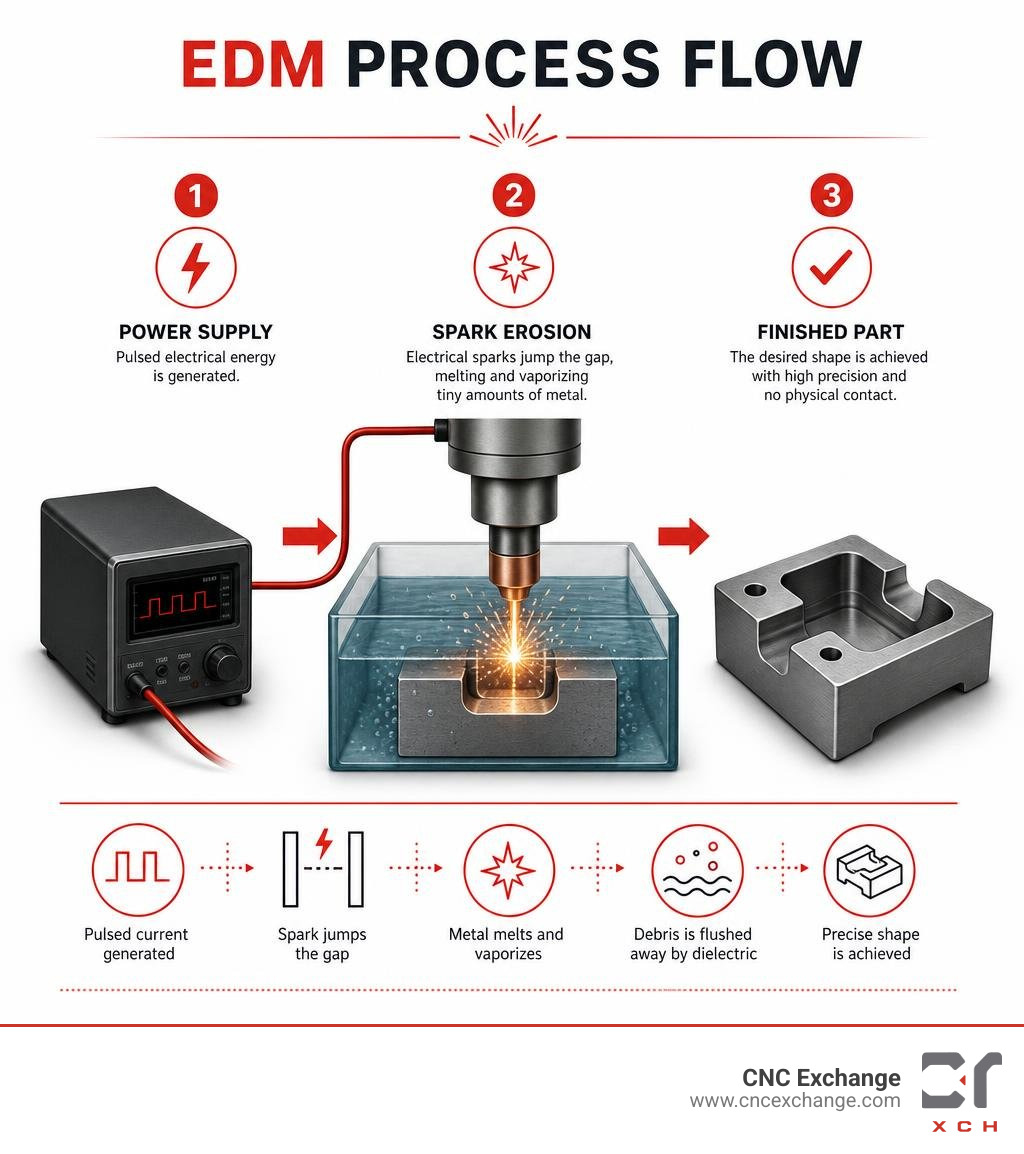
Here's the simple version of how it works: a pulsed electrical charge jumps across a tiny gap between an electrode and the metal workpiece. Each spark reaches temperatures between 8,000°C and 12,000°C — hot enough to melt and vaporize microscopic amounts of material. Repeat that thousands of times per second, and you get a precisely shaped part.
This process is classified as non-traditional machining because nothing ever physically touches the workpiece. That means no mechanical stress, no tool chatter, and no risk of distorting fragile or hardened parts.
For manufacturers dealing with materials that would destroy conventional cutting tools — think hardened tool steel or aerospace-grade titanium — EDM is often the only practical option. It's also the go-to process when a part geometry is simply too complex or too precise for milling or turning.
In this guide, you'll find everything you need to understand EDM machines: how they work, which type fits your application, what materials they can handle, and how modern machines stack up against traditional CNC milling.
What is Electrical Discharge Machining and How Does It Work?
To understand how edm machines accomplish what seems like black magic, we have to look closely at the physics of spark erosion. At its core, Electrical Discharge Machining is a controlled thermal erosion process. Instead of pushing a sharp piece of carbide through steel, we use a series of rapid, high-frequency electrical discharges to vaporize metal.
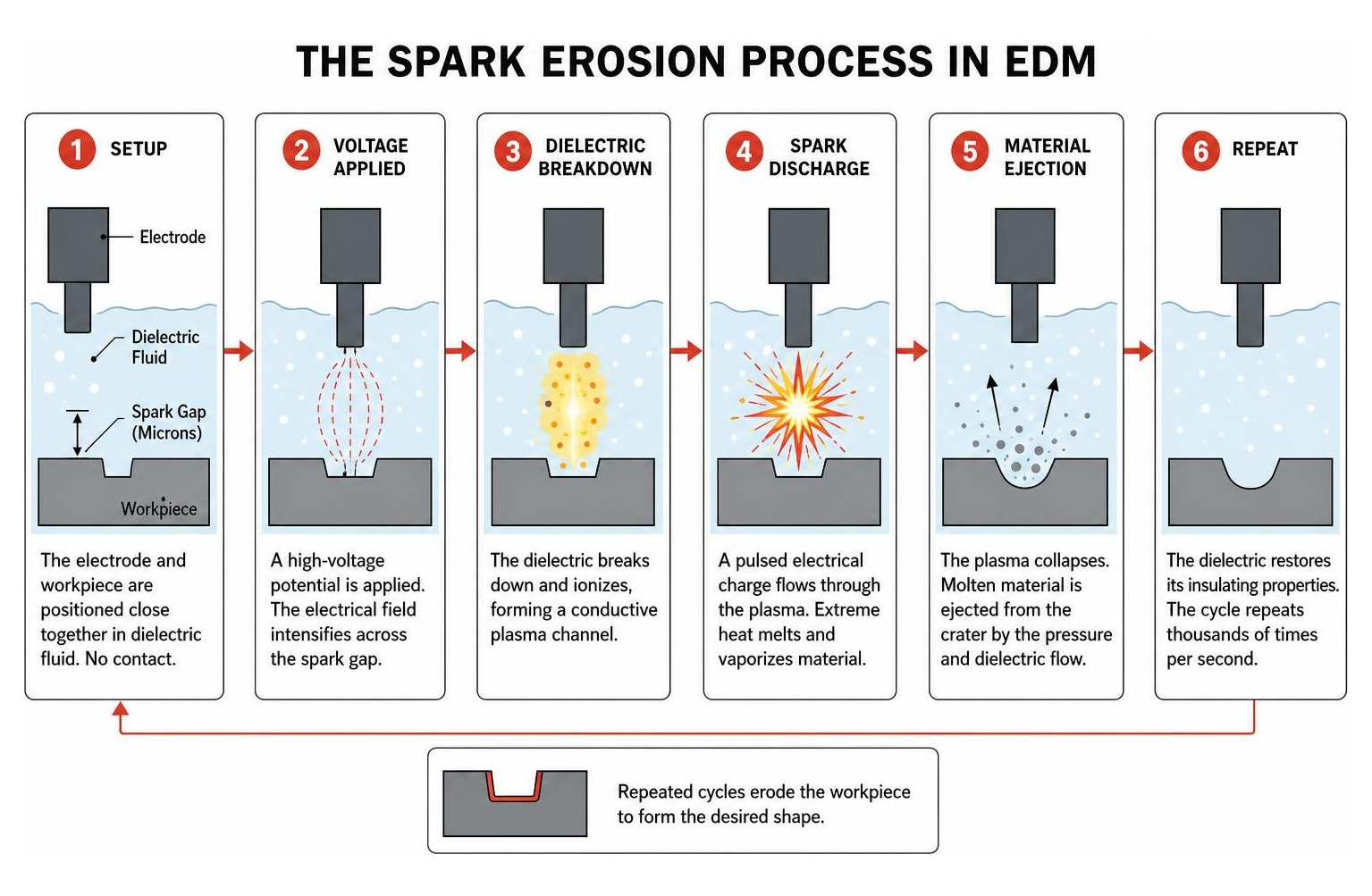
The process begins by placing the workpiece and the electrode (the cutting tool) very close together, but not touching. This tiny space is called the spark gap, and it typically measures only a few microns to a couple of thousandths of an inch. Both the workpiece and the electrode are submerged in a non-conductive liquid known as a dielectric fluid (usually deionized water or a specialized oil).
When we turn on the machine's power supply, it generates a high-voltage electrical potential between the tool and the workpiece. Because the dielectric fluid acts as an electrical insulator, no current flows initially. However, as the electrode moves closer to the workpiece under precise servo control, the electrical field in the spark gap intensifies.
Eventually, the electrical stress becomes too great for the liquid insulator to handle, causing a dielectric breakdown. The fluid ionizes, transforming from an insulator into a highly conductive plasma channel.
Once this channel is established, electricity flows instantly in a concentrated spark. This spark generates localized temperatures ranging from 8,000°C to 12,000°C (warmer than the surface of the sun!). This extreme thermal energy melts and vaporizes a microscopic volume of the workpiece material.
When the pulse of electricity is turned off (known as "off-time"), the plasma channel collapses. This sudden drop in pressure causes the molten metal to be violently ejected from the workpiece surface, leaving behind a tiny, microscopic crater. The circulating dielectric fluid immediately flushes away this microscopic debris and cools the area, restoring the fluid's insulating properties so the cycle can repeat.
By repeating this cycle thousands of times per second, the machine gradually erodes the metal to mirror the shape of the electrode or follow a pre-programmed path.
Key Components of EDM machines
To maintain this delicate balance of electrical charges and micron-level distances, several key components must work together in perfect harmony:
- The Pulsed Power Supply (Generator): This is the brain behind the sparks. It controls the electrical parameters, including voltage, peak current, and the exact duration of the electrical pulses ("on-time" and "off-time").
- The Servo Control System: Because the spark gap is incredibly narrow, the machine must continuously adjust the position of the electrode. If the tool gets too close, it will touch the workpiece, causing a short circuit. If it drifts too far, the dielectric fluid won't break down, and the sparking stops. The servo system monitors the gap voltage and adjusts the physical position of the axes in microseconds.
- The Dielectric System: This system stores, filters, and pumps the dielectric fluid. It is responsible for maintaining the fluid's temperature, insulating properties, and flushing pressure to keep the spark gap clear of eroded metal particles.
- The Electrode (Tooling): The tool that delivers the electrical charge. In wire EDM, this is a continuously fed thin wire. In sinker EDM, it is a custom-machined 3D shape made of graphite or copper.
For shops looking to implement this technology with proven reliability, classic machines like the Okamoto H-OK-18-16 EDM demonstrate how robust mechanical construction and stable power supplies lay the foundation for highly repeatable spark erosion.
The Main Types of EDM machines and Their Differences
While all edm machines rely on the same fundamental physics of spark erosion, the technology is divided into distinct machine classifications depending on how the electrode is shaped and manipulated.
| Machine Type | Electrode Used | Dielectric Fluid | Typical Application |
|---|---|---|---|
| Wire EDM | Continuously spooling thin wire (brass/copper) | Deionized water | Through-cuts, extrusion dies, punches, and complex 2D/tapered profiles |
| Sinker (Ram) EDM | Custom-shaped 3D electrode (graphite/copper) | Dielectric oil | Blind cavities, plastic injection molds, internal splines, and complex 3D shapes |
| Hole Drilling EDM | Hollow tubular electrode (brass/copper) | Deionized water (high pressure) | Small, deep holes, start holes for wire EDM, turbine cooling channels |
Wire EDM machines
Wire EDM is often compared to a super-precise, digital bandsaw. Instead of a physical blade, it uses a hair-thin metal wire (typically brass or coated copper, with diameters ranging down to 0.004 inches or even 0.0008 inches for micro-applications) to slice through metal.
The wire is fed continuously from a supply spool, through upper and lower diamond guides, and onto a take-up spool. This continuous feed ensures that the machine always cuts with fresh wire, preventing the tool wear that would otherwise compromise accuracy.
Because the wire is constantly spooling, wire consumption is often the single largest operating expense for these machines. Traditional wire EDM machining consumes more than one pound of wire per hour! However, advanced builders have developed technologies to dramatically cut these costs. For example, some modern wire EDM systems can cut at twice the industry standard speeds without increasing wire consumption, while others reduce wire consumption by up to 50% compared to legacy models, saving shops thousands of dollars annually.
During operation, the workpiece is typically submerged in deionized water. The CNC controller moves the worktable in the X and Y axes while the upper guide can move independently in the U and V axes. This independent movement allows the machine to perform complex taper cutting — up to 45 degrees or more — which is essential for mold draft angles and extrusion dies.
If you are looking for a reliable entry into wire cutting, machines like the Fanuc Alpha 1iA EDM offer an excellent balance of precision, automatic wire threading, and reliable CNC control. For high-volume manufacturing environments, sourcing advanced systems through established networks like MC Machinery Solutions provides access to cutting-edge wire machines featuring ultra-precise linear shaft motors and AI-driven monitoring.
Sinker and Ram EDM
Sinker EDM, also known as Ram or Die-Sinking EDM, is used to create blind cavities and complex 3D shapes that cannot be cut from the side. Instead of a thin wire, a sinker EDM uses a three-dimensional electrode custom-machined from graphite or copper to mirror the desired cavity.
The shaped electrode is mounted on the machine's ram and slowly lowered into the workpiece, which is submerged in a bath of dielectric oil. As the electrode "sinks" into the metal, it erodes a cavity that is the exact inverse of the electrode's shape.
To improve efficiency, modern sinker EDMs utilize orbital machining paths. Instead of just moving straight down (Z-axis), the electrode moves in circular, spherical, or conical patterns. This orbiting action improves dielectric flushing by pumping the fluid out of deep cavities and allows a single electrode to perform both roughing and finishing operations by gradually increasing the orbit size.
For smaller toolrooms or job shops, compact systems like the Hansvedt CS-1 Workman EDM provide a highly accessible entry point for manual or ZNC die-sinking. On the larger end of the spectrum, heavy-duty industrial applications require immense structural rigidity to maintain flatness under heavy loads.
Large-scale column-moving systems, such as the JSEDM EB1510L Column Moving-Type CNC EDM Machine, feature a moving-column (bullhead) design. Unlike traditional moving-table machines where the weight of a heavy workpiece can cause table deflection and precision loss, a column-moving design keeps the heavy workpiece completely stationary on a rigid base while the column moves the electrode, ensuring absolute accuracy even with workpieces weighing up to 11,000 kg.
Hole Drilling and Micro EDM
Hole drilling EDM (often called fast hole drilling) is a specialized process designed to drill deep, precise, and incredibly small holes in hard metals. It uses a hollow tubular electrode made of brass or copper.
During the drilling process, the electrode rotates to ensure even wear while high-pressure dielectric fluid is pumped directly through the center of the tube. This high-pressure internal flushing is crucial because it instantly forces debris out of the deep hole, allowing the machine to drill through 100 mm of hardened steel in less than 10 seconds!
These machines are commonly used to create "start holes" for wire EDM operations (allowing the wire to be threaded through a solid block of metal) or to drill cooling channels in aerospace turbine blades.
For general-purpose toolroom support, a system like the Misc Omega FH-1 EDM provides quick, reliable hole-popping. For highly demanding, multi-axis industrial production, advanced systems like the EdmDrill™ RT6050 Drilling System offer high-capacity CNC drilling with overhead crane accessibility, tilting drilling heads for angled holes, and specialized "Teach Modes" perfect for turbine engine repair work.
Material Compatibility and Process Parameters in Spark Erosion
One of the most liberating aspects of using edm machines is that material hardness is practically irrelevant. In traditional machining, cutting hard metals like hardened tool steel, tungsten carbide, or titanium requires expensive tooling, slow feed rates, and carries a high risk of tool breakage.
With EDM, because there is no mechanical contact, the physical hardness of the metal does not affect how easily it can be machined. The only absolute requirement is that the workpiece material must be electrically conductive.
This makes EDM incredibly effective for:
- Tool Steels (heat-treated): You can heat-treat a die block to its maximum hardness before machining it with EDM, completely eliminating the risk of part distortion or cracking that often occurs during heat treatment.
- Tungsten Carbides: Extremely brittle and hard, carbides easily chip under mechanical cutting forces but erode smoothly under electrical sparks.
- Superalloys (Inconel, Hastelloy): These heat-resistant metals quickly work-harden and destroy traditional milling cutters, but pose no threat to the thermal erosion process of EDM.

Optimizing Pulse Duration and Peak Current
To achieve the perfect balance of cutting speed, surface finish, and electrode wear, operators must carefully calibrate the machine's discharge parameters:
- Pulse Duration (On-Time): The length of time the spark is active. Longer on-times deliver more thermal energy per spark, increasing the material removal rate (MRR). However, larger sparks create larger craters, resulting in a rougher surface finish.
- Peak Current: The maximum amperage delivered during the discharge. Higher current increases cutting speed but accelerates electrode wear and produces a larger heat-affected zone (HAZ).
- Off-Time (Pulse Interval): The pause between sparks. If the off-time is too short, the dielectric fluid won't have enough time to deionize and flush away debris, leading to unstable sparking or destructive "arcing" (where multiple sparks concentrate in one spot, burning the part).
- Dielectric Flushing: The physical flow of fluid through the spark gap. Proper flushing is critical; without it, the eroded metal particles will remain in the gap, causing short circuits and poor surface finishes.
To manage these variables automatically, modern ZNC (Z-axis Numerical Control) and CNC systems utilize advanced monitoring. For instance, the EDM Solutions Columbia ZNC EDM provides automated Z-axis depth control paired with pre-programmed spark parameters.
For more complex mold and die work, the JSEDM EB707N ZNC EDM Machine incorporates a high-rigidity Meehanite cast iron body and FPGA-based single-discharge waveform monitoring. This system detects abnormal discharges in real-time and automatically adjusts the gap and off-time parameters, reducing electrode wear to as low as 0.15% while preventing carbon buildup.
EDM vs. Traditional CNC Milling: Advantages and Limitations
When deciding whether to route a job to a CNC mill or an EDM machine, manufacturers must weigh several technical and economic factors.
- Mechanical Stress: CNC milling relies on physical force, which can distort thin-walled parts or push fragile geometries out of tolerance. EDM applies zero physical force, making it the premier choice for delicate features like thin ribs, deep slots, and micro-nozzles.
- Tool Wear: Milling cutters wear down, dull, and deflect, causing dimensional drift over long runs. While EDM electrodes do experience wear, wire EDM avoids this entirely by constantly feeding fresh wire, and sinker EDM minimizes it through advanced power supply technology.
- Sharp Inside Corners: Because milling cutters are round, they can never cut a perfectly sharp inside corner—they will always leave a radius equal to the radius of the tool. Wire EDM, however, can cut inside corner radii as small as the wire itself (down to 0.001 inches or less), creating virtually razor-sharp corners.
- Speed: CNC milling is significantly faster than EDM when it comes to bulk material removal on softer metals like aluminum. EDM is a slower, more deliberate process, often reserved for finishing operations or hard metals where milling is impossible.
- The Recast Layer: Because EDM is a thermal process, a microscopic layer of metal melts and resolidifies on the part surface. This is known as the recast layer (or white layer). This layer can be highly stressed and brittle, requiring secondary polishing or specialized "finishing passes" with low energy settings to minimize or remove it.
To bridge this gap, high-performance machines like the Makino SP43 EDM utilize advanced generator technologies (such as BellyWIZARD or H.E.A.T.) to dramatically increase cutting speeds — sometimes cutting up to 18% to 44% faster than standard machines — while holding straightness tolerances to 0.0005 inches in a single pass.
Industrial Applications and Modern Automation Trends
As we move through July 2026, the manufacturing landscape demands higher precision and lower labor costs. EDM has evolved from a highly specialized "toolroom-only" process into a fully automated, high-volume production technology.
Key industries utilizing EDM include:
- Aerospace: Drilling thousands of angled, non-conductive cooling holes in single-crystal turbine blades to allow jet engines to operate at temperatures higher than the melting point of the metal itself.
- Medical Devices: Creating burr-free, microscopic surgical instruments, endoscope components, and titanium orthopedic implants.
- Die and Mold Making: Machining complex, deep ribs in hardened steel injection molds for automotive, consumer electronics, and packaging industries.
For companies looking to outsource high-precision contract manufacturing, specialized facilities like EDM Intelligent Solutions Chicago offer micro-machining, wire EDM, and 3D metrology services right here in Illinois.
On the shop floor, the biggest trend in 2026 is lights-out manufacturing. Modern EDM machines are uniquely suited for unattended, 24/7 operation because they do not suffer from sudden, catastrophic tool breakages like CNC mills.
By integrating Automatic Tool Changers (ATC) for sinker electrodes, automatic wire threaders for wire machines, and robotic pallet-loading systems, a single operator can set up a machine on Friday afternoon and return Monday morning to find dozens of high-precision parts completed with zero human intervention.
Frequently Asked Questions about EDM
What materials cannot be machined with EDM?
Any material that is not electrically conductive cannot be machined using EDM. This includes plastics, glass, wood, rubber, most ceramics, and composite materials like carbon fiber (unless the composite contains a highly conductive metallic matrix).
How accurate are modern EDM machines?
Modern EDM machines are incredibly precise. While standard industrial machines easily hold tolerances of ±0.005 mm (±0.0002 inches), high-end, climate-controlled micro-EDM systems can achieve sub-micron resolutions, holding tolerances down to ±0.001 mm (±0.00004 inches) with surface finishes that look like a polished mirror.
Why is dielectric fluid necessary in EDM?
Dielectric fluid serves three critical functions:
- Insulation: It acts as an electrical barrier, preventing current flow until the voltage is high enough to create a controlled spark.
- Cooling: It cools the electrode and workpiece, preventing thermal distortion and maintaining a stable machining environment.
- Flushing: It physically washes away the microscopic metal debris from the spark gap, keeping the cutting zone clear.
Conclusion
Whether you are cutting intricate extrusion dies, drilling micro-cooling holes in aerospace components, or sinking complex cavities into hardened mold steels, edm machines provide the precision and material versatility that conventional milling tools simply cannot match.
However, adding a brand-new EDM to your shop floor can represent a massive capital investment. That is where we come in. At CNC Exchange, we operate as an online marketplace in the industrial machinery sector, specializing in auctioning, buying, and selling high-quality used CNC machines.
Based in Prospect Heights, Illinois, our mission is to offer shop owners a simple, transparent way to upgrade their manufacturing capabilities, offload underutilized assets, and achieve true fair market value for their equipment.
If you are ready to take your shop's precision to the next level without the steep price tag of buying brand new, check out our current inventory and explore high-performance options like the Mitsubishi Midwest SX20P EDM to find the perfect fit for your production needs.