
What Are CNC Lathes? A Quick Answer Before We Dive In
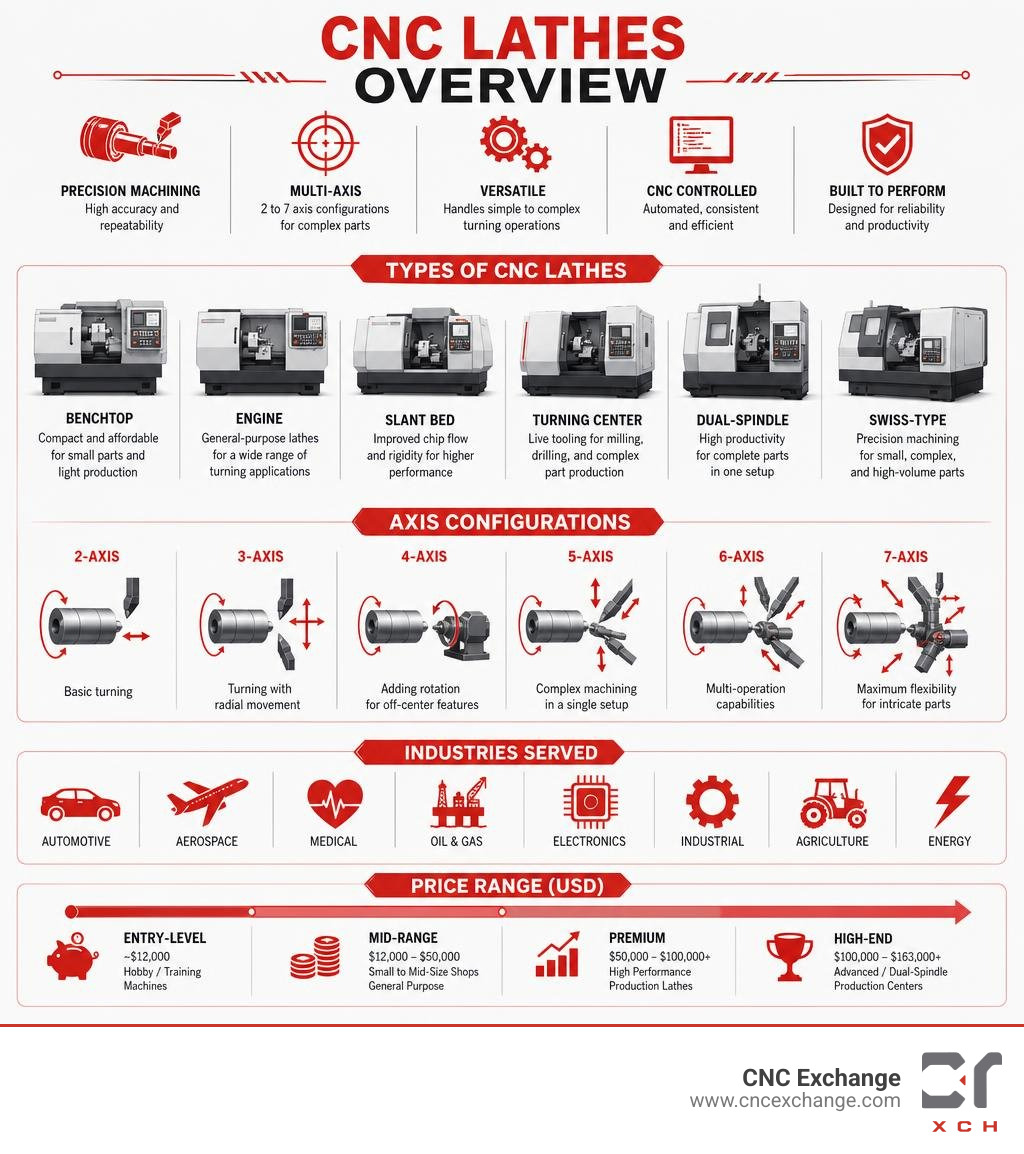
CNC lathes are computer-controlled machine tools that spin a workpiece at high speed while a cutting tool shapes it into precise cylindrical or complex forms — automatically, repeatedly, and with tight tolerances.
Quick facts about CNC lathes:
- What they do: Rotate a workpiece while a cutting tool removes material to create round, cylindrical, or contoured parts
- Key advantage: Can achieve positioning accuracy of ±0.005 mm and repeatability of ±0.002–0.004 mm
- Who uses them: Automotive, aerospace, medical, oil & gas, electronics, and more
- Price range: From ~$12,000 for entry-level hobby/training machines to $163,000+ for high-end dual-spindle production centers
- Axis configurations: 2-axis (basic turning) up to 7-axis (complex multi-operation parts in one setup)
- Control systems: Commonly Fanuc, Siemens, or proprietary systems like Tormach's PathPilot
If you run a manufacturing business, you already know the pressure: deadlines are tight, tolerances are unforgiving, and outdated equipment is costing you jobs. CNC lathes sit at the heart of modern precision manufacturing — they are, as industry professionals often call them, the workhorses of the shop floor.
Whether you're evaluating your first CNC turning center or looking to replace aging machinery with a capable used machine, this guide covers everything you need to make a confident decision.
Understanding CNC Lathes: Definition and Core Mechanics
At its most fundamental level, a CNC lathe operates on the principle of subtractive manufacturing. Unlike additive manufacturing (such as 3D printing), which builds a part layer by layer, turning removes material from a raw block or bar to reveal the final shape.
The defining characteristic of a lathe is that the workpiece rotates while the cutting tool remains stationary (relative to the spinning part, though it moves along the axes to carve out the shape). This makes it highly optimized for producing precise round shapes with well-defined outer diameters (OD) and inner diameters (ID).
In contrast, manual or conventional lathes rely entirely on the physical skill and hand-eye coordination of an operator turning handwheels. While manual lathes still have their place in quick repair shops and educational settings, they fall short in modern production environments. Modern cnc lathes replace physical handwheels with high-precision servo motors controlled by a computer. This shift from manual control to Computer Numerical Control (CNC) delivers unprecedented precision, speed, and repeatability.
With a high-quality machine, such as the CNC lathe | GENOS lathe | horizontal lathe | GENOS L2000-e , shops can consistently achieve tight tolerances and flawless surface finishes across thousands of identical parts.

Key Components of CNC Lathes
To understand how these machines achieve such remarkable accuracy, we have to look under the hood. A CNC lathe is an assembly of highly engineered mechanical and electronic components working in perfect harmony:
- The Machine Bed: The foundation of the machine. High-quality beds are cast from heavy-duty Meehanite cast iron, which is prized for its ability to dampen vibrations and resist thermal distortion during heavy-duty cutting.
- The Main Spindle: The heart of the lathe. It holds and rotates the raw material. Spindles are driven by powerful motors (often ranging from 15 HP to over 55 HP) and supported by ultra-precision bearings to minimize runout.
- The Chuck: Attached to the spindle, the chuck clamps the workpiece securely in place using hydraulic, pneumatic, or manual jaws.
- The Tool Turret: This component holds the cutting tools and indexes (rotates) to bring the correct tool into position. High-speed turrets can index between tools in as little as 0.2 seconds.
- The Tailstock: Positioned opposite the main spindle, the tailstock supports the free end of long workpieces to prevent bending, deflection, and vibration during machining.
- The Guideways: Hardened steel tracks that guide the tool turret's movement along the X and Z axes. Heavy-duty box ways offer maximum rigidity for deep cuts, while linear guides allow for faster rapid traverse rates.
- The Control System: The "brain" of the machine that translates digital code (G-code) into physical movements of the axes and spindle.
When you are looking to upgrade your shop's capabilities, exploring our CNC Lathes Category Page is an excellent way to see how different brands configure these components. For example, a mid-sized production machine like the Miyano BNC-34A CNC Lathes leverages a highly rigid design and quick-indexing turret to maximize throughput in tight floor spaces.
Main Types and Axis Configurations of CNC Turning Centers
CNC lathes are generally classified by the number of axes they control. The more axes a machine has, the more complex the geometries it can produce without requiring manual intervention or secondary setups.
- 2-Axis CNC Lathes: The standard configuration. These machines operate along the Z-axis (parallel to the spindle, controlling part length) and the X-axis (perpendicular to the spindle, controlling part diameter). They are ideal for straightforward turning, boring, facing, and threading.
- 3-Axis CNC Lathes: These add a Y-axis or a rotary C-axis. The C-axis allows the spindle to index and rotate in precise angular increments, while the Y-axis enables off-center milling, drilling, and tapping.
- 4-Axis CNC Lathes: Typically feature dual turrets or an added rotary axis, allowing two tools to cut the workpiece simultaneously. This setup can cut cycle times in half.
- 5-Axis to 7-Axis Turning Centers: These ultra-advanced machines combine twin spindles (main and sub-spindle) with upper and lower turrets, often incorporating a B-axis milling head. These multi-axis systems can complete incredibly complex components in a single setup.
For high-volume, highly complex production, multi-axis turning centers like the GTZ-2600 series represent the pinnacle of efficiency, allowing synchronous machining across multiple axes to eliminate bottlenecks.
Multi-Axis and Dual-Spindle CNC Lathes
When a CNC lathe is equipped with a sub-spindle (or counter-spindle) and live tooling, it transitions from a simple lathe into a full-fledged CNC turning center.
The main advantage of a dual-spindle configuration is the ability to perform 6-sided complete machining. The main spindle holds the raw bar stock and machines the front side of the part. Once completed, the sub-spindle advances, clamps onto the partially machined part, and the main spindle cuts it free. The sub-spindle then retracts to machine the backside of the part while the main spindle begins working on the next piece.
This process eliminates the need for an operator to manually flip the part, reducing human error and handling time. Combining this capability with live tooling (driven tools in the turret that can mill, drill, or tap) means complex parts emerge from the machine fully finished.
To see this technology in action, look at classic production models such as the Mori Seiki DL-151Y CNC Lathes, which utilize dual spindles and Y-axis capability for high-speed, multi-tasking operations. Similarly, the Mori Seiki SL15-MC CNC Lathes integrate live tooling to bridge the gap between traditional turning and milling. For shops looking for high-precision dual-spindle turning in a compact footprint, the Miyano BNJ-42S CNC Lathes offer an exceptional dual-turret design that maximizes overlapping cycles.
Slant-Bed vs. Flat-Bed Designs
If you have ever stood in front of a CNC lathe, you may have noticed that the bed is either flat (parallel to the ground) or slanted (typically at a 30-degree or 45-degree angle).
Flat-bed lathes are highly versatile and are often favored for heavy-duty, large-diameter turning, such as oilfield shafts or large industrial rollers. They provide easy manual access for loading heavy parts.
However, for high-speed production, slant-bed designs are the industry standard. The slanted geometry offers several key benefits:
- Excellent Chip Evacuation: Gravity pulls hot metal chips and coolant straight down into the chip conveyor, preventing them from nesting around the workpiece or tool turret.
- Superior Rigidity: The slant design places the linear guideways and the tool turret on a thicker, more structurally rigid plane, reducing the distance from the cutting tip to the bed foundation.
- Vibration Damping: The natural angle helps absorb cutting forces directly into the cast iron casting, resulting in better surface finishes and extended tool life.
Manufacturers looking for robust slant-bed solutions often turn to heavy-duty options like the Slant-Bed CNC Lathe Machine Order Solutions | CHANSIN series, which are engineered specifically to handle high-torque, high-volume turning.
Key Applications and Industry Use Cases
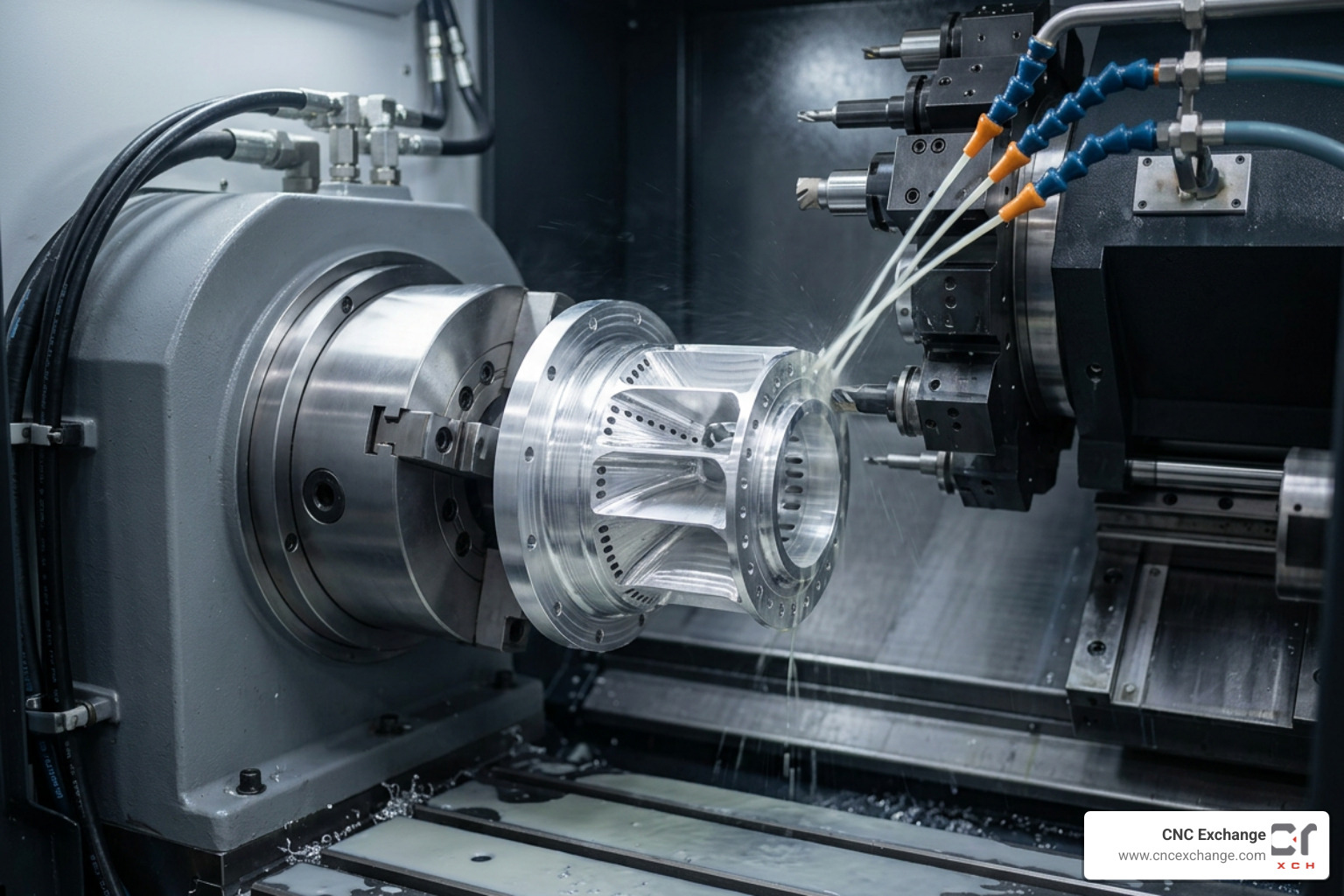
Because of their precision and speed, cnc lathes are indispensable across a wide range of major industries:
- Automotive: Mass production of critical components like drive shafts, camshafts, brake rotors, and gear blanks.
- Aerospace: Machining high-strength, heat-resistant superalloys (like Titanium and Inconel) into turbine parts, landing gear pins, and complex fasteners.
- Medical: Producing tiny, ultra-precise bone screws, dental implants, and surgical instruments where tolerances are measured in microns.
- Oil & Gas: Turning massive drill pipes, valves, and couplings that require specialized big-bore spindles.
For regional businesses looking for reliable manufacturing partners or sourcing equipment, the industrial landscape in Illinois is particularly rich. You can explore the CNC Lathes Suppliers & Manufacturers Serving Illinois - Thomasnet directory to see how local manufacturers deploy these machines.
When high-precision turning is required for demanding aerospace or medical applications, partnering with an experienced Precision CNC Machine Shop Serving Illinois - Owens Industries ensures that parts are manufactured to exact specifications. If you are looking to acquire or service machinery locally, working with a reputable Illinois Metal Machinery Supplier - Alternative Machine Tool can help keep your shop running smoothly.
How to Choose the Right CNC Lathe for Your Shop
Selecting the right lathe is about matching the machine's physical envelope and power to the specific jobs you run. Buying too much machine wastes capital; buying too little leads to missed opportunities and premature machine wear.
| Feature / Tier | Entry-Level (e.g., Tormach 8L) | Mid-Range (e.g., Haas ST-10 / ST-20) | High-End Turning Center (e.g., Okuma Genos L3000) |
|---|---|---|---|
| Typical Chuck Size | 4" to 6" | 6" to 10" | 10" to 12"+ |
| Bar Capacity | Up to 1.0" | 1.75" to 3.0" | 3.0" to 4.0"+ |
| Spindle Horsepower | 1.5 HP to 3 HP | 15 HP to 30 HP | 30 HP to 55 HP+ |
| Primary Use | Prototyping, Education, Light Production | General Job Shop, Medium Batches | High-Volume 24/7 Production, Complex Parts |
When narrowing down your choices, keep these critical specifications in mind:
- Chuck Size and Bar Capacity: The chuck size dictates the maximum diameter of raw stock you can hold. Bar capacity is the maximum diameter of material that can pass completely through the spindle bore. If you plan to use a bar feeder for automated production, bar capacity is your most critical constraint.
- Swing Over Bed: The maximum diameter workpiece that can rotate over the machine bed without hitting the guards or the carriage.
- Horsepower and Torque: High-horsepower spindles are necessary for rapid material removal in tough steels, while high torque at low RPM is vital for large-diameter drilling and threading.
- Tailstock vs. Sub-Spindle: If you turn long, slender shafts, a programmable tailstock is essential to prevent deflection. If you focus on complex, multi-sided parts, a sub-spindle is the smarter investment.
For a deeper dive into how different brands stack up against each other, read our comprehensive analysis on Choosing Between Okuma and Haas Lathes.
Control Systems and Programming Options
The control system is your operator's primary interface. The most common control systems on the market include Fanuc (known for its legendary reliability and standardized G-code), Siemens SINUMERIK (highly intuitive, with advanced conversational programming options), and proprietary platforms like Tormach’s PathPilot.
Operators generally program CNC lathes using one of three methods:
- G-Code (Manual Programming): Writing the coordinate code line-by-line. This is highly efficient for simple parts but slow and error-prone for complex geometries.
- Conversational Programming: An on-machine, menu-driven wizard where the operator inputs dimensions directly from a blueprint, and the control automatically generates the toolpaths.
- Offline CAD/CAM Software: Designing the part in CAD (like SolidWorks or Fusion 360) and using CAM software to generate the toolpath. This is mandatory for complex multi-axis geometries.
Advanced turning centers, such as the SYIL CNC Lathe Turning Centers: Enhance Your Metal Parts Manufacturing series, feature modern Siemens controls that seamlessly integrate offline G-code with user-friendly, on-screen simulations to prevent crashes.
Automation and Productivity Upgrades
If you want to maximize the return on your investment, look closely at automation. A CNC lathe is only making money when the spindle is spinning and tools are cutting metal.
- Bar Feeders: Automatically feed a new length of raw bar stock into the spindle once the previous part is cut off, allowing for hours of unattended "lights-out" manufacturing.
- Parts Catchers: A mechanical arm that swings out to catch the finished part as it is parted off, dropping it into an external bin so it doesn't get damaged by falling into the chip pile.
- Gantry Loaders and Robots: Ideal for loading pre-cut blanks or castings that cannot be fed through the spindle.
- Tool Presetters: Automated probes that measure tool wear and dimensions inside the machine, updating tool offsets automatically to maintain part tolerances.
For high-volume production of small parts, machines like the Miyano LZ-01R CNC Lathes feature built-in, high-speed gantry loaders that dramatically reduce load/unload times, making them incredibly cost-effective.
Maintenance, Safety, and Cost Considerations
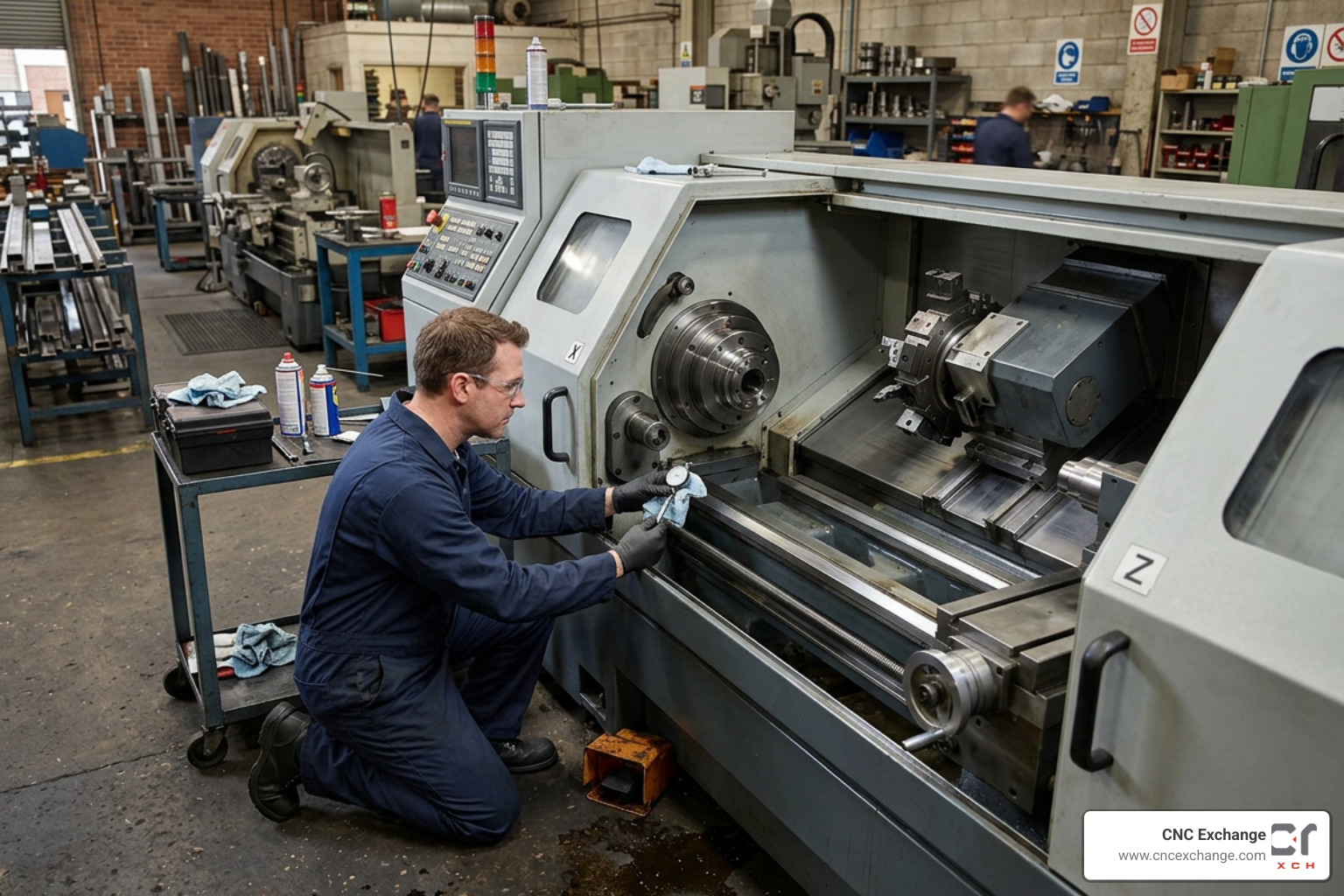
Operating a CNC lathe requires a strict commitment to preventive maintenance and safety. Because these machines spin heavy workpieces at thousands of RPM, minor issues can quickly turn into costly failures.
Essential Maintenance Best Practices:
- Daily Lubrication: Ensure the automatic way-lube reservoir is full. Proper lubrication protects the guideways from wear and prevents friction alarms.
- Coolant Concentration Monitoring: Check coolant levels and concentration daily. Poor coolant quality leads to rapid tool wear, rust on the machine bed, and poor surface finishes.
- Chip Management: Empty chip bins regularly. Nesting chips can jam the tool changer or damage the telescoping way covers.
Safety Protocols:
- Interlocked Enclosures: Never bypass safety door interlocks. The enclosure is designed to contain flying chips, high-pressure coolant, and, in rare cases, a thrown workpiece.
- Load Monitoring: Use the control system's load monitoring features to detect when a drill or turning insert has chipped, stopping the machine before it crashes.
Cost Considerations: When budgeting for a lathe, the purchase price of the machine is only part of the equation. You must also budget for tooling (holders, boring bars, inserts), workholding (collets, special chuck jaws), shipping, rigging, and electrical installation.
For heavy-duty industrial turning, investing in a robust, pre-owned machine like the Haas SL-40LB CNC Lathes or a massive Tacchi HD3-105-H CNC Lathes can save your shop tens of thousands of dollars in upfront capital while still delivering the heavy-metal-removal capabilities you need.
Frequently Asked Questions about CNC Lathes
What is the difference between a CNC lathe and a CNC mill?
The primary difference lies in which part of the system rotates:
- On a CNC lathe, the workpiece rotates in the spindle while the cutting tool remains stationary in the turret (though it moves along the axes). This is ideal for cylindrical, symmetrical parts.
- On a CNC mill, the workpiece remains stationary on a table while the cutting tool rotates in the spindle. This is ideal for flat, square, or complex 3D prismatic shapes.
How much does a CNC lathe cost in 2026?
As of July 2026, pricing generally falls into three main brackets:
- Entry-Level / Toolroom Lathes: $12,000 to $35,000. Great for prototyping, light production, and educational environments.
- Mid-Range Production Lathes: $65,000 to $120,000. These are the workhorses of general job shops, offering high rigidity, fast indexing, and options for live tooling.
- High-End Multi-Axis Turning Centers: $160,000 to $350,000+. These feature dual spindles, multiple turrets, B-axis heads, and full automation packages for high-volume, complex manufacturing.
Purchasing high-quality used machinery through a trusted marketplace is a highly effective way to acquire mid-range or high-end capabilities at a fraction of the cost of buying new.
What materials can be machined on a CNC lathe?
CNC lathes are incredibly versatile and can machine almost any solid material, including:
- Metals: Aluminum, brass, copper, carbon steels, stainless steels, titanium, and superalloys like Inconel.
- Plastics: Delrin (Acetal), Nylon, PTFE, PEEK, and Acrylic.
- Other Materials: Hardwood, composites, and graphite.
Conclusion
Whether you are running a high-volume production facility or a specialized local job shop, investing in the right turning center is one of the most impactful decisions you will make.
At CNC Exchange, we are dedicated to helping you navigate this process. As a trusted online marketplace in the industrial machinery sector, we buy, sell, and auction high-quality used CNC machines. Our mission is to provide a simple, transparent way for shops to upgrade their equipment, clear out underutilized machinery, and achieve fair market value.
If you are looking to add a reliable turning center to your shop floor, consider a proven machine like the Okuma Crown-S 762BB CNC Lathes, which offers the perfect blend of rigidity, accuracy, and long-term value.
Have questions about which machine is right for your specific production goals? Our team is based right here in Illinois at our main office in Prospect Heights. You can find us via CNC Exchange - Prospect Heights or simply Talk to Our Machine Tool Experts Today to discuss your machinery needs. We are here to help you find the perfect fit for your shop.