
What You Need to Know Before Buying Used Horizontal Boring Mills
Used horizontal boring mills are one of the most capable — and most complex — purchases a machine shop can make. Before you commit to one, here's what matters most:
Quick answer for buyers evaluating used horizontal boring mills:
| What to Check | Why It Matters |
|---|---|
| Spindle diameter (3"–5"+) | Determines tooling compatibility and cutting capacity |
| Axis travels (X, Y, Z, W) | Must match your largest workpiece envelope |
| Table load capacity | Ranges from ~7,500 lbs to over 88,000 lbs |
| Control type (CNC vs. manual) | Affects programming, setup time, and price |
| Brand and parts availability | Impacts long-term reliability and maintenance cost |
| Machine condition and way wear | Directly affects accuracy and remaining service life |
| Rigging and transport costs | Can add thousands to the total purchase cost |
These machines are built to bore, mill, and drill massive workpieces — engine blocks, gear housings, aerospace structures — that standard machining centers simply can't handle. A single horizontal boring mill can weigh over 100,000 lbs, span 30+ feet of floor space, and handle workloads measured in tons rather than pounds.
That scale means the buying decision carries real risk. The wrong machine — wrong size, wrong condition, wrong control system — can cost you far more than the sticker price.
Prices range from around $14,500 for older manual machines to well over $100,000 for large CNC models. And that's before rigging, shipping, or installation.
The used market is active. There are hundreds of listings at any given time from brands like Giddings & Lewis, Toshiba, TOS Varnsdorf, Kuraki, and DeVlieg — each with different strengths, specifications, and condition levels. Knowing how to read those differences is what separates a smart purchase from an expensive mistake.
I'm Jared Gray, and I've spent over 12 years buying, selling, and brokering manufacturing equipment — including used horizontal boring mills across a wide range of sizes, brands, and conditions. This guide will walk you through everything you need to evaluate your options clearly and confidently.
Key Types of Used Horizontal Boring Mills and How to Choose
When shopping the used market, you will quickly find that horizontal boring mills (HBMs) are not one-size-fits-all. They are structurally categorized by how they support and move the workpiece. Choosing the wrong configuration can lead to major structural stability issues or parts that simply do not fit your envelope.
To help visualize your options, let us look at how the three primary types compare:
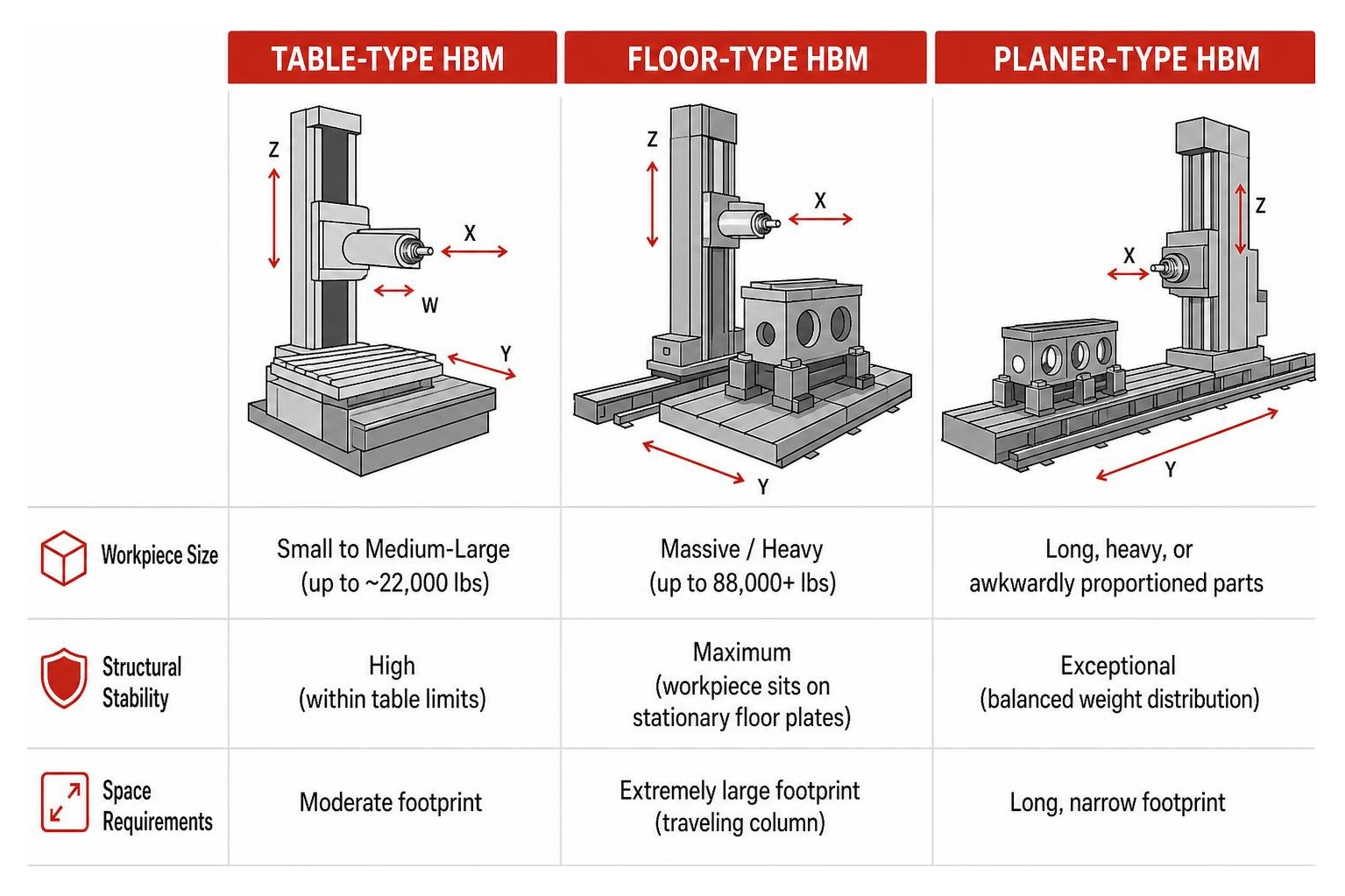
| Feature | Table-Type HBM | Floor-Type HBM | Planer-Type HBM |
|---|---|---|---|
| Workpiece Size | Small to Medium-Large (up to ~22,000 lbs) | Massive / Heavy (up to 88,000+ lbs) | Long, heavy, or awkwardly proportioned parts |
| Structural Stability | High (within table limits) | Maximum (workpiece sits on stationary floor plates) | Exceptional (balanced weight distribution) |
| Space Requirements | Moderate footprint | Extremely large footprint (traveling column) | Long, narrow footprint |
| Machining Versatility | High multi-sided capability with rotary tables | Best for deep boring and massive structural weldments | Ideal for reciprocating, heavy-duty line boring |
Table-Type Used Horizontal Boring Mills
The table-type configuration is the most common style you will find in standard machine shops. In fact, if you browse online listings, you will see that they regularly make up the majority of the available inventory.
On a table-type mill, the workpiece is clamped to a table that moves in both the X (cross) and Z (longitudinal) axes, while the headstock moves vertically (Y-axis) along a fixed column. This setup is highly versatile and perfect for machining medium-sized parts like heavy engine blocks, gear housings, and custom industrial frames.
Many of these machines feature integrated rotary tables, which allow you to rotate the part 360 degrees to machine multiple faces in a single setup. If your shop handles diverse job-shop work or medium-batch production runs, a table-type machine is almost always the most cost-effective and space-efficient choice.
Floor-Type and Planer-Type Configurations
When workpieces become too heavy for a moving table to carry safely, you must step up to a floor-type or planer-type machine.
On a floor-type HBM, the workpiece remains completely stationary, clamped to massive cast-iron floor plates anchored directly to your shop's foundation. Instead of the part moving, the entire column of the machine travels along floor tracks (X-axis). This configuration offers virtually unlimited weight capacity and can accommodate pieces weighing 40 tons or more.
If you are machining massive industrial components, weldments, or turbines for the energy sector, a floor-type mill is indispensable. Heavy-duty options like the Schiess Moweg GmbH FB 225 Horizontal Boring Mills or the massive Skoda Machine Tool WD250 Horizontal Boring Mills are classic examples of floor-type machines designed to handle workpieces of gargantuan proportions.
Planer-type HBMs offer a middle ground. They feature a table that moves only longitudinally (parallel to the spindle) on a long bed, while the column moves crosswise. This balances the structural load and is ideal for long, heavy parts that require highly precise, linear machining.
Critical Specifications to Evaluate Before Buying
Before you start requesting quotes, you need to understand the core specifications that define an HBM's capabilities. For general background on the machining process itself, see this overview of boring in manufacturing.
Spindle Diameter and Taper Standards
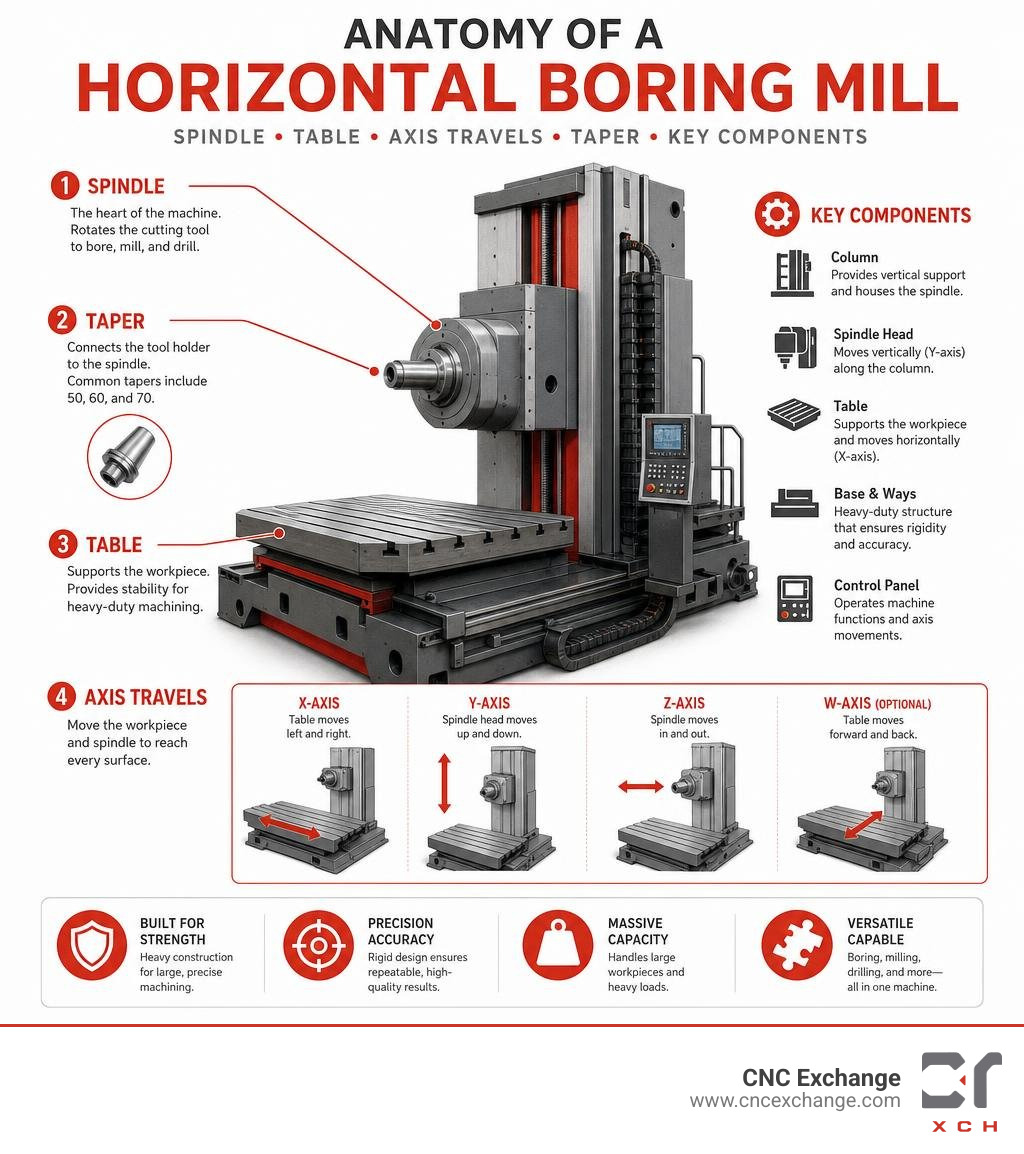
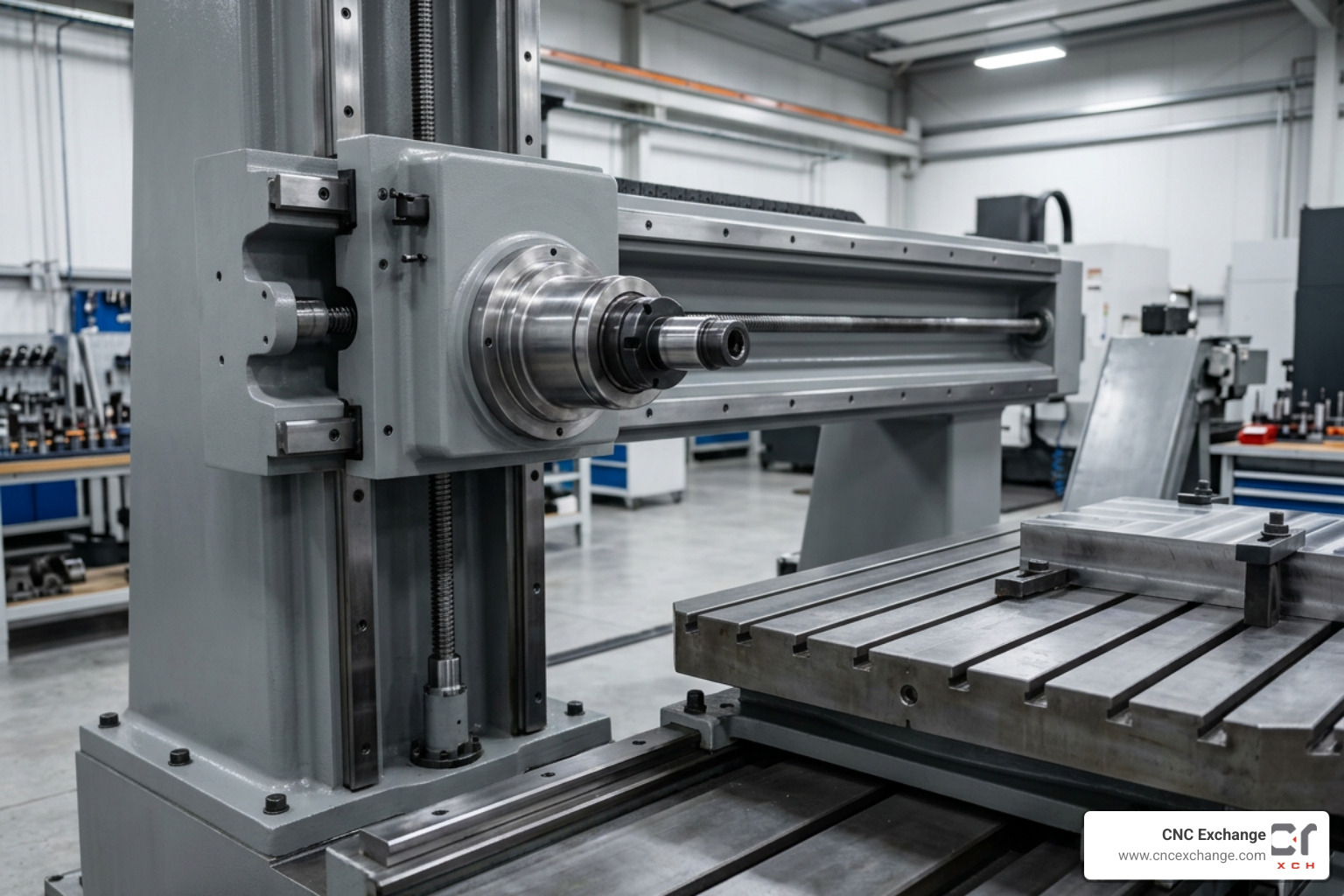
The spindle diameter is the primary classification metric for HBMs. It dictates the machine's overall rigidity, torque capacity, and the size of the holes it can comfortably bore.
- 2.5" to 3" Spindles: Great for lighter-duty precision boring and smaller job-shop work.
- 4" Spindles: The industry "sweet spot." A 4-inch spindle offers a fantastic balance of heavy cutting capacity and versatility.
- 5" to 7"+ Spindles: Reserved for massive structural machining, deep-hole boring, and high-torque milling in tough alloys.
You must also evaluate the spindle taper standard to ensure compatibility with your existing tooling. Most modern and late-model CNC HBMs use standard ISO 50 or CAT 50 tapers, which make finding tool holders easy.
However, if you are looking at older manual machines, you may run into legacy standards like Morse Taper #6 or NMTB 40/50. While these older tapers are incredibly rigid, you will want to verify that you can still source tooling or that the machine comes with a healthy package of included tool holders.
Axis Travels and Table Load Capacity
Calculating your physical envelope requirements requires looking at four key axes:
- X-Axis (Cross Travel): How far the table (or column) moves left to right.
- Y-Axis (Vertical Head Travel): How high the headstock can travel up the column.
- Z-Axis (Saddle/Column Longitudinal Travel): The distance the table or column moves toward or away from the spindle.
- W-Axis (Spindle Quill Travel): How far the actual spindle extends outward from the headstock. This is critical for reaching deep inside cavities or engine blocks.
For a great example of balanced travels on a medium-to-large CNC machine, take a look at the Femco BMC 135R Horizontal Boring Mills, which offer the generous travels and high-torque capabilities needed for deep-hole machining.
Finally, never overlook table load capacity. Exceeding the weight limit of a table-type machine will ruin the guideways and destroy the machine's accuracy. If you regularly handle parts weighing over 15,000 lbs, make sure the machine's rated capacity has a comfortable safety margin.
Top Brands in the Pre-Owned Boring Mill Market
Brand reputation in the used machinery world is not just about prestige; it is about structural rigidity, engineering quality, and whether you can get spare parts when something breaks.
American Workhorses: Giddings & Lewis, Lucas, and DeVlieg
If you are looking for pure mechanical durability, American-made legacy HBMs are legendary. Many of these machines were built so solidly that they continue to run daily in shops across Illinois and the Midwest, decades after they were built.
- Giddings & Lewis (G&L): G&L is one of the most respected names in heavy machining. Their machines, such as the classic Giddings and Lewis H6 T Horizontal Boring Mills, are famous for their massive grey iron castings and outstanding dampening characteristics.
- DeVlieg: Famous for their "Spiramatic" Jigmils, DeVlieg machines are highly sought after for high-precision boring. Models like the Devlieg 4K72 Horizontal Boring Mills are known for holding tight tolerances even after decades of service.
- Lucas Precision: Lucas machines feature robust manual shifting and mechanical feeds that are incredibly reliable. They are highly favored by repair shops that value simple, operator-controlled mechanical dependability.
Global Precision: Toshiba, Tos Varnsdorf, and Kuraki
For shops requiring advanced CNC capabilities, high-speed spindles, and modern controls, international builders dominate the market.
- Toshiba (Shibaura Machine): Toshiba HBMs are renowned for their speed, modern Fanuc or Tosnuc controls, and exceptional indexing accuracy. The Toshiba BTD 200 QE W Horizontal Boring Mills represent the pinnacle of Japanese precision and high-efficiency multi-sided machining.
- Tos Varnsdorf: Based in the Czech Republic, Tos Varnsdorf has set global standards for HBMs for generations. They are highly regarded for their heavy-duty table-type and floor-type boring machines.
- Nomura, Wotan, and Union: Other excellent brands include Nomura, known for precise boring like the Nomura B85 Horizontal Boring Mills; Wotan, with popular models like the Wotan B75 Horizontal Boring Mills; and German-engineered Union, represented by reliable workhorses like the Union BFT 130 Horizontal Boring Mills.
Assessing Condition, Wear, and Accuracy
Buying a used machine tool always requires a thorough inspection. With HBMs, because of their size and mass, small alignment errors can translate into major accuracy issues at the spindle nose.
Inspecting Spindles and Guide Ways on Used Horizontal Boring Mills
When evaluating used horizontal boring mills, we recommend focusing your inspection on three critical areas:
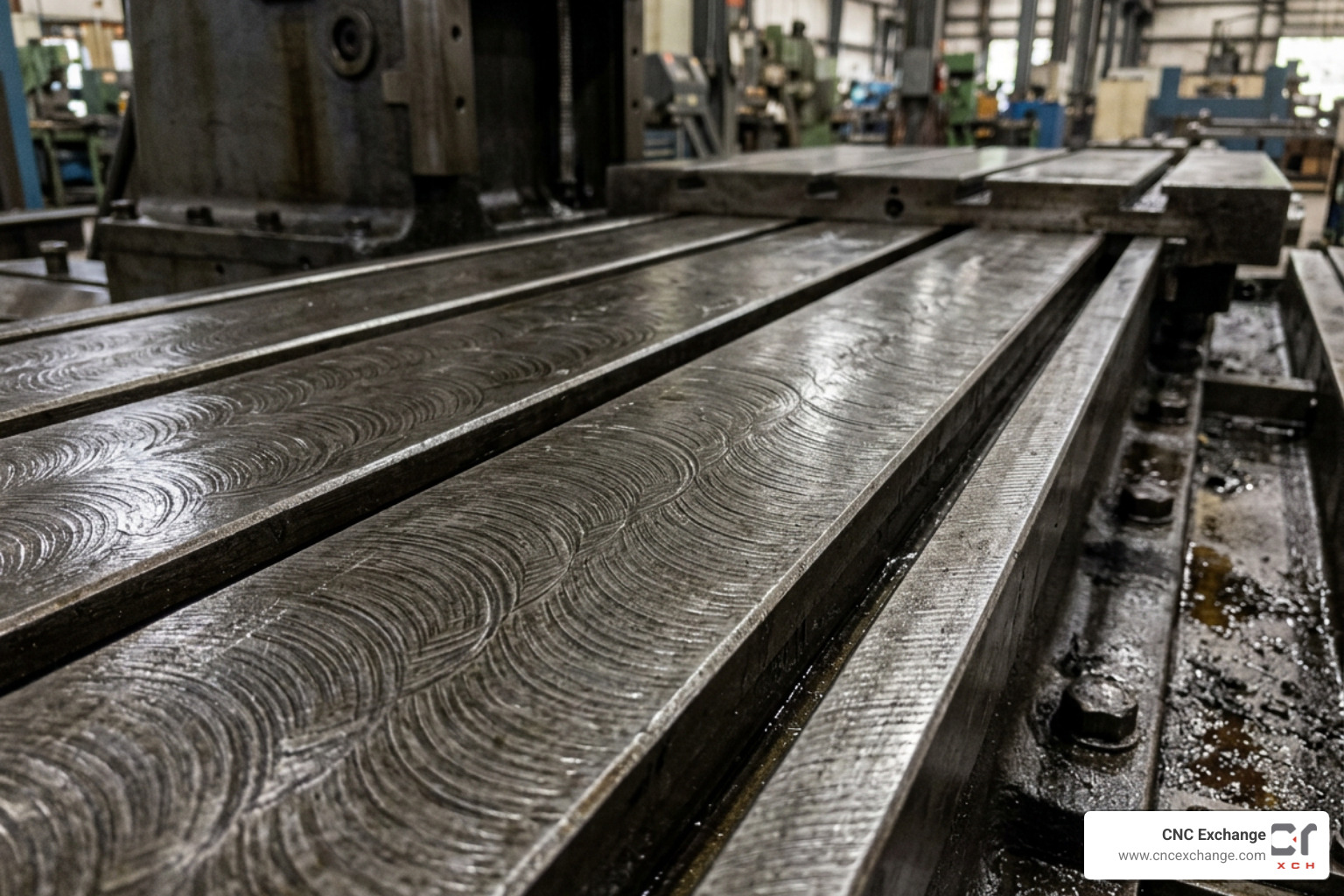
- The Guide Ways: Inspect the physical condition of the ways. Look for scoring, wear on the hardened surfaces, or areas where the lubrication has failed. If the ways are badly worn, the table will sag or "crab" as it travels, destroying your geometric accuracy.
- Spindle Runout and Backlash: Mount a dial indicator and check the spindle runout. Extend the spindle (W-axis) fully and check for play. Excessive play indicates worn spindle bearings, which can be expensive to replace.
- The Lubrication System: Ensure the automatic lubrication system is functioning perfectly. A dry way or spindle on a machine like the Wotan B 105M Horizontal Boring Mills can cause catastrophic mechanical wear in a very short period.
If you are looking at an older manual machine, check if it has been retrofitted with a modern digital readout (DRO) or linear scales. A high-quality 3-axis or 4-axis DRO can breathe new life into a manual HBM, giving you near-CNC positioning accuracy without the programming complexity.
Pricing Factors and Cost Expectations
What should you expect to pay for a pre-owned HBM? The price of used horizontal boring mills is primarily driven by age, condition, size, and control type:
- Older Manual HBMs ($14,500 – $35,000): These are typically vintage 1960s to 1980s machines. They are mechanically simple, highly durable, and excellent for low-volume repair work, but they lack automated speed.
- Mid-Range CNC HBMs ($45,000 – $95,000): Often from the 1990s or early 2000s, featuring older Fanuc, Heidenhain, or Tosnuc controls. These offer great production value but require careful inspection of the electronics.
- Large, Late-Model CNC HBMs ($100,000+): These are modern, heavy-duty machines with high-capacity tool changers, spindle chillers, and modern controls.
Remember to calculate the total cost of ownership. Rigging a 50,000-lb machine out of a facility, transporting it across state lines, pouring a specialized concrete foundation, and hiring professional riggers to assemble it can easily add $15,000 to $30,000+ to your final bill.
To browse a wide variety of listings and get a sense of current market prices, you can check out trusted online machinery platforms.
Frequently Asked Questions About Boring Mills
What is the difference between a horizontal boring mill and a vertical boring mill?
The primary difference is the orientation of the spindle and how the workpiece is supported. On a horizontal boring mill, the spindle is horizontal, and the workpiece is mounted vertically on a table. This is ideal for long parts, deep boring, and multi-sided machining.
On a vertical boring mill (often called a Vertical Turning Lathe or VTL), the table rotates horizontally like a massive pottery wheel, and the cutting tools feed down vertically. VTLs are designed for large, heavy, round parts (like rings, gears, or turbine disks) where gravity helps seat the part flat on the table, preventing deflection.
Why are manual horizontal boring mills still highly sought after?
Manual HBMs remain highly popular because of their mechanical simplicity and rapid setup times. If a job shop needs to perform a quick, one-off line-boring repair on a heavy tractor axle or a custom gearbox casting, programming a CNC machine can take longer than simply setting up the part manually. Manual machines are also easier to maintain and do not suffer from obsolete electronic components.
What are the typical rigging and foundation requirements for these machines?
Because HBMs are incredibly heavy (often weighing 30,000 to 100,000+ lbs), they cannot simply be placed on standard shop concrete. They typically require a dedicated, reinforced concrete foundation — often 12 to 24 inches deep — to prevent the machine from settling and twisting over time. You will also need to hire specialized heavy-duty machinery movers with high-capacity gantry cranes or heavy forklifts to safely load, transport, and assemble the machine.
Conclusion
Smart purchasing comes down to balancing your budget with your technical requirements. If you take the time to verify spindle wear, match the axis travels to your largest workpieces, and partner with a reliable source, a used horizontal boring mill can become the most profitable, hard-working machine on your shop floor.
Whether you are looking to buy, sell, or auction your equipment, we are here to help you navigate the process smoothly. At CNC Exchange, we simplify the buying and selling process to help you get the absolute best value out of your machinery assets.
If you want to explore available options, check out our listings like the Misc 722 Horizontal Boring Mills, or talk to our machine tool experts today to find the perfect fit for your shop's needs!