
Cylindrical vs. Surface Grinders: What's the Real Difference?
A cylindrical surface grinder is one of the most searched — and most misunderstood — terms in precision machining. Here's the short answer:
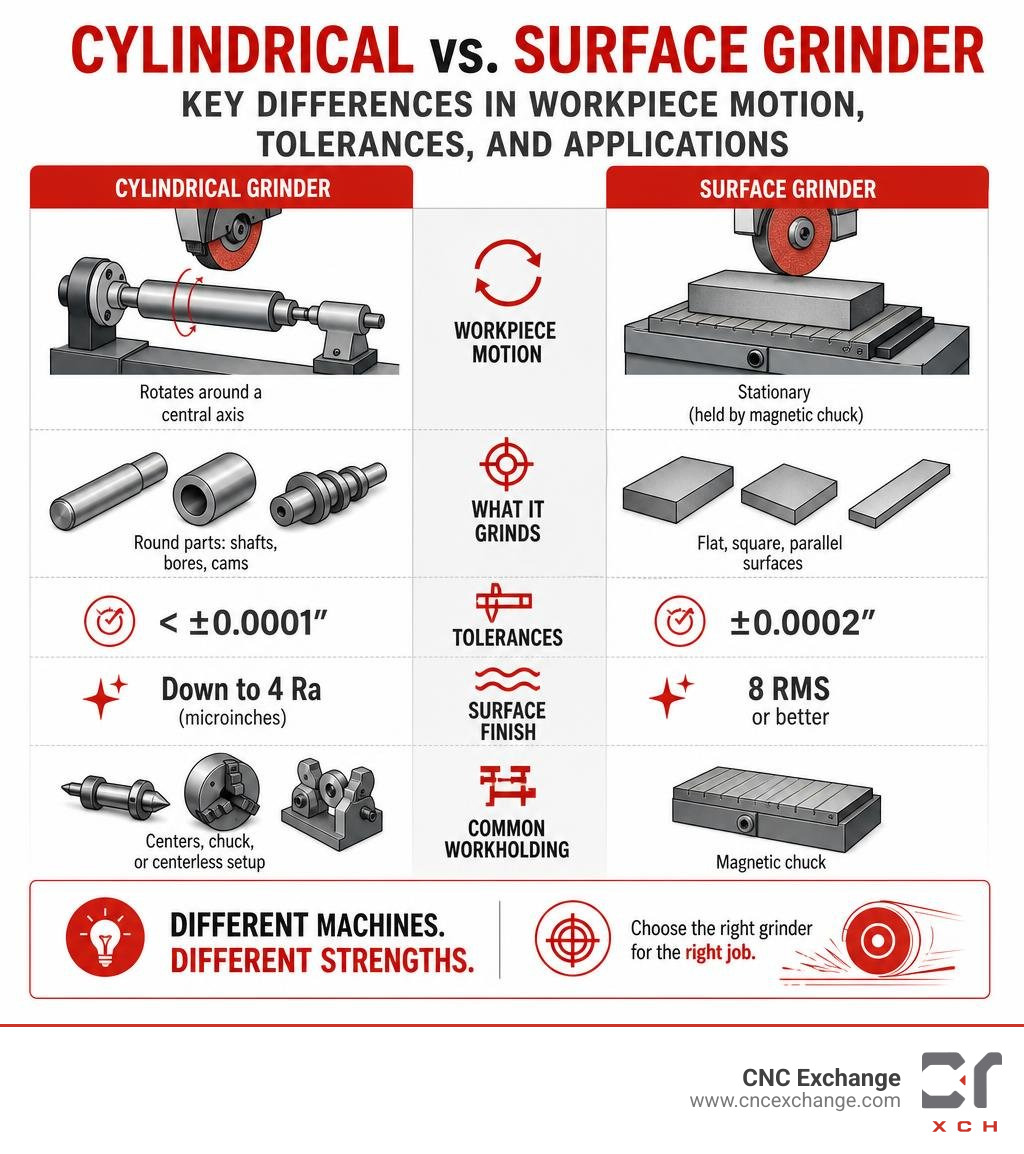
| Feature | Surface Grinder | Cylindrical Grinder |
|---|---|---|
| Workpiece movement | Stationary (held by magnetic chuck) | Rotates around a central axis |
| What it grinds | Flat, square, parallel surfaces | Round parts: shafts, bores, cams |
| Typical tolerances | ±0.0002 inches | Less than ±0.0001 inches |
| Surface finish | 8 RMS or better | Down to 4 Ra (microinches) |
| Common workholding | Magnetic chuck | Centers, chuck, or centerless setup |
These are two distinct machine types — not one combined machine. The phrase "cylindrical surface grinder" usually signals someone trying to understand the difference, or wondering whether one machine can do the job of the other.
The short answer: sometimes yes, but with important trade-offs.
Precision grinding has come a long way since the 1830s, when the first cylindrical grinders were little more than modified lathes. Today, CNC cylindrical grinders routinely hold roundness tolerances down to 0.000025 inches — tighter than anything a standard surface grinder can achieve on a round part.
Whether you're running a job shop, managing a production line, or just trying to figure out which machine belongs on your floor, understanding the difference between these two grinding approaches can save you serious money and scrap.
I'm Jared Gray, and with over 12 years of buying, selling, and brokering CNC equipment — including a wide range of cylindrical surface grinder machinery — I've helped hundreds of shops match the right machine to the right job. In the sections below, I'll break down exactly how each machine works, what they can and can't do, and how to choose wisely.
Defining the Cylindrical Surface Grinder and Its Core Mechanics
To understand why the term cylindrical surface grinder is so common, we have to look at what happens when a machinist needs to grind a round feature but only has a flat-bed surface grinder on the shop floor. In a pure cylindrical grinding machine, the process relies on four essential, synchronized movements:
- Workpiece Rotation: The part spins constantly on its own central axis, held between dead centers or in a chuck.
- Grinding Wheel Rotation: The grinding wheel spins rapidly in the opposite direction at the point of contact to shear away material.
- Traverse Feed: Either the wheelhead or the table moves longitudinally, carrying the contact point along the length of the workpiece.
- In-feed: The wheelhead moves perpendicularly into the workpiece to control the depth of the cut.
In contrast, a standard surface grinder moves a flat workpiece back and forth under a rotating wheel using a reciprocating table. When we try to combine these concepts — either by using a dedicated universal machine or by mounting a rotary attachment onto a flat-surface table — we are attempting to achieve cylindrical results on a surface grinding footprint.
While a dedicated surface grinder excels at flat, square, and parallel finishes of 8 RMS or better on plates up to 12 by 24 inches, a dedicated cylindrical grinder is built from the ground up to handle rotational geometries.
If you want to dive deeper into how these specialized processes compare, you can Learn more about high-precision cylindrical grinding to see how modern job shops leverage both technologies to achieve extreme concentricity.
Key Types of Cylindrical Grinding Operations
When we step into dedicated cylindrical grinding, we aren't just talking about spinning a rod against a wheel. Modern manufacturing in 2026 demands highly specialized sub-types of grinding to handle complex geometries:
- Outside Diameter (OD) Grinding: The most common form, where the external surface of a cylindrical part is ground. This is ideal for shafts, rolls, and arbors.
- Inside Diameter (ID) Grinding: Here, the grinding wheel must be smaller than the bore it is finishing. The wheelhead enters the internal cavity of a spinning workpiece to finish high-precision bores, tubes, and rings.
- Centerless Grinding: Unlike traditional setups, the workpiece is not held between centers or in a collet. Instead, it is supported on a work rest blade between a rapid grinding wheel and a slower regulating wheel. By positioning the workpiece centerline slightly above the wheel centers, high spots do not generate corresponding low spots, drastically improving roundness.
- Plunge Grinding: The wheel feeds directly into the work without traversing along its length. This is perfect for grinding specific shoulders, grooves, or formed profiles.
- Creep Feed Grinding: A heavy-duty method where the wheel takes a full-depth cut in a single slow pass. This can reduce total manufacturing time by up to 50% compared to multiple light passes.
For shops that specialize in complex internal work, choosing a machine with the right spindle speed is critical. For instance, you can Explore the STUDER S131 internal grinder, which features high-speed spindles reaching up to 120,000 rpm to finish small-diameter bores with sub-micron precision.
Adapting a Surface Grinder for Cylindrical Surface Grinder Work
If your shop doesn't have the floor space or budget for a dedicated cylindrical machine, you can adapt a standard surface grinder to perform light cylindrical tasks. This is where the hybrid term cylindrical surface grinder truly comes to life in a practical toolroom environment.
To make this transition, machinists rely on specialized workholding attachments:
- Spin Indexers and Collet Fixtures: By mounting a 5C spin indexer on the magnetic chuck, you can manually or motor-drive a round workpiece under the grinding wheel.
- Harig Grind-All Fixtures: These high-precision indexing fixtures allow you to dial in extremely tight concentricity for small pins and punches.
- Dedtru Centerless Attachments: A highly specialized attachment that essentially converts a flat surface grinder table into a centerless grinding system capable of OD and through-feed grinding.
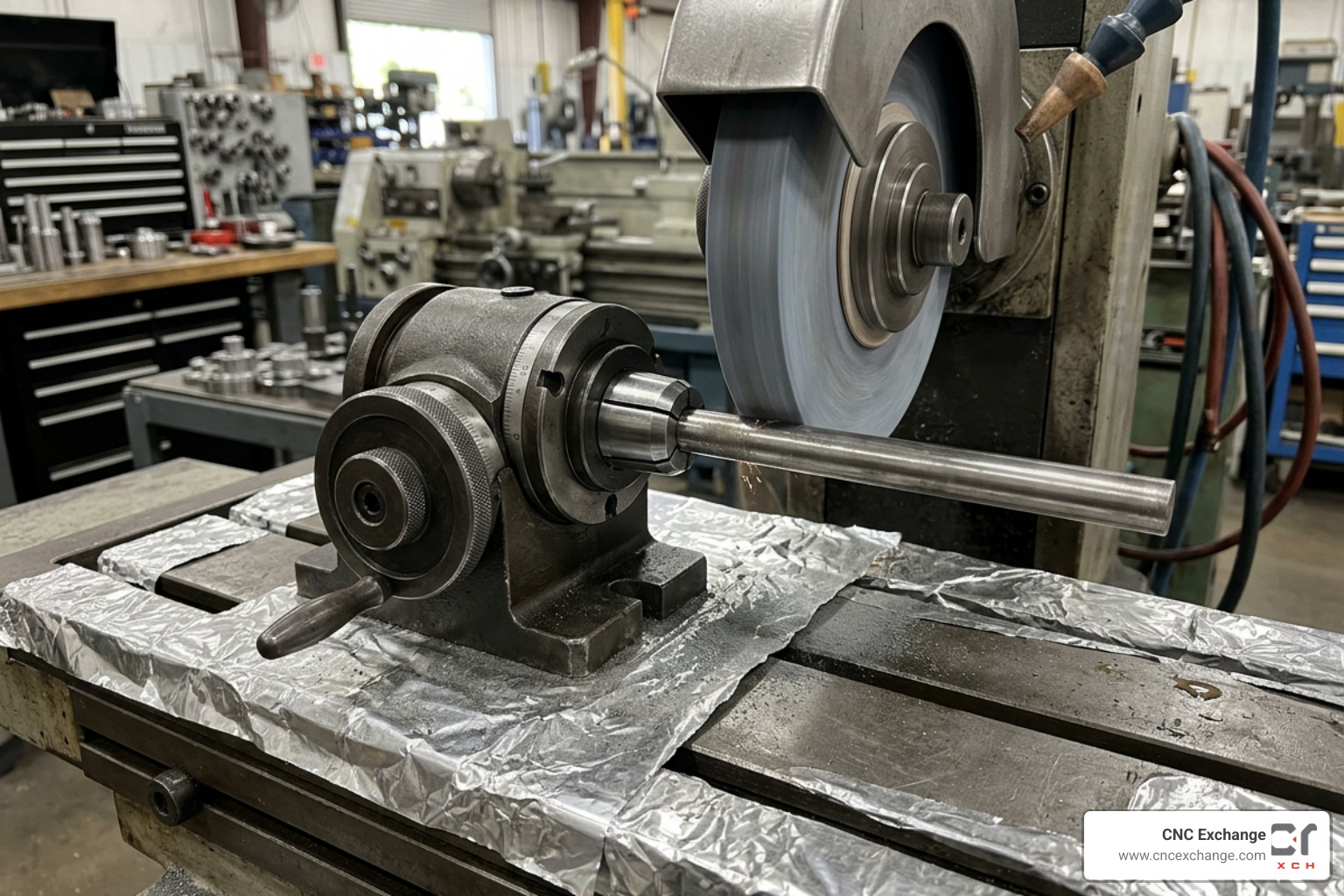
However, running a round part on a flat table introduces serious safety and precision challenges. Here are a few best practices we recommend:
- Workpiece Positioning: Always position the center of the round workpiece directly under the grinding wheel center or slightly to the left. Never position it to the right; if the table slips or the wheel digs in, it can grab the workpiece and pull it under, causing a catastrophic wheel explosion.
- The Sharpie Trick: Paint your workpiece with a permanent marker before touching off. The wear pattern of the ink will immediately show you where the wheel is making contact and whether your part is out-of-round or warped.
- Grit Protection: Grinding dust will quickly destroy the precision ways of your surface grinder. Use aluminum foil or heavy paper as grit guards to protect the table. Avoid cloth or loose plastics, which can easily snag in the spinning wheel.
Universal vs. Production Cylindrical Surface Grinder Systems
If your production volume outgrows temporary surface grinder attachments, you will need to choose between a universal cylindrical grinder and a dedicated production machine.
Universal Cylindrical Grinders are the "Swiss Army knives" of the grinding world. They feature swiveling wheelheads (often with both OD and ID spindles mounted on a B-axis) and swiveling workheads. This allows job shops to switch from grinding an external shaft to finishing an internal taper in a single setup.
If you are looking to add this level of flexibility to your shop, we regularly carry highly versatile machines like the Studer Favorit CNC Grinder, the legendary Kellenberger UR175/1000 Grinder Universal, and the reliable Supertec G20P-50NC Universal Cylindrical Grinders.
Production Cylindrical Grinders, on the other hand, are stripped of this swiveling flexibility in exchange for raw speed, rigidity, and automation. They are designed to grind the exact same part thousands of times with minimal cycle times, often utilizing automatic gantry loaders and in-process sizing gauges.
For shops seeking reliable universal options, we also recommend checking out classic toolroom workhorses such as the Studer S50-42 Grinder Universal, the Studer S-40-12 Grinder Universal, or the highly dependable Brown and Sharpe No.1 Grinder Universal. Other excellent options include the Jones and Shipman 1310 EIU Grinder Universal, the Shigiya GU30-40A Grinder Universal, the Misc Rhu-500 Grinder Universal, the heavy-duty Campbell AS48-60-18D Grinder Universal, and versatile platforms like the Misc Grinder Universal or the Unova R75 Grinder Universal.
Precision, Tolerances, and Industrial Applications
Why do industries like aerospace, automotive, and medical manufacturing rely so heavily on cylindrical grinding? The answer comes down to numbers. While standard machining processes struggle to hold thousandths of an inch on hardened steels, cylindrical grinding easily operates in the sub-micron realm:
- Diameter Tolerances: Less than 0.0001 inches (2.54 µm) are achievable.
- Roundness Precision: Down to 0.000025 inches (0.635 µm).
- Straightness: Down to 0.000050 inches (1.27 µm).
- Surface Finishes: Down to 4 Ra (microinches) or 0.10 µm.
Achieving these numbers requires extreme thermal stability. High-end grinding machines often feature mineral casting bases (like Granitan®) which provide up to ten times better vibration dampening than traditional cast iron and remain highly stable under temperature fluctuations.
Additionally, modern machines utilize hydrostatic bearings, which float the spindle on a thin film of pressurized oil to eliminate metal-on-metal wear and vibration.
In heavy-duty industries where massive parts must be ground sustainably, energy efficiency is also a major factor. For example, you can Discover the energy-efficient LandisFLEX, which reduces energy consumption by 25% using low-energy hydrostatics. For classic, proven toolroom reliability in large-scale operations, many shops still turn to robust mechanical systems like the Landis 3RH Grinder Universal.
Frequently Asked Questions About Cylindrical Grinding
Navigating the nuances of precision grinding can be tricky. Here are some of the most common questions we hear from shop owners on the floor.
What is the difference between a cylindrical grinder and a surface grinder?
The fundamental difference lies in the workpiece geometry and motion. A surface grinder uses a magnetic chuck to hold a stationary, flat workpiece that travels back and forth under a spinning wheel to create flat, parallel surfaces. A cylindrical grinder holds a rotating workpiece between centers or in a chuck, spinning it along a central axis while the grinding wheel removes material to create precise round profiles, steps, and tapers.
Can you perform ID and OD grinding in a single setup?
Yes! This is known as compound grinding. By utilizing a multi-spindle wheelhead on a B-axis, universal machines can grind the outer diameter, flip the wheelhead automatically, and finish the inner bore in a single clamping.
This completely eliminates the concentricity errors that occur when you unclamping and re-chuck a part. If you want to see this technology in action, look at the KG-500LE CNC Internal External Cylindrical Compound Grinding Machine, which uses a dual-spindle setup to maximize throughput and maintain perfect concentricity on complex workpieces.
What safety precautions are essential during cylindrical grinding?
Grinding involves high speeds, intense friction, and fine particulate matter. To keep your operators safe:
- Never Skimp on Coolant: Flood coolant is not just for surface finish; it prevents the workpiece from expanding. If a part heats up, it will expand into the wheel, leading to sudden wheel breakdown and a ruined part.
- Ring-Test Your Wheels: Always perform a ring test on new grinding wheels before mounting them to check for internal cracks.
- Secure Your Workholding: Ensure tailstock pressure is properly adjusted. If a part slips out from between centers at high speed, it becomes a dangerous projectile.
Conclusion
Whether you are looking to adapt your existing machinery with a specialized attachment or ready to invest in a dedicated universal CNC grinding center, choosing the right equipment is the key to holding tight tolerances and keeping your scrap rates low.
At CNC Exchange, we make it simple to upgrade your shop's capabilities. Operating from our headquarters in Prospect Heights, Illinois, we are an online industrial marketplace that helps shops across the US buy, sell, and auction used CNC machinery. We help you get fair market value for your old equipment so you can reinvest in the precision your customers demand.
Ready to take your flat work to the next level? Browse our inventory of surface grinders or contact our team today to find the perfect grinding solution for your floor!