
The Right Horizontal Boring Mill Can Make or Break Your Heavy Machining Operation
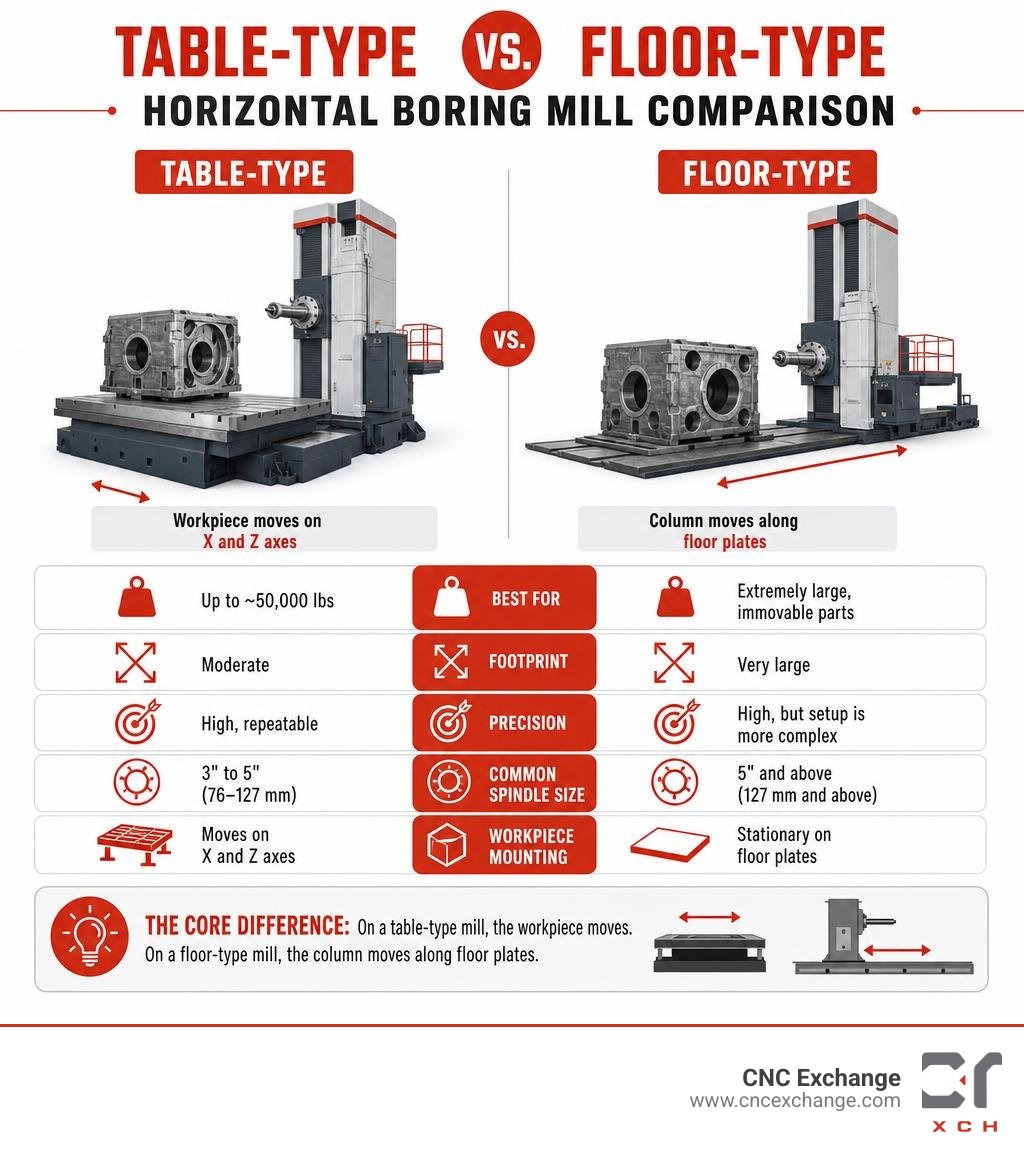
Boring mills horizontal table type are machine tools designed to bore, mill, and drill large, heavy workpieces mounted on a movable table. Here's a quick comparison to help you decide which type fits your needs:
| Feature | Table-Type | Floor-Type |
|---|---|---|
| Workpiece mounting | Moves on X and Z axes | Stationary on floor plates |
| Best for | Parts up to ~50,000 lbs | Extremely large, immovable parts |
| Footprint | Moderate | Very large |
| Precision | High, repeatable | High, but setup is more complex |
| Common spindle size | 3" to 5" (76–127 mm) | 5" and above |
The core difference is simple: on a table-type mill, the workpiece moves. On a floor-type mill, the column moves along floor plates instead.
Most job shops, heavy equipment manufacturers, and energy sector suppliers find the table-type configuration more versatile — it handles parts up to 50,000 lbs while keeping setup times short and positioning accuracy tight.
But choosing the wrong type for your application is an expensive mistake. The gap in capability, floor space, and price between these two configurations is significant — and worth understanding before you buy.
I'm Jared Gray, and over my 12+ years of buying, selling, and brokering manufacturing equipment — including boring mills horizontal table type across every major brand and era — I've helped shops avoid costly mismatches between machine and application. In the sections below, I'll walk you through everything you need to make a confident decision.
Understanding Horizontal Boring Mill Configurations
To make an informed decision for your shop, we first need to look at how different horizontal boring mills (HBMs) handle workpieces and cutting forces. While all horizontal boring mills share the basic principle of a horizontally oriented spindle that rotates the cutting tool, they diverge dramatically in how they move the workpiece relative to that spindle.
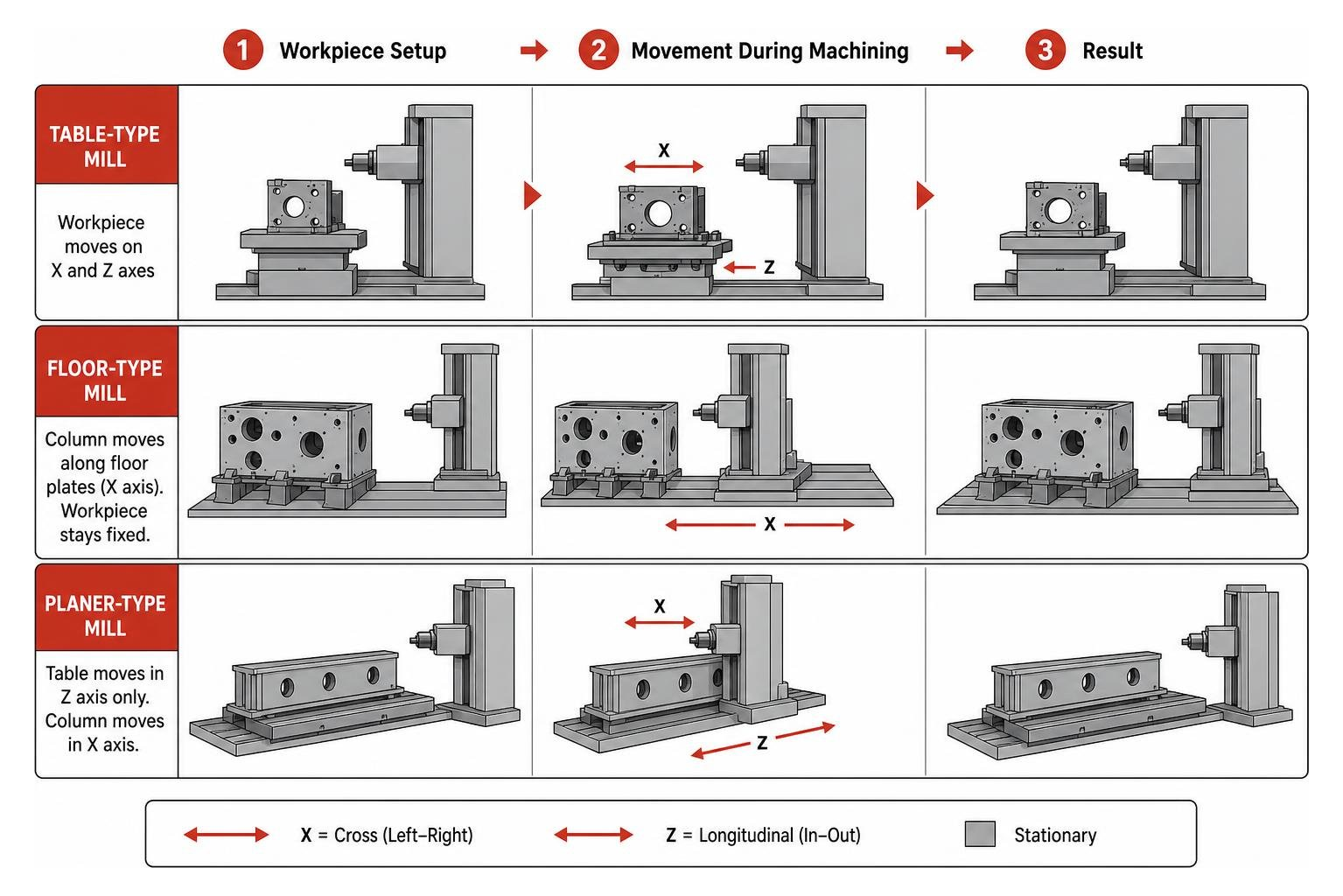
There are three primary configurations of horizontal boring mills:
- Table-Type Boring Mills: In this classic setup, the workpiece is mounted directly onto a built-in table that moves along at least two axes (typically X-axis cross-travel and Z-axis longitudinal travel). The spindle head moves vertically along the column (Y-axis). This configuration provides an exceptionally rigid setup for box-shaped parts, engine blocks, and industrial gearboxes.
- Floor-Type Boring Mills: Here, the workpiece remains entirely stationary, bolted down to massive floor plates. The entire machine column moves along a floor track (X-axis) to reach different sections of the part. This design removes almost all workpiece weight limitations, making it the go-to choice for massive castings, structural weldments, and turbine housings that would crush a standard moving table.
- Planer-Type Boring Mills: Combining elements of both, planer-type mills feature a table that moves only in a single longitudinal direction, while the column moves transverse to the spindle. This is a specialized configuration designed for exceptionally long, narrow workpieces.
Understanding the mechanical differences between these configurations helps us select the exact machine that maximizes productivity. For a deeper look at these mechanical distinctions, you can read more about Horizontal Boring Machines | Floor & Table-Type Boring Mills.
Structural Advantages of Boring Mills Horizontal Table Type
The boring mills horizontal table type configuration remains the most popular choice for general heavy machining, and for good reason. Its structural layout is engineered to deliver a balance of brute strength and repeatable precision.
At the heart of a high-quality table-type mill is its bed and column construction. Reputable manufacturers have historically relied on heavy, one-piece Meehanite castings. Meehanite is a patented cast iron formulation celebrated for its superior vibration damping properties and structural stability. When you are taking heavy roughing cuts on a tough alloy steel casting, the uniform density of a Meehanite base absorbs harmonic vibrations that would otherwise destroy cutting tools or ruin surface finishes.
Furthermore, many traditional and high-performance table-type mills utilize full-contact box ways rather than linear guides. While linear guides excel in high-speed, light-duty applications, box ways provide a massive surface area that distributes cutting forces. This design delivers the rigidity required for deep-hole boring and heavy-duty milling.
To ensure smooth, stick-slip-free movement under heavy table loads, these ways are often lined with Turcite (a low-friction thermoplastic resin) and hand-scraped by skilled technicians. This combination of heavy iron and hand-scraped ways is why legacy machines like the Wotan B75 T Horizontal Boring Mills and the Ceruti AU 70 Horizontal Boring Mills continue to run with high accuracy in shops worldwide, even decades after their manufacture.
Floor-Type Boring Mills for Massive Workpieces
If your shop regularly handles workpieces that weigh 60,000 lbs, 100,000 lbs, or more, a table-type mill will struggle. This is where floor-type boring mills excel.
By mounting the workpiece directly to heavy floor plates anchored to a deep concrete foundation, you eliminate the mechanical deflection that occurs when a massive part moves on a saddle. The column of a floor-type mill travels on a dedicated bed alongside the floor plates, allowing the spindle to access incredibly wide and tall parts.
For example, machines like the Dorries Scharmann Heavy Cut 1 Horizontal Boring Mills are built specifically to handle these extreme industrial components. However, floor-type mills require a much larger physical footprint, complex foundation engineering, and more challenging setup and alignment procedures. For parts within the 10,000 to 50,000-lb range, the table-type design remains far more efficient and cost-effective.
Key Specifications of Boring Mills Horizontal Table Type
When evaluating a boring mills horizontal table type for your facility, you must match the machine's technical specifications to your largest and heaviest part families. Over-specifying results in wasted floor space and higher utility bills, while under-specifying leads to tool deflection, poor finishes, and accelerated machine wear.
| Specification | Typical Range (Medium Duty) | Typical Range (Heavy Duty) |
|---|---|---|
| Spindle Diameter | 3.0" – 4.0" (76.2 – 101.6 mm) | 5.0" – 6.0"+ (127 – 152.4 mm+) |
| Spindle Taper | ISO 40 / NMTB 40 | ISO 50 / CAT 50 / NMTB 50 |
| Table Load Capacity | 5,000 – 15,000 lbs | 20,000 – 50,000+ lbs |
| X-Axis Travel | 40" – 80" | 96" – 144"+ |
| Y-Axis Travel | 36" – 60" | 72" – 96"+ |
| W-Axis (Spindle) | 15" – 25" | 27" – 40"+ |
| Main Motor Power | 15 – 25 HP | 30 – 50+ HP |
To explore engineered solutions and high-rigidity platforms that match these specifications, you can check out Precision boring mill solutions.
Spindle Size and Taper Options
The spindle diameter is the primary metric used to classify horizontal boring mills. It dictates the maximum torque the spindle can transmit and the size of the boring bar it can support without excessive deflection.
- 3-inch to 4-inch Spindles: These are the workhorses of mid-sized job shops. They offer a great balance of speed and rigidity, often topping out around 1,500 to 3,000 RPM. They are ideal for machining industrial pump bodies, valve manifolds, and medium gear housings.
- 5-inch Spindles and Larger: Designed for heavy-duty metal removal. These massive spindles are built to handle high-torque, low-RPM operations. Legacy heavy-duty models like the Devlieg 5K144 Horizontal Boring Mills and the Giddings and Lewis 65 CD5 F Horizontal Boring Mills utilize these larger spindle sizes to bore deep, large-diameter holes in tough structural steels and cast iron.
Spindle taper is equally critical. While some smaller, vintage machines utilize Morse Taper #5 or NMTB 40, modern and heavy-duty mills almost exclusively use ISO 50, CAT 50, or BT 50 tapers. A 50-taper interface provides the face-and-taper contact necessary to prevent tool pull-out and vibration during heavy radial milling cuts.
Table Load Capacity and Axis Travel
A key limiting factor of any boring mills horizontal table type is how much weight its saddle and bed ways can support without binding or losing accuracy. Exceeding the manufacturer's rated table capacity can compress way lubricants, accelerate wear on Turcite liners, and introduce geometric pitch and roll errors into your machining.
When calculating your required axis travels, horizontal boring mills typically feature four linear axes:
- X-Axis: The horizontal cross-travel of the table.
- Y-Axis: The vertical travel of the spindle headstock up and down the column.
- Z-Axis: The longitudinal travel of the table (or column, depending on the machine's structural layout) moving toward or away from the spindle.
- W-Axis: The axial feed of the boring spindle itself (the quill or bar). This axis allows the tool to reach deep inside a cavity while keeping the headstock and table stationary, ensuring maximum rigidity.
For example, a machine like the Femco BMC-110R2 Horizontal Boring Mills offers a built-in rotary table (B-axis) alongside generous X, Y, Z, and W travels, allowing you to machine multiple faces of a heavy workpiece in a single setup.
Sourcing and Inspecting Used Boring Mills
Buying a new horizontal boring mill represents a massive capital investment that often comes with a 6- to 12-month lead time. Because heavy cast iron machines are incredibly durable, the secondary market is a highly active and cost-effective alternative. It is common to find machines built in the late 20th century running alongside brand-new CNC models.
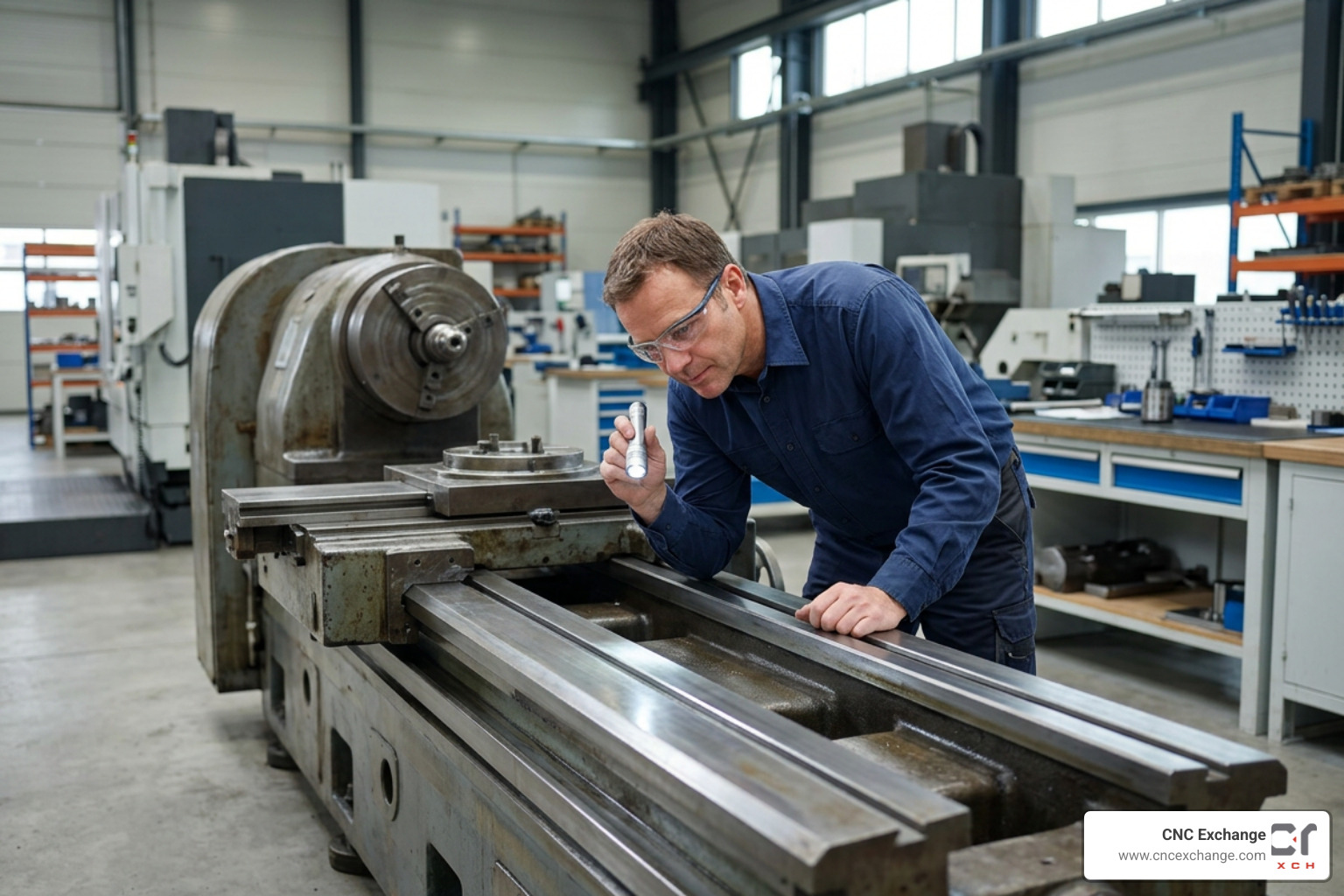
When sourcing a used machine, your inspection process should focus on mechanical integrity, wear points, and control capability. Let's break down the key considerations.
Manual vs. CNC Boring Mills Horizontal Table Type
One of the first decisions you must make is whether a manual machine with a digital readout (DRO) or a full CNC machine is better suited for your production needs.
- Manual Boring Mills: These machines are highly prevalent on the secondary market. They are incredibly durable, mechanically straightforward, and simple to maintain. For low-volume job shops, heavy machinery repair facilities, or custom tool-and-die work, a manual mill retrofitted with a high-quality 3-axis or 4-axis DRO (such as Heidenhain or Acu-Rite) is often the most economical choice. It allows an experienced operator to perform precise, custom setups without the overhead of CNC programming.
- CNC Boring Mills: For high-volume production, complex multi-sided parts, or components requiring precise 3D contouring, CNC is indispensable. Modern CNC models, or older heavy-duty frames retrofitted with modern control systems, offer features like automatic tool changers (ATC), automatic pallet changers (APC), and high-pressure coolant-through-spindle systems.
For instance, a classic machine like the Toshiba BT-10B R3 Horizontal Boring Mills or a multi-axis Mitsubishi MQF150 TC/NC Horizontal Boring Mills represents how CNC integration can transform heavy iron into a highly productive machining center.
Key Wear Points to Inspect
When inspecting a used boring mills horizontal table type, we recommend focusing on several critical wear points:
- Guideway Condition: Inspect the bed and saddle ways. Look for scoring, scratches, or uneven wear patterns. Check if the Turcite liners are intact and if the automatic lubrication system is functioning correctly. Dry ways lead to rapid wear and "stick-slip" errors.
- Spindle Runout and Bearings: Mount a dial indicator on the spindle nose and check for radial and axial play. Listen to the spindle running at various speed steps; growling or high-pitched whining indicates failing spindle bearings.
- Backlash in Lead Screws: On manual machines, check the backlash in the X and Z travel handwheels. On CNC machines, verify the condition of the ballscrews and check if the control system has been programmed with excessive backlash compensation to mask physical wear.
- Retrofit Quality: Many older machines, such as the Lucas 75T97 Horizontal Boring Mills or the Wotan B-105M Horizontal Boring Mills, have been retrofitted with newer CNC controls (like Fanuc, Heidenhain, or Mitsubishi). Inspect the electrical cabinet neatness, the quality of the new servo drives, and ensure that linear glass scales are installed on the primary axes to provide direct position feedback.
Frequently Asked Questions about Horizontal Boring Mills
What is the difference between a table-type and a floor-type boring mill?
On a table-type boring mill, the workpiece is mounted on a table that moves along the X (cross) and Z (longitudinal) axes relative to the spindle. On a floor-type boring mill, the workpiece is bolted to stationary floor plates, and the entire machine column travels along a floor track (X-axis) to machine the part. Table-type mills are faster to set up and ideal for parts under 50,000 lbs, while floor-type mills are reserved for massive, ultra-heavy components.
What is the purpose of the W-axis on a horizontal boring mill?
The W-axis represents the axial travel (extension and retraction) of the boring spindle itself, also known as the quill or bar. This allows the cutting tool to reach deep inside boring cavities or machine hard-to-reach internal faces while keeping the heavy spindle headstock and machine table stationary, preserving maximum structural rigidity.
How much weight can a table-type horizontal boring mill support?
Table load capacities vary widely by machine size and design. Smaller 3-inch spindle mills typically support between 5,000 and 12,000 lbs. Medium-duty 4-inch spindle models often support 15,000 to 30,000 lbs. Heavy-duty 5-inch spindle table-type mills, engineered with wide box ways and outrigger supports, can easily handle workpieces exceeding 40,000 to 50,000 lbs.
Conclusion
Choosing the right horizontal boring mill is a balancing act between the physical size of your workpieces, your required tolerances, and your capital budget. Whether you need the high-speed capability of a modern CNC boring mill or the reliable, heavy-cutting power of a vintage manual machine retrofitted with digital readouts, selecting a machine built on a rigid, high-quality cast iron foundation is key to long-term success.
At CNC Exchange, we specialize in helping manufacturers navigate the secondary machinery market. As an online marketplace based in Prospect Heights, Illinois, we make it simple to auction, buy, and sell used CNC and manual machinery, helping you upgrade your shop's capabilities and achieve fair market value for your surplus assets.
If you are ready to expand your heavy machining capabilities, we invite you to browse our current inventory of horizontal boring mills, such as this heavy-duty horizontal boring mill, or reach out to our team of machine tool experts today.