
Understanding CNC Router Bits and Their Uses
Understanding CNC router bits and their uses is the fastest way to get cleaner cuts, longer tool life, and less wasted material on your CNC router. Here is a quick overview of the most common bit types and what each one does:
| Bit Type | Best Used For |
|---|---|
| Upcut Spiral | Deep cuts in solid wood, plastics; clean bottom edge |
| Downcut Spiral | Clean top surface on wood, shallow pockets |
| Compression Spiral | Melamine, veneered plywood; clean top and bottom edge |
| V-Bit | Engraving, sign lettering, chamfers |
| Ball-Nose | 3D carving, relief work, curved surfaces |
| O-Flute (Single-Flute) | Acrylic and plastics; prevents melting |
| Surfacing/Spoilboard Bit | Flattening spoilboards, wide surface leveling |
The right bit depends on three things: your material, the finish you need, and your machine's spindle setup. Pick the wrong one and you get burning, chipping, or a bit that wears out in hours instead of days.
I'm Jared Gray, and over 12 years of buying, selling, and brokering CNC equipment — including machines built around precision tooling — I've seen how the wrong CNC router bits and their uses can limit even a well-spec'd machine's output. Let's walk through exactly how to match the right bit to every job.
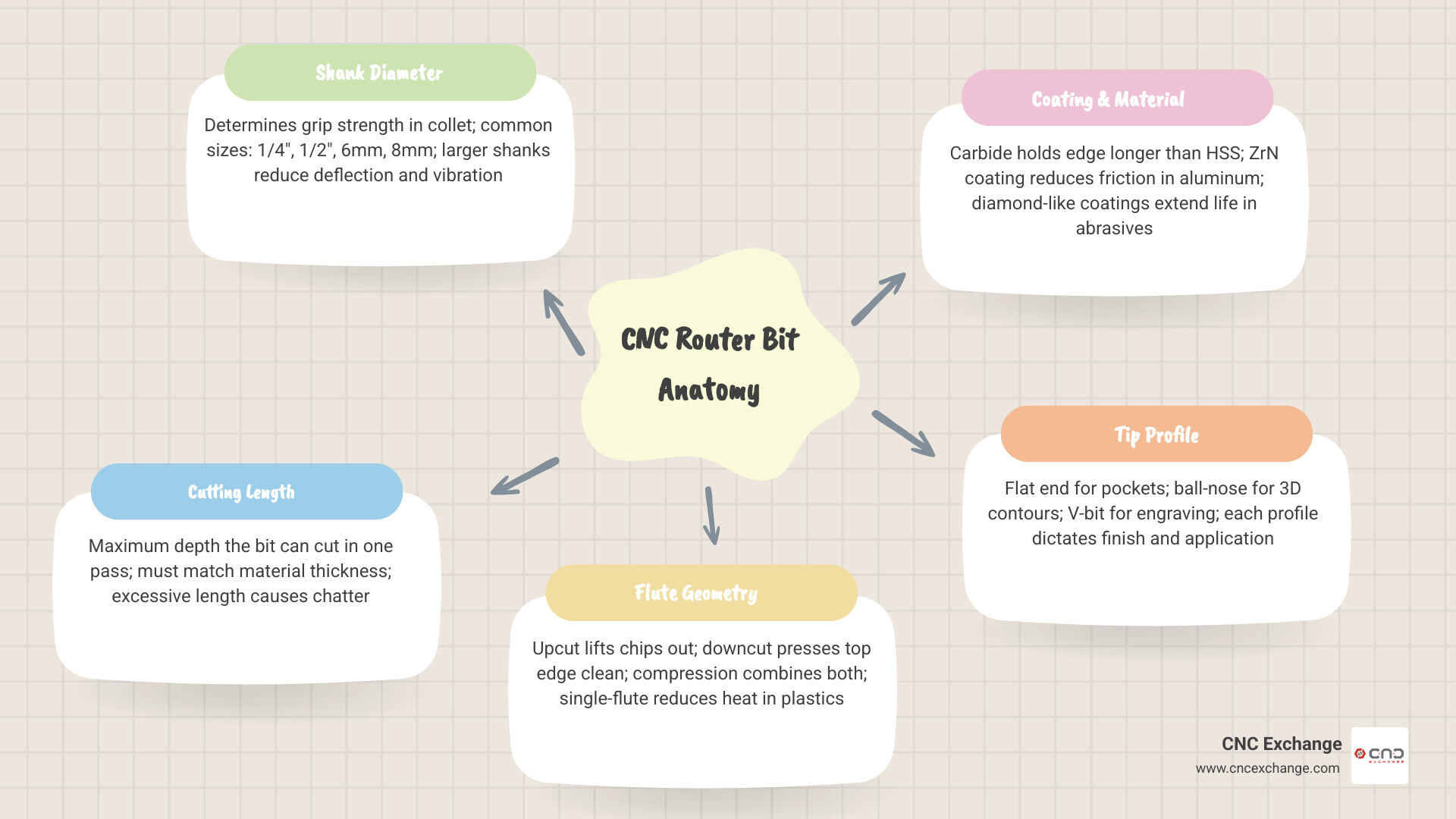
Selecting the proper tooling is the foundation of high-quality CNC machining. When we evaluate cnc router bits and their uses, we must look beyond the surface profile and analyze the physical engineering of the tool. Key parameters such as shank diameter, cutting length, flute geometry, and raw material composition dictate how a bit handles heat, clears chips, and resists deflection.
For a deeper dive into these fundamentals, you can read the CNC Router Bit Guide: Understanding Different Bit Types and Uses – RouterBit Mall .
When analyzing tool construction, the choice of material is critical:
- High-Speed Steel (HSS): These bits are inexpensive and tough, but they lack heat resistance. They are best reserved for low-speed, light-duty applications or soft materials where high speed is not critical.
- Solid Carbide: This is the professional standard. Solid tungsten carbide is incredibly hard and heat-resistant, allowing it to maintain sharp edges far longer than HSS under heavy production loads. Solid carbide bits can utilize harder, more wear-resistant formulations than brazed carbide-tipped tools because they bypass the high-heat brazing process during manufacturing.
- Carbide-Tipped: These feature a steel body with carbide cutting wings brazed onto the tips. They offer a cost-effective compromise for large-diameter profiling bits, though they lack the overall rigidity of solid carbide.
The physical dimensions of the tool also play a massive role. You should always select the shortest cutting length and overall length possible for your project. A shorter tool minimizes tool deflection (bending under force), which prevents chatter marks on your finished edges and keeps the bit from snapping under lateral loads.
Upcut vs. Downcut vs. Compression Spiral Geometries
The direction of the helical spiral on a bit determines how chips are evacuated and where the cutting forces are applied. Choosing between upcut, downcut, and compression geometries is one of the most critical decisions you will make.
- Upcut Spiral Bits: These bits feature a clockwise spiral that pulls chips upward and out of the cut, much like a standard drill bit. This excellent chip clearance makes them the best choice for deep profiling, slotting, and heavy material removal. Because they pull upward, they leave a perfectly clean edge on the bottom of the workpiece, but they can cause tearout or fraying on the top surface. They also exert upward force on the material, meaning you need robust workholding (like a strong vacuum table) to keep flexible sheets from lifting.
- Downcut Spiral Bits: These feature an anticlockwise spiral that forces chips downward. This downward pressure holds thin or flexible materials firmly against the table and leaves an incredibly clean, chip-free edge on the top surface of the workpiece. However, because they push chips down into the cut, chip clearance is poor. They run hotter and require slightly slower feed rates to manage heat buildup. Safety note: Be highly paranoid about clearing chips with downcut bits; trapping hot sawdust in a deep groove can generate enough friction to ignite a vacuum table's spoilboard.
- Compression Spiral Bits: These are the ultimate "best of both worlds" tools for sheet goods. A compression bit features an upcut geometry at the very tip (typically the first 3 to 8mm) and a downcut geometry on the rest of the body. When cutting through a sheet in a single pass, the upcut tip pulls the bottom fibers upward while the downcut body pushes the top fibers downward, compressing the material toward the center. This leaves completely clean, chip-free edges on both the top and bottom faces. Crucial rule: To benefit from compression geometry, your depth of cut must exceed the length of the upcut tip on the first pass; otherwise, you are simply running an upcut bit and will chip the top surface.
Compared to straight-flute cutters, which slam into the workpiece all at once and create significant vibration, spiral fluted cutters shear the material gradually. This allows spiral cutters to run up to 3x faster while leaving a vastly superior surface finish.
V-Bits and Ball-Nose Bits for Engraving and 3D Carving
When transitioning from profile cutting to detailed artistic work, V-bits and ball-nose bits become the primary tools in your inventory.
- V-Bits (V-Groove Bits): These are designed for engraving, sign-making, chamfering, and intricate calligraphic text. They are commonly available in angles such as 30°, 45°, 60°, 90°, and 120°. A 30-degree V-bit is ideal for ultra-fine, deep-looking detail, while a 90-degree bit is perfect for broad lettering and clean chamfers. When programming V-carving, setting a shallow depth of cut (typically 0.005 to 0.010 inches or 0.1 to 0.2 mm) for fine lines protects the delicate, sharp tip from snapping.
- Ball-Nose Bits: These feature a rounded tip and are the go-to choice for 3D contouring, organic sculpting, and deep relief carving. Because the very center of a ball-nose tip has zero surface speed during rotation, it does not cut efficiently; instead, it tends to smear the material. To get the best finish, you should perform a roughing pass with a flat-bottom end mill to bulk-remove material, and then let the ball-nose bit perform the finishing pass. The smoothness of a 3D ball-nose finish is determined by the "stepover"—the lateral distance the bit moves over on each pass. A smaller stepover reduces "scallop" heights but increases machining time.
Matching Router Bits to Specific Materials
Every material reacts differently to the heat and mechanical stress of CNC routing. Hardwoods require sharp edges to shear tough fibers cleanly; softwoods need large flutes to prevent resin clogging; plastics require clean chip evacuation to avoid melting; and metals demand specialized coatings to prevent the material from welding itself to the tool.
The table below provides a quick reference for matching tool life expectations and geometries to common materials:
| Material | Recommended Bit Geometry | Expected Tool Life (Hours) | Key Operational Factor |
|---|---|---|---|
| Solid Softwood | 2-Flute Upcut / Downcut | 50 – 100 | Keep feed rates high to avoid pitch buildup |
| Solid Hardwood | 2-Flute Upcut / Downcut | 20 – 50 | Requires sharp edges to slice tough wood fibers |
| Plain MDF | 2-Flute Upcut / Compression | 15 – 30 | Highly abrasive resin content dulls carbide quickly |
| Melamine Board | Compression Spiral | 20 – 40 | Must engage downcut section on first pass |
| Plywood | Compression / Upcut | 30 – 60 | Glues and alternating grain limit bit life |
| Acrylic & Plastics | Single-Flute O-Flute | 30 – 60 | High feed rates prevent melting and re-welding |
| Aluminum (ACP) | 2-Flute Upcut (O-Flute) | 10 – 20 | Requires polished flutes and cooling/lubrication |
Best CNC Router Bits and Their Uses for Wood, MDF, and Plywood
Machining wood products is the core of most CNC operations, but "wood" is a broad category. Understanding the differences between solid timber and engineered wood composites is essential for selecting the right tool. For a comprehensive look at woodworking tooling, see the CNC Router Bits for Woodworking: A Complete Guide to Choosing the Right Router Tooling - Superstar CNC .
- Solid Wood (Hardwood and Softwood): Hardwoods like oak and maple have dense, interlocking fibers that require highly polished, sharp cutting edges to prevent tearout. Softwoods like pine are less dense but contain sticky resins that can bake onto the bit. A quality two-flute upcut or downcut carbide bit works beautifully here, typically lasting 50 to 100 hours in softwoods and 20 to 50 hours in hardwoods.
- MDF (Medium-Density Fiberboard): MDF is incredibly abrasive because it is held together by synthetic resins and glues. This abrasive binder dulls standard carbide tools rapidly; a quality carbide upcut bit typically lasts only 15 to 30 hours of cutting time in MDF. To combat this, high-production shops often upgrade to PCD (Polycrystalline Diamond) tooling, which can last 25 times longer than standard carbide.
- Plywood: Plywood consists of alternating grain layers bonded by tough adhesives. This structure causes rapid tool wear and is highly prone to chipping on both the top and bottom veneers. A compression spiral bit is the gold standard for plywood, ensuring clean face veneers on both sides. Expect 30 to 60 hours of clean cutting before the bit needs sharpening or replacement.
- Melamine-Faced Particleboard: Melamine features a brittle, hard plastic face over a highly abrasive particleboard core. Standard upcut bits will instantly shatter the top melamine surface. A compression bit is mandatory here to keep both the top and bottom faces pristine, yielding an approximate tool life of 20 to 40 hours.
Selecting CNC Router Bits and Their Uses for Acrylic, Plastics, and Aluminum
Cutting non-wood materials requires a completely different approach to chip geometry and heat management. Standard woodworking bits will fail rapidly when applied to plastics or non-ferrous metals.
- Acrylic and Plastics (PVC, Sign Foam): Standard two-flute woodworking bits do not clear plastic chips fast enough. This traps heat, causing the plastic to melt and weld itself back to the cut edge, leaving a ruined workpiece and a clogged bit. The single-flute O-flute bit is non-negotiable for professional-quality plastic edges. The large, polished open channel of an O-flute evacuates large, cool chips before they have a chance to melt, leaving a polished, transparent edge.
- Aluminum and Non-Ferrous Metals: Aluminum is a "gummy" metal that easily sticks to hot cutting edges, leading to built-up edge (BUE) and immediate bit breakage. When routing aluminum, we use 2-flute or single-flute carbide end mills with highly polished flutes. Specialized coatings like Zirconium Nitride (ZrN) provide a slick, low-friction surface that prevents aluminum from adhering to the tool. Applying a mist coolant or simple lubricant like WD-40 during the cut drastically extends tool life.
Optimizing Feeds, Speeds, and Tooling Setup
Even the highest-quality bit will perform poorly if your feeds and speeds are incorrect. The goal of any CNC cut is to maintain the correct "chip load"—the actual thickness of the chip that each flute shears off the material.
If your feed rate is too slow, or your spindle RPM is too fast, the bit will rub against the material instead of cutting it. This rubbing generates extreme friction and heat, which ruins the temper of the carbide and dulls the cutting edge in minutes. Conversely, if your feed rate is too fast or your RPM is too slow, the bit will take too large of a bite, leading to excessive tool deflection, rough edge finishes, and broken bits.
You can calculate your starting feed rate using this standard formula:
Feed Rate = Spindle RPM * Number of Flutes * Recommended Chipload
For example, if you are cutting MDF with a 2-flute bit at 18,000 RPM, and the manufacturer recommends a chipload of 0.004 inches per tooth:
Feed Rate = 18,000 * 2 * 0.004 = 144 inches per minute (IPM)
Shank Diameters, Collet Maintenance, and Runout
The physical connection between your CNC's spindle and your router bit is the collet. This small, slotted steel sleeve is responsible for keeping your tool perfectly centered and rigidly held at high rotational speeds.
- Shank Sizes: Common shank diameters include 1/4 inch (6.35mm) and 1/2 inch (12.7mm), as well as metric sizes like 6mm and 12mm. Always match the shank size of your bit exactly to your collet size; never use adapters or bushings to bridge a size gap, as they introduce vibration and reduce rigidity. Whenever possible, choose 1/2-inch shanks over 1/4-inch shanks for bits larger than 3/8-inch cutting diameter to minimize deflection.
- Runout: Runout is the deviation of the tool from its perfect central axis of rotation (wobble). Runout of as little as 0.05mm can cut your tool life in half and ruin your edge finish. Runout is usually caused by dirt, pitch, or resin buildup inside the collet or the spindle taper, or by a worn-out collet.
- Collet Maintenance: Collets are wear items. They lose their elasticity over time and should be replaced every 400 to 600 hours of spindle use, even if they look undamaged. Clean your collet, collet nut, and spindle taper daily with a brass brush and a lint-free cloth to prevent debris buildup.
When inserting a bit, push it into the collet until it covers about two-thirds of the shank. Never push the bit all the way in so that the end of the shank bottoms out against the inside of the spindle; heat expansion during operation can lock the shank in place, straining the collet nut and causing tool runout. Pull the bit back about 1/16 to 1/8 inch before tightening.
Heavy industrial machines, such as the Thermwood C510 CNC Router or the Biesse Rover B FT 1224 CNC Router, rely on perfectly maintained tool holders and collets to deliver their high-torque, high-speed cutting capabilities without sacrificing accuracy or tool longevity.
Key Signs Your CNC Router Bit Needs to Be Replaced
Running a dull bit increases the load on your spindle, risks burning your workpiece, and can lead to catastrophic tool breakage. For a detailed reference on tooling terms and wear indicators, consult the Router Bit Glossary: Router Bit Terms Explained.
Watch for these warning signs that your bit has reached the end of its useful life:
- Fuzzy or Rough Edges: If your plywood veneer starts fraying or your MDF edges feel fuzzy, the cutting edge has lost its razor sharpness.
- Scorching or Burning: Dark burn marks on the wood or smoke during a cut mean the bit is rubbing and generating excessive heat instead of shearing chips.
- Increased Noise and Vibration: A dull bit requires more force to push through material, which causes the machine to labor, leading to high-pitched chatter or deep vibrations.
- Inspect the Edge: Use a jeweler's loupe to inspect the cutting edge. If you see tiny chips, rounded corners, or a shiny line along the very edge (which indicates rounding), the bit needs to be sharpened or retired.
Common Mistakes to Avoid in CNC Tooling
Avoiding beginner mistakes can save you thousands of dollars in ruined material, broken bits, and spindle repairs.
- Mistake 1: Using the wrong collet size. Trying to force a 6mm metric shank into a 1/4-inch (6.35mm) collet, or vice versa, will prevent the collet from clamping evenly. This causes extreme runout, tool slippage, and can cause the bit to fly out of the spindle.
- Mistake 2: Running too slow of a feed rate. Beginners often slow down their feed rate out of fear, thinking it is safer. In reality, slow feed rates cause the bit to rub and overheat. If you see fine sawdust instead of distinct wood chips, your feed rate is too slow.
- Mistake 3: Ignoring compression bit depth limits. If you use a compression bit to make a shallow pocket or a shallow first pass (less than the upcut tip length), you are cutting entirely with the upcut section. This will cause tearout on the top veneer, defeating the entire purpose of the compression geometry.
- Mistake 4: Bottoming out the bit in the collet. Pushing the bit shank completely to the bottom of the spindle housing prevents proper clamping and can cause the bit to seize or run out of round due to thermal expansion.
- Mistake 5: Using one bit for everything. Trying to cut acrylic with a woodworking bit or solid oak with a cheap straight-flute cutter will result in poor finishes and short tool life. Match your geometry to your material.
Frequently Asked Questions About CNC Router Bits
What is the difference between an end mill and a router bit?
On modern CNC routers, the terms are often used interchangeably, but there is a historical and design difference. Traditional woodworking router bits often feature brazed carbide edges and are designed for edge profiling, sometimes using a pilot bearing. End mills, originating from metalworking, are typically solid carbide, feature helical spiral flutes, and are designed to cut both laterally (side-to-side) and axially (plunging). Most high-performance CNC "router bits" are technically wood-routing end mills.
How long do CNC router bits typically last?
Bit life depends heavily on the material being cut. In highly abrasive MDF, a quality carbide upcut bit typically lasts 15 to 30 hours of cutting time. In solid hardwoods, you can expect 20 to 50 hours, and up to 100 hours in softwoods. For high-volume industrial operations, switching to PCD (Polycrystalline Diamond) tooling can extend tool life by 25 times or more compared to standard carbide.
Can I use handheld router bits on a CNC machine?
Generally, no. Handheld router bits often feature pilot bearings designed to ride along a template; these bearings cannot handle the high lateral forces and feed rates of a CNC machine and can fail catastrophically. Additionally, handheld bits are not balanced for the extreme rotational speeds (up to 24,000 RPM) of CNC spindles, posing a severe safety risk. Always use CNC-specific, balanced tooling without pilot bearings.
Conclusion
Mastering cnc router bits and their uses is the most direct path to improving your shop's production quality and reducing operating costs. By matching the correct helix geometry, flute count, and material coating to your specific workpiece, you protect your machinery and elevate the quality of your finished products.
At CNC Exchange, we help shops of all sizes upgrade their production capabilities. If you are looking to scale up your operations or trade in your current machinery for a high-performance system, we provide a simple, transparent marketplace to buy, sell, and auction industrial equipment. Browse CNC Machinery for Sale today to find the perfect platform for your tooling setup.