
When Your Grinder Goes Down, So Does Everything Else
CNC grinder preventive maintenance is the scheduled, systematic practice of inspecting, cleaning, lubricating, and servicing your grinding machine before something breaks — not after.
If you're looking for a quick reference, here's what an effective CNC grinder PM program covers:
| Frequency | Key Tasks |
|---|---|
| Daily | Inspect grinding wheel, check coolant concentration, lubricate ways, visual walk-around |
| Weekly | Check belt tension, clean way wipers, inspect electrical connections, clean machine bed |
| Monthly | Inspect spindle bearings, test hydraulic system, check coolant system, dress grinding wheel |
| Annually | Re-level machine, replace batteries, calibrate axes, replace worn seals and belts |
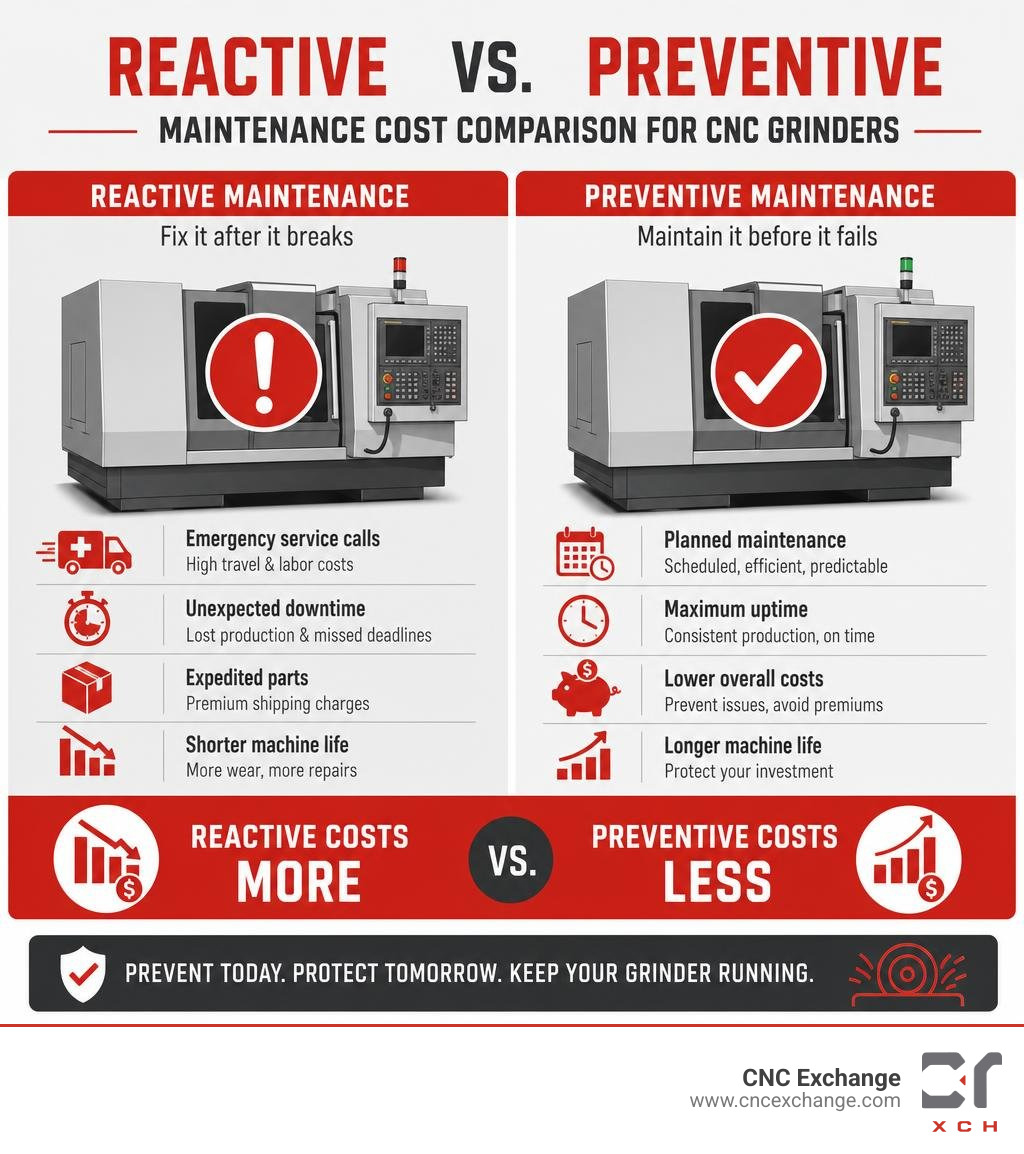
The stakes are high. A single emergency service call — with travel time, diagnostics, expedited parts, and lost production — typically costs more than a full year of preventive maintenance visits. And without a proper PM program, machine life can drop from 12–15 years down to just 5–7 years.
Consider this: a five-minute daily visual inspection catches 90% of minor issues before they turn into expensive disasters. That's not a big time investment for the protection it buys.
Yet most shops only think about maintenance after the grinder groans, throws a fault code, and goes silent in the middle of a critical production run.
I'm Jared Gray — with over 12 years of experience in CNC machinery, I've seen how CNC grinder preventive maintenance separates shops that run smoothly from those stuck in constant firefighting mode. That experience shapes everything we cover in this guide.
Why CNC Grinder Preventive Maintenance Pays for Itself
Grinding is fundamentally different from milling or turning. While standard CNC machines produce chips, grinding machines produce a highly abrasive cocktail of metal swarf and shattered abrasive grit. This fine dust behaves like liquid sandpaper. If it gets past your machine's defenses, it will destroy linear guides, score ball screws, and ruin expensive spindle bearings.
Implementing a structured cnc grinder preventive maintenance program is the only way to protect your equipment from this hostile environment.
Proper maintenance can extend a grinder's service life from a mediocre 5–7 years to an impressive 12–15 years. It also directly impacts your tooling costs. When a machine is poorly maintained, grinding wheels wear out up to 30% faster due to micro-vibrations and misalignment. By keeping the system rigid and balanced, you can achieve savings of 20–25% on wheel costs alone.
Furthermore, proper maintenance keeps your parts within spec. A well-maintained grinder can easily hold tolerances of ±0.002 mm, whereas a neglected machine will struggle to stay below ±0.01 mm, leading to high scrap rates and rejected parts.
Safety is another critical factor. Grinding wheels operate at extreme speeds, often exceeding 6,000 surface feet per minute (SFPM). A damaged, cracked, or improperly mounted wheel can catastrophically explode, putting your operators in severe danger. Following a disciplined maintenance routine ensures compliance with OSHA safety standards for abrasive wheel machinery, keeping your shop safe and compliant.
The High Cost of Neglect vs. Proactive Care
Let’s talk numbers. When a critical machine goes down unexpectedly, the clock starts ticking. You have to pay for an emergency service call, which includes travel time, premium diagnostic rates, and expedited shipping for replacement parts.
But the direct repair bill is only a fraction of the true cost. The real damage comes from lost production capacity. If your shop rate is $150 per hour and a machine is down for two weeks waiting for a custom spindle rebuild, you stand to lose upwards of $24,000 in capacity alone, not to mention damaged customer relationships and missed deadlines.
By contrast, proactive care identifies wear before it causes a breakdown. A scheduled PM visit allows you to replace a $50 seal or a $200 belt during scheduled downtime, saving the spindle from a $10,000 rebuild. At CNC Exchange, we help shops maximize their return on investment by keeping their machinery running at peak efficiency. To learn more about how to protect your equipment, check out our More info about CNC machine services.
The Ultimate CNC Grinder Maintenance Schedule
To keep your grinders holding sub-micron tolerances, you need a structured, time-based maintenance schedule. Concrete settles, shop floors shift, and heavy iron moves over time. Regular calibration and re-leveling are essential to counteract these natural shifts.
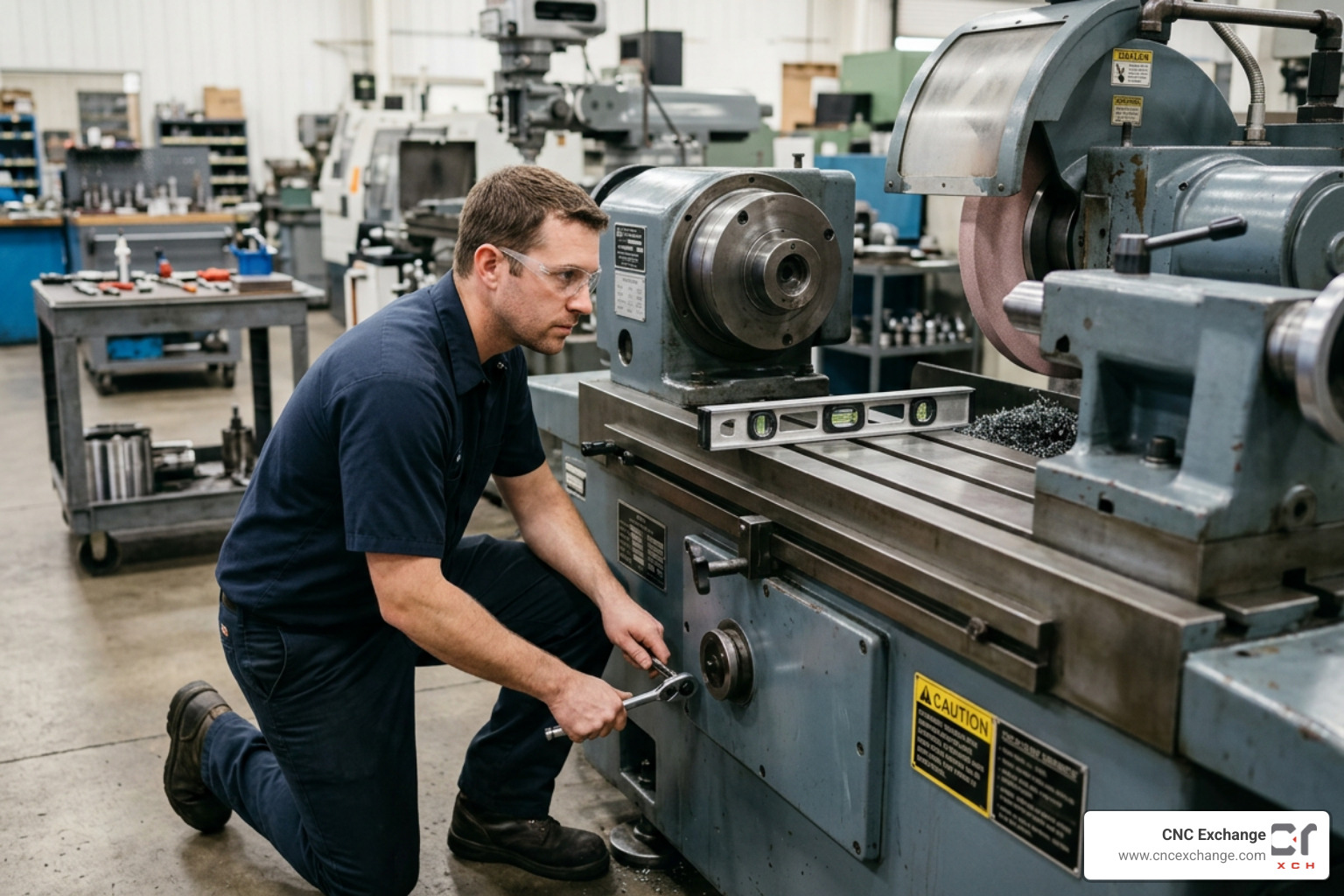
The following table outlines the essential intervals and tasks required to keep your CNC grinding machines in top condition:
| Frequency | Mechanical Tasks | Fluid & Coolant Tasks | Electrical & Control Tasks |
|---|---|---|---|
| Daily | Clean work area, inspect wheel for cracks, wipe guideways | Check coolant concentration, verify way lube level | Test emergency stops, check air pressure, monitor alarms |
| Weekly | Inspect way wipers, check belt tension, balance wheel | Clean coolant settling tray, check for hydraulic leaks | Inspect cables for wear, tighten loose terminals |
| Monthly | Inspect spindle bearings for runout, clean way covers | Replace dirty hydraulic oil, clean coolant tank | Clean cabinet fans, check limit switches and sensors |
| Semi-Annually | Check machine leveling, inspect linear motor magnet plates | Change power unit oil, replace hydraulic filters | Back up system parameters, inspect encoder cables |
| Annually | Calibrate axes, replace worn belts and seals, grease motors | Flush and clean entire coolant system | Replace control batteries, test motor insulation resistance |
Daily and Weekly CNC Grinder Preventive Maintenance Tasks
Every shift should begin with a five-minute walk-around. Operators must visually inspect the grinding wheel for chips, cracks, or discoloration. Even a minor ding in a bonded abrasive wheel can cause it to fail under centrifugal force.
Next, check your coolant concentration using a handheld refractometer. Grinding coolant must be kept at the manufacturer’s exact recommended ratio (usually between 5% and 10%). If the mixture is too lean, you run the risk of rusting the machine bed and burning your workpieces. If it is too rich, you waste money and invite skin irritation for your operators.
On a weekly basis, clean and inspect the physical way wipers. These rubber and brass guards are your primary defense against abrasive grinding grit. If they are cracked or torn, grit will slip underneath the carriage and score the guideways. Additionally, check the tension of all drive belts. Loose belts cause wheel slippage, which leads to poor surface finishes and dimensional errors. For a broader look at maintaining shop floor accuracy, refer to the Modern Machine Shop guide to machine tool preventive maintenance.
Monthly and Annual Deep Maintenance
Monthly maintenance moves beyond visual checks into diagnostic territory. Technicians should use a dial indicator to measure spindle radial runout, ensuring it remains within the typical 2 μm limit. If you hear unusual humming, grinding, or knocking noises from the spindle, it is time to perform a vibration analysis to catch bearing wear early.
Test the hydraulic system by checking the reservoir level and monitoring the oil pump pressure to ensure it stays within the standard 0.3–0.6 MPa range. If the hydraulic oil appears cloudy or milky, it has been contaminated with water and must be replaced immediately.
Annually, the machine must be re-leveled using a high-precision master machinist level. Over time, the weight of the machine combined with floor settling will twist the cast iron bed, introducing taper errors into your parts.
Do not forget to replace the CNC controller batteries annually. If these batteries die while the machine is powered off, you will lose your system parameters and PLC programs, leading to days of unnecessary downtime. For shops running versatile grinding setups, you can find More info about universal grinders to see how these principles apply to multi-axis machines.
Tailoring Maintenance for Cylindrical, Surface, and Centerless Grinders
Different types of grinders have unique maintenance bottlenecks that require specialized attention:
- Cylindrical Grinders: These machines rely on precise alignment between the workhead, tailstock, and wheelhead. Technicians must periodically clean and inspect the work centers and spindle taper holes. Any accumulation of grinding dust here will cause non-concentric rotation, leading to out-of-round parts. For more on these systems, see our More info about cylindrical grinders.
- Surface Grinders: The magnetic chuck is the heart of a surface grinder. It must be kept perfectly flat and free of residual magnetism. Degauss the chuck regularly and check for flatness with a dial indicator. Additionally, inspect the longitudinal table guideways for even lubrication to prevent stick-slip errors.
- Centerless Grinders: Centerless grinding involves a grinding wheel, a regulating wheel, and a work rest blade. The regulating wheel head and the grinding wheel dresser slides must move smoothly. Grease the zirc fittings on the dressers quarterly, and inspect the work rest blade for wear or grooving, which will ruin part roundness.
To understand how these different grinding methods fit into modern production environments, check out the Production Machining guide to grinding processes.
Critical Fluid Management: Coolant and Lubrication
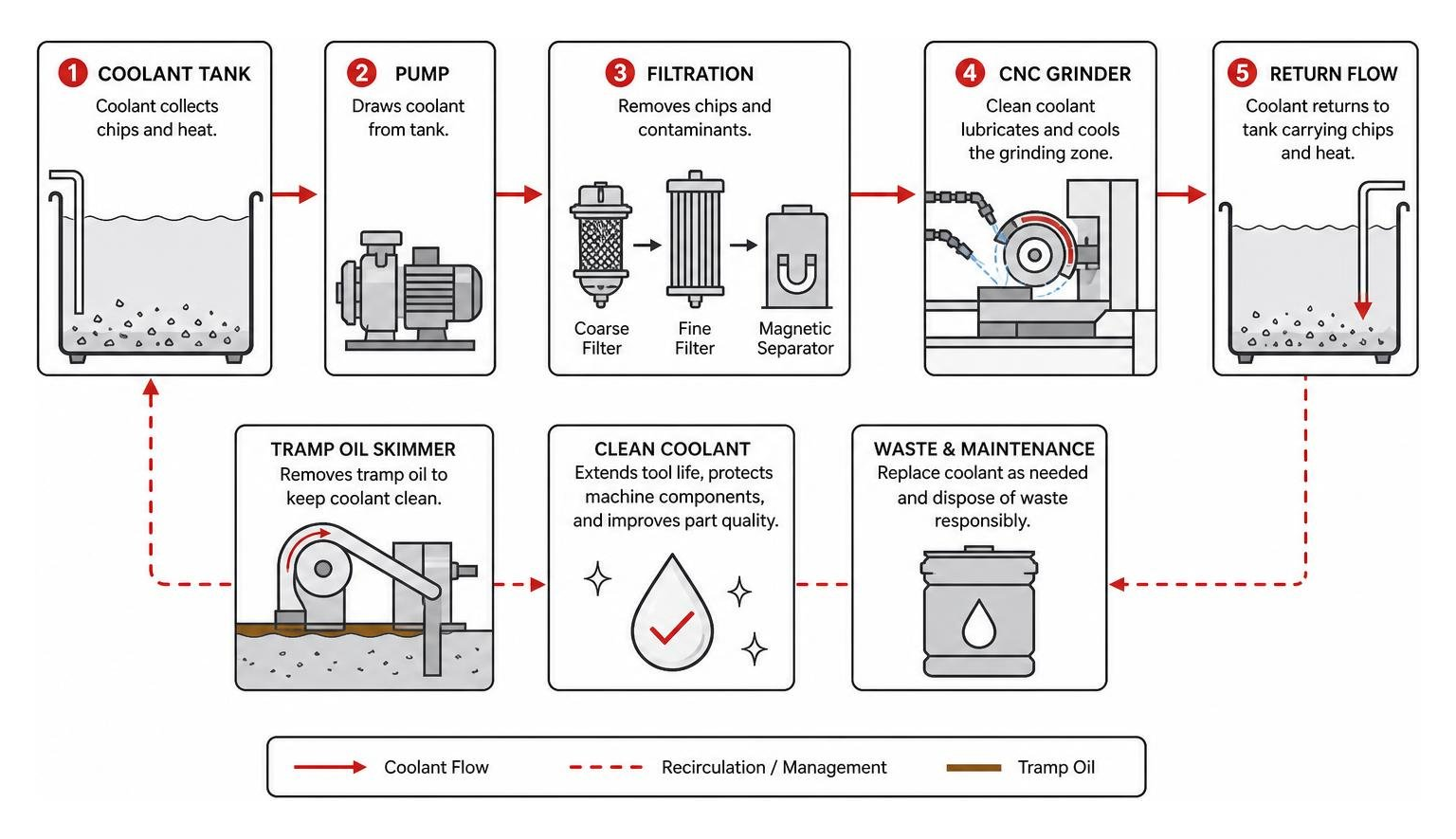
If the spindle is the heart of your CNC grinder, the fluids are its lifeblood. Proper management of coolant and way lubrication is the single most effective way to prevent premature mechanical wear.
Way lubrication requires a specialized oil, typically an ISO VG 68 viscosity oil with tackifiers and extreme pressure (EP) additives. The tackiness prevents the lubricant from being washed away by high-pressure coolant, ensuring a consistent fluid film between the slide and the guideway.
Tramp oil — hydraulic oil or way lube that leaks into the coolant reservoir — is a major enemy. It floats to the top of the coolant tank, sealing off oxygen and allowing anaerobic bacteria to thrive. This leads to foul odors, skin dermatoses, and acidic coolant that corrodes machine castings. Install a disc or belt-type tramp oil skimmer to keep the coolant clean.
Preventing Coolant-Related Spindle Bearing Damage
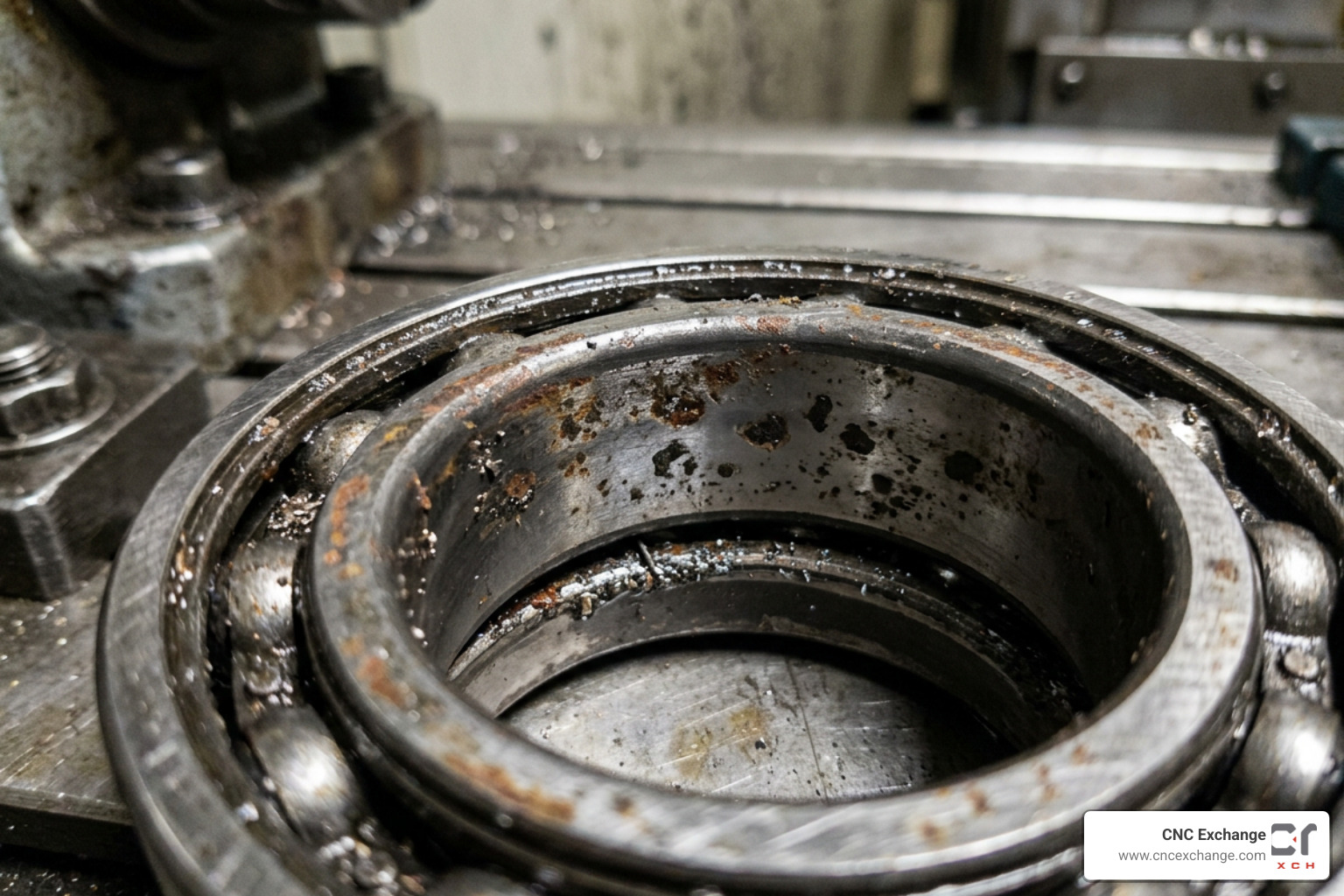
Spindle bearings are incredibly precise and run at high speeds, making them highly sensitive to contamination. Most modern grinding spindles use labyrinth seals or air-purge seals to keep fluids out. However, if an operator directs a high-pressure coolant nozzle directly at the spindle nose, the fluid can easily bypass these seals.
Once coolant enters the bearing housing, it washes away the synthetic grease, leading to metal-to-metal contact, rapid heat buildup, and catastrophic bearing failure.
To prevent this, use synthetic lubricants with high thermal stability and oxidation resistance. Ensure that coolant nozzles are positioned to target the grinding zone, not the spindle nose. For a deeper dive into industrial lubrication chemistry, refer to the Machinery Lubrication guide to machine tool lubrication.
Implementing a CNC Grinder Preventive Maintenance Program
A successful PM program is built on three pillars: operator training, consistent documentation, and a strategic spare parts inventory.
First, train your operators to take ownership of their machines. They are your first line of defense. By teaching them How to diagnose unusual machine sounds, they can flag a whining spindle or a groaning hydraulic pump before it fails completely.
Second, maintain a physical or digital maintenance log. Document every fluid change, belt replacement, and calibration check. This historical data is invaluable for troubleshooting recurring issues and significantly boosts the resale value of the machine when it comes time to upgrade.
Finally, keep a critical spare parts inventory on hand. Do not wait for a breakdown to order common wear items. Your stock cabinet should always contain:
- Replacement way wipers and bellows
- Drive belts for the spindle and workhead
- A set of system backup batteries
- Replacement hydraulic and air filters
- A spare grinding wheel dresser diamond
Frequently Asked Questions about CNC Grinder Maintenance
How often should CNC grinder polycarbonate safety windows be replaced?
Polycarbonate safety windows should be replaced every two years. Over time, continuous exposure to grinding coolants, oils, and cleaning solvents chemically degrades the polycarbonate, making it brittle. This loss of impact resistance is completely invisible to the naked eye, but it means the window may fail to contain a fragment if a grinding wheel explodes. For more safety guidelines, consult the Modern Machine Shop guide to grinding wheel safety.
Why is using compressed air to clean a CNC grinder discouraged?
Using compressed air to blow swarf off a grinder is one of the most common — and damaging — mistakes on the shop floor. The high-pressure air blast forces microscopic abrasive grinding grit past way wipers, telescoping steel covers, and spindle seals. Once inside, this grit mixes with grease to form an abrasive paste that rapidly wears down precision surfaces. Instead, use a low-pressure coolant wash-down hose or a soft brush to clean the machine bed.
What are the signs of failing spindle bearings on a grinder?
The three primary indicators of spindle bearing failure are:
- Unusual Noise: A high-pitched whine, grinding, or clicking sound that increases with spindle speed.
- Excessive Heat: The spindle housing runs hot to the touch (typically exceeding 140°F / 60°C) after a short warm-up cycle.
- Surface Finish Defects: The appearance of chatter marks, herringbone patterns, or poor surface finishes on your ground parts, indicating radial or axial runout.
Conclusion
A disciplined cnc grinder preventive maintenance program is not an operational expense — it is production insurance. By protecting your machines from abrasive grit, keeping your fluids clean, and performing regular calibrations, you ensure that your shop floor remains accurate, productive, and safe.
When the time comes to scale your operations or upgrade your machinery, having a documented history of proper maintenance ensures you receive top dollar for your equipment. At CNC Exchange, we make it easy to buy, sell, or auction pre-owned industrial machinery, helping you maximize your asset value.
Ready to take your production to the next level? Explore our inventory of universal cylindrical grinders today, or reach out to our team in Prospect Heights, Illinois, to discuss how we can help you upgrade your shop floor.