
What Are Large Horizontal Boring Mills — and Do You Need One?
Large horizontal boring mills are heavy-duty machine tools built to bore, mill, and drill massive workpieces that standard machining centers simply cannot handle. If you need a quick answer:
Who needs a large horizontal boring mill?
- Manufacturers machining parts that weigh tens of thousands of pounds
- Shops working in oil & gas, aerospace, energy, or heavy equipment sectors
- Operations requiring deep-hole boring, heavy roughing, or multi-face machining in a single setup
What makes them different from standard mills?
| Feature | Standard Machining Center | Large Horizontal Boring Mill |
|---|---|---|
| Workpiece weight | Up to a few thousand lbs | Up to 110,000+ lbs |
| Spindle orientation | Vertical or horizontal | Horizontal, with quill (W-axis) extension |
| Deep-hole reach | Limited | Purpose-built for deep boring |
| Multi-face machining | Requires repositioning | Built-in rotary table options |
| Structural rigidity | Moderate | Extreme — Meehanite castings, box ways |
When a part is too big, too heavy, or too complex for a conventional machine, a horizontal boring mill is what gets the job done. These machines are engineered for long-travel accuracy, high spindle torque, and the kind of structural stability that keeps tolerances tight across workpieces that can weigh more than 50,000 lbs.
That's not a niche use case. For manufacturers in heavy industry, it's an everyday reality.
I'm Jared Gray — I've spent over 12 years buying, selling, and brokering CNC equipment, and large horizontal boring mills are among the most consequential purchasing decisions I see manufacturing businesses make. In this guide, I'll walk you through everything you need to evaluate, select, and acquire the right machine for your operation.
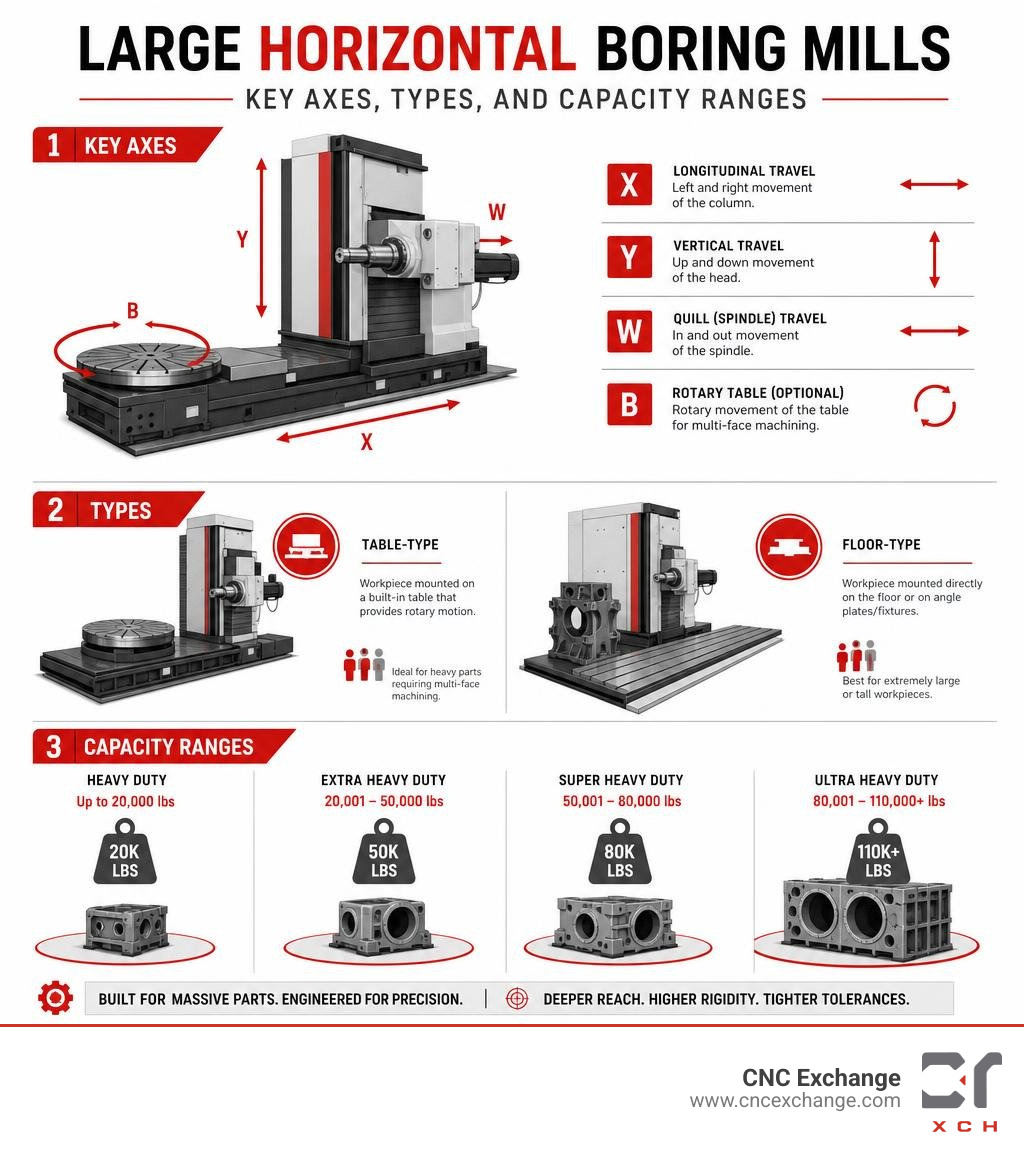
Table-Type vs. Floor-Type Large Horizontal Boring Mills
When you begin your search for large horizontal boring mills, the very first fork in the road is deciding between a table-type and a floor-type configuration. The difference isn't just about floor space; it completely dictates how the workpiece moves (or doesn't move) during the machining process.
Table-Type Boring Mills: The Workpiece Moves
In a table-type boring mill, the workpiece is clamped to a table that moves along the X-axis (crosswise) and Z-axis (longitudinally). The column remains stationary or moves on a single axis, while the spindle head moves vertically (Y-axis).
This design is highly versatile and ideal for block-like, heavy components such as large gearboxes, engine blocks, and machine frames. However, because the table must move the entire weight of the part, there is a physical limit to how heavy the workpiece can be before it compromises geometric accuracy.
Floor-Type Boring Mills: The Machine Moves
For parts that are simply too heavy or awkwardly shaped to slide back and forth on a table, you need a floor-type boring mill. Here, the workpiece is bolted directly to stationary floor plates (often custom-configured) or a massive, independent rotary table. The entire column travels along a runway (X-axis) to bring the spindle to the part.
Floor-type mills often utilize a V-axis rotary table to rotate massive workpieces in place, allowing multi-sided machining without moving the part's center of gravity across long travel distances.
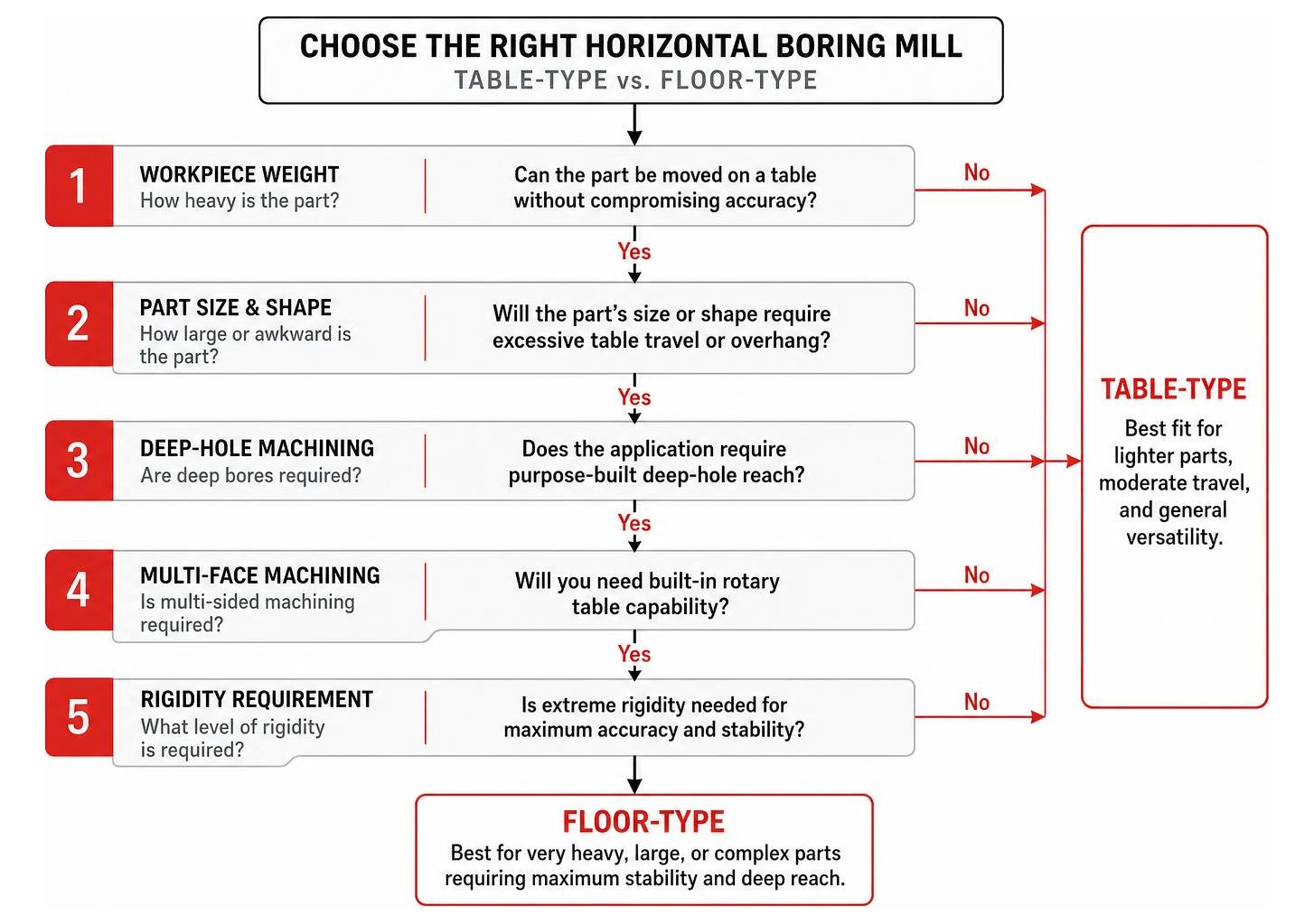
Here is a quick comparison to help you visualize the structural differences:
| Feature | Table-Type Boring Mills | Floor-Type Boring Mills |
|---|---|---|
| Primary Axis Movement | Table moves the workpiece (X and Z) | Column moves along a runway (X) |
| Typical Weight Limits | Up to 40,000–50,000 lbs | Virtually unlimited (200,000+ lbs) |
| Best Suited For | Blocky parts, gear housings, engine frames | Massive weldments, wind turbine hubs, structural steel |
| Footprint | Compact to moderate | Massive (requires dedicated foundation runways) |
Why Industries Rely on Large Horizontal Boring Mills
Walk into any facility manufacturing parts for the oil & gas, aerospace, energy, or heavy construction sectors, and you are almost guaranteed to find a large horizontal boring mill humming in the corner. Why? Because these industries deal with massive structural weldments, blowout preventers, turbine rotors, and mining shovel arms that reject standard vertical gantries.
For instance, in the oilfield sector, rotating a multi-ton forging on a conventional table isn't a viable option; the articulating head and deep-reach spindle must do the work. These industries rely on Precision boring mill solutions to handle tough-to-cut materials like titanium, Inconel, and heavy steel casting alloys while maintaining tight tolerances over long reaches.
Key Structural Features for Rigidity and Long-Term Accuracy
To maintain high-precision tolerances while taking heavy, interrupted cuts on a 40,000 kg workpiece, a machine tool needs world-class bone structure. When evaluating large horizontal boring mills, look closely at the following engineering elements:
Meehanite Castings
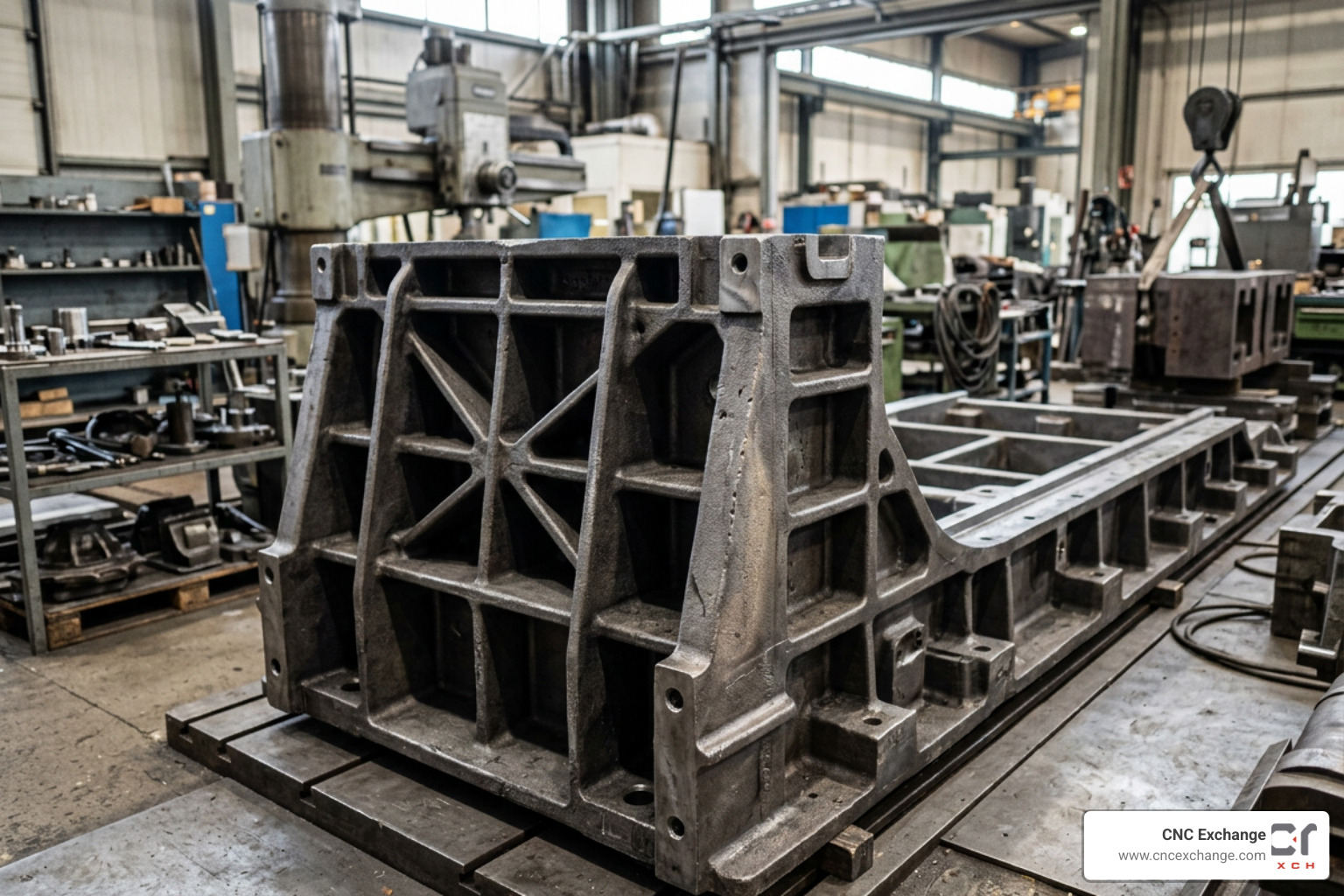
Welded steel fabrications might look clean, but nothing beats cast iron for vibration damping. Look for machines built on certified Meehanite® castings. Meehanite is a patented formulation of cast iron engineered for exceptional structural strength and thermal stability. It absorbs the massive harmonic vibrations generated by high-torque, low-RPM cutting, preventing tool chatter and ensuring superior surface finishes.
Box-Way Construction vs. Linear Guides
While modern linear roller guides are fantastic for high-speed, light-duty machining, heavy roughing and deep-hole boring require the dampening power of hand-scraped box ways. Box ways provide a massive surface contact area, distributing cutting forces evenly and resisting deflection.
Some next-generation hybrid machines use a clever combination: box ways on the vertical (Y) and quill (W) axes for maximum cutting rigidity, and preloaded roller guides on the travel axes to achieve rapid traverse rates of up to 41 m/min without sacrificing positioning accuracy.
Hydrostatic Tables
When supporting loads that weigh as much as several adult elephants, standard mechanical bearings can experience friction, wear, and stick-slip errors. High-end boring mills solve this by incorporating hydrostatic bearing systems on their rotary tables.
A thin film of highly pressurized oil completely supports the table, reducing friction to near-zero. This allows a B-axis table to index continuously (often down to 0.001 degrees) and rotate smoothly even when loaded with up to 110,000 lbs of steel. You can find excellent examples of this engineering in the JTEKT HB Series | JTEKT Machinery North America .
Linear Scale Feedback and Thermal Compensation
Because these machines feature long travel ranges, small thermal shifts in the shop floor can cause major positioning errors. High-precision linear glass scales (such as Heidenhain) bypass the ball screw entirely, reading the physical position of the axis directly. Coupled with active thermal compensation systems (which monitor temperature probes across the spindle and castings), these systems ensure repeatable accuracy of ±0.0003 inches per meter.
Typical Specifications of Large Horizontal Boring Mills
To give you an idea of the physical scale we are talking about, let’s look at some typical specifications you will encounter across popular series on the market today:
- X-Axis Travel: Typically ranges from 59 inches (1,500 mm) on compact table-type models up to 591 inches (15 meters) or more on customizable floor-type runways.
- Table Load Capacity: From 11,000 lbs on entry-level models to over 110,000 lbs on heavy hydrostatic rotary platforms.
- Spindle Speed Ranges: Heavy-duty gear-driven spindles typically top out between 1,000 and 3,000 RPM, while high-speed hybrid spindles can reach up to 5,000 RPM.
If you are browsing the used market, classic workhorses like the Toshiba BT 10B R3 Horizontal Boring Mills or the highly capable Union BFT 130 Horizontal Boring Mills offer a fantastic balance of heavy-duty casting mass, reliable spindle torque, and proven industrial longevity.
Spindle Dynamics and Performance in Heavy Roughing
The heart of any horizontal boring mill is its spindle. Unlike a standard machining center where the spindle nose is fixed, a true horizontal boring mill features a live spindle or quill (the W-axis) that physically extends outward from the headstock.
This W-axis travel allows the machine to reach deep inside complex castings and weldments to perform boring operations without requiring excessively long, unstable tooling.
Spindle Diameter and Quill Size
The diameter of the spindle quill (typically ranging from 110 mm to 155 mm or more) directly dictates the machine’s cutting rigidity. A larger ø130 mm quill can support longer extensions and heavier cutting forces than a ø110 mm quill. For deep-cavity boring, choosing a machine with a larger quill diameter and generous W-axis travel (often 500 mm to 700 mm) is critical to preventing tool deflection and maintaining roundness.
For shops looking to bridge the gap between high-speed milling and deep boring, a hybrid machine like the Niigata, Inc. | HN1000-S-BAR Hybrid HMC with Boring Function, Long Stroke combines the agility of a horizontal machining center with a programmable 130mm boring spindle.
High-Torque Spindle Configurations
When roughing out massive steel castings, speed takes a back seat to raw torque. This is why heavy-duty boring mills rely on gear-driven headstocks rather than direct-drive or belt-driven designs.
A multi-speed gearbox (typically 2 to 4 speeds) trades high-end RPM for massive low-end torque. For example, a 100 HP geared spindle can deliver up to 6,098 ft-lbs of torque at a crawling 87 RPM. This low-speed grunt is what allows the machine to drive large indexable boring bars and face mills through tough alloy steels without stalling.
If your production pipeline demands relentless roughing power, exploring heavy legacy platforms like the Giddings and Lewis 570 FAUR Horizontal Boring Mills or the robust Mitsubishi American Inc FAF 140/95 Horizontal Boring Mills will give your shop the structural mass and geared spindle torque needed to hog out material day in and day out.
Automation and Productivity Enhancements
Historically, operating a large horizontal boring mill was a slow, highly manual craft. Operators spent hours setting up parts, manually changing massive tools, and checking dimensions with hand calipers. Today, modern automation has turned these giants into highly efficient, high-throughput production centers.
Automatic Tool Changers (ATC) and Pallet Systems
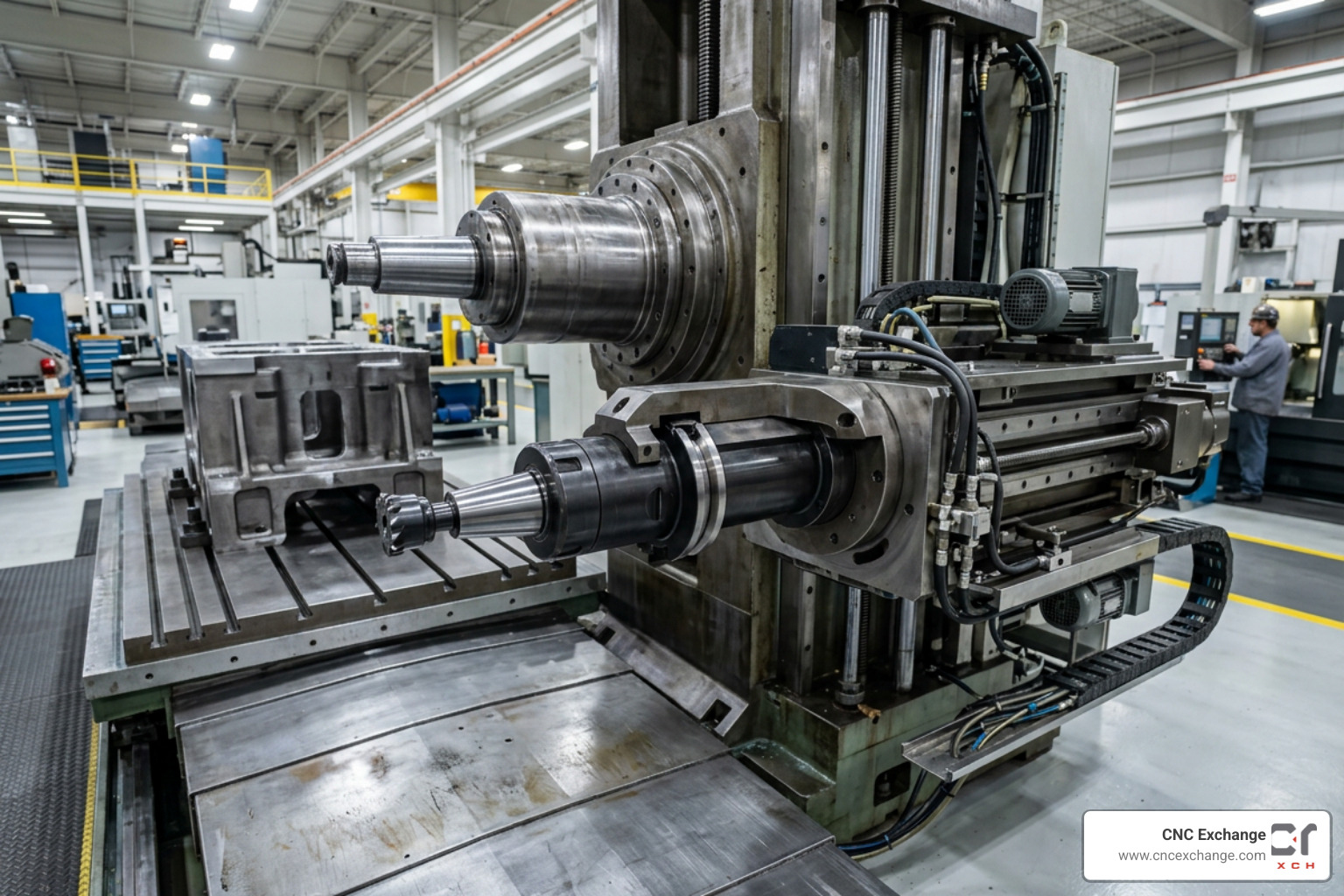
Modern boring mills can be configured with ATCs supporting 40, 60, or even 120+ tools, handling heavy CAT 50 or BT 50 tapers with ease. To maximize spindle uptime on smaller, repeatable parts, dual-pallet shuttle systems allow operators to set up one workpiece while the machine cuts another inside the enclosure. High-speed systems like the NHX 10000 - Horizontal Milling - DMG MORI excel at integrating these automated pallet setups for continuous, high-precision operations.
Automatic Attachment Changers (AAC)
For complex, multi-sided parts, manual repositioning is a recipe for setup errors. An Automatic Attachment Changer allows the machine to automatically swap out the standard spindle for right-angle heads, universal milling heads, or programmable facing heads. This consolidates multiple setups into a single, automated program.
CNC Control Options and Precision Feedback
A massive machine is only as good as the brain controlling it. The three dominant control platforms in this space are:
- Fanuc: Renowned for its bulletproof reliability, ease of sourcing spare parts, and widespread operator familiarity.
- Siemens: Highly favored for complex, multi-axis machining and custom cycles.
- Heidenhain: Exceptional for shops programming complex geometries directly at the machine, offering incredibly powerful conversational programming.
These controls work in tandem with high-resolution feedback systems to monitor thermal growth and adjust coordinates in real-time, ensuring that a 30-ton machine can repeat its positioning down to a fraction of a human hair. High-end boring mills like the PBT Series - Horizontal Boring - DMG MORI combine these advanced CNC controls with manual alignment craftsmanship to deliver unmatched, long-term precision.
Buying Considerations: New vs. Used and Remanufactured Options
Acquiring a large horizontal boring mill is a major capital investment. A brand-new, built-to-order machine can easily cost between $400,000 and $1,000,000+, with lead times ranging from 6 to 12 months (plus ocean shipping and customs).
For many shops, the used or remanufactured market represents a highly attractive alternative. Because these machines are built on incredibly heavy, durable cast-iron frames, a well-maintained 15-to-20-year-old machine can perform just as accurately as a brand-new one—often at 30% to 50% of the cost, and with immediate availability.
If you are looking for a highly customizable, heavy-duty floor-type mill, platforms like the Johnford FBMC Series - Floor-Type Horizontal Boring Mills illustrate how modern heavy-duty engineering can be custom-tailored to a shop's exact travel and weight requirements.
Logistics, Rigging, and Foundation Preparation
Before you sign on the dotted line for any boring mill, you must factor in the "hidden" costs of installation:
- The Foundation: You cannot simply park a 70,000 lbs machine on a standard 6-inch shop floor. Large boring mills require a dedicated concrete foundation pit—often 3 to 5 feet deep, reinforced with rebar, and isolated from the rest of the shop floor to prevent building vibrations from affecting machining accuracy.
- Rigging and Freight: Moving a machine of this scale requires specialized heavy-haul transport and professional rigging crews with heavy-duty gantry cranes. This logistics phase can easily add tens of thousands of dollars to your project budget.
- Power Requirements: Ensure your facility has the electrical service (often 50 to 100+ KVA) to handle these massive spindle motors and hydraulic systems.
Inspecting Used Boring Mills
If you decide to explore the used market, a physical or video inspection is critical. Here is a quick checklist of what to look for:
- Way Wear: Inspect the box ways for scoring or uneven wear, especially near the center of travel where the machine spends most of its life.
- Spindle and Quill Play: Check the spindle taper for damage and run a test indicator on the quill to check for axial or radial play.
- Backlash: Test the ball screws on the X, Y, and Z axes to measure backlash.
- Retrofitting Potential: Don't walk away from an older manual or early CNC machine just because the electronics look dated. Legacy cast-iron frames are prime candidates for retrofitting with modern digital readouts (DROs) or brand-new CNC controls, giving you modern precision on a classic, heavy-duty frame.
Shops looking for reliable used options often turn to classic models like the Giddings and Lewis G60 TX Horizontal Boring Mills or the highly versatile Union BFT 105 Horizontal Boring Mills, both of which are celebrated for their rebuild-friendly architectures and long-term structural integrity.
Frequently Asked Questions about Industrial Boring Mills
What is the difference between a horizontal boring mill and a vertical boring mill?
The primary distinction lies in what rotates. In a horizontal boring mill (HBM), the workpiece remains stationary (or indexes on a table) while the cutting tool rotates on a horizontal spindle. In a vertical boring mill (VBM)—often called a vertical turret lathe—the massive circular table rotates the workpiece at speed, while the cutting tools remain stationary or feed into the part vertically. HBMs are preferred for prismatic, long, or deeply pocketed parts, while VBMs are the go-to for large, symmetrical, round components like rings and discs.
Why is box-way construction preferred over linear guides for heavy boring?
Box ways feature a flat, wide metal-to-metal contact surface lubricated by a thin film of oil. This massive contact area provides superior vibration damping and structural rigidity, which is essential for preventing chatter during heavy, interrupted cuts in tough materials. Linear guides use ball or roller bearings on a rail; while they are faster and have lower friction, they have a much smaller contact footprint, making them more susceptible to vibration and deflection under extreme cutting loads.
What are the typical foundation requirements for installing a large boring mill?
Because of their immense weight (often 30,000 to 90,000+ lbs) and long travel ranges, these machines require a specially engineered concrete foundation. This typically involves excavating a pit 3 to 6 feet deep, pouring high-strength reinforced concrete, and utilizing specialized vibration-isolation joints. This prevents the machine from flexing under its own weight or the weight of a massive workpiece, and isolates it from external shop vibrations (like nearby press brakes or forklifts) that could ruin a fine finish.
Conclusion
Whether you are machining massive structural weldments for the energy sector or boring out heavy industrial gearboxes, a large horizontal boring mill is the ultimate tool for heavy-duty machining at scale. By understanding the structural differences between table-type and floor-type configurations, prioritizing rigid features like Meehanite castings and box ways, and carefully planning your installation logistics, you can secure a machine that will serve your shop reliably for decades.
At CNC Exchange, we make the process of upgrading your shop's capacity simple and straightforward. Our online marketplace is designed to help you buy, sell, or auction high-quality industrial machinery, ensuring you get fair market value and expert guidance every step of the way.
Ready to expand your boring and milling capabilities? Talk to Our Machine Tool Experts Today to discuss your part requirements, or explore our current inventory of Misc 722 Horizontal Boring Mills to find the perfect heavy-duty workhorse for your shop floor. You can also visit us in person at CNC Exchange, 75 E Palatine Rd, Prospect Heights, IL 60070, US.