
Why Shops Are Investing in New Horizontal Boring Mills Right Now
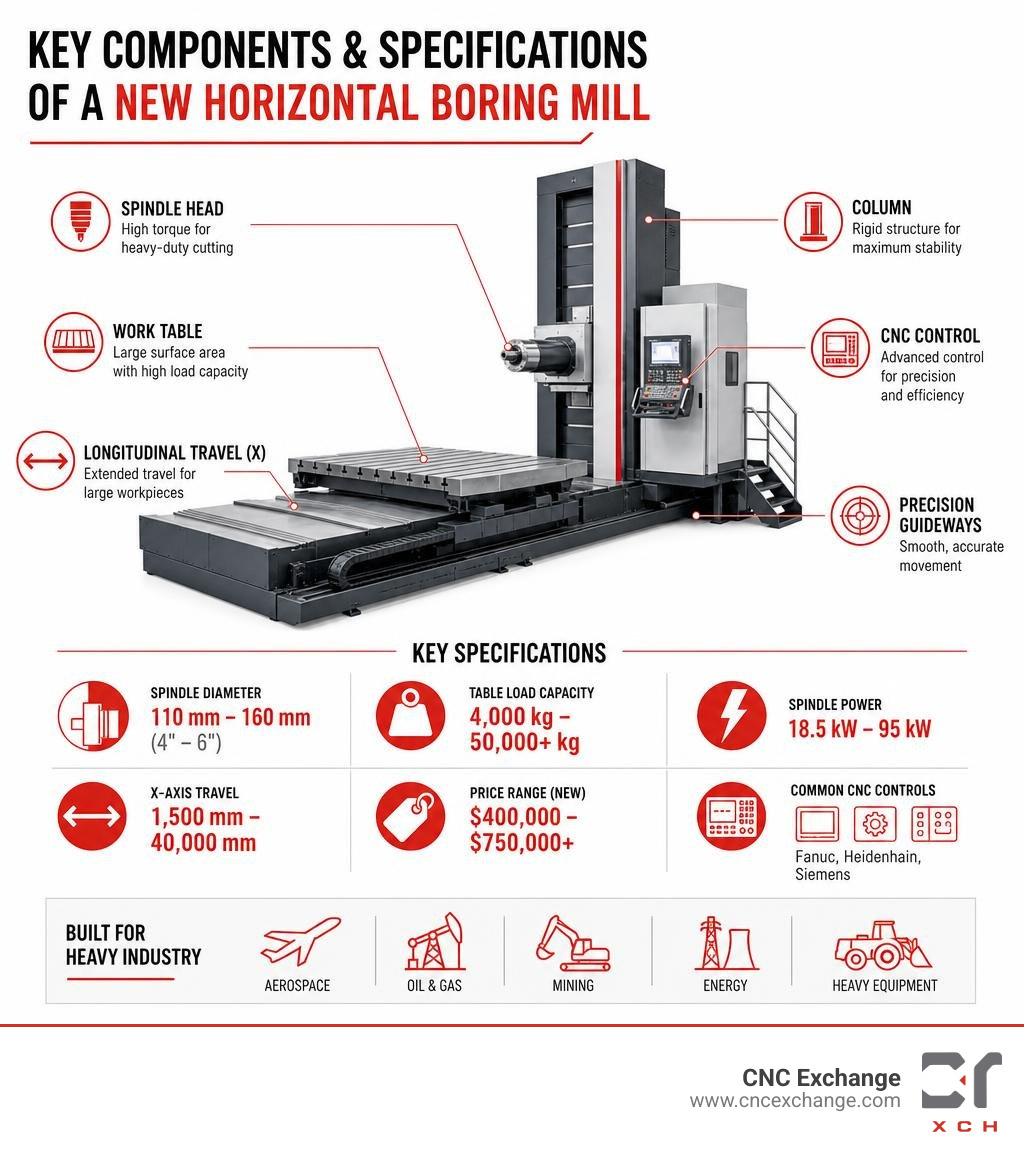
New horizontal boring mills are large, high-precision CNC machines designed to bore, mill, and drill massive workpieces that simply can't be handled by standard machining centers. If you're evaluating one for your shop, here's a fast-reference overview:
What to know at a glance:
| Feature | Typical Range |
|---|---|
| Spindle diameter | 110 mm – 160 mm (4" – 6") |
| Table load capacity | 4,000 kg – 50,000+ kg |
| Spindle power | 18.5 kW – 95 kW |
| X-axis travel | 1,500 mm – 40,000 mm |
| Price range (new) | $400,000 – $750,000+ |
| Common CNC controls | Fanuc, Heidenhain, Siemens |
These machines are the backbone of heavy manufacturing — used in aerospace, oil and gas, mining, energy, and heavy equipment production. They excel where other machine tools simply run out of capacity.
The decision to invest in a new machine versus a rebuilt or retrofitted one isn't simple. Older iron from brands like Giddings & Lewis has a well-earned reputation for outlasting the shop around it — some facilities rebuilt and retrofitted their machines every 10 to 15 years rather than replacing them. But newer machines bring real advantages: hydrostatic guideways, Industry 4.0 connectivity, automatic tool changers, and dramatically better thermal stability.
This guide breaks down the configurations, technologies, brands, and price points you need to evaluate before you commit.
I'm Jared Gray, and over my 12+ years of buying, selling, and brokering CNC equipment, I've handled everything from legacy workhorses to the latest new horizontal boring mills entering the North American market. That hands-on experience — across our 30,000-square-foot showroom and dozens of plant liquidations — shapes every recommendation in this guide.
Key Configurations of New Horizontal Boring Mills
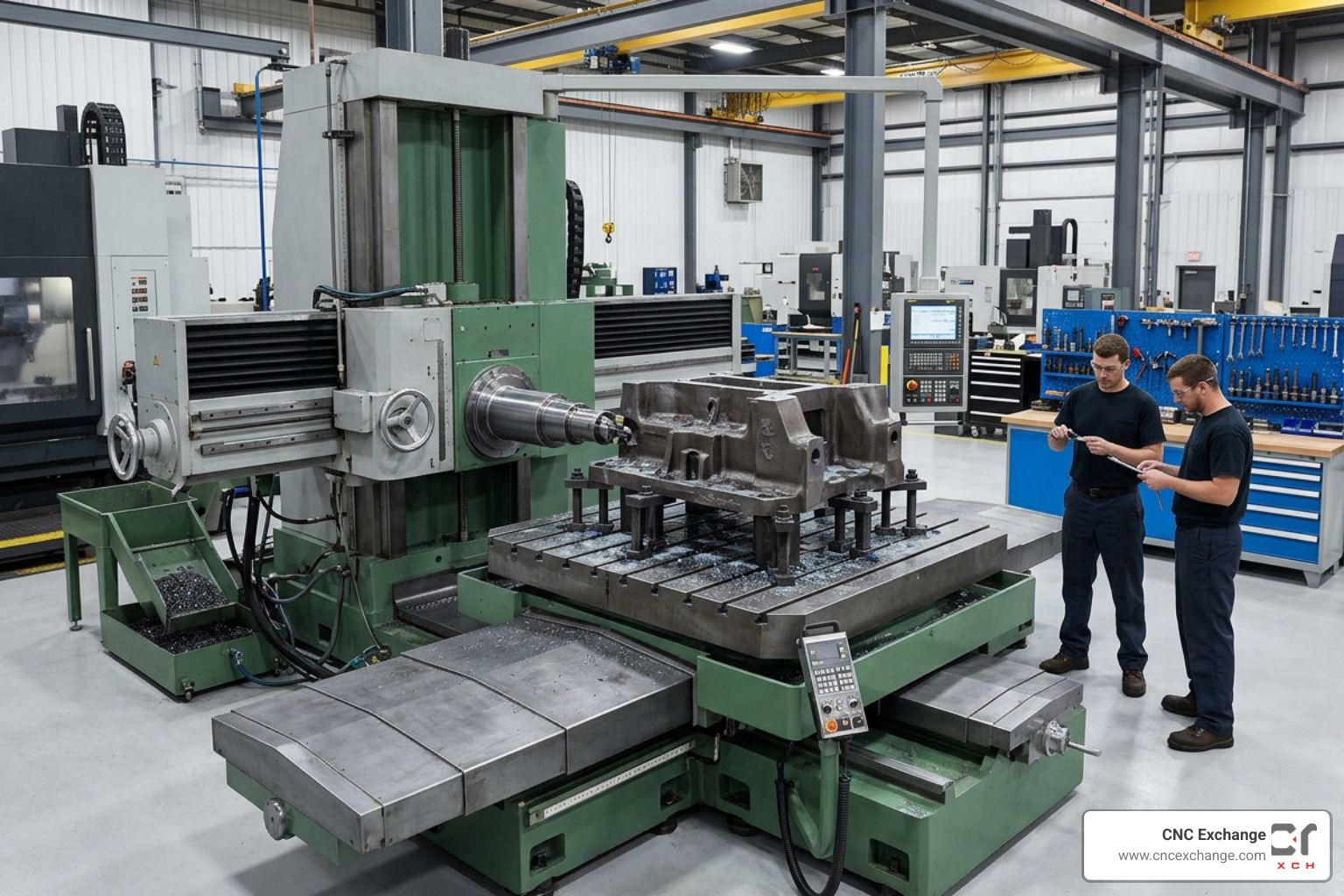
When selecting a horizontal boring mill (HBM), the first decision is choosing the physical architecture. The way the machine supports and moves the workpiece relative to the spindle dictates the size, weight, and geometry of the parts you can run.
Table-Type vs. Floor-Type Designs
The primary distinction lies in how the machine handles the weight of the workpiece.
- Table-Type Boring Mills: In these machines, the workpiece is mounted on a table that moves in two axes (typically X and Z). The column remains fixed or moves longitudinally. These are highly versatile "all-in-one" platforms. However, because the table must physically move the part, there is a hard limit on workpiece weight. Modern table-type platforms, like the Nomura B-85BT-2 Horizontal Boring Mills or the Toshiba BTD-200 QE Horizontal Boring Mills, excel at handling block-like components up to certain limits, while heavy-duty options can handle workpieces exceeding 50,000 lbs.
- Floor-Type Boring Mills: Floor-type mills do away with the moving table. Instead, the workpiece is clamped directly to stationary floor plates (or a separate, independent rotary table), and the entire column travels along a runway (X-axis). Because the workpiece never moves, the weight capacity is virtually unlimited. If you are machining an 80-ton engine block or a massive structural casting, a floor-type mill is your only viable path.
- Planer-Type Boring Mills: This configuration features a table that moves only longitudinally between two columns, while the column moves transversely. It offers a middle ground of high rigidity for long, narrow workpieces.
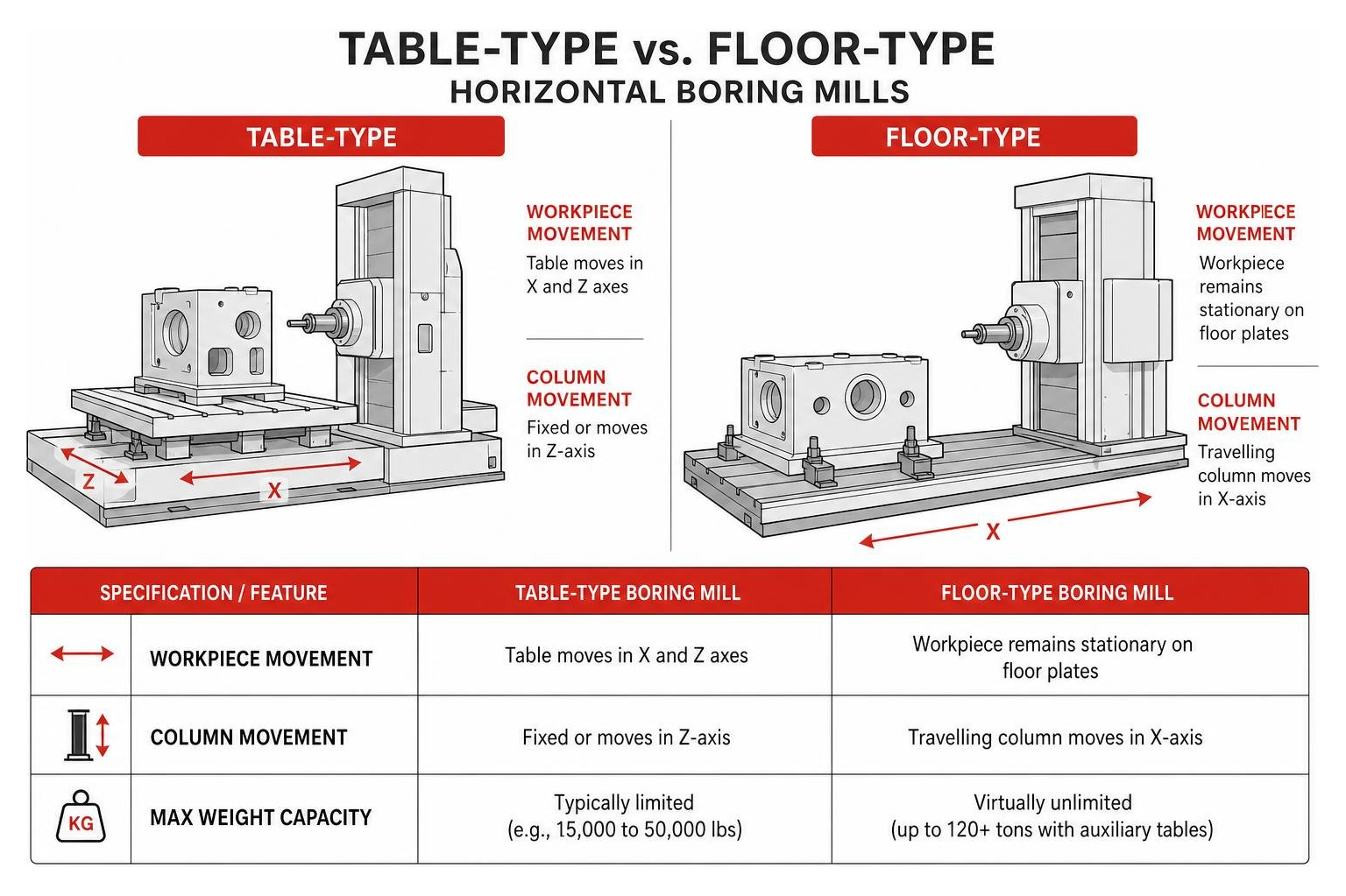
| Specification / Feature | Table-Type Boring Mill | Floor-Type Boring Mill |
|---|---|---|
| Workpiece Movement | Table moves in X and Z axes | Workpiece remains stationary on floor plates |
| Column Movement | Fixed or moves in Z-axis | Travelling column moves in X-axis |
| Max Weight Capacity | Typically limited (e.g., 15,000 to 50,000 lbs) | Virtually unlimited (up to 120+ tons with auxiliary tables) |
| Best Suited For | Prismatic, block-like, medium-to-heavy parts | Oversized castings, structural weldments, massive parts |
| Footprint Requirements | Self-contained, compact to medium | Large, requires extensive floor space and deep foundation |
Choosing the Right Configuration for Your Shop
To pick the correct style, look closely at your current and target contracts:
- Aerospace Fixtures & Tooling Blocks: These require high repeatable accuracy. A table-type machine with a built-in high-precision rotary table (often offering 0.001-degree resolution) is ideal.
- Structural Weldments & Heavy Infrastructure: Large, awkward fabrications that are difficult to fixture are best suited for a floor-type mill where they can be set up once on floor plates.
- Oilfield Components: Deep-cavity drilling on heavy valves and blow-out preventers requires a rigid spindle and excellent torque. A heavy-duty table-type mill with box-way construction provides the damping needed for these aggressive cuts.
Advanced Technologies in New Horizontal Boring Mills
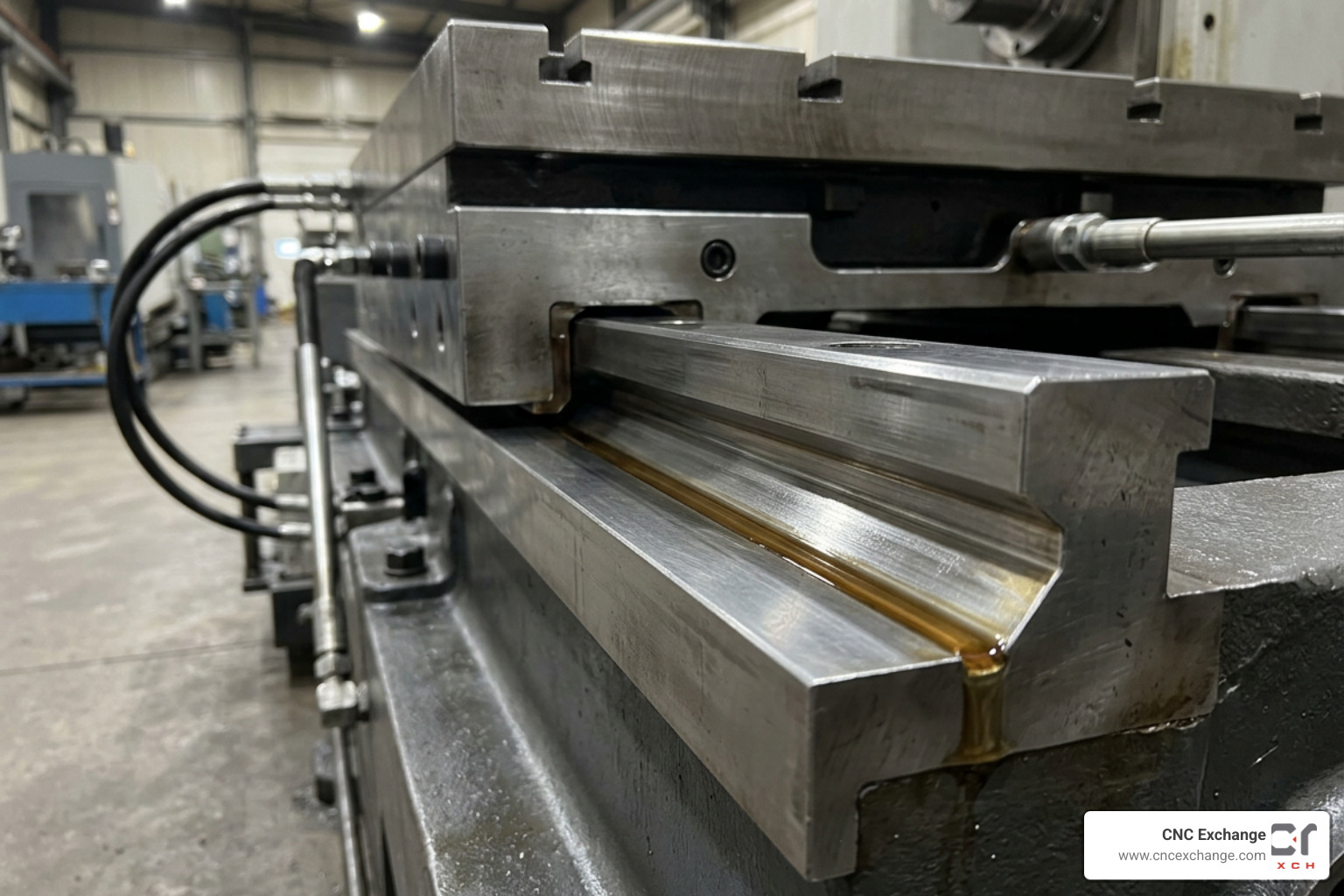
Modern HBMs are not just bigger versions of the manual machines from decades past. They incorporate advanced materials, fluid dynamics, and digital controls that completely change the productivity equation.
Hydrostatic Guideways vs. Box Ways and Linear Guides
The choice of guideway system is one of the most critical decisions affecting the machine's longevity, rigidity, and damping capabilities.
- Hydrostatic Guideways: Systems like the LAZZATI High Performance Boring Mills Linea Floor-Type Ram Milling HB 2M Evo4.0 for high precision machining | LAZZATI – The Hydrostatic Boring Mill float the machine's massive components on a thin, pressurized film of oil. Because there is zero metal-on-metal contact, mechanical wear is virtually eliminated, ensuring lifetime precision. They provide unmatched vibration damping, which is crucial when boring deep holes with long spindle extensions (W-axis).
- Box Ways: Traditional hardened-and-ground steel box ways, often hand-scraped, offer excellent rigidity and surface area contact. They are the classic choice for heavy, high-torque roughing. However, they introduce higher friction and require meticulous lubrication to prevent stick-slip.
- Linear Guides: Modern preloaded roller guide ways (as opposed to ball-type linear ways) have become highly popular. For example, Giddings & Lewis utilizes preloaded roller guides that offer double the load capacity and up to 10 times the service life of standard ball-type guides. They provide fast traverse rates (up to 25 m/min), low friction, and minimal thermal growth, making them excellent for high-speed, high-precision contouring.
Automation and Smart Features in New Horizontal Boring Mills
Investing in a new horizontal boring mill also means opening the door to advanced automation that minimizes spindle downtime:
- Automatic Tool Changers (ATC) & Pallet Changers: Modern systems feature tool magazines holding from 40 up to 240 tools, alongside dual pallet shuttles. This allows operators to load and fixture a massive part on one pallet while the machine is actively cutting on the other.
- In-Process Probing & Compensation: Probing systems allow the machine to measure the part mid-cycle, automatically compensating for tool wear or thermal expansion. On massive floor-type machines with long rams, active systems like Lazzati’s Dynamic Compensation System (DCS) hydraulically and mechanically compensate for ram deflection in real-time.
- Multitasking Mill-Turn Capabilities: Some high-end horizontal platforms, such as the Mitsui Seiki Unveils HU63A-5XT Five-Axis Mill-Turn Center for High-Precision Aerospace Manufacturing - MTDCNC - The home of CNC milling. turning, 5 axis and precision machining , integrate simultaneous five-axis milling, turning, and boring on a single platform. By completing highly complex aerospace or energy components in a single setup, you eliminate the cumulative alignment and clamping errors that occur when transferring heavy parts between different machines.
Evaluating Critical Specifications and Top Manufacturers
When you begin shopping for a new machine, the specification sheets can be overwhelming. Let's break down the numbers that actually matter to your shop floor.
Key Technical Specifications to Analyze
- Spindle Diameter & Taper: Standard HBM spindles range from 110 mm (approx. 4") to 160 mm (approx. 6"). Heavy-duty work demands a CAT50, BT50, or ISO 50 Big Plus taper. Spindle diameter directly correlates to torsional rigidity; a larger spindle can handle larger boring bars with less deflection.
- Spindle Torque & Power: Do not just look at horsepower. For heavy roughing and deep-hole boring in tough alloys like titanium or stainless steel, torque is king. Look for gear-driven spindles that deliver high torque at low RPMs (e.g., up to 4,250 Nm on premium models).
- Axis Travels (X, Y, Z, and W):
- X-axis: Longitudinal travel of the table or column.
- Y-axis: Vertical travel of the spindle headstock.
- Z-axis: Longitudinal travel of the column or table.
- W-axis: The extension of the boring spindle itself. A long W-axis (typically 500 mm to 1,100 mm) is vital for reaching deep inside cavities.
- Table Load Capacity: Ensure the table can support your heaviest parts plus the weight of any rotary tables or custom fixturing.
Leading Brands of New Horizontal Boring Mills
Several global manufacturers are widely recognized for their engineering excellence in the boring mill category:
- Kuraki: A Japanese builder specializing exclusively in horizontal boring mills. Known for incredible precision and reliability, machines like the Kuraki KBT-1003W Horizontal Boring Mills or the Kuraki KBT-11W A Horizontal Boring Mills are highly regarded on the shop floor. In North America, Kuraki is represented by major networks, ensuring solid support (see the announcement regarding DMG MORI USA to Represent Kuraki America Horizontal ... ).
- Nomura: Another premier Japanese brand, famous for its hand-scraped wide slideways, massive ball screws, and rugged, gear-driven spindles. Stories of Nomura machines running for over 20 years before requiring their first service call are common among machinists. Models like the HBA-110T R3 (4") and HBA-135P R5 (5") are distributed in North America by SB Machine Tools (learn more from SB Machine Tools introduces Nomura Horizontal Boring Mills - Shop Metalworking Technology ).
- Giddings & Lewis (Fives Group): An iconic American brand built on massive castings and highly customizable configurations. From their RT and PT series (handling up to 40,000 kg) to their automated MC series, they are built for extreme rigidity. Legacy models like the Giddings and Lewis 70a DP5 T Horizontal Boring Mills or Giddings and Lewis PC40 Horizontal Boring Mills are legendary, while their modern T-bed designs allow for flat floor installation to save on foundation preparation.
- Lazzati: An Italian manufacturer at the cutting edge of hydrostatic technology. Their HB 130T and HB 150MM Evo 4.0 series combine heavy-duty hydrostatic guides with modern Industry 4.0/5.0 touch-screen interfaces, making them highly productive, low-maintenance powerhouses.
- Fermat & PAMA: European builders known for exceptionally heavy castings and high-performance headstock designs, offering highly competitive solutions for large-scale machining.
Buying Guide: Cost, Support, and Common Pitfalls
Understanding the Price Range of New Horizontal Boring Mills
A new CNC horizontal boring mill is a major capital investment. The total cost of ownership is influenced by several distinct tiers:
- Base Pricing: A standard 4-inch table-type CNC mill typically starts around $400,000 to $500,000.
- Fully Loaded Configurations: Adding high-capacity automatic tool changers, hydrostatic rotary tables, high-pressure coolant systems (e.g., 50 Bar), and advanced probing packages can easily push the price to $600,000 to $750,000+.
- Used & Rebuilt Alternatives: For shops looking to balance capability with capital preservation, the secondary market is incredibly strong. A high-quality used or rebuilt mill can often be acquired for a fraction of the cost of new. However, be aware that high-demand, late-model used machines (such as a 2023 Lazzati or Kuraki) can sometimes command a premium because they bypass the long factory lead times associated with new builds.
Common Mistakes to Avoid When Purchasing
- Underestimating Foundation Costs: You cannot simply drop a 35,000-lb boring mill onto a standard 6-inch shop floor. These machines require engineered, deep concrete foundations to maintain their geometric accuracy. Overlooking this can add tens of thousands of dollars in unexpected installation costs. (Note: Some models, like the Giddings & Lewis T-bed series, are specifically engineered for flat floor installation to mitigate this issue).
- Ignoring the Physical Footprint: HBMs require a massive operational envelope. A machine like a Wotan B-105M Horizontal Boring Mills has physical dimensions of roughly 17 feet in length and nearly 11 feet in height — and that's before accounting for full axis travels.
- Overlooking Counterbalance Systems: Heavy vertical headstocks rely on counterbalance weights or hydraulic cylinders. Failing to inspect and maintain these components (such as chains or hydraulic seals) can result in catastrophic failures if a headstock drops, potentially cracking the machine bed beyond repair.
- Prioritizing Brand Over Local Support: A machine is only as good as the technician who can service it. Before you buy, ensure there is a reputable local dealer or service network in your region with readily available spare parts.
Frequently Asked Questions About Horizontal Boring Mills
What is the difference between a horizontal boring mill and a vertical boring mill?
The fundamental difference lies in what rotates and what remains stationary:
- Horizontal Boring Mill: The workpiece remains stationary (clamped to a table or floor plate) while the cutting tool rotates on a horizontal spindle. This design is highly versatile, allowing you to reach deep into small cavities and machine exceptionally long or oddly shaped parts.
- Vertical Boring Mill (VBM/VTL): The workpiece is clamped to a rotating circular table (chuck) while the cutting tool remains stationary or feeds into the part. VBMs are ideal for large, heavy, round components (like turbine rings or massive gears) because gravity helps seat the heavy part naturally on the table.
Why is local dealer support so critical for new horizontal boring mills?
Because of the sheer size and complexity of these machines, any unscheduled downtime can cost thousands of dollars per hour. Having a local dealer means faster access to factory-trained technicians, rapid deployment of critical spare parts, and reliable preventative maintenance. If you purchase a brand with no local support footprint in North America, you may find yourself waiting weeks for international technicians or custom-shipped parts.
How do European, Japanese, and American boring mills compare?
- Japanese Mills (e.g., Kuraki, Nomura): Renowned for meticulous build quality, hand-scraped ways, and exceptional long-term reliability. They hold tight tolerances for decades and are favored by high-precision job shops.
- European Mills (e.g., Lazzati, Fermat, PAMA): Often lead the industry in integrating advanced fluid dynamics (hydrostatics) and modern software interfaces. They are highly productive and versatile.
- American Mills (e.g., Giddings & Lewis): Historically known for massive, rugged cast-iron structures, high customization, and incredible longevity. They are built to handle the heaviest roughing cuts in heavy industrial environments.
Conclusion
Investing in a new horizontal boring mill is a transformative step for any heavy machining facility. Whether you choose a highly dynamic table-type mill with hydrostatic guideways or a massive floor-type traveling column machine, the key is matching the machine's physical architecture and local support network to your shop's specific workflow.
If you are looking to upgrade your shop's capabilities, we can help. At CNC Exchange, located in Prospect Heights, Illinois, we provide a simple, transparent marketplace to buy, sell, or auction industrial machinery. We can help you achieve fair market value for your trade-in equipment or find the perfect fit for your next project.
Ready to take the next step? Talk to Our Machine Tool Experts Today to discuss your part requirements, or Explore our inventory of horizontal boring mills to see what we currently have in stock.