
What Is a Horizontal Boring Mill Machine — and Do You Actually Need One?
A horizontal boring mill machine is a heavy-duty industrial machine tool designed to enlarge and finish pre-drilled or cast holes with extreme precision — holding tolerances down to the micrometer level.
Here's a quick-reference overview:
| Feature | Details |
|---|---|
| Primary function | Enlarging and finishing existing holes with high precision |
| Spindle orientation | Horizontal |
| Key axes | X, Y, Z, and W (spindle quill travel) |
| Typical workpieces | Engine blocks, gear housings, turbine components, structural frames |
| Common spindle sizes | 2.5" to 5" (or 110 mm to 130 mm) |
| Table load capacity | From ~10,000 lbs up to 44,000+ lbs |
| Industries served | Aerospace, energy, automotive, defense, heavy equipment |
Think about the biggest, heaviest parts your shop machines. Now imagine trying to bore a deep, precise hole through the side of a 10,000 lb casting using a standard vertical mill.
It doesn't work.
That's exactly the problem horizontal boring mills were built to solve. They give you the structural rigidity, spindle reach, and axis travel to handle workpieces that would be impossible on conventional equipment — all while holding tolerances that rival the finest precision machining centers.
The technology is older than most people realize. The first boring machine was invented by John Wilkinson back in 1775 — predating the United States itself — and modern versions have evolved into sophisticated CNC powerhouses used across aerospace, energy, and defense manufacturing.
I'm Jared Gray, and over my 12+ years of buying, selling, and brokering CNC equipment here at CNC Exchange, I've seen how the right horizontal boring mill machine can be the difference between a shop that wins large contracts and one that has to turn them away. In this guide, I'll walk you through everything you need to know to understand, evaluate, and choose the right machine for your operation.
What is a Horizontal Boring Mill Machine and How Does It Work?
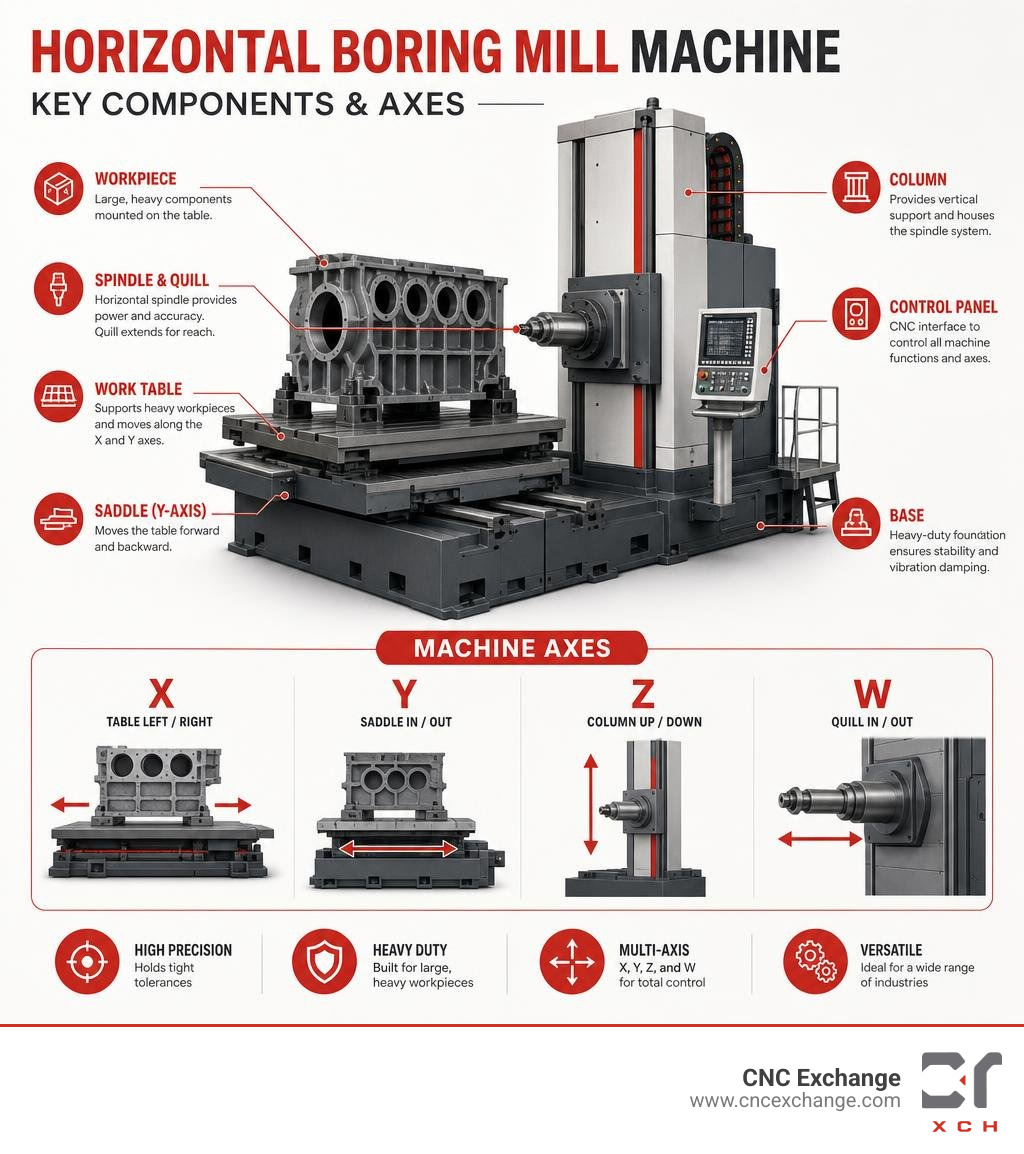
To understand why this machine is such a game-changer, we have to look at what it actually does. At its core, a horizontal boring mill machine (often abbreviated as HBM) is designed to enlarge, align, and finish holes that have already been drilled or cast.
The history of this machine is deeply tied to the Industrial Revolution. John Wilkinson's 1775 invention of the boring machine was actually what made James Watt's steam engine viable, as it was the only machine capable of boring cylinders with the required accuracy. The word "boring" itself has a surprisingly elegant lineage, deriving from the Old French alaisier, meaning "to widen," which traces back to the Latin latus, meaning "wide." So, despite the name, these machines are anything but uninteresting!
Unlike standard drilling, which creates a new hole from solid material, boring is all about refining an existing cavity. It is a specialized process focused on establishing absolute coaxiality (ensuring multiple holes share the exact same geometric axis) and concentricity, even when working deep inside massive metal structures. For shops looking to take on high-precision contracts, having reliable Precision boring mill solutions is essential to achieving these micrometer-level tolerances.
The Mechanics of a Horizontal Boring Mill Machine
So, how does it physically operate? The system relies on a clear division of labor between cutting motion and feed motion:
- The Cutting Motion: The machine's primary spindle rotates the cutting tool (often mounted on a boring bar) at a controlled speed.
- The Feed Motion: The workpiece or the spindle column moves linearly along designated axes to feed the tool into the material.
What truly sets a horizontal boring mill apart from standard mills is the inclusion of a spindle quill, which introduces the W-axis. While the Z-axis typically controls the longitudinal travel of the column or the table, the W-axis represents the physical extension and retraction of the boring spindle bar itself. This allows the spindle to reach deep inside complex, hollow workpieces with minimal tool deflection.
To maintain extreme accuracy under the massive forces of heavy-duty cutting, high-end boring mills often utilize hydrostatic guides. These systems float the machine's heavy moving components on a thin, pressurized film of oil, virtually eliminating mechanical friction and stick-slip wear. If you want to see a classic example of robust mechanical design paired with reliable control, machines like the Wotan B-105MNC Horizontal Boring Mills demonstrate how these physical principles are put to work on the shop floor.
Boring vs. Milling: Key Differences
While many modern HBMs can perform both boring and milling operations, the two processes serve fundamentally different purposes.
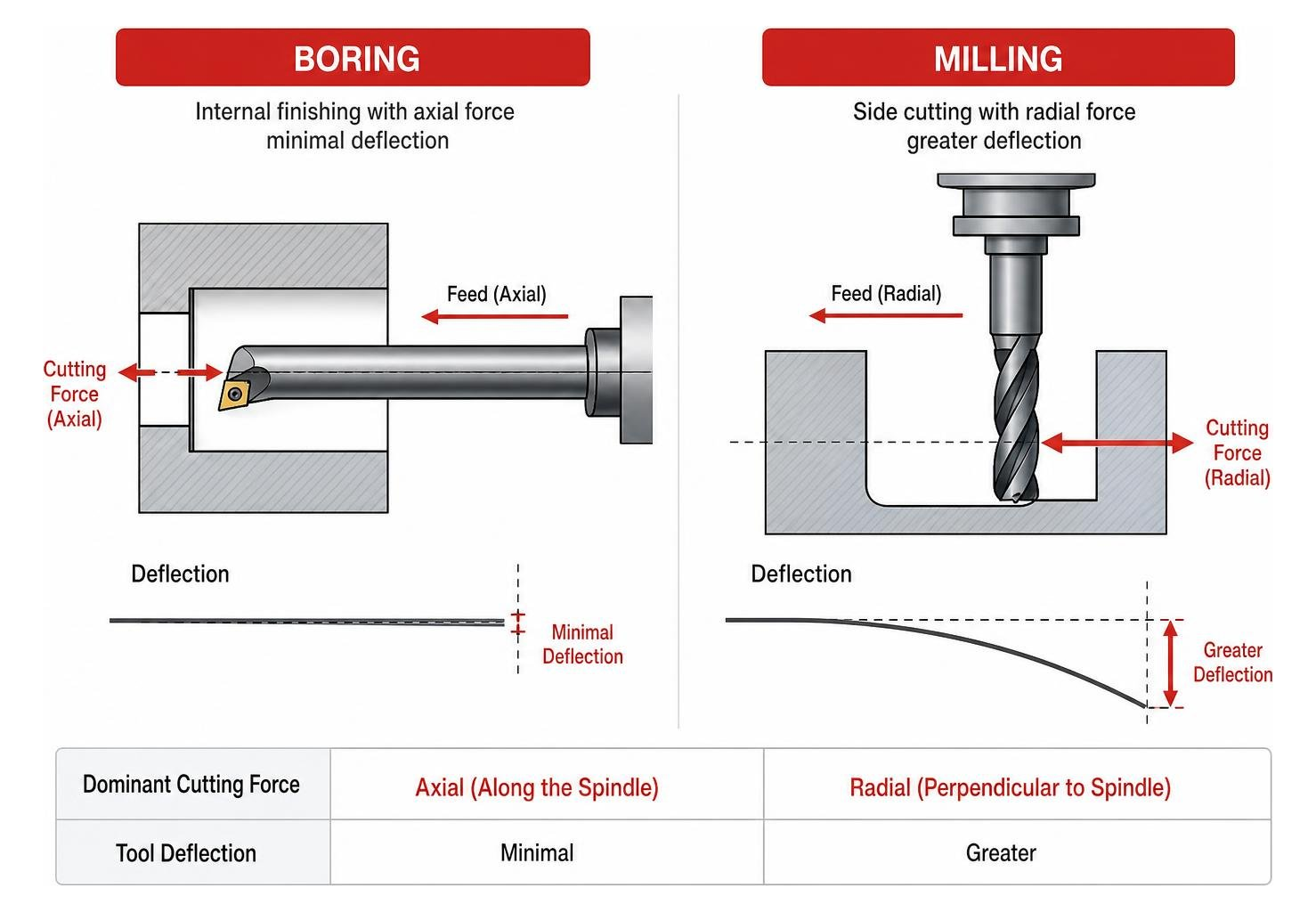
Milling is primarily focused on surface material removal. The cutting forces are mostly radial (perpendicular to the spindle), which can cause standard milling tools to deflect or vibrate when trying to cut deep cavities.
Boring, on the other hand, is an internal diameter finishing process. Because the cutting tool is supported by a rigid boring bar—and often fed via the W-axis quill—it minimizes tool deflection, ensuring that deep internal holes remain perfectly round, straight, and true to size over long distances.
Here is a quick comparison of how these operations differ on the shop floor:
| Operational Parameter | Boring Operations | Milling Operations |
|---|---|---|
| Primary Goal | Perfecting internal hole geometry, coaxiality, and finish | Rapid surface material removal and external profiling |
| Force Direction | Primarily axial and balanced radial forces | Heavy radial forces causing lateral tool pressure |
| Tool Reach | Extended reach via W-axis spindle quill | Limited by tool holder and spindle nose clearance |
| Typical Tolerances | Micrometer-level precision (extremely tight) | Standard machining tolerances |
For versatile shops, having a machine that can seamlessly transition between these two operations is highly efficient. Heavy-duty workhorses like the Misc 340T Horizontal Boring Mills are highly sought after precisely because they can handle both high-torque milling and ultra-precise boring in a single setup.
Main Types of Horizontal Boring Mills
Horizontal boring mills are not one-size-fits-all. They are classified into three primary configurations based on their structural morphology, machine footprint, and the weight of the workpieces they are designed to support.
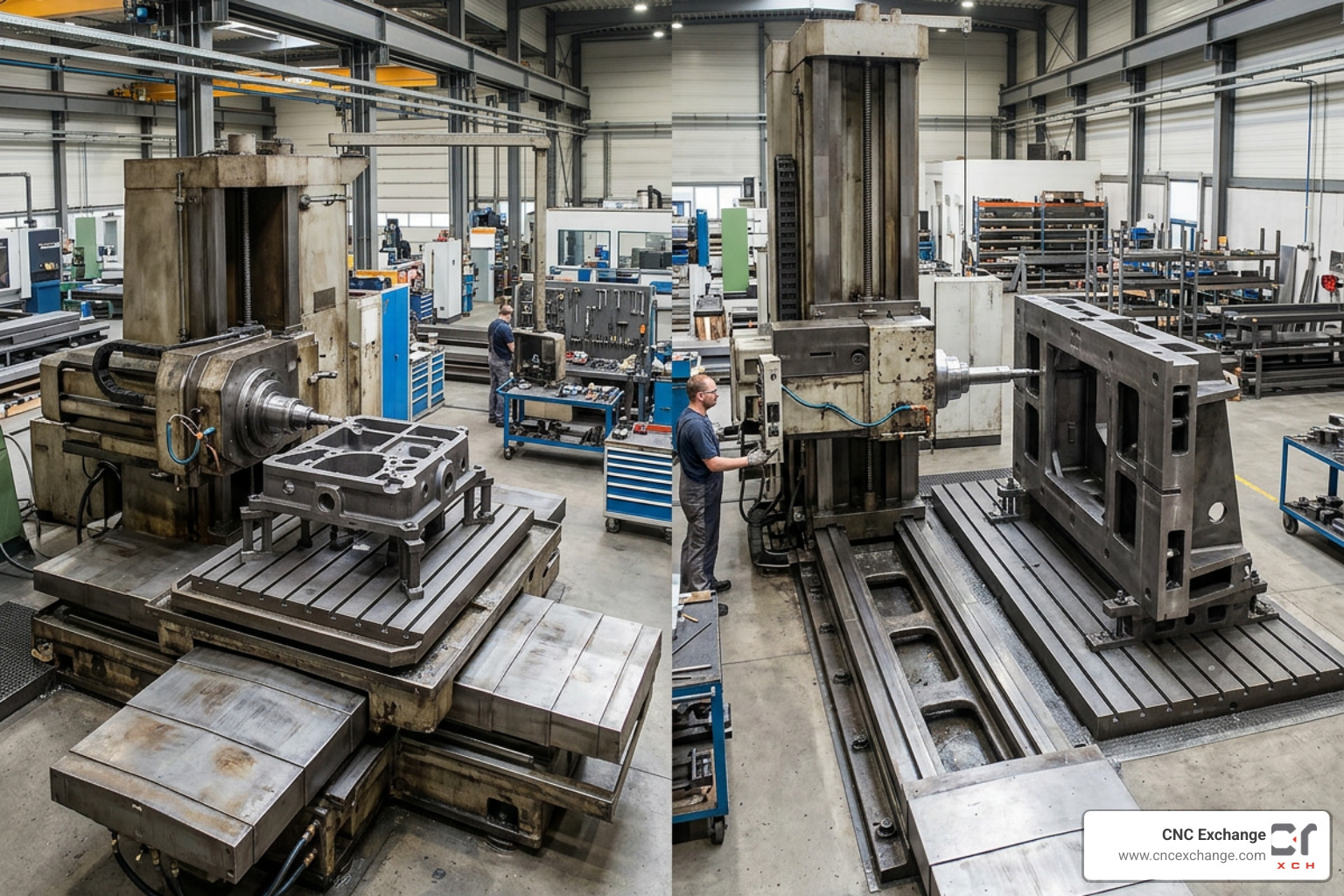
Table Type Boring Mills
The table type horizontal boring mill is the most common configuration found in machine shops. In this setup, the workpiece is clamped to a movable table that slides and rotates to align the part with the spindle. The spindle headstock moves vertically up and down the column (Y-axis), while the table moves longitudinally (Z-axis) and transversely (X-axis).
Table-type mills are highly versatile and ideal for general machining of small-to-medium workpieces, such as gearboxes, pump housings, and engine blocks. Because the table itself must move, the maximum weight capacity is limited by the table's guideways. In the used market, legacy brands are highly valued for their solid cast-iron foundations. For example, the Giddings and Lewis G60T Horizontal Boring Mills remain incredibly popular because their heavy-duty table designs offer exceptional rigidity and long-term reliability.
Floor Type Boring Mills
When your workpieces are too heavy or physically massive to be moved on a table, you need a floor type horizontal boring mill. In this configuration, there is no movable table. Instead, the workpiece is clamped directly to a stationary floor plate (or a massive rotary table set into the floor), and the entire spindle column travels along bed tracks (X-axis) to machine the part.
Floor-type HBMs are built for XXL dimensions. Some heavy-duty systems, like the UNION P-series, can handle workpieces up to 40 meters long and 10 meters high, with a boring spindle (W-axis) travel of up to 1,500 mm. These machines are the backbone of industries like shipbuilding, power generation, and heavy mining. When evaluating high-capacity floor-type models, options like the Mitsubishi MQF150 TC/NC Horizontal Boring Mills represent the pinnacle of heavy-duty, traveling-column engineering.
Planer Type Boring Mills
The planer type boring mill (sometimes called a T-type design) offers a hybrid approach. It features a stationary column and a table that only moves in a single axis (transverse to the spindle), while the column moves parallel to the spindle.
This layout provides maximum structural support directly under the cutting zone, making planer-type mills exceptionally rigid. They are specifically engineered for machining complex, prismatic workpieces where maintaining tight tolerances and perfect perpendicularity is critical. Classic models like the Lucas 20DCS56 Horizontal Boring Mills are excellent examples of this highly rigid design, providing stable cutting platforms for high-precision contract manufacturing.
Key Specifications to Consider When Selecting a Machine
Choosing a horizontal boring mill machine requires a careful look at several critical technical specifications. Because these machines are a significant investment, matching the machine's physical limits to your shop's workflow is crucial.
First, look at the underlying construction. High-quality boring mills are typically built using Meehanite® cast iron for the bed and column castings. Meehanite iron is heavily ribbed and chemically formulated to provide superior vibration-damping characteristics, which is the secret to achieving smooth surface finishes during heavy-duty cutting. You must also evaluate the spindle motor horsepower (typically scaling from 20 HP to 50 HP or more) and the spindle speed range to ensure you have enough torque for low-speed roughing and enough RPM for modern tooling.
Spindle Diameter and Axis Travels
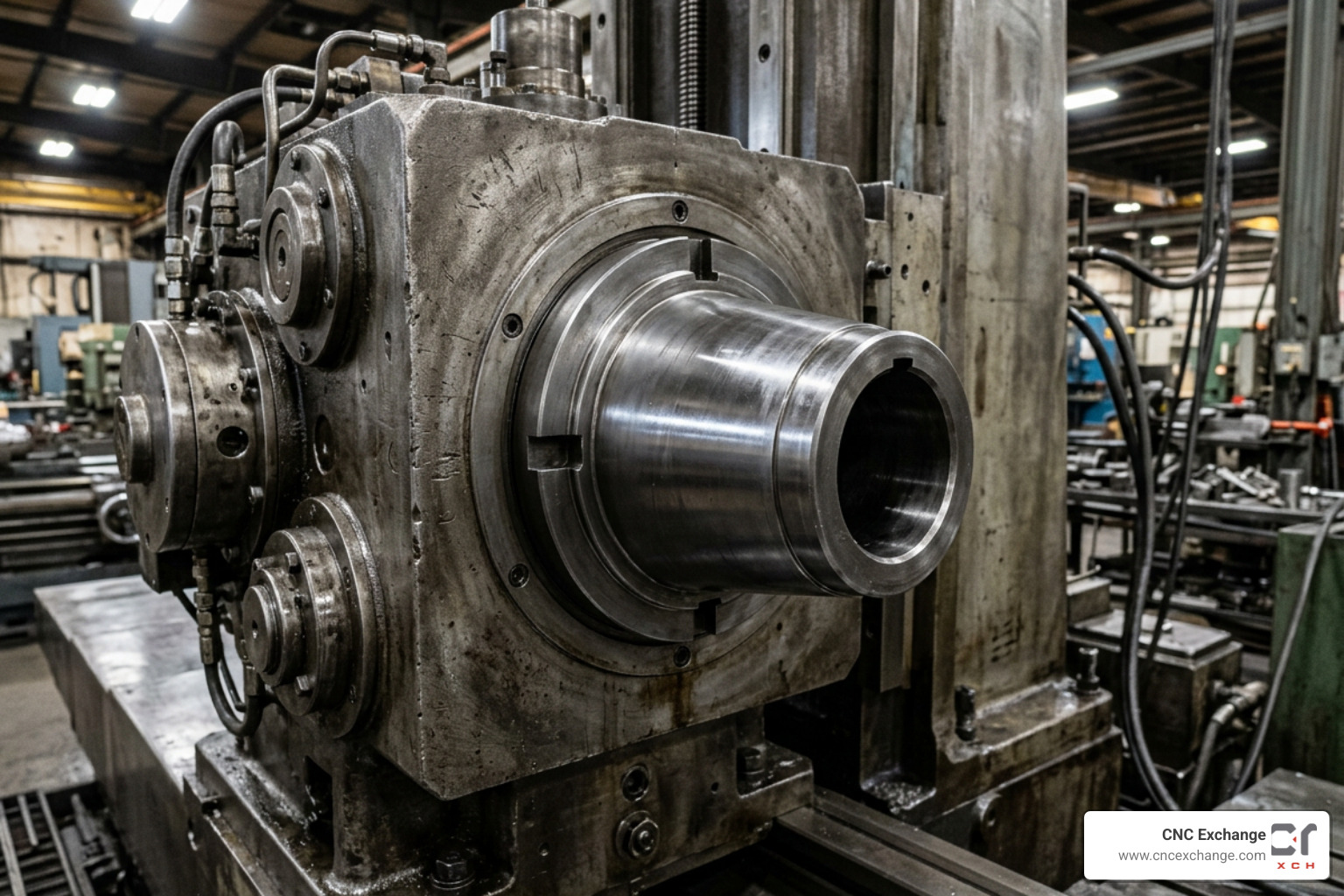
The spindle diameter is the primary way boring mills are classified. Common sizes in the used and new markets range from 2.5 inches to 5 inches (or Ø110 mm to Ø130 mm in metric systems). A larger spindle diameter allows for deeper boring bars and greater rigidity, minimizing tool deflection.
You must also match the machine's spindle taper (such as ISO 50, NMTB 40, or Morse Taper #5) with your shop's existing tooling inventory to avoid high replacement costs. Additionally, calculate your required travel limits across all primary axes:
- X-axis: Table or column transverse travel.
- Y-axis: Spindle head vertical travel.
- Z-axis: Table or column longitudinal travel.
- W-axis: Spindle quill extension.
For high-precision applications, modern systems like the PBT Series - Horizontal Boring - DMG MORI offer generous travel envelopes (such as a 3,000 mm X-axis stroke) combined with standard spindle speeds up to 5,000 RPM, giving you the flexibility to handle both heavy roughing and high-speed finishing.
Table Size and Weight Capacity
For table-type and planer-type mills, verifying the maximum table load capacity is critical to prevent structural damage to the guideways. For instance, the HB Series from WELE (JTEKT) offers a maximum table load capacity of up to 12 tons (24,000 lbs) on its B-axis rotary table.
If your work requires machining multiple faces of a part in a single setup, look for a machine equipped with a B-axis rotary table featuring hydrostatic bearings. This design ensures smooth, backlash-free 360-degree continuous rotation even under maximum weight. You can explore the technical limits of these heavy-duty rotary systems by checking out the HB Series | JTEKT Machinery North America specifications, or browse robust classic models like the Misc 256B Horizontal Boring Mills to see how table capacities scale in the used market.
Industrial Applications and Advantages of CNC Models
Because of their immense size and precision, horizontal boring mills are indispensable in high-value manufacturing sectors, including aerospace, energy, defense, and heavy industrial equipment.
Primary Industrial Applications
What are shops actually making with these machines? Typical projects include:
- Energy & Wind Technology: Machining massive turbine housings, generator rotors, and gearbox casings.
- Aerospace & Defense: Processing large structural landing gear components, helicopter rotor hubs, and armored vehicle frames.
- Heavy Equipment: Fabricating engine blocks for locomotives, marine vessels, and mining trucks.
To see how specialized shops leverage these capabilities, you can read about real-world manufacturing setups on the Horizontal Boring Mills | Chicago Deep Hole Drilling page. Even vintage manual models, such as the Ceruti ABC 75 Horizontal Boring Mills, continue to find active use in contract maintenance and repair shops due to their simple, rugged design.
CNC vs. Manual Horizontal Boring Mill Machine Models
While manual boring mills with Digital Readouts (DROs) are still highly capable for repair work and one-off parts, upgrading to a CNC model offers massive advantages in productivity and repeatability.
Modern CNC boring mills utilize glass linear scales on the X, Y, and Z axes to provide real-time positioning feedback with sub-micron accuracy. They also feature active thermal stabilization systems to compensate for spindle heat expansion during long machining cycles. Furthermore, CNC automation allows for complex tool paths, automatic tool changers (ATC), and automatic pallet changers (APC), keeping the spindle running with minimal operator intervention.
If you are looking for a machine that bridges the gap between classic heavy-duty iron and modern precision, retrofitted models like the Giddings and Lewis G60 RTX Horizontal Boring Mills show how upgrading older machines with modern CNC controls can deliver incredible ROI.
Frequently Asked Questions about Horizontal Boring Mills
What is the difference between a horizontal boring mill and a vertical boring mill?
The primary difference lies in the orientation of the spindle and how the workpiece is held:
- Horizontal Boring Mill (HBM): The spindle is horizontal. The workpiece is mounted vertically on a table or floor plate. This is ideal for long, deep-hole boring and multi-sided machining of rectangular or prismatic parts.
- Vertical Boring Mill (VBM): The spindle is vertical, and the workpiece sits on a large, rotating horizontal table (like a potter's wheel). VBMs are designed for massive, heavy, and round parts (like turbine discs or large rings) where gravity helps seat the part securely on the table.
For ultra-precise, specialized work, classic jig borers like the SIP 6 Hydroptic Horizontal Boring Mills represent the historical peak of horizontal alignment and mechanical positioning precision.
How much does a new or used horizontal boring mill cost?
Because of their size, horizontal boring mills represent a significant capital investment:
- New CNC Models: A brand-new, mid-sized CNC horizontal boring mill typically starts around $380,000 and can easily exceed $550,000+ depending on travels, automation, and accessories.
- Used Market: The used market offers incredible value. An older, functional manual boring mill from the 1970s or 1980s can often be found for $8,000 to $30,000. Mid-aged CNC models or retrofitted machines generally range from $50,000 to $150,000+.
Buying a used machine and retrofitting it with modern controls is a highly cost-effective way to get heavy-duty capacity on a budget. You can explore these price dynamics by looking at listings like the Kuraki AKB 13 Horizontal Boring Mills to see how age, condition, and control packages affect market value.
What are the most common optional accessories for these machines?
To maximize the versatility of your HBM, consider these common upgrades:
- Facing Head (U-axis): A programmable mechanical attachment that allows the machine to perform facing, turning, and threading operations on large diameters.
- Universal or Right-Angle Milling Heads: Allows the spindle to cut at various angles, turning your boring mill into a true 5-sided machining center.
- Spindle Chiller Unit: Regulates spindle temperature to prevent thermal growth during high-speed operation.
- Automatic Tool Changer (ATC): Standard capacities range from 40 to 120 tools, allowing for complex, unattended machining sequences.
Integrating these features, as seen on advanced systems like the Nomura BN-130 SWR ATC Horizontal Boring Mills, can completely transform your shop's throughput and capability.
Conclusion
At CNC Exchange, we are committed to helping machine shops find the right equipment to grow their businesses. Whether you are looking to buy a high-capacity CNC horizontal boring mill, sell your surplus machinery, or list equipment in one of our online auctions, we make it simple to achieve fair market value.
From our headquarters in Prospect Heights, Illinois, we work with shops across the country to navigate the used machinery market safely and efficiently. If you are ready to take your shop's heavy machining capabilities to the next level, we invite you to Upgrade your shop with our Horizontal Boring Mills today, or reach out to our team to find the perfect fit for your floor space and budget.