
What is a CNC Boring Milling Machine?
A cnc boring milling machine is a heavy-duty, computer-controlled machine tool designed to precisely enlarge and finish pre-drilled or cast holes in large metal workpieces — while also performing milling, drilling, reaming, and tapping in a single setup.
Quick answer — what makes it different from a standard CNC mill:
- Orientation: Horizontal spindle (vs. vertical on most standard mills)
- Primary purpose: Internal hole finishing to micrometer-level tolerances
- Workpiece size: Built for large, heavy components — often exceeding 10,000 lbs
- Axes: Includes a W-axis (spindle extension) and B-axis (rotary table) for deep-reach and multi-sided machining
- Construction: Massive Meehanite cast iron frames for vibration dampening and rigidity
- Best for: Gearbox housings, turbine components, structural weldments, and other complex box-type parts
If you're running a shop that handles large, heavy, or complex parts, a standard vertical machining center will eventually hit its limits. Deep holes, tight bore tolerances, and multi-ton workpieces demand a machine built specifically for the job.
That's exactly what the CNC boring mill was engineered to do.
The concept of precision boring goes back to 1775, when John Wilkinson invented the first boring machine. Today's CNC versions are a world apart — equipped with automatic tool changers, live CNC feedback, and multi-axis control systems that can complete an entire complex part in one clamping.
I'm Jared Gray, and over my 12 years of buying, selling, and brokering CNC equipment — including CNC boring milling machines — I've helped hundreds of manufacturers find the right machine for their production needs. In this guide, I'll break down everything you need to know to make a confident decision.
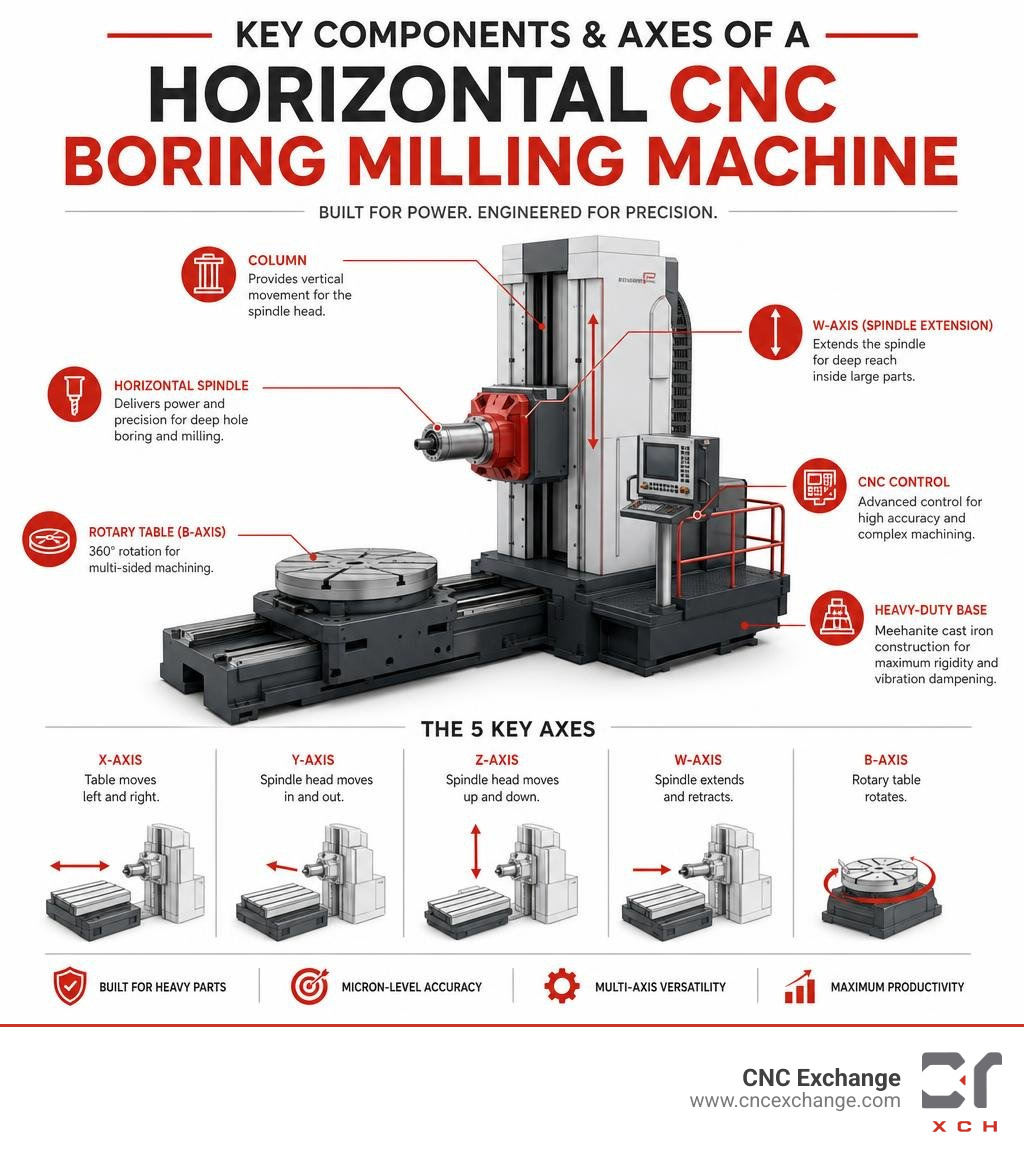
At its core, a cnc boring milling machine (often referred to simply as a horizontal boring mill, or HBM) is designed to handle what standard milling machines cannot: massive workpieces requiring deep, highly accurate internal hole finishing. While a standard mill is exceptional at profiling surfaces and cutting shallow pockets, it struggles with deep-hole coaxiality and concentricity.
The horizontal boring mill solves this by utilizing a heavy-duty horizontal spindle. This spindle is supported by a robust headstock that travels vertically up and down a massive column. The machine's frame is typically constructed from heavily ribbed Meehanite cast iron, a licensed gray and ductile iron casting process renowned for its superior vibration-dampening qualities and long-term structural rigidity.
To reach deep inside complex castings or weldments, these machines utilize a specialized spindle quill. This quill allows the cutting tool to extend forward along the longitudinal axis, maintaining high geometric accuracy even when machining deep cavities. Combined with heavy-duty box ways or high-precision linear guides, the entire assembly provides the brute strength and micro-level precision required for demanding industrial applications.
Key Differences: Standard Milling vs. a CNC Boring Milling Machine
The differences between a standard CNC milling machine and a cnc boring milling machine go far beyond their physical size. They represent entirely different machining philosophies.
- Structural Alignment: Standard CNC mills are predominantly vertical, meaning the spindle moves down toward a table. Boring mills are almost exclusively horizontal, allowing chips to fall away naturally during deep-hole operations and accommodating much heavier workpieces.
- Ram and Spindle Stability: A standard mill relies on the Z-axis headstock travel. An HBM features an extending boring spindle (the W-axis) housed within a robust square ram. This design provides superior centripetal force and stability, allowing the tool to reach deep into a workpiece with minimal deflection.
- Programming and Feed Rates: In standard machining centers, feed rates are typically programmed as feed-per-minute (inches or millimeters per minute). In contrast, CNC boring mills are frequently programmed using feed-per-revolution during critical boring and drilling operations. This ensures a consistent chip load and superior surface finish inside highly precise bores.
Here is a quick comparison to help visualize these differences:
| Feature | Standard CNC Mill (VMC) | CNC Boring Milling Machine (HBM) |
|---|---|---|
| Spindle Orientation | Vertical (typically) | Horizontal |
| Primary Focus | Surface profiling, pockets, and light drilling | Deep-hole boring, facing, and heavy-duty milling |
| Workpiece Weight | Usually under 5,000 lbs | Up to 110,000 lbs (50,000 kg) or more |
| Spindle Reach | Limited to Z-axis travel | Extended reach via W-axis spindle quill |
| Clamping Setups | Often requires multiple setups for 5-sided parts | Single setup using a B-axis rotary table |
If you are looking to scale up your shop's capacity to handle massive box-type parts, investing in a robust platform like the TK6113 table type horizontal boring &milling machines - Longbiao is a logical step. These machines are engineered to bridge the gap between heavy-duty metal removal and micrometer-level finishing.
Conventional vs. CNC Boring Mills
While conventional (manual) boring mills have kept job shops running for decades, the transition to CNC has completely revolutionized heavy manufacturing productivity.
Conventional machines, such as the BO 110 - Conventional Boring and Milling Machines | KNUTH USA , are fantastic for repair work, one-off prototyping, and simple manual operations. With a table load capacity of 5,500 lbs and a 4-inch spindle diameter, a manual machine like the BO 110 relies on mechanical handwheels and digital readouts (DROs) to position the tool. Skilled operators can achieve impressive results, but the process is slow, highly dependent on manual alignment, and prone to human error.
Modern CNC boring mills replace manual handwheels with high-torque servo motors, precision ball screws, and advanced CNC controllers (such as Fanuc, Siemens, or Heidenhain). This automation introduces several game-changing benefits:
- Simultaneous Multi-Axis Linkage: CNC systems can coordinate the X, Y, Z, W, and B axes simultaneously, enabling complex 3D helical milling, circular interpolation, and thread chasing that are impossible on manual machines.
- Safety Interlocks: Unlike older manual machines, CNC boring mills feature fully enclosed workspaces, safety light curtains, and software-monitored interlocks that prevent axes from colliding or running under unsafe conditions.
- Repeatability: Once a program is proven, the machine can produce identical, high-precision parts all day long without manual intervention.
Major Configurations of CNC Horizontal Boring Mills
Selecting the right horizontal boring mill configuration depends entirely on the physical size, weight, and geometry of the parts you intend to machine.
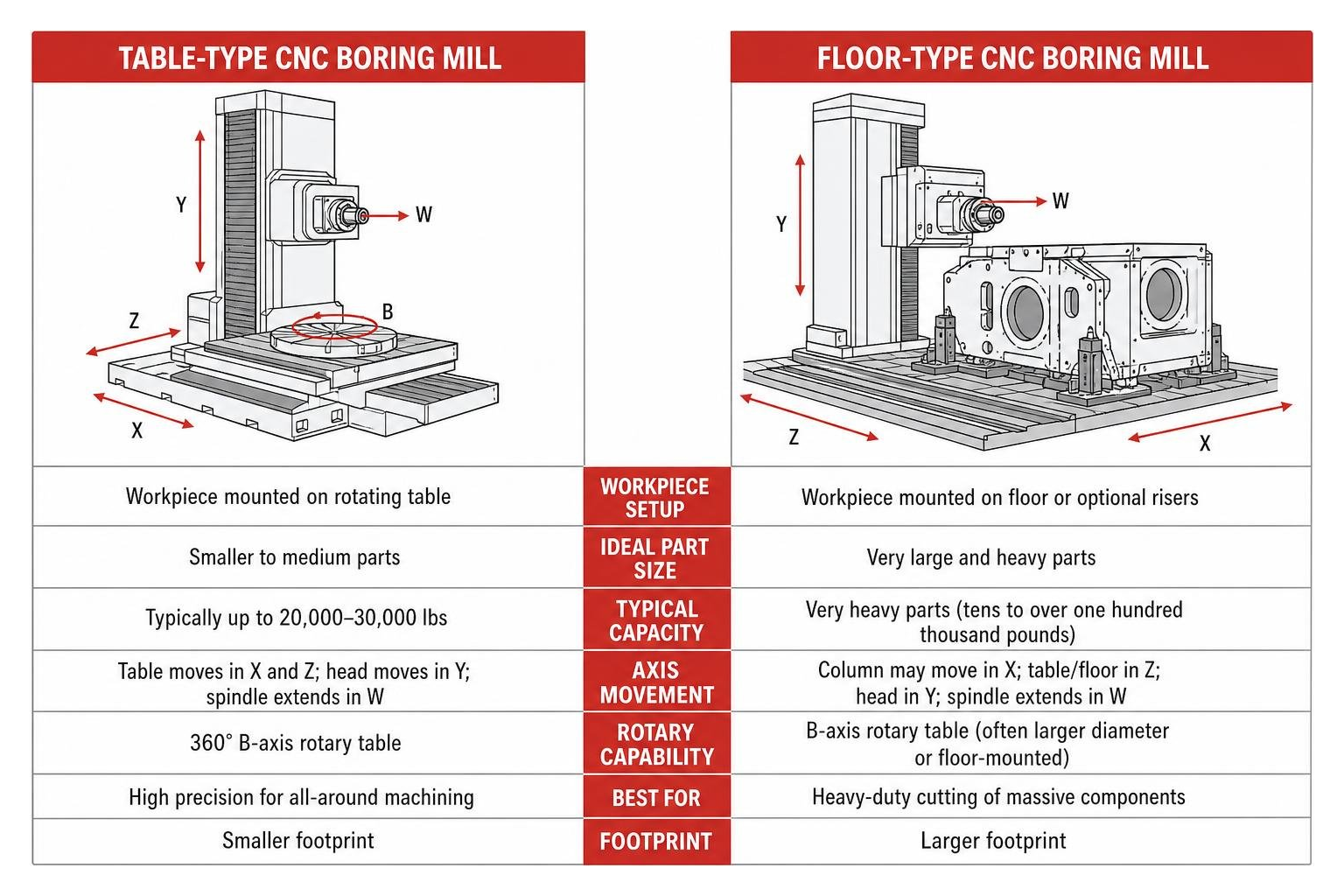
Table-Type Boring Mills
Table-type boring mills are the most common configuration found in precision machine shops. On these machines, the workpiece is mounted directly to a table that moves in both the longitudinal (Z-axis) and cross (X-axis) directions. The column remains stationary, while the spindle headstock moves vertically (Y-axis).
This setup is ideal for small-to-medium-heavy parts (typically up to 20,000 or 30,000 lbs). Because the table can rotate 360 degrees (the B-axis), operators can machine all four sides of a complex component in a single clamping. If you are shopping the used market for a highly reliable table-type machine, legendary models like the Nomura B100SP Horizontal Boring Mills or the classic Giddings and Lewis 340T Horizontal Boring Mills offer incredible rigidity and long-term value for growing shops.
Floor-Type and Planer-Type Boring Mills
When a workpiece is simply too massive or heavy to be moved back and forth on a table, a floor-type boring mill is the only viable solution. On a floor-type machine, the workpiece remains stationary, bolted down to a massive, heavy-duty floor plate (or T-slotted floor bed). The entire column of the machine travels along floor-level bed guideways (the X-axis) to perform machining operations.
This configuration is essential for machining massive structural weldments, ship propeller shafts, and large power-generation components. For example, high-capacity platforms like the TK6913 CNC floor type boring mill with moving rotary working table - Longbiao allow shops to combine the benefits of a floor-type machine with a heavy-duty auxiliary rotary table. Similarly, a CNC floor type boring milling machine with spindle diameter 160mm - Longbiao provides the massive spindle torque and structural stability needed to cut through tough alloys on a monumental scale.
Planer-type boring mills represent a hybrid design. The column moves longitudinally (Z-axis) while the table moves crosswise (X-axis) between two upright columns, providing a balanced solution for exceptionally long, heavy parts that require high-speed milling.
The Power of the W-Axis and B-Axis
What truly elevates a cnc boring milling machine above a standard horizontal machining center is the integration of the W-axis and B-axis.
- The W-Axis (Spindle Extension): This represents the physical translation and extension of the boring spindle itself, independent of the headstock ram (Z-axis). This allows the tool to reach deep inside narrow cavities, internal bores, and complex housings without requiring excessively long, unstable tool holders. It maintains maximum rigidity close to the spindle bearings, ensuring micrometer-level roundness.
- The B-Axis (Rotary Table): A high-precision rotary table (often featuring a resolution down to 0.001°) allows the workpiece to rotate 360 degrees. This enables multi-sided machining in a single setup. By rotating the part, you can bore, drill, and mill multiple faces with perfect perpendicularity and concentricity, eliminating cumulative setup errors.
Key Advantages for Large and Heavy Part Machining
When you are dealing with parts that weigh several tons, any unnecessary movement or repositioning is a liability. CNC boring mills excel in these high-stakes environments for three major reasons:
- Unmatched Structural Rigidity: Built from premium cast iron and utilizing heavy box-way construction, these machines absorb the massive cutting forces generated during heavy roughing. This damping capacity prevents harmonic vibrations (chatter), extending tool life and ensuring superior surface finishes.
- High Spindle Torque: Unlike high-speed vertical machining centers designed for rapid aluminum carving, boring mills utilize powerful gear-driven spindles (often paired with a ZF transmission) to deliver massive torque at low RPMs. This is crucial for driving large-diameter boring bars through tough steels and cast irons.
- Reduced Setup Times: By combining milling, boring, drilling, and tapping on a single machine with a rotary table, you can complete a part in one or two setups rather than moving it across multiple machines. This saves dozens of hours in material handling and crane time.
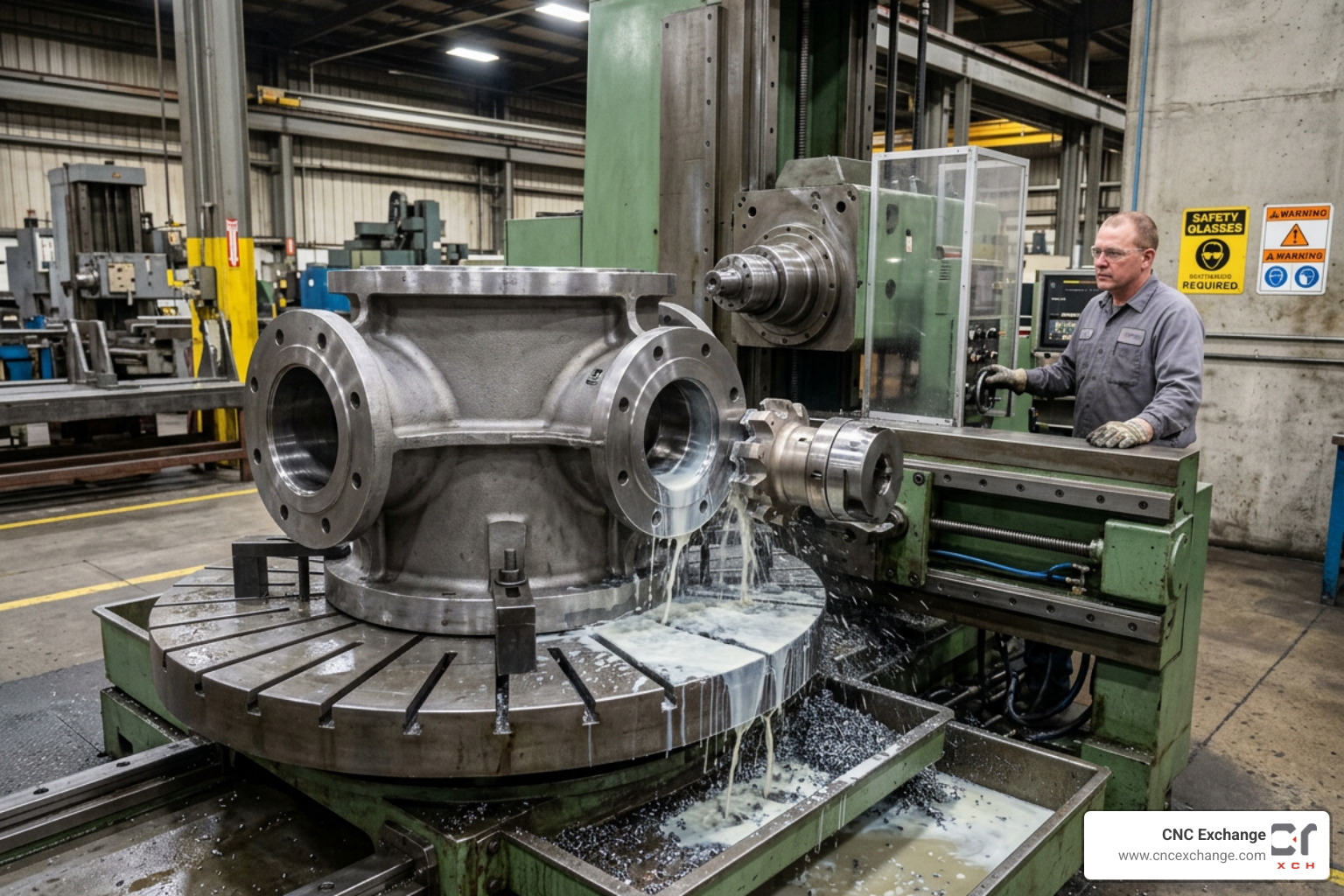
Selecting the Right CNC Boring Milling Machine for Your Shop
When browsing new or used machinery, you must carefully align the machine's specifications with your target workpieces. Key specifications to evaluate include:
- Spindle Diameter: Typical spindle diameters range from 110 mm (approx. 4 inches) to 130 mm (5 inches) or larger. A larger spindle diameter directly correlates with greater rigidity and deep-boring capacity.
- Table Load Capacity: Always verify the maximum weight limit. While a standard machine might support 5,500 to 17,000 lbs, heavy-duty models can support over 110,000 lbs.
- Axis Travels (X, Y, Z, and W): Ensure the work envelope can accommodate your largest parts, plus clearance for tooling. For example, a classic Giddings and Lewis PMC4 Horizontal Boring Mills or a compact Nomura B85SR Horizontal Boring Mills will offer very different footprint-to-travel ratios.
- Feedback Systems: Look for machines equipped with high-precision linear glass scales on the X, Y, and Z axes to ensure real-time thermal and positioning compensation.
Target Industries and Applications
CNC boring mills are the backbone of heavy industrial manufacturing. You will find them actively running in:
- Aerospace: Machining massive landing gear components, titanium structural bulkheads, and engine housing fixtures.
- Energy and Wind Power: Boring out massive gearbox housings, turbine rotors, and generator frames.
- Shipbuilding & Maritime: Machining massive engine blocks, rudder horns, and propeller shaft supports.
- Nuclear Power: Fabricating heavy-duty containment vessels and structural shielding components.
For regional manufacturers in the Midwest, having access to local heavy machining capabilities is a massive competitive advantage. If your shop is looking to outsource massive projects or partner with local experts, exploring resources like a premier CNC Machine Shop Illinois or utilizing specialized services for Large Boring Mill Machining in Chicago can keep your production lines moving smoothly.
Frequently Asked Questions about CNC Boring Mills
What is the typical price range for new and used CNC boring mills?
The price of a cnc boring milling machine varies dramatically based on its size, age, condition, and configuration.
- New CNC Boring Mills: A brand-new, high-end CNC horizontal boring mill typically starts around $400,000 for a compact table-type model and can easily exceed $1,500,000 for a massive, fully loaded floor-type system with automatic tool changers and auxiliary rotary tables.
- Used CNC Boring Mills: The used market offers exceptional value. Older, highly reliable workhorses from the late 1990s or 2000s can range from $30,000 to $150,000 depending on their operational condition. High-quality used options, such as a well-maintained Giddings and Lewis H6T CNC Horizontal Boring Mills, allow shops to acquire massive machining capacity at a fraction of the cost of a new machine.
What standard and optional features should I look for?
When sourcing a boring mill, consider these productivity-boosting features:
- Automatic Tool Changers (ATC): Standard capacities usually range from 40 to 90 tools. An ATC is essential for unattended CNC operations.
- Through-Spindle Coolant (TSC): High-pressure coolant running directly through the boring bar is critical for evacuating chips and managing heat during deep-hole boring.
- Spindle Oil Cooling: Maintains thermal stability during prolonged, high-torque cutting cycles.
- Telescopic Steel Covers: Protects the bed guideways and precision ball screws from hot chips and abrasive dust.
- Specialized Milling Heads: Right-angle heads, universal heads, or edge-drilling attachments — like those utilized on the BOSM-14060 CNC Edge Drilling & Milling Center -Oturn — allow you to perform complex chamfering and multi-angle groove machining without refixturing.
How do hydrostatic guides compare to box ways?
Both guide systems are designed for heavy-duty machining, but they achieve it differently:
- Box Ways: Feature metal-on-metal contact (often hardened steel mating with a low-friction Turcite lining). They offer exceptional mechanical damping and are highly preferred for heavy, interrupted roughing cuts. However, they experience higher friction and wear over time.
- Hydrostatic Guides: Utilize a continuous, pressurized film of oil to completely separate the moving machine components. This eliminates friction and mechanical wear entirely, allowing for incredibly smooth movement and micrometer-level positioning accuracy over long travels. They are highly common on premium, large-scale floor-type boring mills but require more complex maintenance.
Conclusion
The cnc boring milling machine remains an absolute game changer for any manufacturing facility handling large, heavy, or complex industrial components. By combining unmatched structural rigidity, high-torque horizontal spindles, and the multi-axis flexibility of the W-axis and B-axis, these machines allow you to tackle the toughest machining jobs with absolute confidence.
Whether you are looking to expand your shop's capabilities, purchase your first horizontal boring mill, or sell surplus machinery to free up floor space, we are here to help. At CNC Exchange, we provide a simple, secure, and transparent online marketplace to buy, sell, and auction high-quality industrial equipment.
Ready to take your manufacturing capabilities to the next level? Talk to Our Machine Tool Experts Today to discuss your specific part requirements, or explore our inventory of horizontal boring mills to find the perfect machine for your shop floor.