
Fundamentals of Logistics Management and Supply Chain Scope
Comparing logistics service providers requires evaluating provider tiers (1PL through 5PL), specialized heavy-haul equipment, rigging expertise, comprehensive transit insurance, and key operational metrics like On-Time In-Full (OTIF) delivery. Assessing these criteria ensures equipment and materials move safely, compliantly, and cost-effectively across complex supply chains.
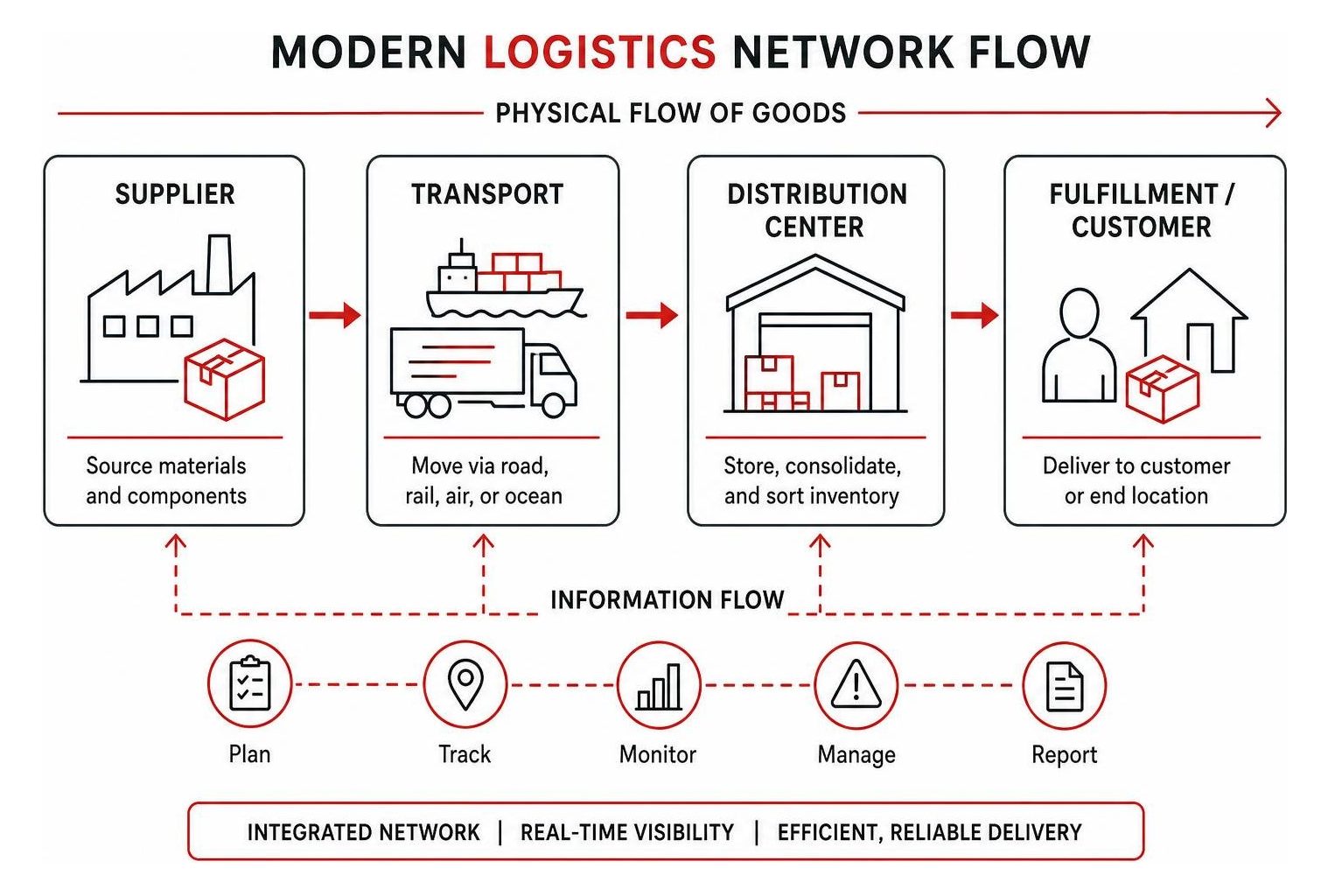
At its core, logistics coordinates physical material flow, informational data streams, and storage management between origin and destination points. The term traceably stems from the French military title maréchal des logis—officers tasked with organizing quarters, moving matériel, and managing sustenance for marching regiments. While modern industrial facilities no longer marshal cavalry regiments, the fundamental requirement remains unchanged: having essential assets in the exact place required to prevent operational stagnation.
In modern enterprise operations, logistics serves as the physical execution arm that operationalizes broad business strategies. Without disciplined distribution nodes, network design, and reliable storage hubs, industrial supply chains quickly unravel. The modern industrial landscape demands sophisticated Logistics Real Estate & Supply Chain Logistics | Prologis solutions, where facilities provide not only dry square footage, but also robust energy resilience, onsite power generation, and advanced structural loading capabilities to handle heavy robotics and heavy-duty machinery.
Historical Evolution and the Seven R's Framework
Logistics has evolved from rudimentary military supply lines into a multi-trillion-dollar global discipline. Today, business-to-business e-commerce is projected to reach an estimated USD 32.8 trillion, with cross-border sales constituting roughly 44 percent of that massive total. Managing movements across regional and international borders requires adhering to timeless foundational principles.
In professional transport management, operational performance is governed by the classic Seven R's Framework:
- Right Product: Ensuring the exact SKU, tooling, or heavy machinery asset is correctly matched to the order without substitution errors.
- Right Quantity: Delivering exact unit volumes—preventing both production-halting stockouts and balance-sheet-bloating surplus.
- Right Condition: Preserving the structural, functional, and cosmetic integrity of the cargo through proper crating, rigging, and climate controls.
- Right Place: Transporting shipments to the exact drop point, whether an offloading bay, a designated job site, or a specialized machine bed.
- Right Time: Hitting defined delivery windows precisely to synchronize with rigging crews, crane rentals, and assembly line shifts.
- Right Customer: Directing high-value shipments to the authorized recipient with verified documentation and chain-of-custody handoffs.
- Right Cost: Optimizing transportation and handling spend to protect operating margins without compromising asset safety or transit speed.
Auditing freight carriers against these seven criteria establishes a measurable standard for operational execution.
Differentiating Logistics from Supply Chain Management
While frequently used interchangeably, logistics and supply chain management represent distinct operational scopes:
- Supply Chain Management (SCM): The overarching strategic umbrella that encompasses end-to-end product lifecycles. SCM governs raw material procurement, vendor relationship management, demand forecasting, production scheduling, cross-border regulatory compliance, and post-sale customer relationship governance.
- Logistics Management: The tactical, operational subset of SCM dedicated specifically to the physical movement, storage, handling, and tracking of goods. SCM establishes what needs to be made and sourced; logistics determines how physical items safely move from point A to point B.
Understanding this division helps machine shops and industrial facilities across diverse manufacturing industries served pinpoint where carrier breakdowns occur. A strategic vendor supply agreement means nothing if physical transport fails during transit.
Key Service Models: Evaluating 1PL Through 5PL Provider Tiers
Logistics partnerships range from direct, internal fleet ownership to fully outsourced autonomous management networks. Choosing the right tier depends on cargo complexity, shipment volume, and internal management resources.
| Tier | Model Description | Core Capabilities | Ideal Industrial Use Case |
|---|---|---|---|
| 1PL (First-Party) | Self-Managed Logistics | In-house trucks, drivers, and internal warehouse handling. | Local deliveries, internal facility transfers within regional boundaries. |
| 2PL (Second-Party) | Direct Asset-Based Carriers | Dedicated asset operators (ocean lines, trucking lines, freight rail). | Booking full truckloads (FTL) or rail carloads for single origin-destination runs. |
| 3PL (Third-Party) | Integrated Service Providers | Integrated transport, warehousing, customs clearance, and inventory picking. | Standardized parts warehousing, regional inventory deployment, and freight handling. |
| 4PL (Fourth-Party) | Lead Logistics Providers | Strategic oversight managing multiple 3PL networks, technology integrations, and data. | Enterprise manufacturing networks coordinating dozens of facilities and regional carriers. |
| 5PL (Fifth-Party) | Aggregate Logistics Organizers | Optimization of entire supply networks via massive aggregate e-business platforms. | High-volume cross-border digital marketplace distribution and dynamic freight networks. |
Global service providers like Global Transport and Logistics | DSV demonstrate the reach of scaled 3PL and 4PL models, orchestrating multi-modal transport via air, sea, road, and intermodal rail across dozens of international hubs.
Core Operational Functions and Logistics Types
Logistics management encompasses several operational workflows:
- Inbound Logistics: Handling raw materials, foundry castings, and sub-assemblies arriving at a manufacturing facility to support steady production runs.
- Outbound Logistics: Packaging, staging, and shipping completed inventory or capitalized assets out to buyers, distributors, and end users.
- Reverse Logistics: Managing return flows for equipment warranty rebuilds, MRO (maintenance, repair, operations) tooling refurbishments, trade-ins, or end-of-life recycling.
- Heavy Industrial Transport: Moving oversized assets, such as pre-owned industrial equipment, which demand customized load distribution, heavy-haul flatbeds, permits, and escorts.
Third-Party (3PL) and Fourth-Party (4PL) Capabilities
Modern 3PL and 4PL organizations provide high-leverage services that simplify complex supply chains:
- Multi-Modal Freight Forwarding: Booking complex container movements across ocean freighters, inland barges, Class I freight rail, and over-the-road trucking lines.
- Automated Customs Brokerage: Managing Harmonized Tariff Schedule (HTS) classifications, navigating Section 301 duties, and processing duty drawback recovery to reduce imported asset costs.
- Digital Integrations: Connecting Enterprise Resource Planning (ERP) systems directly to carrier Transportation Management Systems (TMS) via API and EDI protocols for end-to-end shipment status updates.
Digital-first platforms such as Freight Forwarding & Supply Chain Platform | Flexport illustrate how machine learning algorithms optimize container consolidation, helping industrial shippers reduce unnecessary less-than-container-load (LCL) freight costs.
Critical Criteria for Evaluating Heavy Freight and Machinery Carriers
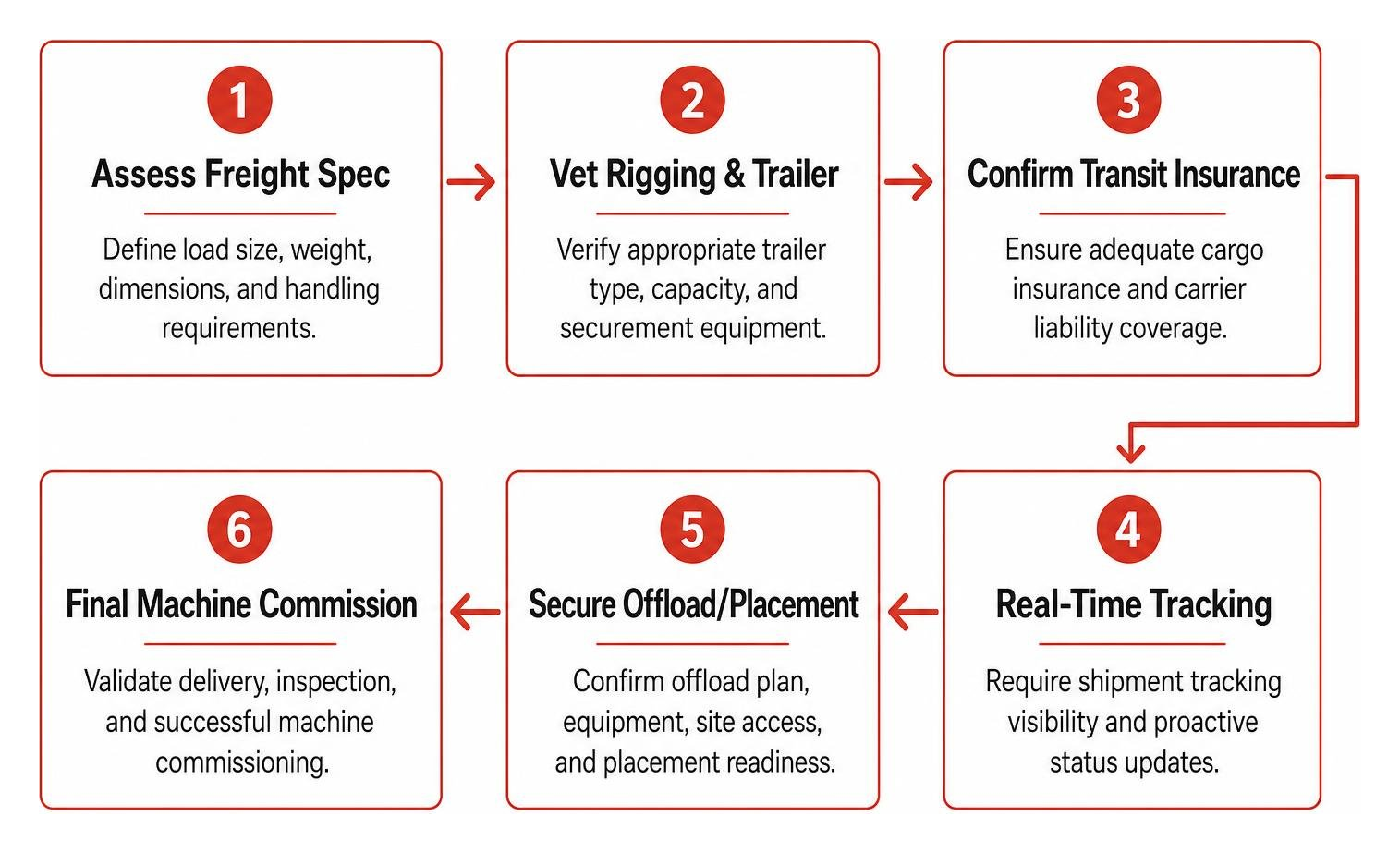
Transporting heavy machinery presents operational challenges that standard pallet carriers cannot handle. A high-precision 5-axis vertical machining center or a 30-ton hydraulic press brake cannot be treated like dry consumer packaged goods. When evaluating heavy freight logistics providers, focus on the following technical criteria:
- Asset-Specific Experience and Equipment Match: Confirm that the carrier has access to lowboy, RGN (removable gooseneck), step-deck, or double-drop trailers appropriate for your equipment's height, width, and weight profile.
- Specialized Rigging and Millwright Partnerships: Moving machinery requires skilled machinery riggers who understand center-of-gravity balancing, specialized lifting points, crane capacities, and secure blocking, bracing, and chain-tie-down methods.
- Comprehensive Inland Marine Insurance: Standard motor carrier liability policies often cover only a nominal dollar value per pound (frequently as low as $0.50 to $2.00 per pound). Ensure the carrier issues an explicit certificate of insurance covering the full actual cash or replacement value of your specific industrial machinery during transit.
- Route Permitting and Escort Coordination: Oversized and overweight loads require specialized state-by-state oversize/overweight (OSOW) permits, bridge analysis, route planning, and pilot car coordination.
- Regional Infrastructure Knowledge: In major midwestern manufacturing centers, tapping into specialized Transportation, Distribution, and Logistics networks ensures access to experienced heavy-haul drivers and regional machinery transport corridors.
Technological Capabilities and Real-Time Visibility
Modern logistics requires complete shipment transparency. Leading freight carriers use advanced digital management tools:
- Real-Time IoT Sensor Telemetry: Tracking ambient shock, vibration, tilt, temperature, and humidity directly on machine packaging to verify delicate spindle and control components remain within safe thresholds throughout transit.
- Dynamic Route Optimization: Using fleet management software to route drivers around sudden low-clearance obstacles, construction zones, seasonal frost laws, and high-risk traffic bottlenecks.
- Digital Twin and Floor Modeling: Simulating load geometry and factory floor movement prior to physical dispatch to ensure machinery passes cleanly through facility dock doors and bay aisles.
Essential Performance Metrics and Safety Standards
To assess prospective carriers objectively, track and benchmark these key logistics Key Performance Indicators (KPIs):
- On-Time In-Full (OTIF) Rate: The percentage of shipments delivered within the scheduled delivery window without missing equipment, manuals, or auxiliary tool changers.
- Freight Claim Ratio: The frequency of cargo loss, transit damage, or insurance claims relative to total loads hauled. High-performing machinery carriers maintain near-zero claim rates.
- Driver and Safety Fitness Scores: Verification of carrier safety ratings, Department of Transportation (DOT) safety records, and Federal Motor Carrier Safety Administration (FMCSA) operating authority.
- Dock Turnaround Time (TAT): How swiftly the carrier’s driver stages, blocks, chains, and secures equipment at loading docks, minimizing downtime for plant millwrights and rigging teams.
Maintaining high standards across these metrics ensures your production schedules stay on track, whether receiving newly acquired plant equipment or sourcing wanted machinery for expanding manufacturing lines.
Frequently Asked Questions About Industrial Transportation
What is the fundamental difference between inbound and outbound freight?
Inbound freight focuses on moving raw inventory, casting materials, sub-assemblies, and replacement components from suppliers into a manufacturing facility to support production. Outbound freight focuses on picking, preparing, and transporting finished industrial products or decommissioned machinery from the facility floor out to buyers, end clients, or distribution centers. Review our machinery freight FAQs for detailed answers on staging dock pickups and organizing plant freight.
How are AI and autonomous transport transforming freight tracking?
AI is reshaping industrial freight through:
- Predictive Dispatching: Machine learning models analyze seasonal freight surges, weather patterns, and regional truck availability to assign loads to optimal carriers dynamically.
- Automated Exception Handling: Software instantly identifies transport delays, mechanical breakdowns, or detention bottlenecks, re-routing connecting legs before operations are disrupted.
- Autonomous Long-Haul Fleet Runs: Commercial autonomous freight trucks are moving from initial testing to real-world highway runs along designated freight corridors, helping offset long-term truck driver shortages.
Why is specialized rigging critical when moving heavy industrial assets?
Standard dock handling tools cannot safely manage massive multi-axis machines. Specialized machinery rigging provides:
- Precision Weight Balancing: Proper calculation of asymmetrical centers of gravity, preventing machinery tipping during crane picks or trailer transitions.
- Spindle and Bed Protection: Specialized jacking, skidding, and air-caster techniques that prevent twisting, warping, or putting stress on sensitive machine ways and linear guides.
- Safe Facility Extraction: Safely navigating heavy, high-value assets around existing, operational equipment in tight plant spaces without endangering personnel or building infrastructure.
Conclusion

Comparing logistics service providers requires evaluating more than base freight rates. For industrial machine shops and fabrication plants, choosing the right logistics partner involves verifying carrier equipment capabilities, load-rigging expertise, active transit insurance, and digital shipment visibility.
A well-executed logistics plan safeguards your machinery investments, keeps production lines running smoothly, and prevents unexpected downtime. When you are ready to expand your shop floor, source reliable machinery, or invest in high-performance fabrication machinery, choosing experienced transportation partners ensures your industrial assets arrive safely, on time, and ready to produce.