
Finding a Used Centroid A560 for Sale: Market Value and Availability
High-performance engine machine shops rely heavily on dedicated CNC platforms to balance workflow, accuracy, and cycle times. Because the machine serves as a dedicated revenue generator, finding a unit on the secondary market requires understanding current valuations and market availability.
Pricing Benchmarks and Depreciation Factors
A brand-new turnkey package presented at industry trade shows typically commands between $200,000 and $250,000, reaching upwards of $290,000 when fully optioned with high-output spindles, complete probing packages, and multi-axis CAD/CAM seats.
On the secondary market as of August 2026, a pre-owned A560 generally trades in the $95,000 to $165,000 range depending on age, mechanical condition, and bundled accessories.
Several key factors dictate where an individual unit falls on this depreciation curve:
- Software Licensing and Turnkey Toolpaths: Unlike general-purpose vertical machining centers, an engine shop CNC's valuation is heavily tied to its software package. A machine bundled with fully licensed Mastercam Port Expert, digitizing routines, and a proven library of cylinder head porting programs can command a premium over a bare machine.
- The Block Machining Package: Units outfitted with the PB (Port and Block) option—which includes specialized fixturing, probing macros, and extended vertical clearance—hold resale value better because they eliminate the need for separate engine block machining equipment.
- Spindle and Drive Health: Replacement of a 20,000 RPM high-frequency motorized spindle or a worn roller-cam rotary mechanism can run tens of thousands of dollars, making mechanical wear a primary price driver.
Refer to the official CENTROID A560 factory specifications for baseline tolerances and standard equipment configurations when verifying a seller's listing.
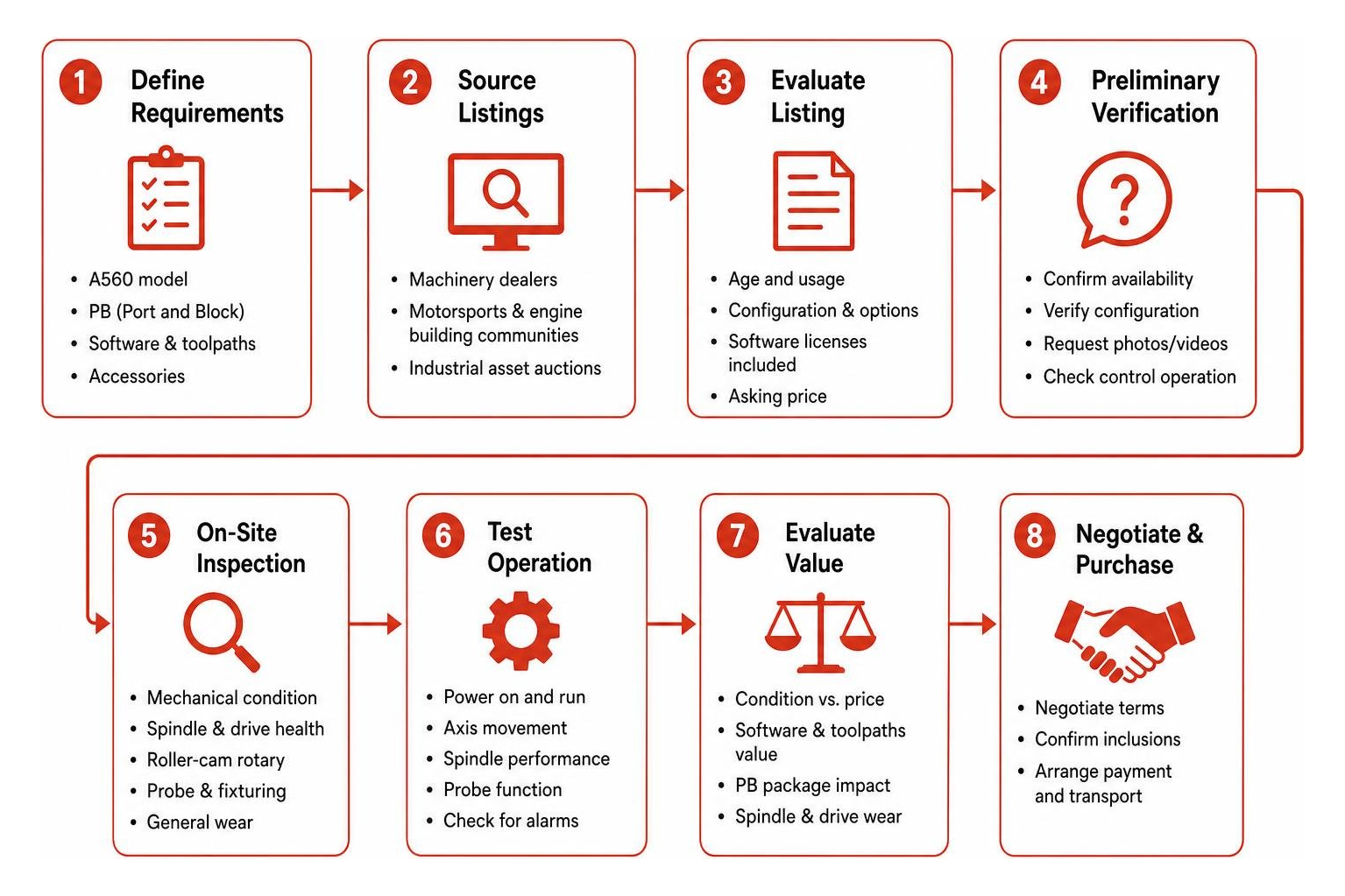
Where to Source a Used Centroid A560 for Sale
Because owners rarely decommission these machines while their engine shops remain active, standard public classifieds rarely have listings. When searching for available inventory, consider these sourcing channels:
- Specialized Machinery Marketplaces: Reputable industrial machinery dealers frequently handle shop liquidations, trade-ins, and consignments before machines reach public auction boards.
- Motorsports and Engine Building Communities: Professional racing networks, engine-building classifieds, and industry-specific discussions are prime locations where shop owners post upcoming equipment upgrades.
- Industrial Asset Auctions: Shop closures and commercial bankruptcy liquidations occasionally feature fully tooled machines. Ensure you inspect or verify the control operational status prior to bidding, as auction units are generally sold without warranties.
Technical Capabilities: 5-Axis Porting and Engine Block Blueprinting
The A560 combines multi-axis cylinder head porting, on-machine digitizing, and comprehensive block machining into a single physical footprint.
B-Axis Roller Cam Drive and 3+2 Kinematics
At the heart of the machine's contouring capability is its articulating B-axis spindle head. The B-axis utilizes a heavy-duty roller cam drive mechanism providing +/- 90 degrees of tilt (180 degrees total travel).
To support heavy-stock removal during engine block blueprinting or billet fabrication, the head incorporates a high-pressure hydraulic brake. When locked in place, the brake eliminates angular deflection during heavy drilling, deck surfacing, and rigid tapping, giving the articulating head the rigidity of a fixed vertical machining center.
The machine functions through both simultaneous multi-axis motion and rigid 3+2 positional machining:
- Continuous 5-Axis Contouring: Essential for driving lollipop cutters through curved intake and exhaust ports without tool gouging.
- 3+2 Positioning: Locks the head at compound angles to perform lifter bore machining, splayed 4-bolt main cap conversions, and compound head stud drilling.
- Integrated Probing: Equipped with continuous digitizing probes (such as the DP-4 or DP-7), the system reads physical hand-ported heads directly on the spindle table, passing coordinate geometry straight into CAM software without requiring an external coordinate measuring machine (CMM).
Standard A560 vs A560 XL Model Differences
For shops working on larger diesel blocks, industrial powerplants, or custom multi-cylinder marine applications, the A560 was produced in both standard and extended travel (XL) variants.
| Specification | Centroid A560 | Centroid A560 XL |
|---|---|---|
| X-Axis Travel | 42 in (1,067 mm) | 60 in (1,525 mm) |
| Y-Axis Travel | 24 in (607 mm) | 26 in (660 mm) |
| Z-Axis Travel | 37 in (904 mm) | 37 in (904 mm) |
| Spindle Horsepower | 36 HP standard (42 HP opt.) | 36 HP standard (42 HP opt.) |
| Max Spindle Speed | 20,000 RPM (CAT 40) | 20,000 RPM (CAT 40) |
| Table Load Capacity | 2,200 lbs (1,000 kg) | 2,425 lbs (1,100 kg) |
| Tool Changer Capacity | 30-Station Swing Arm | 40-Station Swing Arm |
| Machine Weight | 15,500 lbs (7,031 kg) | 23,000 lbs (10,432 kg) |
| Max Head Length | 29 1/8 inches | 48+ inches |
| Max Block Length | 25 1/2 inches | 40+ inches |
The standard A560 accommodates nearly all production V8s, inline engines, and motorcycle heads. For specialized engine applications, review practical cylinder head and block fixturing setups to ensure the table travels match your shop's component portfolio.
Critical Evaluation: What to Inspect Before Buying
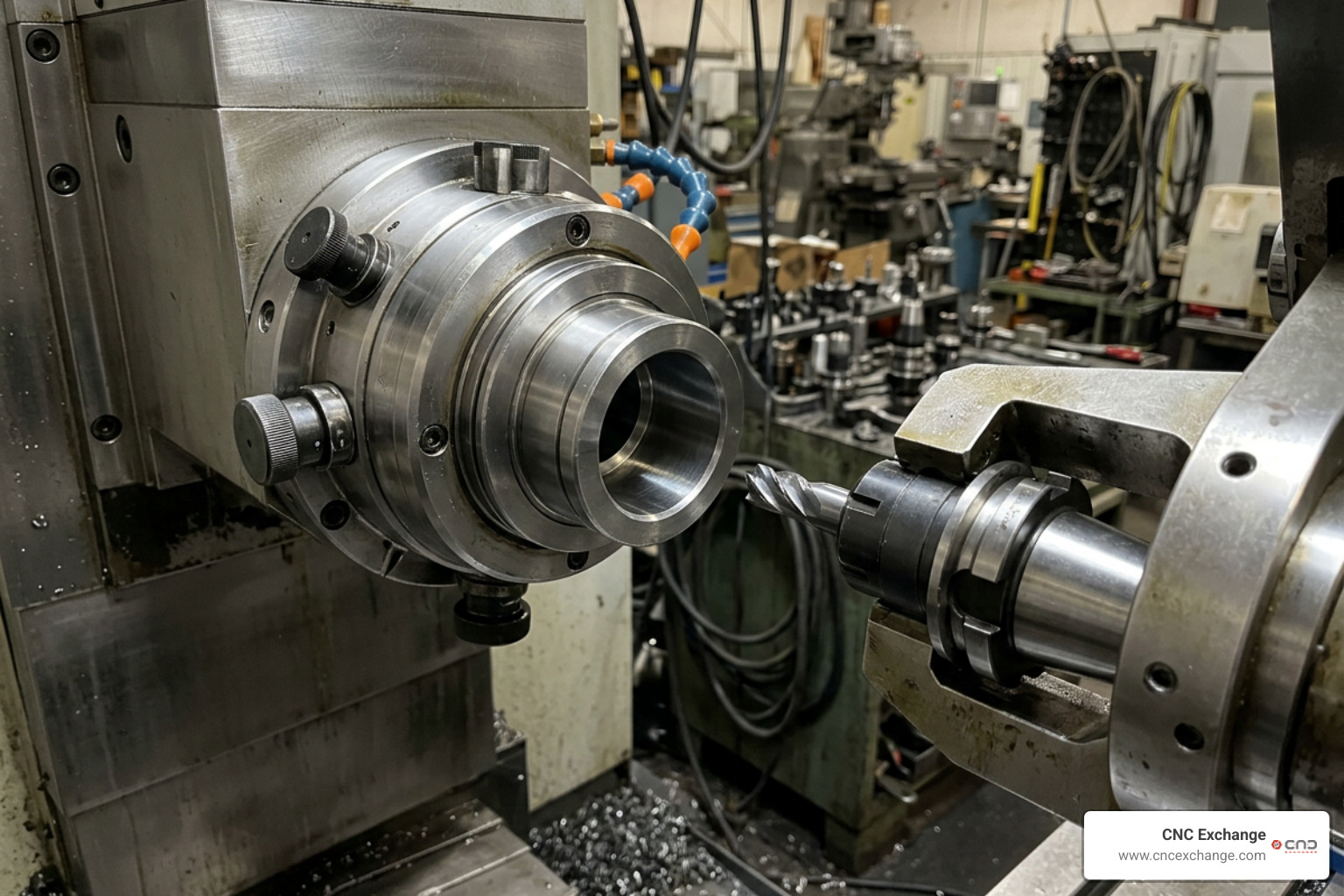
When evaluating a pre-owned machine, a systematic physical inspection ensures you avoid unexpected rebuild expenses.
Key Inspection Checklist for a Used Centroid A560 for Sale
- Spindle Runout and Bearing Noise: Run the 20,000 RPM spindle across its full operational range. Check for excessive vibration, bearing whine, and thermal rise. Use a dial test indicator inside the CAT 40 taper to confirm total indicated runout (TIR) is within 0.0002 inches.
- B-Axis Roller Cam Backlash: Check for mechanical play in the articulating head at various angular positions (e.g., 0°, +45°, -45°). Engage and release the hydraulic brake to verify proper holding torque and seal integrity.
- Linear Guideways and Ball Screws: Inspect the linear guides and ballscrews across the X, Y, and Z axes for scoring, lubrication breakdown, or backlash. The factory positioning accuracy is rated at 0.0005 inches with 0.0002 inches repeatability; high deviation points to worn thrust bearings or ball nuts.
- Automatic Tool Changer (ATC): Run the 30-position tool changer through multiple tool change cycles. Check for smooth arm rotation, positive tool retention, and proper alignment during spindle orientation.
- Spindle Chiller and Hydraulic Unit: Inspect the closed-loop spindle chiller and hydraulic power unit for fluid leaks, steady operating pressure, and clean heat exchanger coils.
Turnkey Packages, Tooling Fixtures, and Software Licensing
Acquiring the iron is only part of the investment. To ensure immediate operational readiness, check what accessories and licenses are included in the transfer:
- Software Dongles & Post-Processors: Confirm whether Mastercam Port Expert licenses and Centroid CNC12/M400 control software unlock codes convey with the sale.
- Digitizing Probes: Verify the physical condition and calibration status of the spindle probe (DP-4 or DP-7).
- Fixture Plates & Bore Adapters: Standard cylinder head rolling fixtures require bore-spacing adapter plates (often costing roughly $1,400 each when bought new). Having common Small Block and Big Block Chevy/Ford plates included significantly reduces initial setup costs.
- Tooling Packages: CAT 40 toolholders, extended-reach collet chucks, and specialized carbide porting cutters represent substantial tooling value if included with the purchase.
Frequently Asked Questions About the Centroid A560
Is the Centroid A560 a true 5-axis machine or a 3+2 positioning center?
The Centroid A560 is capable of true simultaneous 5-axis motion as well as 3+2 positional machining. During cylinder head porting, the controller coordinates the X, Y, Z linear axes alongside the articulating B-axis and rotating A-axis to maintain optimal cutter engagement through curved runners. For operations like engine block deck surfacing, cylinder boring, and main cap drilling, the machine utilizes 3+2 positioning, locking the B-axis via its hydraulic brake for maximum tool rigidity.
Can the Centroid A560 machine both cylinder heads and engine blocks?
Yes. When equipped with the Port/Block (PB) option and unified engine fixturing, the machine accommodates cylinder heads up to 29 1/8 inches and engine blocks up to 25 1/2 inches. The conversational control includes canned cycles for automatic block blueprinting, cylinder boring, head stud conversion, lifter bore machining, stroker crank clearance, and deck surfacing without requiring manual G-code programming.
What rigging and electrical requirements are needed for installation?
The standard A560 weighs 15,500 lbs (7,031 kg), while the XL variant weighs 23,000 lbs (10,432 kg). Installation requires heavy-duty rigging equipment, a reinforced concrete foundation (minimum 6-inch solid slab recommended), a 208–240 VAC 3-phase electrical drop rated at 100 Amps, and a clean, dry compressed air supply delivering 90–100 PSI at 15 CFM.
Conclusion
A pre-owned Centroid A560 offers motorsports teams and performance engine builders a versatile platform for head digitizing, 5-axis porting, and engine block blueprinting. By methodically verifying the B-axis roller cam assembly, spindle condition, software licensing, and included fixturing, buyers can secure exceptional machining capability at a fraction of new turnkey capital costs.
If you are expanding your shop's machining capacity or looking to upgrade your existing equipment, browse available inventory of used CNC machinery for sale to find vetted, high-performance machinery tailored to your production needs.