
The Manual Horizontal Boring Mill Is Not Dead — It's Just Misunderstood
A manual horizontal boring mill is a machine tool that uses a rotating horizontal spindle to enlarge and finish pre-drilled or cast holes in large, heavy workpieces — all controlled by an operator through handwheels, levers, and (increasingly) digital readouts rather than a CNC program.
Quick answer — what sets a manual HBM apart:
| Feature | Manual HBM |
|---|---|
| Control method | Handwheels, levers, pendant controls, DRO |
| Best for | Low-volume, large, or one-off heavy parts |
| Spindle diameter | Typically 3" to 5" (75mm–130mm) |
| Typical table load | 2,500 lbs up to 26,500 lbs depending on model |
| Key advantage | Lower cost, flexible setup, no programming required |
| Key limitation | Slower cycle times, operator-dependent precision |
The machining world has largely moved on to CNC. Flashy 5-axis machining centers and automated pallet changers get all the attention. But walk into any serious heavy-manufacturing job shop — the kind rebuilding massive gear housings, boring out engine blocks, or refurbishing industrial weldments — and you will almost certainly find a big, heavy, decades-old boring mill still holding its own.
These machines trace their lineage all the way back to 1775, when John Wilkinson invented the first boring machine to solve a very real industrial problem. That core idea — a horizontal rotating spindle advancing into a stationary workpiece — hasn't changed much since. And for a lot of heavy machining work, it doesn't need to.
The used market alone tells the story. There are over 118 listed horizontal boring mills available at any given time, with the overwhelming majority being pre-owned manual machines from makers like Giddings & Lewis, TOS, DeVlieg, and Shibaura. Experienced machinists and shop owners keep buying them — not out of nostalgia, but because they work.
I'm Jared Gray, and over my 12+ years of buying, selling, and brokering manufacturing equipment — including a wide range of manual horizontal boring mill inventory across our 30,000-square-foot showroom — I've seen why these machines refuse to disappear. In this piece, I'll break down exactly why that is, and help you decide whether one belongs in your shop.
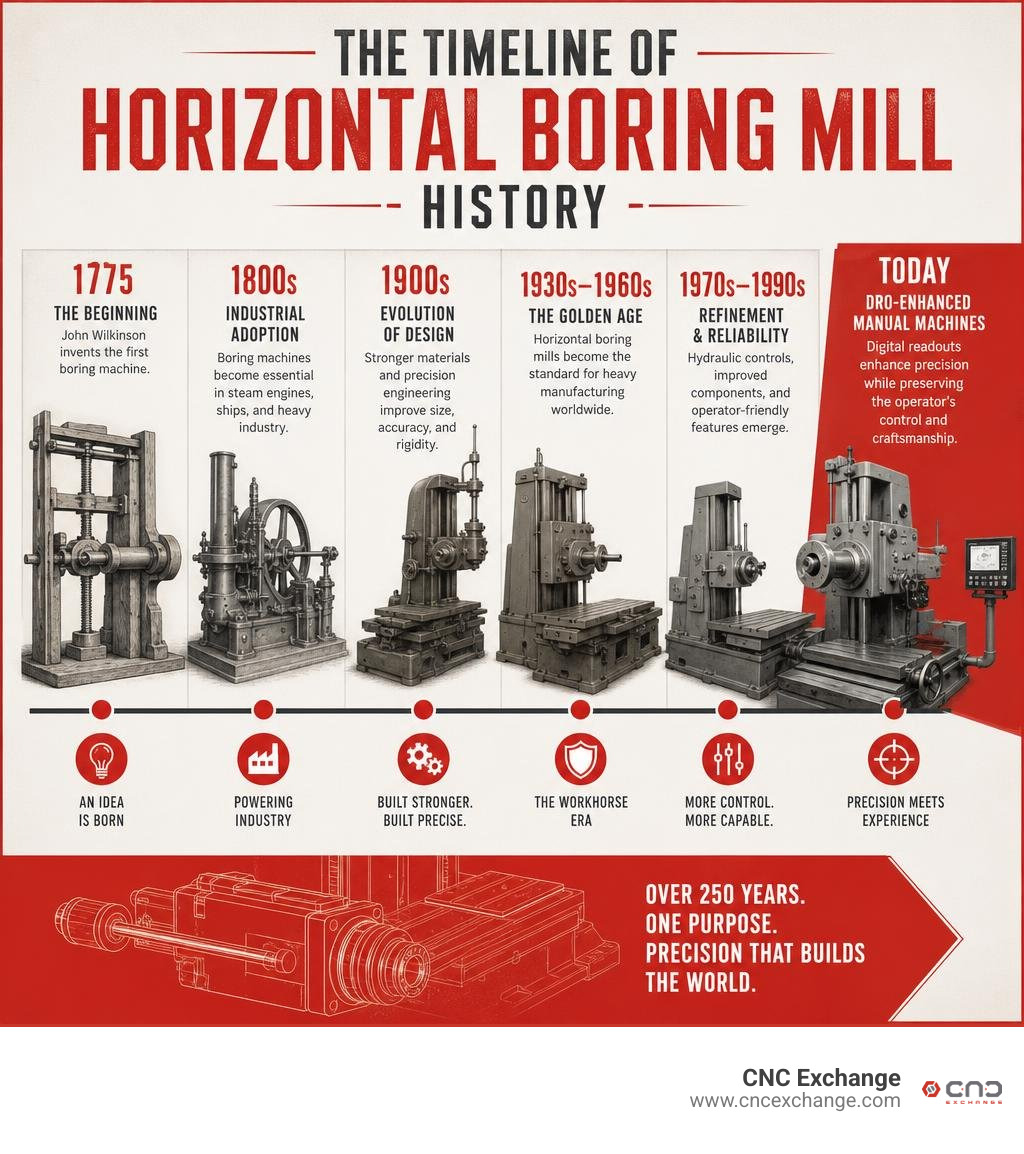
Why the Manual Horizontal Boring Mill Remains an Unsung Hero
When people think of manual machine tools, they often picture a small lathe in a hobbyist's garage or a basic knee mill used for quick bracket modifications. The manual horizontal boring mill is a completely different beast. These are massive, industrial-grade workhorses designed to handle workpieces that would crush standard milling machines.
The secret to their enduring relevance lies in their structural rigidity. Most classic manual HBMs are constructed from heavily ribbed Meehanite cast iron. This material is globally celebrated for its incredible vibration-dampening properties and structural strength. When you are spinning a heavy boring bar deep inside a massive casting, vibration is the enemy of precision. The sheer mass of a cast iron boring mill absorbs these forces, allowing for smooth, accurate cuts even at the limits of the machine's capacity.
For low-volume production and custom job shops, a manual HBM is often the most cost-effective tool in the building. If a client brings in a single, massive gearbox housing that needs a bearing bore repaired, writing a CNC program, setting up software coordinates, and verifying the tool paths can take hours. A skilled operator on a manual machine can mount the part, align it using manual handwheels, and start cutting in a fraction of the time. In our industry, time is money, and for one-off repair work, the manual mill is still king.
The Anatomy of a Classic Manual Horizontal Boring Mill
To truly appreciate these machines, you have to understand how they are built. Unlike a standard milling machine where the spindle moves primarily on a vertical axis, a horizontal boring mill features a spindle mounted horizontally that advances outward from the headstock.
Here are the key components that make up this classic design:
- The Spindle Quill: This is the heart of the machine. The spindle advances along the longitudinal axis (known as the W-axis), allowing the cutting tool to reach deep inside small, restricted cavities of massive workpieces without moving the entire column or table.
- The Column: A massive, vertical cast iron structure that supports the headstock and guides its vertical movement (the Y-axis).
- The Ways: These are the physical tracks on which the table, saddle, and column travel. High-quality machines feature hardened and ground guideways (often called hardways) to ensure long-term geometric accuracy.
- Independent Outriggers: To support exceptionally heavy or oddly shaped workpieces, many manual HBMs feature auxiliary outrigger supports. These outriggers run parallel to the bedways, supporting the saddle and table at the extreme limits of their travel to prevent sagging or misalignment.
- Table Load Capacity: The physical capacity of these machines is staggering. While smaller units might support 5,500 lbs (2,500 kg), larger heavy-duty models can easily support workpieces weighing up to 26,500 lbs (12,000 kg) or more on tables exceeding 70" x 78".
Primary Applications: Where Manual Precision Beats Automation
Where do we actually see these machines in action? They excel in environments where parts are too large, too heavy, or too awkwardly shaped to be rotated on a vertical lathe or fit inside a standard machining center.
Common applications include:
- Engine Blocks: Boring out cylinders and aligning main bearing saddles on massive diesel engine blocks for the marine, locomotive, and power generation industries.
- Gear Housings: Precision finishing of internal bearing bores in large, box-type industrial gearboxes to ensure perfect shaft alignment.
- Heavy Castings and Weldments: Machining flat mounting surfaces and boring out alignment holes on custom structural fabrications.
- Repair and Maintenance Work: Restoring worn-out bores on heavy construction equipment, mining machinery, and industrial presses.
When a single mistake on an irreplaceable, multi-ton casting can cost tens of thousands of dollars, having a highly skilled machinist manually "feeling" the cut through the handwheels provides an invaluable layer of security. This tactile feedback is something no CNC program can replicate. For specialized custom shops looking to expand their heavy machining capabilities, understanding these physical limits is key, as detailed in our guide on Capabilities | Detail Equipment Specification.
The Great Divide: Manual vs. CNC in Heavy Machining
It is easy to assume that CNC is always better, but the choice between manual and CNC horizontal boring mills is rarely black and white. It is a balance of setup times, capital expenditure, operator skill, and the specific nature of your work.
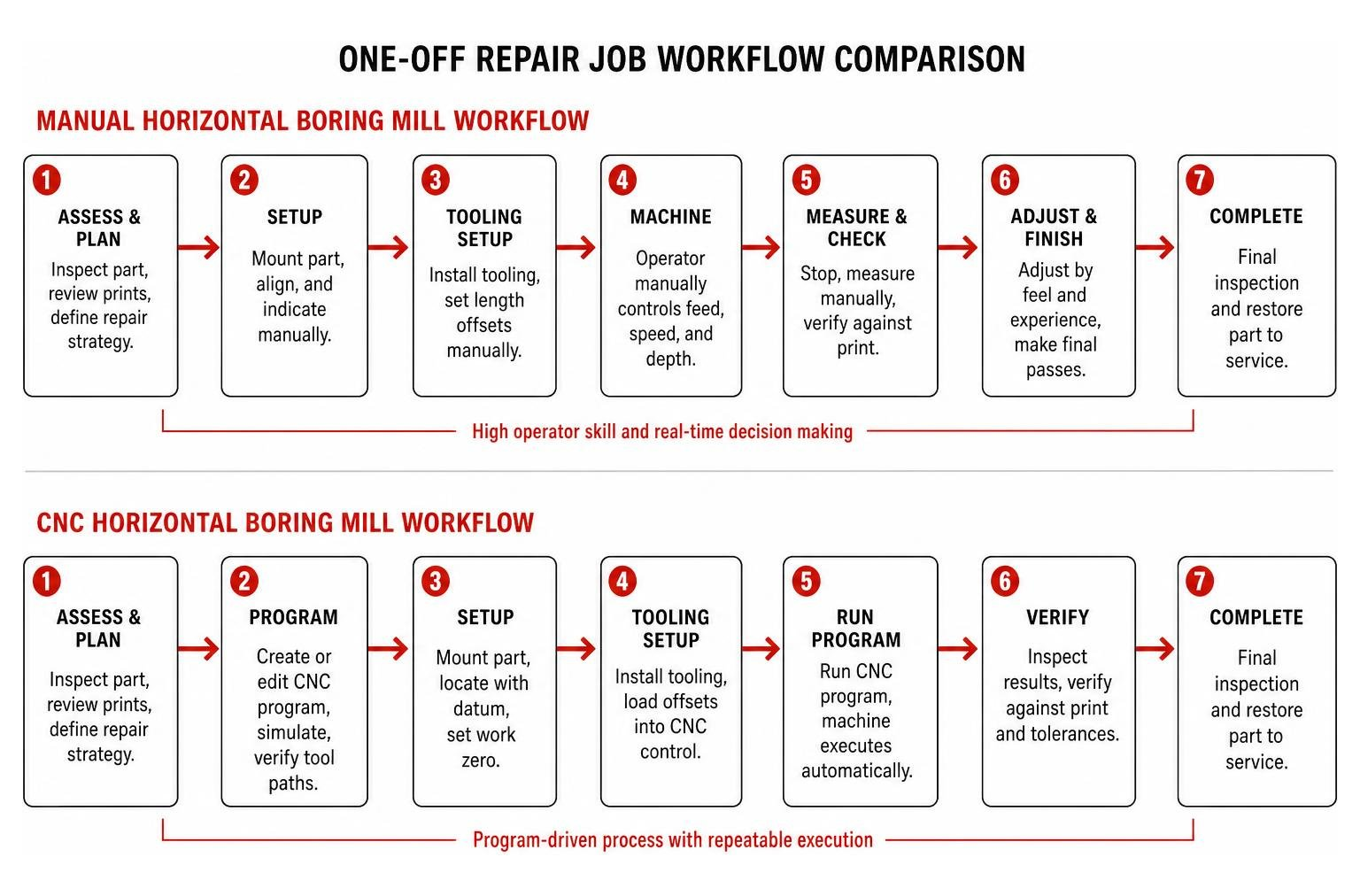
Let's break down how these two approaches compare across the most critical operational categories:
| Operational Metric | Manual Horizontal Boring Mill | CNC Horizontal Boring Mill |
|---|---|---|
| Capital Expenditure | Relatively low ($15k - $50k used) | Extremely high ($150k - $800k+) |
| Setup Time (One-Offs) | Fast (direct physical alignment) | Slow (programming, dry runs, software alignment) |
| Production Speed | Slow, operator-dependent | Fast, automated continuous cutting |
| Required Skillset | Deep mechanical intuition, manual layout | G-code programming, CAD/CAM software |
| Tactile Control | High (operator feels tool pressure) | None (entirely automated) |
| Complexity of Geometries | Limited to standard coordinates/angles | Virtually unlimited (3D contours, complex curves) |
For high-volume production of complex parts, CNC is the clear winner. But if your business model relies on heavy repair work, custom fabrications, or low-volume industrial components, a manual horizontal boring mill offers a level of flexibility and cost-efficiency that is incredibly hard to beat.
Key Differences in Setup, Control, and Deflection
One of the major mechanical advantages of a horizontal boring mill over a standard horizontal machining center (HMC) is how it manages tool deflection. On a standard mill, reaching deep into a cavity requires a long, extended tool holder, which is highly susceptible to bending and vibration.
On an HBM, the spindle quill itself extends along the W-axis. Because this quill is housed inside a massive, rigid headstock casting, it provides vastly superior support. This means you can perform deep-hole boring operations with minimal deflection, maintaining tight tolerances over long distances.
The control interfaces also dictate how these machines are operated. On a manual mill, the operator uses physical handwheels, levers, and joysticks on a central pendant to control feed rates and spindle speeds. This hands-on interface allows the machinist to adjust parameters on the fly based on the sound, vibration, and chip formation of the cut. For a deeper look at the mechanical specifications and physical controls of these heavy-duty systems, you can review the technical documentation available in the SUMMIT manual.
The Role of Digital Readouts (DRO) in Bridging the Gap
If there is one technology that has saved the manual horizontal boring mill from obsolescence, it is the Digital Readout (DRO). Back in the day, manual operators had to rely on physical vernier scales and dials to track their position. This was time-consuming and highly prone to human error.
Today, almost every productive manual HBM is retrofitted with a multi-axis DRO system from manufacturers like Acu-Rite or Heidenhain. These systems use high-precision linear scales mounted directly to the machine's axes to track physical movement.
By integrating a modern DRO, a manual machine can achieve:
- 0.005 mm Precision: Real-time coordinate tracking down to the micrometer level, eliminating the guesswork of manual handwheels.
- Easy Indexing: Quickly switching between absolute and incremental dimensions, making multi-hole layouts incredibly simple.
- Inch/Metric Conversion: Instantaneous unit switching at the touch of a button, allowing shops to handle international jobs with ease.
- Error Reduction: Visually displaying coordinates on a bright screen, drastically reducing the risk of costly operator miscalculations.
With a DRO, a manual horizontal boring mill becomes a high-precision coordinate measuring and cutting machine, effectively bridging the gap between old-school manual craftsmanship and modern electronic accuracy.
Sourcing the Iron: Rebuilt Classics vs. Modern Imports
If you've decided that a manual HBM is the right fit for your shop, you face a major decision: do you buy a brand-new imported machine, or do you source a rebuilt classic from the golden era of machine tool manufacturing?
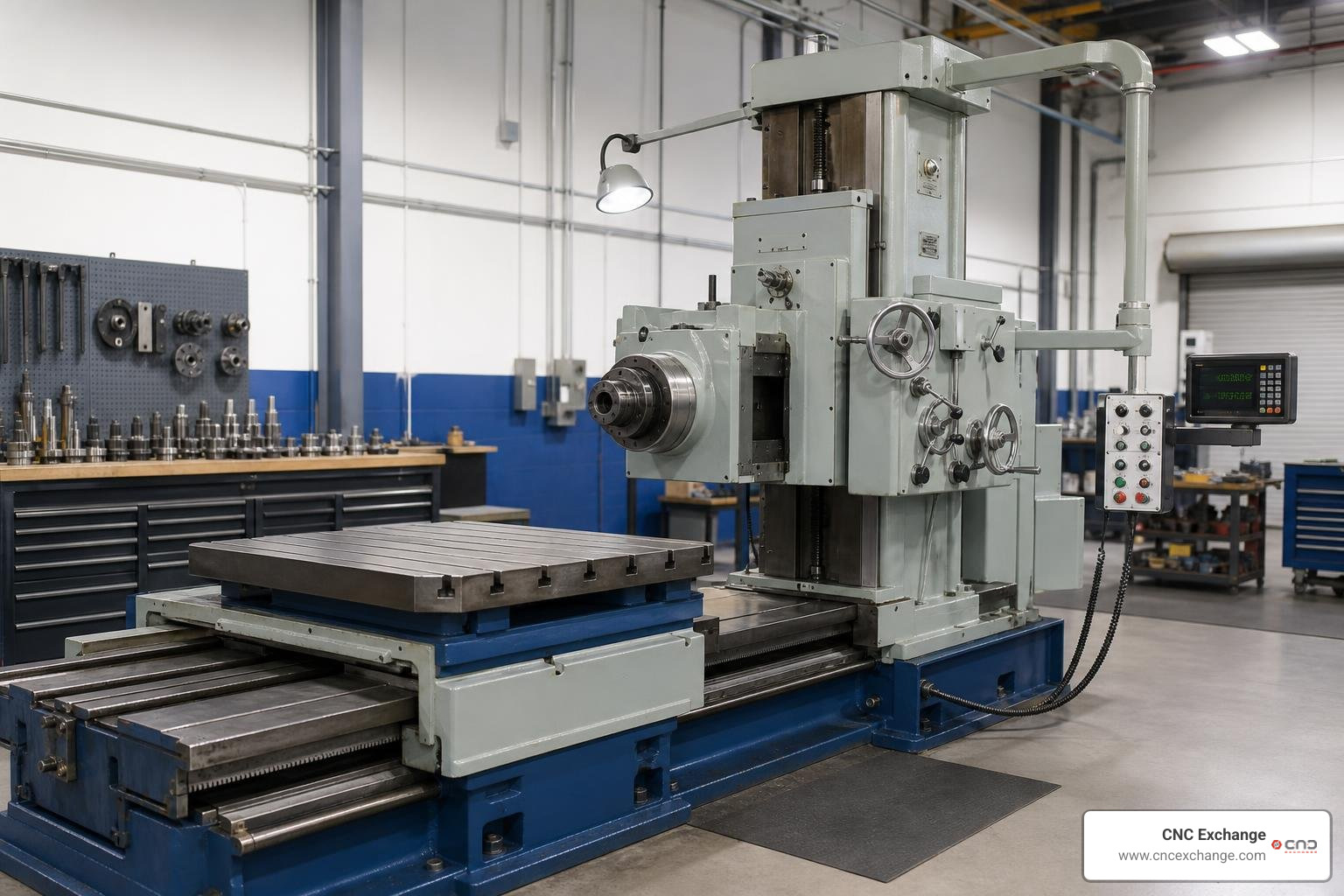
If you read the forums on Practical Machinist or talk to old-timers in the trade, the consensus is clear: most manual machines being made today are either lower-quality imports or fantastically expensive high-end specialty models.
For this reason, the premier strategy for most North American machine shops is "rebuilding old iron." Sourcing a classic, American-made or European-made manual boring mill and restoring it to OEM specifications is often far more cost-effective than buying new. These vintage machines were built with a level of structural mass and hand-scraped precision that is virtually impossible to find in modern budget machinery.
What to Look For When Buying a Used Manual Horizontal Boring Mill
When inspecting a used or rebuilt manual HBM, you need to look past the fresh paint and evaluate the physical geometry of the machine. Because these tools are used for heavy-duty metal removal, they are subject to immense physical forces over their lifespans.
Here is your inspection checklist:
- Inspect the Bedways: Look closely at the hardways. Are there deep scores, ridges, or visible wear patterns? Wear on the bedways will directly translate to geometric inaccuracies in your finished parts.
- Check for Backlash: Rotate the handwheels and measure how much they turn before the table or saddle actually moves. While some backlash is normal on manual lead screws, excessive play indicates worn nuts or screws.
- Evaluate Spindle Wear: Check the internal spindle taper (commonly ISO 40, ISO 50, or Morse Taper). Look for scoring or pitting that could prevent rigid tool clamping. Run the spindle at various speeds to listen for bearing noise.
- Verify the Lubrication System: Heavy boring mills rely on centralized lubrication systems to keep the massive ways and gearboxes running smoothly. Ensure all metering units are clear and oil is actively reaching the guideways.
If you are looking for a proven, heavy-duty platform with a massive work envelope, classic models like the Giddings and Lewis 70 E4 T Horizontal Boring Mills are legendary for their durability and make excellent candidates for rebuilding or direct shop integration.
Legendary Manufacturers: The Gold Standard of Old Iron
When searching the used market, certain brand names stand out as the gold standard of heavy machining. These manufacturers built machines designed to last for generations:
- Giddings & Lewis (G&L): Perhaps the most famous name in American boring mills. Known for their rock-solid construction and massive capacities. Spindle diameters commonly range from 3" to 5", with models like the 65-Series remaining highly sought after.
- DeVlieg: Famous for their "Jigmils." While technically a highly specialized, ultra-precise horizontal boring and milling machine, DeVliegs are legendary for holding incredibly tight tolerances.
- TOS (Varnsdorf): A highly respected European manufacturer. Models like the TOS W100A are incredibly popular in job shops globally for their versatile built-in rotary tables and reliable mechanical designs.
- Lucas Precision: Another legendary American brand. Lucas machines are so highly regarded that specialized rebuilders still support and remanufacture them today. If you are looking for a heavy-duty manual machine with a proven track record of precision, models like the Lucas 441B72 Horizontal Boring Mills are highly recommended.
- Union: Known for producing robust, long-lasting German-engineered machine tools. A classic model like the Union BFT 105 Horizontal Boring Mills is a perfect example of a highly reliable, mid-sized table-type mill that continues to deliver exceptional service in modern repair shops.
Frequently Asked Questions about Horizontal Boring Mills
What is the difference between a table-type and a floor-type boring mill?
The primary difference lies in which part of the machine moves to accommodate the workpiece.
- Table-Type (Universal) Boring Mills: The workpiece is clamped to a table that moves along the X (cross) and Z (longitudinal) axes relative to the spindle. These are ideal for compact, boxy parts like engine blocks and gearboxes.
- Floor-Type Boring Mills: The workpiece remains completely stationary, clamped to a massive floor plate. The entire column of the machine travels along a floor track to reach different areas of the part. These are reserved for exceptionally large, heavy, or long structural components that are too massive to be moved on a table.
For shops handling medium-to-heavy industrial parts, a versatile table-type machine with an integrated rotary table offers the best balance of footprint and capability, as seen in the specifications of the Comprehensive Overview of HBM-110L Horizontal Boring & Milling Machine · Chung Sing Machinery.
Why is the W-axis so critical on a horizontal boring mill?
On a standard 3-axis milling machine, the Z-axis controls the depth of the cut by moving the table or the entire headstock. On a horizontal boring mill, depth is managed by two distinct axes: the Z-axis (which moves the table closer to the column) and the W-axis (which physically extends the boring spindle quill outward from the headstock).
The W-axis is critical because it allows you to reach deep inside restricted cavities or bore through multiple parallel walls of a large casting while keeping the massive table and column stationary. This minimizes the moving mass during the cut, which dramatically increases tool rigidity and improves the geometric accuracy of the bore.
Is it better to buy a new import or rebuild an older American machine?
This is the ultimate job shop debate. A new import offers the peace of mind of a factory warranty and modern electrics, but the structural castings are often lighter and less rigid than vintage machines.
Rebuilding a classic American or European machine (like a G&L, Lucas, or TOS) gives you access to incredibly high-quality, heavy-duty cast iron frames that have already "settled" over decades, meaning they will not warp or distort. When properly scraped, fitted with new lead screws, and retrofitted with a modern DRO, a rebuilt classic will often hold tighter tolerances, handle heavier cuts, and hold its resale value far better than a cheap modern import.
Conclusion
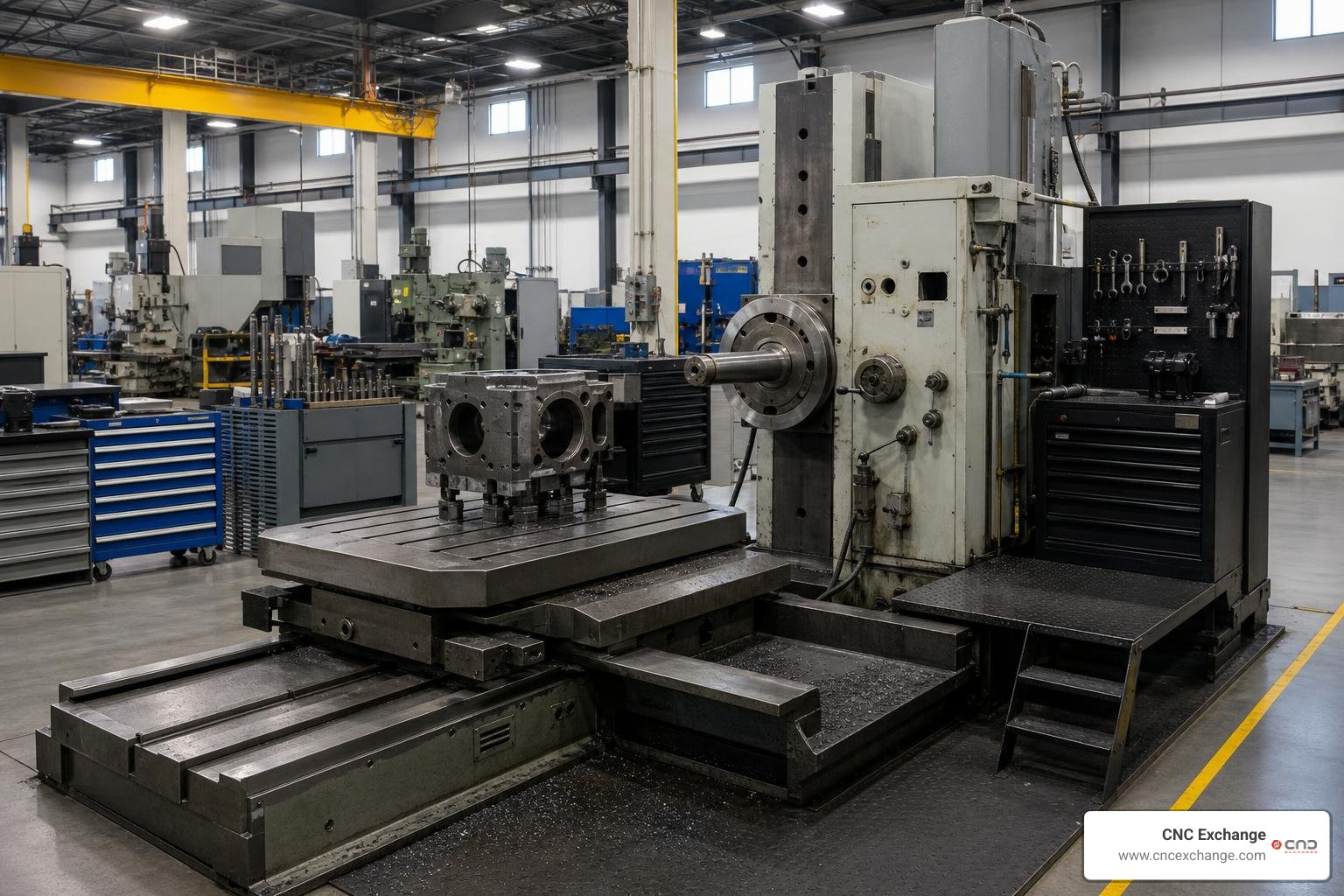
The manual horizontal boring mill may seem like a relic of a bygone era, but in heavy industry, repair, and custom job shops, it remains an indispensable asset. It represents a perfect marriage of tactile craftsmanship, massive physical rigidity, and modern coordinate tracking through digital readouts.
If your business relies on making massive, complex, or one-off parts, don't let the allure of full automation blind you to the practical, cost-effective reality of manual "old iron." Sometimes, the best way to move your shop forward is to bring in a classic workhorse that was built to last.
At CNC Exchange, we help manufacturers navigate these machinery decisions every day. From our headquarters in Prospect Heights, Illinois, we buy, sell, and auction a wide range of industrial equipment, helping you achieve fair market value for your surplus or upgrade your capabilities with confidence.
If you are ready to explore your options, we invite you to browse our current inventory of used horizontal boring mills or contact our team of machine tool experts today. Let's find the perfect piece of iron to keep your shop cutting precisely for decades to come.