
Why Buying CNC Machinery in 2026 Is One of the Smartest Production Investments You Can Make
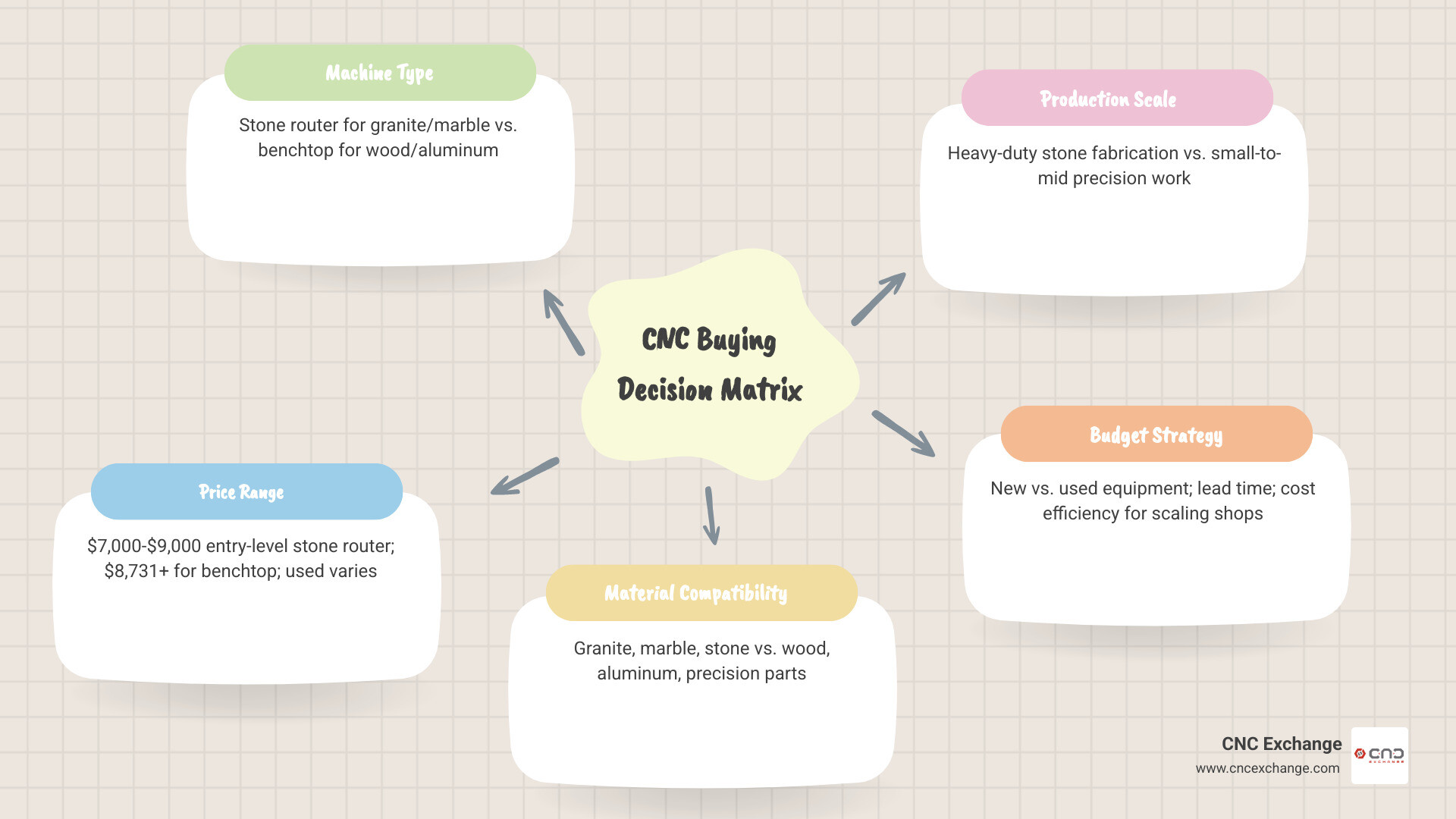
If you're in the market for CNC machinery for sale, here's a quick look at what's available and what you should expect to pay:
| Machine Type | Best For | Price Range |
|---|---|---|
| Stone CNC Router (1228) | Granite, marble, stone fabrication | $7,000 – $9,000 |
| Benchtop CNC (3'x3') | Wood, aluminum, precision parts | $8,731+ |
| Used CNC Equipment | Budget-conscious buyers, scaling shops | Varies widely |
Manufacturing costs are rising. Lead times on new equipment are long. And for many small-to-mid-size shops, buying new isn't always the most practical path forward.
That's where the used CNC equipment market comes in.
Whether you need a heavy-duty stone router for fabricating granite countertops or a compact benchtop machine for precision aluminum work, the used market offers real options at a fraction of new prices — if you know what to look for.
This guide walks you through the key machine types, specs that matter, and how to avoid costly mistakes when evaluating used equipment.
I'm Jared Gray, and with over 12 years of experience buying, selling, and brokering CNC machinery for sale — including managing a 30,000-square-foot showroom where machines are available for live demos — I've seen what separates a smart purchase from an expensive regret. Let's make sure you're in the first category.
Key Types of CNC Machinery for Sale: Stone Routers vs. Benchtop Models
When browsing the market for CNC machinery for sale, it is easy to get overwhelmed by the sheer variety of configurations. However, most equipment falls into distinct classes based on frame rigidity, footprint, and intended material compatibility.
To help you visualize the core differences, here is a quick comparison:
| Feature | Industrial Stone CNC Router | Compact Benchtop CNC |
|---|---|---|
| Primary Materials | Granite, marble, quartz, engineered stone | Hardwoods, plywood, plastics, aluminum |
| Typical Footprint | Extremely large (heavy cast-iron/steel frame) | Space-saving (fits on a sturdy workbench) |
| Drive System | High-torque rack & pinion or heavy ballscrews | Dual-drive precision ballscrews |
| Cooling Method | Constant flood water-cooling (with recycling) | Air-cooled or mist coolant for soft metals |
| Dust/Debris Management | Heavy-duty water gutters and splash guards | Vacuum dust shoes and enclosed cabinets |
Heavy-Duty Stone Routers: Industrial CNC Machinery for Sale
If your shop specializes in stone fabrication, architectural elements, or heavy masonry, a standard woodworking router simply won't cut it. Stone processing requires immense frame rigidity to dampen vibrations and specialized tooling designed to handle highly abrasive materials like granite and marble.
Heavy-duty stone routers, such as industrial 1228-size models, are engineered specifically for these harsh environments. These machines frequently feature a dual-spindle approach. By integrating a dedicated horizontal saw spindle alongside a traditional vertical routing spindle, a single machine can execute rapid, straight slab cuts and intricate surface engraving in a single setup.
To drive through dense minerals, these units rely on high-torque configurations, such as a 5.5kw water-cooled spindle paired with a robust 7.5kw inverter system. If you are looking to expand into commercial stone carving or countertop fabrication, exploring this class of 1228 Stone CNC Router With Horizontal Saw Spindle | Blue Elephant CNC options can dramatically lower your entry costs while delivering industrial-grade output.
Compact Benchtop CNC Machines for Precision Work
On the other end of the size spectrum are compact benchtop CNC machines. These units are highly sought after by prototyping labs, educational makerspaces, and small woodworkers or metalworkers who need high precision without sacrificing valuable floor space.
A prime example of this class is the Benchtop PRO 3636 3' x 3' CNC Machine | Avid CNC, which features a versatile 37.6" x 37.6" (955mm x 955mm) work area. Unlike flimsy hobbyist routers, professional-grade benchtop machines utilize rigid aluminum extrusion or cast-aluminum frames and dual-drive ballscrews. This rigid construction allows them to machine non-ferrous metals like aluminum with incredible accuracy, making them a powerhouse for precision parts manufacturing.
Technical Specifications: Spindles, Motors, and Control Systems
Investing in CNC machinery for sale requires looking past the shiny paint job and diving straight into the technical specifications. The right combination of Z-axis travel, spindle power, motor feedback, and controller software determines whether a machine will thrive in your shop or sit idle due to frequent breakdowns.
Maintaining these mechanical assemblies is critical to avoiding unexpected downtime, which is why we always recommend keeping up with Preventive Maintenance Tasks for CNC Routers to protect your investment.
Work Area Dimensions and Z-Axis Travel
The physical work envelope dictates the maximum size of the raw materials you can process. A compact 37.6" x 37.6" work area is perfect for cabinet parts, custom signs, and small mechanical components. However, if you are processing full sheets of Baltic birch or large stone slabs, you will need a larger industrial footprint, such as a 1200x2800mm (approximately 4'x9') work area.
Equally important is the Z-axis travel and the material feeding height clearance. A machine might have a wide table, but if its Z-axis travel is limited to 6 inches, you cannot process thick blocks or use a rotary axis. Professional benchtop models often offer Z-axis travel options up to 9" (230mm), while heavy-duty stone routers can feature 400mm (nearly 16 inches) of Z-axis travel. This generous clearance allows operators to safely load thick stone slabs or mount deep carving fixtures without risking a collision.
Spindle Power, Inverters, and Accuracy Tolerances
The spindle is the heart of any CNC machine. Its power (measured in kilowatts or horsepower) and speed (RPM) determine how fast you can cut. For heavy-duty stone cutting, a 5.5kw water-cooled spindle running at 24,000 RPM provides the necessary torque. This spindle is paired with an inverter (such as a 7.5kw Fuling inverter) that uses advanced control algorithms to maintain constant speed and torque under fluctuating loads, reducing tool wear.
In terms of precision, look closely at the manufacturer's accuracy and repeatability ratings:
- Industrial Stone Routers: Typically achieve a working accuracy of ±0.05mm and a re-positioning accuracy of ±0.03mm.
- Precision Benchtop Units: Can achieve a repeatability of ±0.001" (0.025mm) and a cutting accuracy of ±0.005" (0.127mm) or better.
Selecting a machine with the right tolerances prevents part rejection and keeps your production line running smoothly. Pushing a machine past its accuracy limits can lead to severe component wear, and unexpected CNC Router Downtime Spikes During Spring Rushes when your shop can least afford it.
Stepper Motors vs. Closed-Loop Servo Systems
The drive motors dictate how fast and reliably the machine moves along its axes.
- Standard Stepper Motors (NEMA 23 / NEMA 34): These are highly affordable and reliable, but they operate on an "open-loop" system. If the tool hits a hard knot or takes too deep of a cut, the motor can "lose steps," throwing off the entire coordinate system and ruining the workpiece.
- Closed-Loop Servo Systems (ClearPath / Leadshine Servo): Servos utilize continuous encoder feedback to monitor the motor's actual position. If an error or resistance is detected, the system instantly corrects its position or pauses the job to prevent damage.
Additionally, servo systems deliver incredible speeds. While standard steppers might limit you to cutting speeds of 200 Inches Per Minute (IPM), a servo-driven benchtop machine can reach rapid traverse speeds of up to 500 IPM (or 25m/min on large stone routers), drastically cutting down cycle times.
Choosing the Right Controller: DSP A11 vs. CNC12
The control system is your primary interface with the machine. A poor controller leads to operator frustration, while a great one makes setup a breeze.
- DSP A11 Handheld Controller: This is a standalone, pendant-style controller that does not require a dedicated computer next to the machine. It is incredibly popular for industrial routers because it is immune to computer operating system crashes. It features a built-in watchdog timer to monitor system health and a fault self-diagnosis function that simplifies troubleshooting.
- CNC12 Software: Often paired with PC-based control systems, CNC12 offers a visual, feature-rich interface. It is highly intuitive, supports advanced macro programming, and makes finding your workpiece corners simple when paired with an automatic touch plate.
Maximizing Versatility: Essential Add-Ons and Installation Logistics
When looking at used CNC machinery for sale, the base machine is only part of the equation. To truly maximize your return on investment, you must consider the accessories that expand its capabilities and the logistics of getting the machine up and running in your space.
Whether you are setting up a small garage shop or a multi-million dollar production floor, keeping 5 Must-Know Tips for Machine Shop Safety in mind during the layout phase is essential.
Versatile Upgrades: Rotary Axes, Lasers, and Dust Shoes
To prevent your machine from becoming a single-use tool, consider these highly valuable add-ons:
- Rotary 4th Axis: Allows you to perform 3D indexing and carve cylindrical objects like table legs, columns, or stone pillars.
- Deployable Laser System: High-end benchtop machines can integrate a laser system alongside the spindle. The laser automatically deploys and retracts, letting you engrave fine details or burn part numbers onto a workpiece without manual tool changes.
- Dust Shoe System: Essential for woodworking and plastic routing to keep abrasive dust out of your linear guides and ballscrews.
- Auxiliary Power Relays: These allow the CNC controller to automatically turn on accessories, like your vacuum dust collector or water-coolant pump, only when the spindle is active.
Shipping, Assembly, and Shop Setup Logistics
Before pulling the trigger on a purchase, make sure you have a plan for delivery and installation.
A professional benchtop machine weighs around 307 lbs (139kg) to 312 lbs. It can typically be shipped via standard LTL freight and assembled by two people in about 3 to 5 hours using basic tools.
Industrial stone routers, however, are massive steel-and-iron beasts that require flatbed shipping, a crane or heavy forklift for unloading, and dedicated electrical hookups. You will also need to plan for a water-coolant recycling system to handle the constant flow of water required to cool the diamond tooling and suppress highly hazardous stone dust.
Pricing, Warranties, and Evaluating Used Equipment
The primary appeal of used CNC machinery for sale is the cost savings, but a low price tag can quickly turn into a money pit if you buy a machine with hidden mechanical wear.
Understanding how age and brand affect value is crucial; you can learn more about these dynamics in our guide on What Influences CNC Machine Resale Value Over Time.
Understanding Price Ranges and Cost Justifications
The price of a CNC machine is directly tied to its frame rigidity, drive components, and control systems.
- Entry-Level Industrial / Custom Units: Specialized stone routers can range from $7,000 to $9,000. While this is highly affordable, these machines are often imported and may require a higher degree of technical self-reliance from the buyer.
- Precision Benchtop Units: Premium benchtop packages often start at a base price of $8,731.00. While the physical footprint is smaller, the price is justified by high-end components like closed-loop brushless servos, precision ground ballscrews, and US-based customer support.
When evaluating a used machine, always calculate the "landed cost" — including shipping, rigging, tooling, and any necessary software licenses. For a complete breakdown of these hidden fees, check out our article on the True Cost Used CNC Machines for Sale.
Inspecting and Securing Used CNC Machinery for Sale
If you are buying a used machine that is no longer covered by a manufacturer’s 12-month limited warranty, a thorough pre-purchase inspection is mandatory.
We recommend checking the following key areas:
- Backlash: Test the ballscrews and linear guides for any physical play or wiggle.
- Spindle Bearings: Run the spindle at various RPMs and listen for high-pitched whining or excessive vibration.
- Wiring Harnesses: Inspect the cable carrier tracks for frayed or brittle wiring.
If you are on the other side of the transaction and looking to upgrade your shop's capabilities, you can read our step-by-step guide on How to Sell Your CNC Machine to ensure you get top dollar for your current equipment.
Frequently Asked Questions
What is the difference between stepper and servo motors?
Stepper motors move in fixed increments (steps) and operate in an open-loop system, meaning they cannot detect if they have drifted off course due to material resistance. Servo motors use closed-loop encoder feedback to constantly monitor and correct their position. Servos offer significantly higher speeds, greater torque at high RPMs, and automatic error recovery, but they come at a higher price point than standard steppers.
Can I run a laser and a spindle on the same benchtop CNC?
Yes. Modern professional benchtop CNC machines support deployable laser systems. The laser is mounted on an automated actuator that lowers it into position for engraving and retracts it out of the way when the spindle is routing. This dual-process integration allows you to cut and engrave a workpiece in a single program without manual tool changes.
What are the maintenance requirements for stone CNC routers?
Stone machining creates highly abrasive slurry and dust. Maintenance requires washing down the machine daily, ensuring the water-filtration and recycling systems are free of sediment, and using the automatic lubrication system daily to flush out the linear guide rails and ball screws. Failure to manage stone dust will rapidly destroy bearings and lead to costly mechanical failures.
Conclusion
Finding the right CNC machinery for sale in July 2026 doesn't have to be a stressful process. By focusing on your primary materials, understanding the mechanical differences between stepper and servo drives, and performing diligent pre-purchase inspections, you can secure a high-performing machine that will scale your production for years to come.
At CNC Exchange, we make buying and selling industrial equipment simple, transparent, and secure. Whether you are looking to buy a reliable used machine or trade in your current model to upgrade your capabilities, explore our active inventory of CNC machinery for sale today to find the perfect fit for your shop floor.