
What Is the Machine Used for Turning Wood?
The machine used for turning wood is a wood lathe. It spins a wood blank while you shape it with hand tools, or, in production settings, with CNC-controlled cutters. A lathe can make round or symmetrical parts such as pens, bowls, chair legs, balusters, and decorative columns.
For a practical starting point:
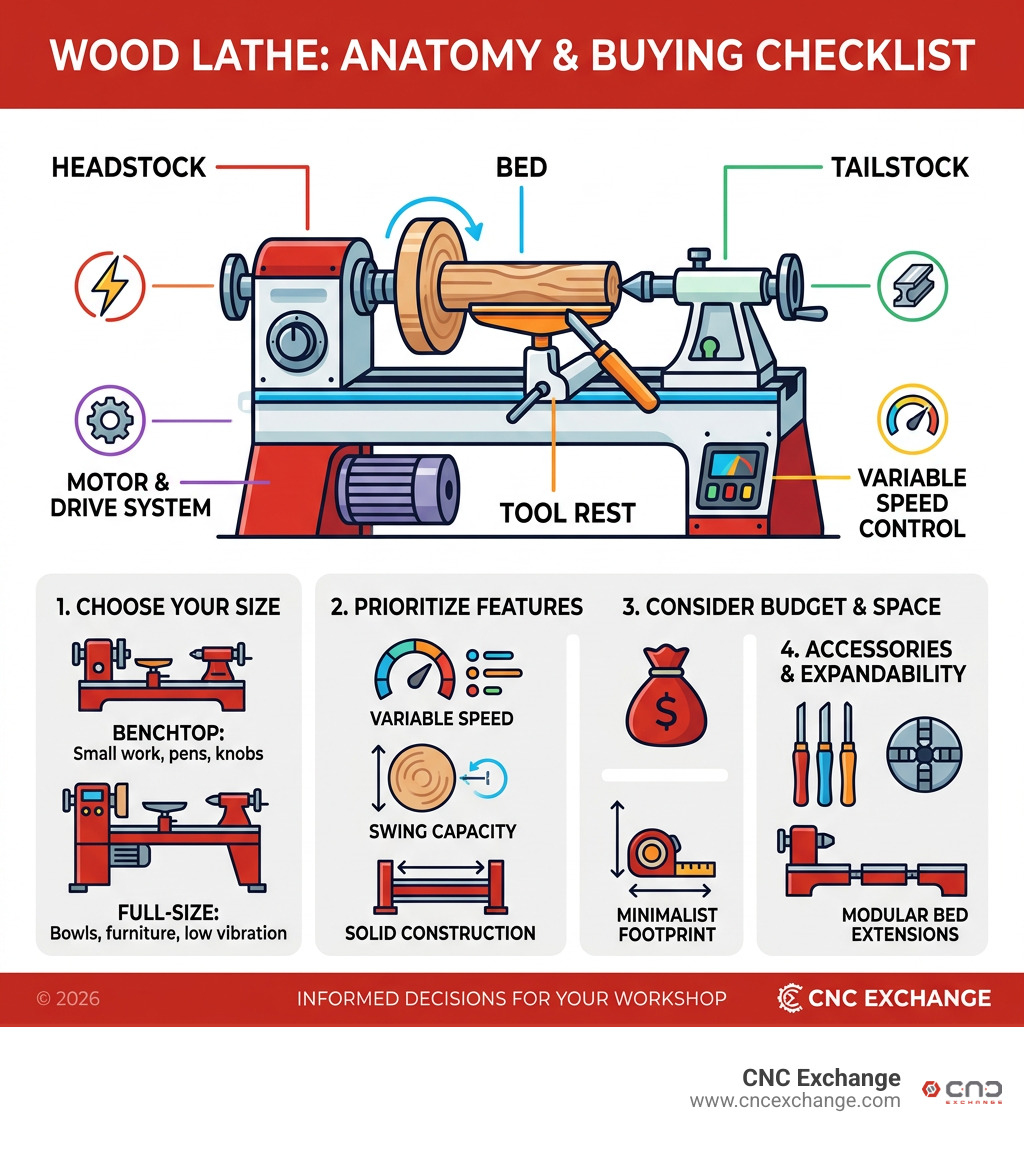
- Choose a benchtop lathe for small work like pens, knobs, and short spindles.
- Choose a full-size, heavier lathe for bowls, long furniture parts, and reduced vibration.
- Prioritize variable speed, enough swing for your largest blank, and a solid bed and base.
- Use a face shield, dust collection, and secure workholding before switching the machine on.
Woodturning has moved from foot-powered lathes to modern electric and CNC systems, but the core idea is unchanged: rotate the workpiece and remove material in controlled passes. The right machine helps a shop turn raw stock into repeatable parts with better finish quality and less manual labor.
I am Jared Gray, with more than 12 years of experience buying, selling, and sourcing manufacturing equipment, including CNC machinery for production shops. I help businesses evaluate the machine used for turning wood based on capacity, condition, workflow, and long-term value.
Understanding the Machine Used for Turning Wood: Core Components and Mechanics
At its core, a wood lathe operates on continuous revolution. While early artisans relied on reciprocal spring-pole systems, modern lathes use continuous electric motors or industrial drive assemblies to rotate the stock against stationary cutting edges. To select and operate equipment effectively, you need to understand the mechanical anatomy that makes precision turning possible. The historical evolution of wood lathes illustrates how foundational these components remain across generations of machine design.
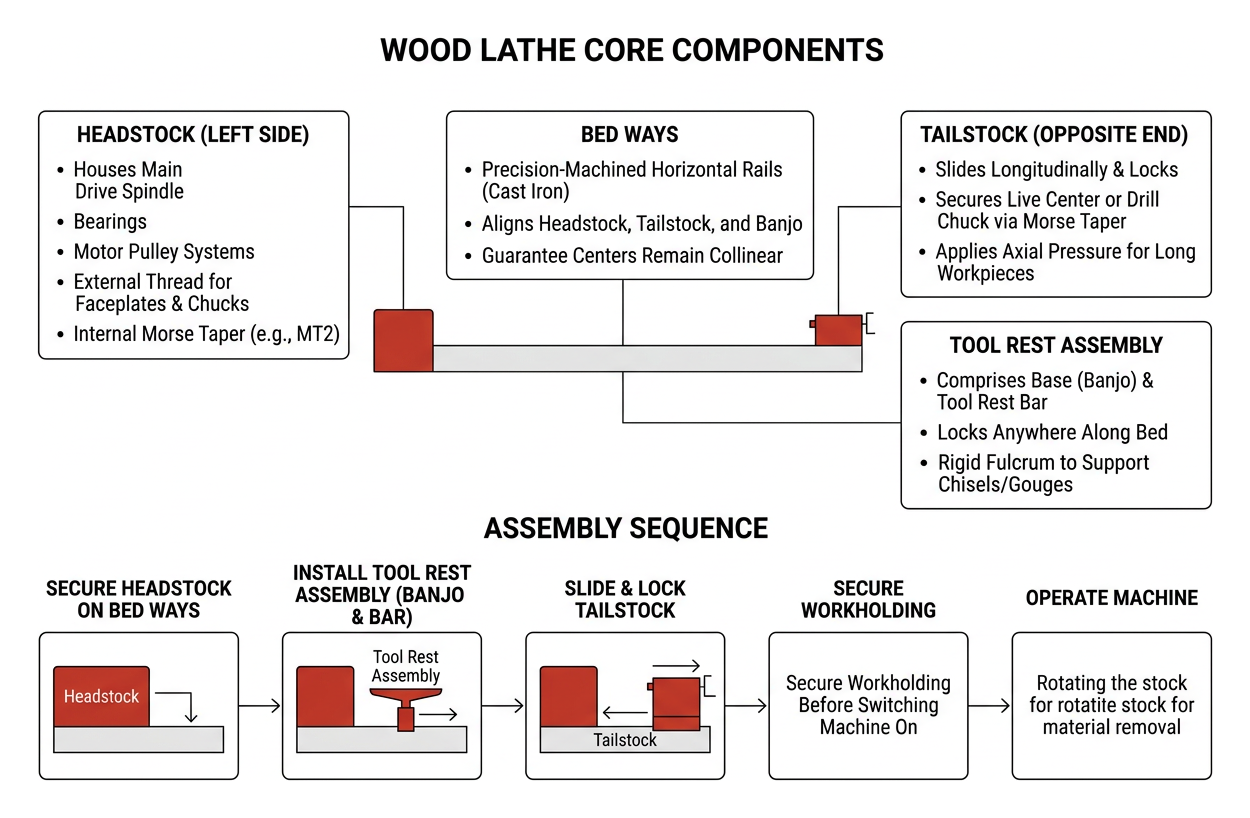
- The Headstock: Located on the left side of the machine, the headstock houses the main drive spindle, bearings, and motor pulley systems. The spindle features an external thread for attaching faceplates and four-jaw chucks, as well as an internal Morse taper (typically MT2) to accept spur drive centers.
- The Tailstock: Mounted on the opposite end of the bed ways, the tailstock slides longitudinally and locks in place. It secures a live center or drill chuck via its own Morse taper, applying axial pressure to stabilize long workpieces between centers.
- The Tool Rest Assembly: Comprising the base (banjo) and the tool rest bar, this component locks anywhere along the bed. It provides a rigid fulcrum to support hand-held chisels and gouges, absorbing cutting forces and preventing tool deflection.
- The Bed Ways: The precision-machined horizontal rails—usually cast iron—that align the headstock, tailstock, and banjo. Flat, true bed ways guarantee that the centers remain collinear during operation.
Key Specifications to Evaluate in a Machine Used for Turning Wood
Evaluating a lathe requires balancing workpiece geometry against motor capacity and mass:
- Swing Over Bed: The maximum diameter of raw stock you can turn without contacting the bed ways. A 10-inch swing accommodates small platters, while a 12-inch to 20-inch swing is necessary for large bowl blanks and hollow forms.
- Distance Between Centers (DBC): The maximum length of stock that can fit between the drive center in the headstock and the live center in the tailstock. This dictates whether you can turn architectural balusters, baseball bats, or dining table legs.
- Motor Horsepower (HP): Entry-level benchtop units typically range from 1/3 HP to 3/4 HP (250W to 550W), which is sufficient for light spindle work. Mid-range and industrial units offer 1.5 HP to 5 HP (1.1 kW to 3.7 kW) or more, delivering the continuous torque required to cut heavy, off-center hardwood burls without bogging down.
- Variable Speed and Digital RPM Displays: Modern electronic variable speed (EVS) systems let turners adjust spindle rotation instantly using a potentiometer dial, typically spanning 250 to 3,800 RPM. A digital RPM readout removes guesswork, helping you match surface cutting speeds to workpiece diameter.
- Vibration Dampening and Cast-Iron Mass: As wood spins, natural density variations create harmonic imbalance. Lathes built with cast-iron beds and heavy headstocks absorb these dynamic forces, preventing tool chatter and rough surface finishes.
Manual Lathes vs. Multi-Axis CNC Wood Turning Systems
Manual woodturning relies entirely on the operator's physical control, manipulating handheld gouges and scrapers against the spinning timber. This approach offers artistic flexibility for one-off sculptural pieces and custom bowls.
In contrast, automated production facilities utilize multi-axis CNC wood lathes. Modern automated turning centers incorporate dual rotary axes, servo-driven ball screws, and automatic tool turrets. High-performance industrial systems often combine longitudinal turning, four-axis milling spindles, drilling units, and integrated sanding attachments into a single continuous cycle. A production CNC lathe can turn, fluting-mill, and sand an intricate furniture leg in roughly 60 to 90 seconds, delivering dimensional repeatability that manual methods cannot match.
Benchtop vs. Floor-Standing Wood Lathes: Choosing the Right Setup
Selecting the proper machine format depends on your available floor space, production volume, and the scale of workpieces you intend to turn.
| Specification / Feature | Benchtop / Mini Wood Lathes | Full-Size Floor-Standing Lathes | Multi-Axis Industrial CNC Lathes |
|---|---|---|---|
| Typical Swing Capacity | 8" to 12" (200 mm – 300 mm) | 14" to 24"+ (350 mm – 600 mm+) | 8" to 16"+ (200 mm – 400 mm+) |
| Distance Between Centers | 12" to 18" (expandable via bed extensions) | 36" to 60"+ | 40" to 100"+ (1,000 mm – 2,500 mm) |
| Motor Power | 1/3 HP to 3/4 HP (DC / Induction) | 1.5 HP to 3 HP+ (AC / EVS) | 5 HP to 10 HP+ (3.7 kW – 7.5 kW) |
| Total Machine Weight | 40 to 120 lbs (18 kg – 55 kg) | 350 to 900+ lbs (160 kg – 400 kg) | 3,000 to 4,500+ lbs (1,400 kg – 2,000 kg) |
| Primary Workflow | Pens, bottle stoppers, small bowls | Furniture legs, large vessels, bowls | High-volume architectural & furniture parts |
| Vibration Resistance | Moderate (benefits from workbench bolting) | High (dense cast-iron chassis) | Maximum (rigid structural cast frame) |
| Electrical Supply | Standard 110V/120V 1-Phase | 120V or 220V/240V 1-Phase | 220V / 380V / 480V 3-Phase |
Types of Projects Matched to Each Machine Used for Turning Wood

Matching the tool to the task prevents motor strain and structural instability:
- Mini and Midi Benchtop Lathes: Ideal for small-diameter spindle turning, writing pens, bottle stoppers, chess pieces, and bowls under 8 inches in diameter. Their compact footprint makes them great for hobbyist workshops or dedicated secondary work stations.
- Heavyweight Floor Lathes: Essential for turning large salad bowls, hollow forms, architectural newel posts, and long chair spindles. The extended bed length and heavy cast-iron mass prevent vibration when turning out-of-round log blanks.
- Production CNC Turning Centers: Purpose-built for batch runs of identical components, including Roman columns, stair balusters, baseball bats, and custom furniture legs.
Essential Tooling, Accessories, and Safety Gear for Woodturning

Operating a lathe requires specialized cutting tools and secure mounting accessories. Traditional turning practices emphasize specific cutting edge geometries, as detailed in the core principles of traditional woodturning.
- High-Speed Steel (HSS) vs. Carbide: Traditional HSS gouges—such as M2 high-speed steel and cryogenic-treated alloys—deliver smooth sheared finishes along curved profiles but require frequent sharpening on a bench grinder equipped with a Cubic Boron Nitride (CBN) wheel. Modern replaceable carbide-insert tools use square, round, or diamond inserts that require no sharpening, making them practical for aggressive roughing and beginners.
- Core Hand Gouges and Chisels: A balanced manual kit includes a 3/4" roughing gouge for converting square stock to cylinders, a 1/2" bowl gouge with a swept-back grind for interior hollowing, a spindle detail gouge for rolling beads and coves, a parting tool for establishing diameters and cutting work off the lathe, and a round-nose scraper for refining interior curves.
- Workholding Devices: Beyond basic drive spurs and live centers, modern turners rely on four-jaw self-centering scroll chucks to grip bowl tenons and mortises securely. Faceplates, secured directly to the wood blank with heavy-duty screws, provide maximum stability for large, unbalanced bowl blanks.
Workshop Safety Protocols and Protective Gear
A spinning lathe introduces unique workshop hazards. Turners should implement the SAFER checklist before striking the start switch:
- S – Speed: Verify the spindle speed setting is low enough for the diameter and balance of the mounted blank before starting.
- A – Aside: Stand to the side of the line of fire when first powering on the machine in case an unseen crack causes the blank to separate.
- F – Fixings: Check that the headstock chuck, tailstock quill lock, banjo, and tool rest clamp are tightened down.
- E – Eye and Ear Protection: Wear a full-face shield conforming to ANSI Z87.1 standards, not just basic safety glasses. Use active dust collection or an air-fed respirator to handle fine wood particles.
- R – Revolve: Rotate the mounted workpiece by hand for one full revolution to ensure it clears the tool rest and bed ways before applying power.
Crucial Safety Rule: Never wear loose clothing, ties, jewelry, or work gloves when running a wood lathe. Long hair must be tied back securely, as rotating spindles can snag loose materials instantly.
Buying Considerations, Price Tiers, and Machine Maintenance
Whether purchasing an entry-level benchtop lathe or an automated turning center, knowing the market price tiers helps you budget accurately:
- Entry-Level Benchtop Models ($150 – $450): Mini lathes offering 8" to 10" swing and 1/3 to 1/2 HP motors. These units provide an accessible starting point for hobbyists turning pens and small spindles, though lighter sheet-metal and aluminum components require conservative cut depths.
- Mid-Range / Midi Lathes ($500 – $1,200): Feature 12" swing over bed, 1 HP motors, cast-iron beds, and electronic variable speed controls. These versatile workhorses handle both detailed spindle work and medium-sized bowls.
- Professional Floor Lathes ($1,800 – $5,000+): Heavy-duty cast-iron machines weighing 400 to 900+ lbs, equipped with 1.5 to 3 HP motors, 16" to 24" swing capacities, sliding or rotating headstocks, and digital readouts. Built for continuous daily production.
- Industrial Multi-Axis CNC Turning Centers ($8,000 – $35,000+): Production-grade systems with automatic feeding racks, pneumatic clamping, multi-tool turrets, and integrated sanding systems.
To maintain machine accuracy and equipment lifespan, clean wood chips from the bed ways after every turning session and apply a coat of paste wax to raw cast-iron surfaces to prevent corrosion. Periodically check spindle drive belts for proper tension and inspect headstock bearings for radial play. CNC units also require regular checks of their centralized automatic lubrication lines and pneumatic pressure regulators.
Frequently Asked Questions About Wood Turning Machines
What is the ideal speed range for turning bowls versus spindles?
Spindle turning speeds are determined by workpiece diameter and balance. As a rule of thumb, multiply the workpiece diameter in inches by the RPM; the total should generally sit between 6,000 and 9,000 for safe roughing.
- Bowls (8" to 14" diameter): Rough out unbalanced blanks at 250 to 500 RPM. Once the piece is balanced and round, finishing cuts can run between 800 and 1,200 RPM.
- Spindles (1" to 3" diameter): Rough out between 1,200 and 1,800 RPM, and execute detailed beads, coves, and final sanding passes at 2,000 to 3,200 RPM.
Can beginners learn safely on a mini benchtop lathe?
Yes. Mini benchtop lathes are well-suited for beginners because their lower motor power (1/3 to 1/2 HP) and smaller swing limits reduce kickback severity if a cutting tool catches. They help new turners master tool presentation, bevel support, and sharpening technique without managing massive rotational inertia.
How does cast-iron construction prevent turning defects?
When cutting tools engage raw wood grain, the intermitted cutting forces create mechanical vibration. Lightweight sheet-metal or aluminum beds flex under these loads, causing tool chatter that leaves ripple patterns across the wood surface. Heavy cast iron absorbs and dampens these dynamic harmonic vibrations, keeping the tool rest rigid and ensuring smooth, clean cuts.
Conclusion
The wood lathe transforms raw timber blanks into balanced, functional, and artistic cylindrical components. From small benchtop units turning delicate writing pens to automated CNC production centers producing architectural columns, selecting the right machine comes down to swing capacity, distance between centers, motor power, and chassis mass.
When you are ready to expand your workshop's production capabilities, explore commercial lathes and turning centers to find robust machinery that fits your manufacturing needs. At CNC Exchange, we help shops assess equipment options, secure reliable machinery, and achieve long-term performance on the shop floor.