
Introduction
The best small horizontal boring mill models fall into three main categories: precision table-type HBMs such as the HBM-110L class, dedicated deep-hole cylinder boring machines like the T21 series, and universal combination mills such as the ZX6350B class. Precision table-type units offer 110 mm spindles, up to 5,000 kg table loads, and multi-sided boring on rotary tables. Deep-hole cylinder machines handle bores from 20 mm to 360 mm across depths of 1 to 8 meters. Universal combination mills provide horizontal and vertical spindles in a compact toolroom footprint. Finding the right small horizontal boring mill comes down to balancing rigidity, travel envelope, spindle reach, and floor space. As manufacturing tolerances tighten in 2026, smaller job shops, maintenance facilities, and prototyping toolrooms face a familiar challenge: machining deep internal bores, multi-sided pump housings, and precision gearbox casings without dedicating half the plant floor to a massive gantry or floor-type machine.
Compact horizontal boring equipment solves this by keeping the structural stiffness and horizontal spindle orientation of heavy industrial machinery while fitting into standard shop layouts. Whether you are producing aerospace components, repairing industrial hydraulic cylinders, or building custom automotive tooling, understanding how compact configurations perform helps you make an informed equipment investment.
Overview: Precision Machining with Compact Horizontal Boring Equipment
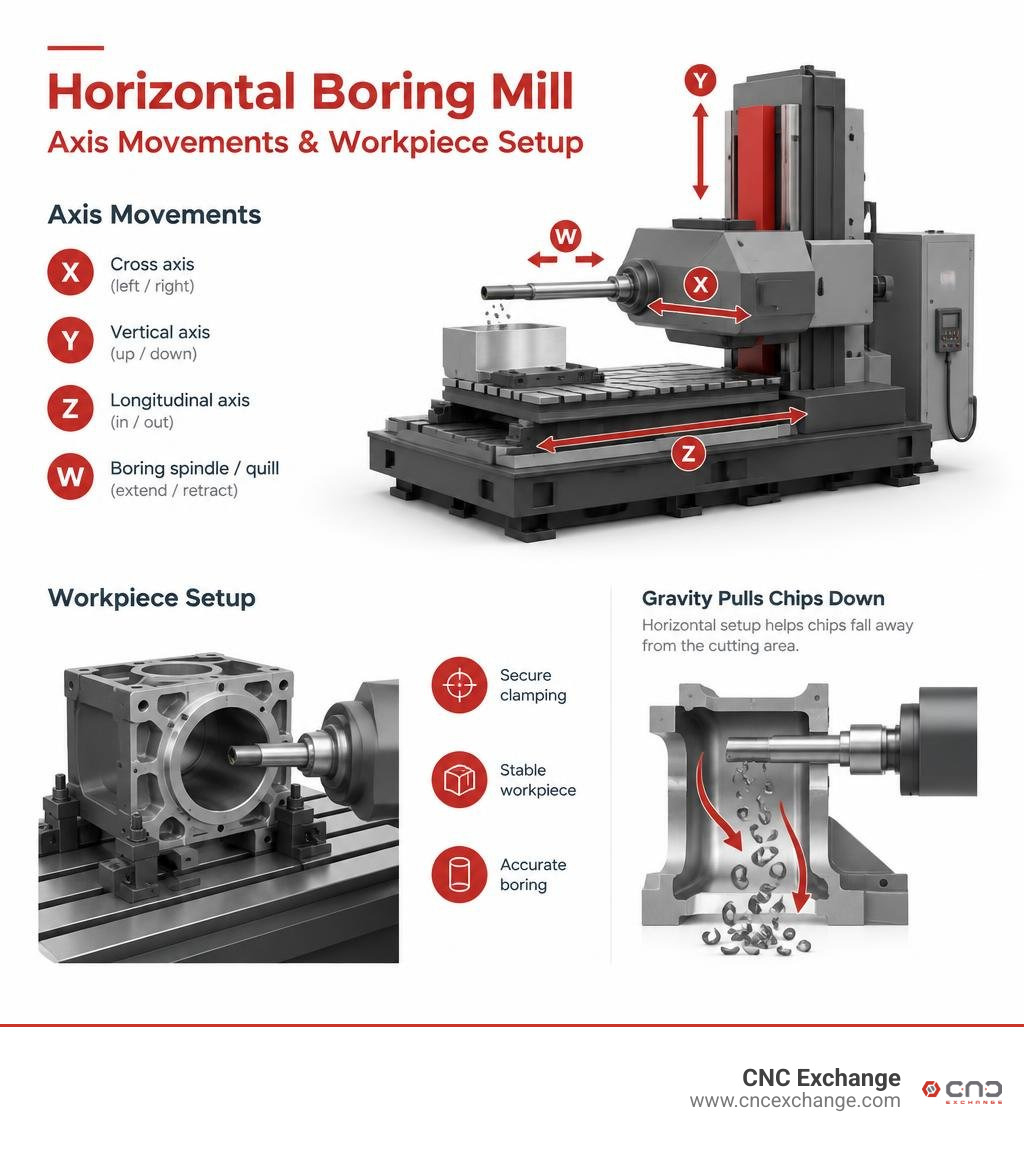
Horizontal boring mills (HBMs) are designed around a horizontally oriented spindle that travels along vertical ($Y$), cross ($X$), and longitudinal ($Z$) axes, often complemented by an extendable boring spindle or quill ($W$-axis). Unlike vertical machining centers where gravity works against chip evacuation during deep pocketing, a horizontal setup lets gravity pull chips down and out of deep cavities.
In modern manufacturing, small table-type configurations offer a balanced footprint for processing medium-to-large prismatic components. Workpieces are secured directly to a stationary or built-in rotary worktable, allowing operators to bore, face, drill, and mill multiple sides of a part in a single setup. This minimizes part handling, eliminates cumulative datum transfer errors, and delivers tight concentricity across opposed bearing bores.
What Distinguishes a Small Horizontal Boring Mill from Heavy Gantry Systems?
The primary differences between a small horizontal boring mill and larger gantry or floor-type boring mills are scale, foundation requirements, and mechanical architecture:
- Spindle Diameter and Quill Travel: Compact units typically feature spindle diameters ranging from 50 mm up to 110 mm, with quill extensions ($W$-axis) between 200 mm and 500 mm. Heavy gantry and floor-type mills often exceed 130 mm to 200 mm spindle diameters with quills reaching over a meter.
- Table Load Capacities: Smaller shop mills carry table capacities from 500 kg up to 5,000 kg (11,020 lbs), whereas large-scale floor-type systems carry tens of thousands of kilograms.
- Floor Footprint and Civil Prep: High-capacity industrial boring mills require isolated, deep-reinforced concrete foundation pits to absorb cutting forces and prevent vibration transfer. A compact table-type boring mill or universal horizontal mill installs directly onto standard reinforced industrial concrete floors.
- Part Accessibility and Ergonomics: Smaller machines allow easier line-of-sight and quicker manual setups, making them ideal for rapid turnaround repairs and small-batch production runs.
For facilities that regularly process mid-sized gearboxes or heavy industrial castings, proven table-type units such as Giddings and Lewis PC 50s Horizontal Boring Mills provide rigid, dependable platforms that fit moderate plant footprints while retaining industrial cutting torque.
Why Invest in a Small Horizontal Boring Mill Over a Vertical Mill?
Vertical machining centers (VMCs) and standard drill presses are common in most shops, but they face clear physical limitations when handling deep internal features, long boring bars, or complex prismatic geometries.
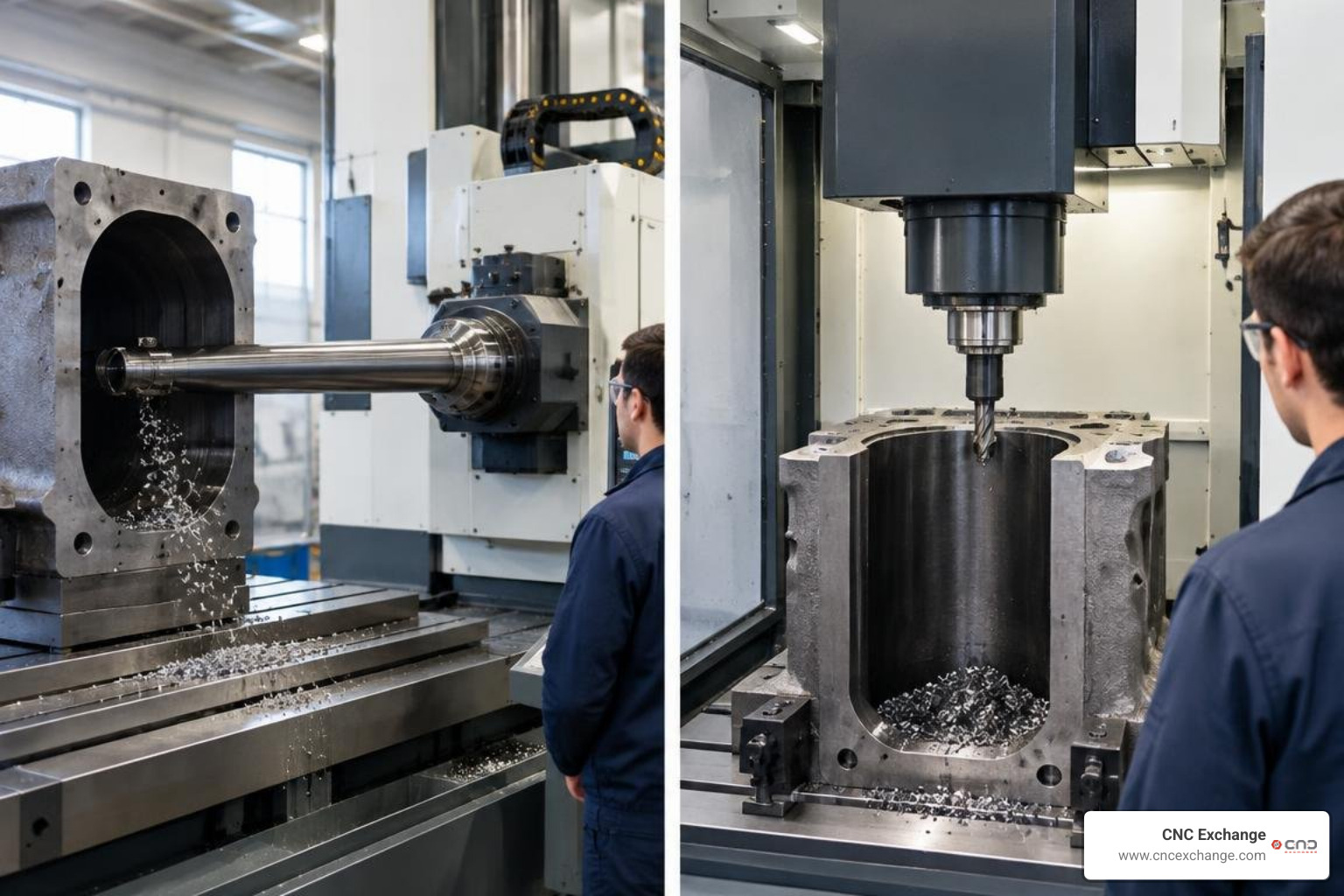
- Extended Horizontal Quill Reach: A horizontal boring mill utilizes a rigid, extendable spindle quill ($W$-axis) that feeds deep inside narrow part cavities without requiring massive toolholder extensions that induce chatter on a vertical mill.
- Gravity-Assisted Chip Clearing: In deep blind holes, vertical tools pack chips at the bottom of the cut, causing tool recutting, poor surface finishes, and premature insert failure. Horizontal spindles allow chips to fall clear of the bore.
- Multi-Sided Machining via Rotary Tables: By mounting parts to an integrated rotary table, operators can machine four sides of a component in one clamping sequence. This maintains accurate perpendicularity and bore-to-bore alignment across opposite faces.
- Heavy Interrupted Cuts: The wide box-way construction and robust gearing of an HBM absorb heavy interrupted facing and line-boring cuts far better than standard quill-type drill presses or light VMCs.
Evaluating the Top Small Horizontal Boring Mill Configurations
Depending on your production requirements, compact horizontal boring solutions fall into three main categories: dedicated deep-hole cylinder machines, robust table-type precision boring mills, and versatile universal combination machines.
| Machine Configuration | Typical Spindle / Tool Size | Table Size / Travel ($X \times Y$) | Max Spindle Speed Range | Max Table Load / Capacity | Ideal Applications |
|---|---|---|---|---|---|
| Precision Table-Type HBM (e.g., HBM-110L Class) | 110 mm Spindle (ISO 50) | $1,200 \times 1,500\text{ mm}$ ($1,800 \times 1,400\text{ mm}$ travel) | 20 – 1,500 rpm | Up to 5,000 kg (11,020 lbs) | Heavy castings, gearboxes, multi-side precision boring |
| Deep-Hole Cylinder Boring (e.g., T21 Series Class) | Boring $\Phi20 - \Phi360\text{ mm}$ | Bed Lengths: 1 m to 8 m depth capacity | Up to 1,200 rpm | Long cylinder stock & heavy bar work | Hydraulic cylinders, oil-field liners, gun barrels |
| Universal Combination Mill (e.g., ZX6350B Class) | ISO 40 Taper | $320 \times 1,250\text{ mm}$ ($600 \times 300\text{ mm}$ travel) | 40 – 1,300 rpm (Horiz) / 115 – 1,750 rpm (Vert) | 300 – 500 kg | Toolrooms, light repair, combined vertical/horizontal jobs |
| Mini Mill-Drill / Benchtop (e.g., BF-16V Class) | 3MT / R8 Taper | $400 \times 120\text{ mm}$ ($220 \times 160\text{ mm}$ travel) | 100 – 3,000 rpm | Up to 25 kg | Prototyping, educational labs, micro-hole boring |
| Low-Profile Magnetic Drill (e.g., MAB 155PRO Class) | 19 mm Weldon (up to 35 mm core drill) | Magnetic Base ($80 \times 160\text{ mm}$) | Single Speed (approx. 450 rpm) | 11 kg unit weight (Direct Mag Mount) | On-site steel fabrication, structural beams, tight frames |
Deep Hole and Cylinder Boring Solutions
For tubular workpieces requiring exceptional depth-to-diameter ratios, dedicated horizontal deep hole drilling and boring machines—such as the T21 series—are the industrial standard. These units are built specifically for manufacturing and reconditioning hydraulic cylinders, oil-field sleeves, and heavy barrels.
- High-Pressure Coolant Delivery: Deep boring requires internal coolant systems running at pressures up to 2.5 MPa. Coolant is pumped directly through the boring bar to flush swarf out through the bore continuously.
- Stepless Servo Feed Systems: Equipped with high-torque servo motors and precision-ground lead screws, these machines deliver stepless feed regulation from 5 mm/min up to 2,000 mm/min, ensuring constant chip load across tough alloy steels.
- Boring Capacities: Standard models accommodate bore diameters from $\Phi20\text{ mm}$ up to $\Phi100\text{ mm}$, with larger variants handling up to $\Phi360\text{ mm}$ across continuous boring depths ranging from 1 meter to 8 meters.
Detailed technical specs on modular deep-hole platforms can be reviewed via the Premach T21 Series Machine Overview.
Table-Type Precision Boring and Milling Units
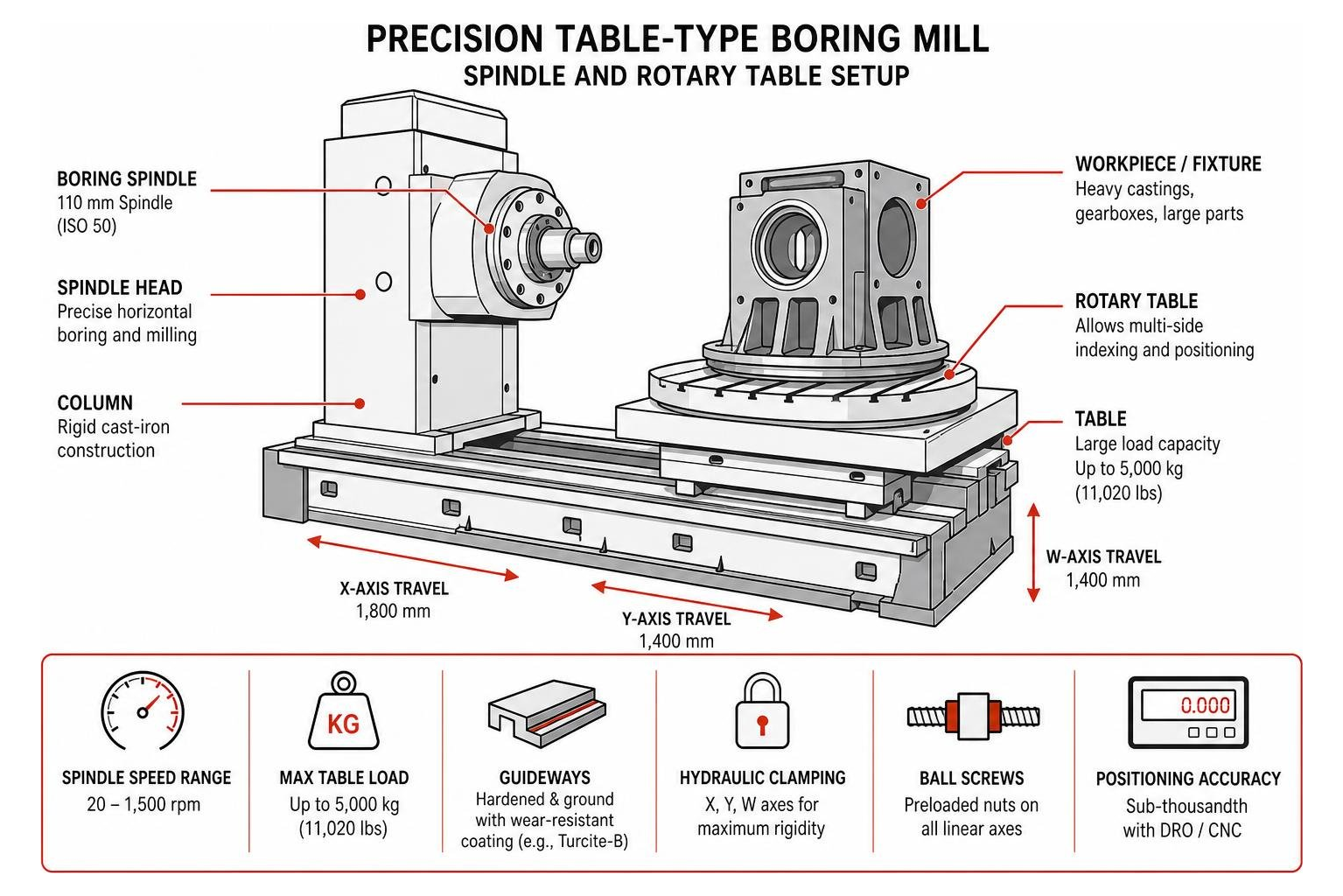
Table-type boring mills are the backbone of high-precision prismatic machining. Machines built to specifications like the Comprehensive Overview of HBM-110L Horizontal Boring & Milling Machine · Chung Sing Machinery offer a rigid cast-iron bed, large axis travels ($1,800\text{ mm}$ on $X$, $1,400\text{ mm}$ on $Y$, and $1,400\text{ mm}$ on $W$), and high load capacities up to 5,000 kg.
Key mechanical features of this class include:
- Hardened and ground box guideways treated with wear-resistant coatings (such as Turcite-B) to dampen cutting vibrations.
- Hydraulic clamping mechanisms on the $X$, $Y$, and $W$ axes to maintain structural rigidity during heavy facing operations.
- Precision ball screws with preloaded nuts on all linear axes, paired with digital readouts (DRO) or full CNC integration for sub-thousandth positioning accuracy.
Shops looking for robust industrial capability often turn to the secondary equipment market for proven workhorses. Reliable models like Giddings and Lewis 65 H6 T Horizontal Boring Mills and high-rigidity rotary-table models like Giddings and Lewis G60 RTX Horizontal Boring Mills illustrate the enduring value of heavy cast-iron engineering.
Universal Combination and Ultra-Compact Magnetic Units
When floor space or budget does not permit a dedicated horizontal boring mill, hybrid machines bridge the gap:
- Universal Milling/Drilling Machines: Equipment like the ZX6350B Universal horizontal vertical milling drilling machine features dual independent spindles. The vertical head swivels $\pm90^\circ$ for angled drilling, while a separate horizontal spindle with an arbor support allows side-milling and light line boring. Its $320 \times 1,250\text{ mm}$ table and manual micro-feed controls suit maintenance toolrooms.
- Mini Benchtop Mills: For hobbyists, small instrument makers, or prototype shops, machines like the Mini OptiMill Drill Geared & Tilting Head BF 16V - Machineryhouse offer a compact alternative. With a variable speed range of 100 to 3,000 rpm, a 3MT spindle taper, and a $\pm90^\circ$ tilting head, these 78 kg benchtop units can handle light boring operations using adjustable boring heads.
- Ultra-Low-Profile Magnetic Drills: For on-site fabrication where you cannot bring the part to the machine, ultra-compact horizontal magnetic drills like the Low Height Magnetic Drill MAB 155PRO | COMPACT DESIGN provide targeted holemaking. Weighing just 11 kg (24 lbs) with a total height of 180 mm, it fits into tight structural steel pockets, utilizing a 1,050 W motor and double-coil electro-magnet to core drill holes up to 35 mm in diameter.
Essential Specifications and Technical Buying Factors
Selecting the proper machine requires reviewing core mechanical specifications against your typical part drawings.
Spindle Dimensions, Travel Capacities, and Table Load
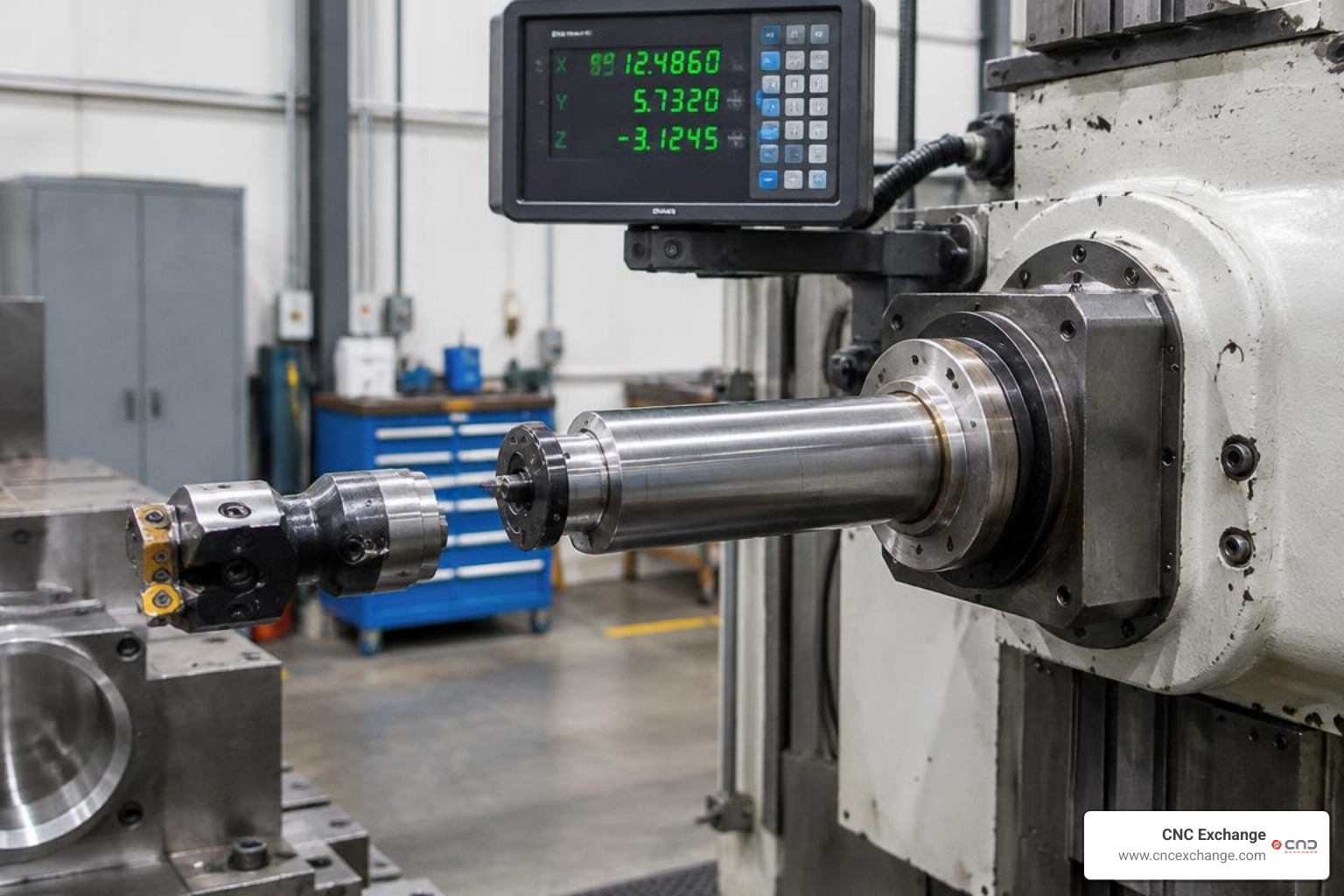
The spindle diameter directly dictates the cutting stiffness and maximum boring bar length you can run without tool chatter:
- Spindle Taper: Standard industrial units feature ISO 50 or ISO 40 tapers to resist high torsional and radial cutting loads. Benchtop units use 3MT or R8 tapers.
- Quill Travel ($W$-Axis): Verify whether the machine provides an independent quill feed ($W$-axis) or relies entirely on table saddle movement ($Z$-axis). An extendable quill is essential for reaching deep internal bearing lands.
- Axis Travel Ratios: Ensure the cross travel ($X$) accommodates the full width of your parts, while vertical travel ($Y$) allows the spindle centerline to drop below the top of the table for low-profile setups.
- Table Load Rating: Overloading a table degrades positioning accuracy, accelerates guideway wear, and causes axis drive stall. Always calculate both the raw casting weight and the necessary clamping fixtures.
Spindle Motor Power, Gearbox Torque, and Speed Ranges
Horizontal boring requires significant low-end torque for large-diameter facing heads and wide-diameter boring bars, as well as higher spindle speeds for secondary drilling and end milling:
- Geared Headstocks vs. Direct Drives: Multi-range mechanical gearboxes provide high torque at low speeds (20 to 300 rpm), which is crucial for roughing cast iron or exotic alloys.
- Variable Frequency Drives (VFD): Modern machines integrate VFDs with stepped gearboxes to deliver stepless speed control within each gear range, allowing operators to fine-tune surface feet per minute (SFM).
- Motor Sizing: Compact industrial boring mills typically utilize spindle motors between 7.5 kW and 15 kW (10 to 20 HP). Deep-hole machines frequently scale up to 30 kW or 65 kW to drive deep-penetration cutting heads.
Safety Protocols, Maintenance Schedules, and Troubleshooting
Operating high-torque horizontal boring equipment demands structured safety protocols and preventative maintenance to ensure repeatable accuracy and operator safety.
Essential Operator Safety and Protective Features
- Interlocking Enclosures and Chip Shields: Because horizontal spindles throw chips sideways at high velocity, transparent polycarbonate guards with electrical interlocks should enclose the cutting zone.
- Emergency Stop (E-Stop) Integration: Modern HBMs require category-rated E-stop circuits that cut drive power and engage mechanical spindle brakes simultaneously.
- Magnetic and Clamp Safety: When using portable magnetic equipment, always secure safety lashing straps to catch the machine in case of sudden electrical power loss.
- Chip Management: Never clear long, stringy chips by hand or with handheld hooks while the spindle is turning. Utilize proper chip conveyors, auto-reversing cycles, and chip breakers.
Preventative Maintenance and Resolving Common Mechanical Issues
A disciplined preventative maintenance schedule prevents unexpected downtime and maintains positioning accuracy over decades:
- Automatic Lubrication Delivery: Ensure the centralized auto-lube reservoir is inspected daily. Lack of oil on hardened box ways leads to stick-slip, galling, and rapid loss of geometric accuracy.
- Ball Screw Backlash Checks: Periodically inspect linear axis ball screws and preloaded thrust bearings. If backlash exceeds 0.015 mm ($0.0006''$), adjust the preloading nut or calibrate pitch error compensation in the digital readout or CNC control.
- Hydraulic System Pressures: Check hydraulic clamp circuits weekly. Insufficient clamping pressure allows the column or table to shift under heavy cutting loads, causing dimensional errors.
- Spindle Taper Runout: Check spindle runout using a precision test arbor and dial indicator every six months. Runout should not exceed 0.005 mm ($0.0002''$) at the spindle nose.
Frequently Asked Questions
What is the maximum hole diameter and boring depth achievable on compact models?
On standard table-type compact HBMs with an ISO 50 spindle, boring diameters typically range from 20 mm up to 300 mm using standard boring heads, and up to 500 mm or more when utilizing facing heads. Boring depth on table-type machines is governed by quill travel and bar length (commonly 300 mm to 800 mm). On dedicated deep-hole horizontal machines, continuous boring depths can extend from 1 meter up to 8 meters.
What factors drive the cost of compact horizontal boring machinery?
Key cost drivers include:
- Control Level: Manual DRO units are more affordable than full 4-axis or 5-axis CNC platforms with rotary tables.
- Spindle and Quill Size: Stepping from an ISO 40 spindle to a heavy 110 mm ISO 50 spindle adds mass and cost.
- Included Accessories: Built-in facing heads, angular milling heads, high-pressure through-spindle coolant systems, and optical scales impact the final machine price.
What electrical and foundation requirements are necessary for installation?
Most small industrial horizontal boring mills require a 400V–480V 3-phase power drop, drawing between 15 kW and 30 kW. Facilities with non-standard voltages require dedicated step-up or step-down isolation transformers. While compact HBMs do not require deep foundation pits, they must be anchored to a crack-free, level reinforced concrete floor (minimum 150 mm to 200 mm / 6 to 8 inches thick) using leveling wedge pads to maintain bed alignment.
Conclusion
A small horizontal boring mill is an essential asset for machine shops tackling complex prismatic components, deep internal bores, and multi-sided fabrications. By providing horizontal tool access, exceptional rigidity, and efficient chip evacuation, these machines handle demanding operations that overwhelm standard vertical mills.
When selecting your machine, balance your core technical specifications—such as spindle diameter, quill reach, table load capacity, and footprint—against your shop's daily production requirements. If you are ready to expand your machining capabilities or evaluate cost-effective used machinery options, explore inventory of horizontal boring mills or Talk to Our Machine Tool Experts Today to find the right equipment for your facility.