
Key Specifications to Evaluate in a Used Wood Turning Lathe
A used wood turning lathe is typically a sound buy at 50% to 70% of its current retail price, provided you prioritize rigid cast-iron construction, standard MT2 tapers, spindle runout under 0.002 inches, and an in-person operational test before purchase. Evaluating a pre-owned machine requires looking beyond fresh paint. The mechanical capacities dictate what projects you can physically mount, while the build quality determines how much vibration the tool absorbs when turning an out-of-round blank.
- Swing Over Bed: This measurement defines the maximum diameter of wood you can rotate over the bedways without hitting the cast iron. A 10-inch to 12-inch swing suits pens, bottle stoppers, and small cereal bowls. If you plan to turn large platters or salad bowls, look for a 14-inch to 20-inch swing.
- Distance Between Centers (DBC): This is the maximum length of stock you can mount between the headstock drive center and tailstock live center. Benchtop mini lathes typically offer 14 to 20 inches, which is plenty for tool handles and goblets. Turning architectural spindles, table legs, or baseball bats requires a DBC of 36 to 44 inches, or a modular bed extension.
- Bed Construction and Mass: High structural mass dampens harmonic vibration. Cast iron remains the industry standard for lathe beds, headstocks, banjos, and tailstocks because it absorbs resonance far better than welded sheet steel or lightweight aluminum extrusions. A sturdy midi lathe can easily weigh 100 to 200 pounds, while full-sized floor models often exceed 400 to 600 pounds.
- Benchtop vs. Floor Models: Benchtop units save floor space but require a rigid, heavy workbench to prevent wandering during roughing cuts. Floor models include dedicated cast-iron or heavy tubular steel legs, often featuring adjustable leveling pads and lower sills designed to hold ballast sandbags.
Spindle Threading and Taper Compatibility
The headstock spindle nose is the primary mounting point for workholding chucks, faceplates, and screw chucks. Sticking to standard sizes ensures you can find affordable modern accessories without resorting to custom-machined adapters:
- 1" x 8 TPI: The most common thread standard on mini and midi lathes across North America.
- 1-1/4" x 8 TPI: Standard on medium-to-large capacity lathes (14-inch swing and above), providing the rigidity required for heavy off-balance bowl blanks.
- M33 x 3.5: A heavy-duty metric European standard frequently found on modern commercial imports and lathes fitted with dedicated reversing locks.
Internal tapers inside the headstock spindle and tailstock barrel should be standard Morse Taper #2 (MT2). Avoid older or obscure machines that use MT1 or proprietary tapers, as sourcing compatible drive centers, drill chucks, and live centers will prove frustrating and costly.
Power Requirements and Motor Phase
Motor output directly governs whether the machine stalls under aggressive cutting with a roughing gouge:
- 0.5 HP to 0.75 HP: Adequate for small spindle work, pens, and lightweight finials.
- 1.0 HP to 1.5 HP: The sweet spot for midi lathes capable of roughing 10-to-12-inch hardwood bowls.
- 2.0 HP to 3.0 HP+: Professional-grade power designed for coring large green timber and turning heavy architectural posts without bogging down.
Check the electrical configuration before arranging pickup. Most benchtop and midi lathes run on standard 110V/120V household current. Larger commercial lathes often require dedicated 220V/240V single-phase lines.
Be cautious of vintage industrial machinery configured for three-phase power (often 208V, 230V, or 460V). Unless your workshop has native three-phase service, running these units requires adding a digital phase converter or a modern variable frequency drive (VFD). For broader guidance on evaluating machine tool specifications, see wood lathe.
Variable-Speed vs. Belt-Driven Wood Lathes
How a lathe alters its rotation speed fundamentally shapes your turning workflow, daily convenience, and maintenance schedule.
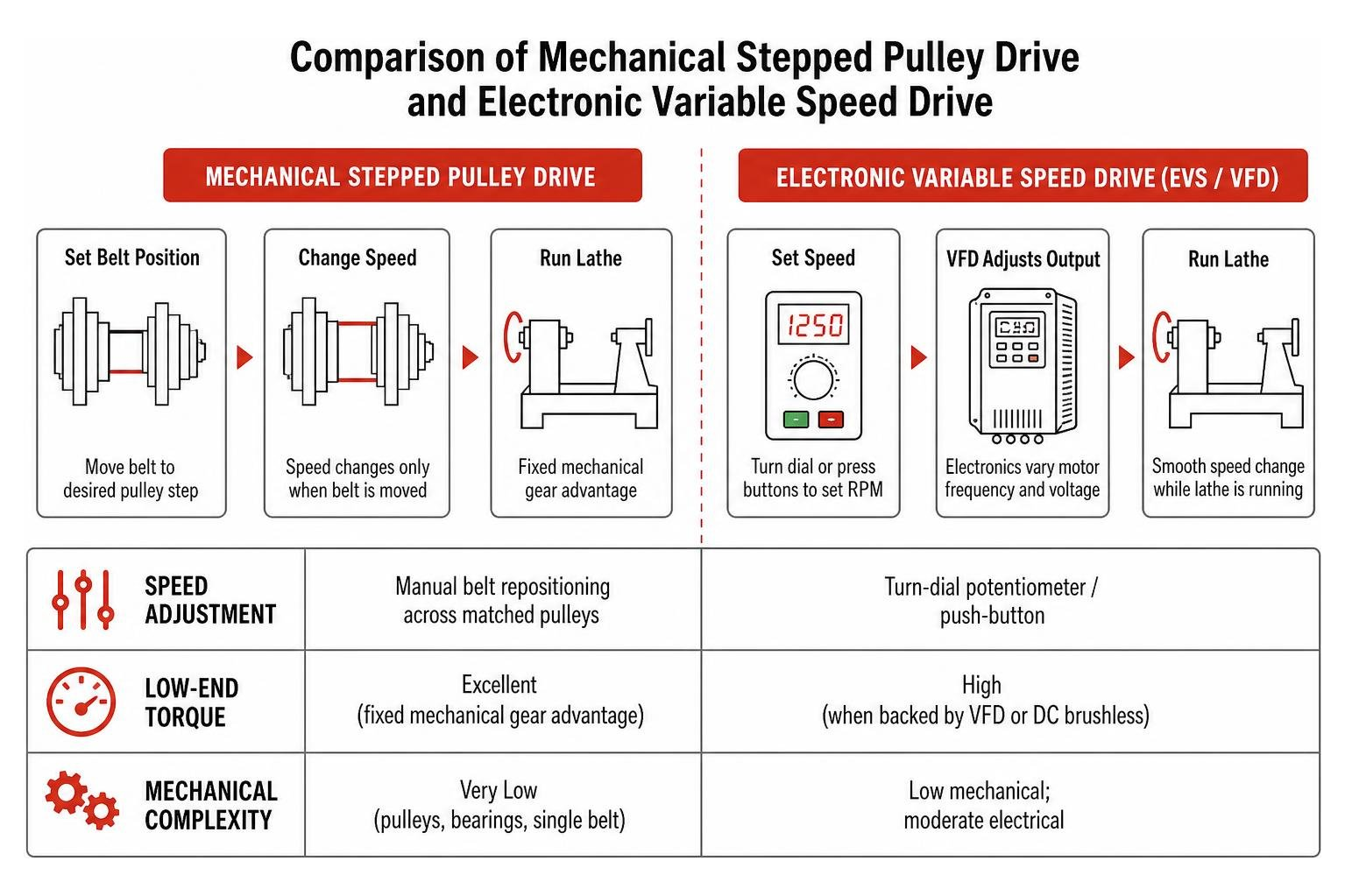
| Feature | Stepped-Pulley Belt Drive | Mechanical Reeves Drive | Electronic Variable Speed (EVS / VFD) |
|---|---|---|---|
| Speed Adjustment | Manual belt repositioning across matched pulleys | Hand lever rotated while motor runs | Turn-dial potentiometer / push-button |
| Low-End Torque | Excellent (fixed mechanical gear advantage) | Moderate (belt slippage under heavy loads) | High (when backed by VFD or DC brushless) |
| Mechanical Complexity | Very Low (pulleys, bearings, single belt) | High (split sheaves, springs, moving cams) | Low mechanical; moderate electrical |
| Maintenance Needs | Rare belt replacement | Regular sheave lubrication; spring wear | Keep electronics clean of fine wood dust |
| Beginner Usability | Slower workflow, but highly durable | Convenient, but prone to mechanical jamming | Superior; dial in exact safe roughing speeds |
Pulleys and Mechanical Variable-Speed Drives
Manual step-pulley lathes use multi-step pulleys (typically 3 to 6 steps) on both the motor and the spindle. Changing speeds requires opening the access door, loosening the motor belt tension lever, physically moving the belt to the matching pulley step, and retensioning. While this takes 15 to 30 seconds, it is mechanically indestructible, delivers zero electronic failure points, and transfers maximum torque.
Mechanical variable-speed systems (frequently referred to as Reeves drives) use split-cone pulleys that expand and contract via a mechanical lever while the spindle rotates. While they eliminate manual belt changes, older used Reeves drives are common failure points. If neglected, their moving sheave faces wear unevenly, develop rattles, seize up from accumulated sawdust, or suffer spring fatigue.
Electronic Variable Speed and Inverter Drives
Modern turning increasingly relies on Electronic Variable Speed (EVS). These systems allow you to alter spindle speeds from near zero to 3,500+ RPM simply by turning a dial.
Modern units utilize either brushless DC motors or three-phase AC induction motors controlled by an integrated Variable Frequency Drive (VFD) inverter. High-end VFD systems preserve broad torque profiles even at low rotational speeds—an essential feature when carefully roughing an out-of-round log at 200 RPM. Many advanced machines also include forward and reverse rotation switches (invaluable for directional sanding) and digital RPM readouts for precision speed monitoring.
Pre-Purchase Inspection: Assessing Machine Condition
Never buy a pre-owned machine based purely on photos. Lathes can hide bearing wear, structural cracks, and spindle runout that are impossible to diagnose without a hands-on mechanical check.

Inspecting a Used Wood Turning Lathe for Mechanical Wear
Follow this hands-on inspection sequence before handing over cash:
- Check Spindle Runout and Bearings: Mount a dial indicator against the smooth unthreaded outer surface of the spindle nose and rotate the spindle by hand. Total indicated runout should ideally stay below 0.001 to 0.002 inches. Next, grab the spindle and vigorously pull and push axially and radially; you should feel zero clunk, slop, or free play.
- Examine Bedways and Banjo Clamping: Slide the tool-rest base (the banjo) and the tailstock along the entire length of the bed. They should travel smoothly without binding or catching on deep gouges. Lock the levers down; the cam-action clamp must hold firmly against heavy hand pressure without slipping.
- Verify Center-to-Center Alignment: Insert a 4-prong drive center into the headstock and a 60-degree live center into the tailstock. Slide the tailstock forward until the points almost touch. Lock the tailstock and extend the quill. The points should align precisely tip-to-tip. Misaligned centers indicate twisted bed castings, bent sheet bases, or mismatched headstock components.
- Listen to the Motor and Drive Train: Power the machine through all speed ranges. Listen for grinding, rattling, or high-pitched squealing that points to worn motor bearings or dry spindle bearings. Feel the headstock casting after running for three minutes; it should remain cool to the touch.
Valuing Included Tooling and Accessories
A used lathe sold with an assortment of functional accessories represents significant financial savings compared to a bare-bones machine:
- Scroll Chucks: A quality 4-jaw self-centering woodturning chuck with standard 50mm jaws adds $120 to $250 in value. Extra accessory jaws (pin jaws, bowl jaws, cole jaws) add even more.
- High-Speed Steel (HSS) Gouges: Look for quality woodturning chisels: roughing gouges, bowl gouges, spindle gouges, skew chisels, and parting tools. Avoid soft carbon steel vintage tools. A set of used name-brand HSS tools easily saves $150 to $400.
- Centers and Faceplates: Verify that the package includes a drive spur, a smooth-bearing live center, a knockout bar, and at least one cast-iron faceplate for mounting flat bowl blanks.
Smart Sourcing: Marketplaces, Valuation, and Scam Prevention
Finding well-maintained machinery requires patience, realistic valuation models, and disciplined marketplace navigation.

A fair market price for a standard used wood lathe in good mechanical health typically hovers around 50% to 70% of its current retail equivalent. Heavily worn or legacy belt-driven machines often trade between $200 and $500, while well-equipped modern midi and full-sized floor lathes run between $700 and $2,200 depending on motor size, VFD electronics, and included tooling packages.
Navigating Online Classifieds and Avoiding Red Flags
Online classifieds are rich hunting grounds, but they require caution:
- Demand Local Testing: Never send untraceable electronic deposits to hold a tool. Arrange a daytime pickup where you can see the motor run and perform your dial-indicator checks in person.
- Beware of Incomplete "Bargains": If a seller offers an industrial-grade cast-iron lathe missing its matching tailstock, outboard banjo, or tool rest, factor in the replacement cost. Finding orphan parts that match legacy center-height geometry is notoriously difficult and can erase any initial purchase savings.
- Check the Environment: A lathe stored in a climate-controlled home workshop usually has decades of clean life left. Machines left under tarps in unheated, humid sheds often suffer from pitted bed surfaces and rusted internal bearing races.
Sourcing Replacement Parts for Legacy Lathes
Before closing a deal on an older or discontinued model, search online machine registries and owner forums to confirm replacement parts availability:
- Standard Consumables: Drive belts, poly-V serpentine belts, and common deep-groove ball bearings (e.g., 6000-series and 6200-series) can almost always be sourced affordably through industrial bearing supply houses.
- Proprietary Castings: Levers, custom-cast banjos, tailstock quills, and electronic display boards are often impossible to buy new once a manufacturer retires a model line. If these are cracked or missing, walk away unless you possess the metalworking tools to fabricate replacements yourself.
Frequently Asked Questions About Wood Lathes
What is a realistic starter budget for a used wood turning lathe package?
Plan for a total setup budget of $600 to $1,000. While you might secure a sound pre-owned midi lathe for $350 to $500, turning wood requires support equipment that beginners often forget to budget for:
- Quality safety face shield: $35 – $60
- Basic 4-piece High-Speed Steel (HSS) chisel set: $80 – $150
- 8-inch slow-speed bench grinder with aluminum oxide or CBN wheels: $130 – $220
- Sharpening jig system: $70 – $120
Without sharp tools, turning is unsafe and frustrating. Factor the sharpening system into your initial equipment budget.
How much spindle runout is acceptable on a pre-owned machine?
For general woodturning, total radial spindle runout measured at the spindle nose should be under 0.002 inches (0.05 mm), with 0.001 inches or less being ideal. While wood is a forgiving material compared to metal, excessive runout causes chuck wobble, severe vibration during delicate spindle work, and misaligned tenons when reversing bowls. Spindle runout exceeding 0.003 to 0.004 inches indicates bent spindle shafts or badly worn bearings that require immediate replacement.
What are the main disadvantages of buying used versus new?
The primary disadvantage is the absence of a factory warranty and manufacturer technical support. If an electronic control board or VFD fails two weeks after purchase, the repair cost rests entirely on you. Used machines may also conceal hidden flaws—such as dry motor windings or internal casting cracks—and rarely offer returns. However, thoroughly testing the equipment before purchase offsets most of these risks.
Conclusion
Securing an affordable pre-owned wood lathe is one of the most cost-effective ways to establish a high-capacity turning studio. By prioritizing rigid cast-iron construction, verifying spindle runout, checking taper standards, and testing electrical drives under real power, you can confidently invest in a machine that will deliver precise, chatter-free performance for decades to come.
When you are ready to expand your machining operations beyond manual timber work into high-precision production environments, explore CNC Exchange's extensive inventory of lathes and turning centers to find vetted industrial equipment and upgrade your workshop capabilities.