
Core Factors Determining Laser CNC Machine Price
Typical laser CNC machine prices fall into three broad tiers: entry-level systems from $17,000 to $31,000, mid-range production machines from $20,000 to $60,000, and heavy industrial high-power systems from $60,000 to well over $250,000. The exact price within each tier depends on laser wattage, source technology, bed size, and automation features.
When calculating the total expenditure for a machine tool, the base sticker price rarely tells the whole story. The overall investment reflects the engineering tolerances, hardware reliability, optical technology, and build quality of the machine.
A heavy, stress-relieved welded steel frame eliminates high-frequency vibrations during rapid direction changes. When a cutting head accelerates at 0.5g to 1.5g across a sheet, an under-engineered chassis flexes, destroying edge quality and degrading positioning accuracy. High-end machines integrate precision-ground helical racks, high-torque servo motors, and automated optical heads with capacitive height sensing to deliver tight tolerances (often within ±0.03mm) across years of multi-shift operation.
How Wattage and Power Output Drive Laser CNC Machine Price
Laser wattage is the single largest cost multiplier in any machine configuration. In metal fabrication, power output directly dictates the maximum thickness of sheet plate you can sever and the linear speed at which you process standard gauges.
- 1,000W to 1,500W: Entry-level power designed primarily for sheet metal up to 3mm–4mm stainless steel or 6mm carbon steel.
- 2,000W to 3,000W: The versatile sweet spot for light fabrication, easily processing up to 12mm carbon steel and 5mm aluminum.
- 4,000W to 6,000W: Production-grade power handling up to 20mm–25mm mild steel with rapid pierce routines and blazing speeds on thin gauge stock.
- 8,000W to 12,000W+: Heavy industrial processing capable of cutting thick plate past 30mm with minimal edge taper.
Scaling from a 1kW source to a 6kW or 12kW unit does not just increase the price of the resonator; it requires higher-flow water chillers, heavier cutting heads, and robust motion components to absorb the dynamic forces of rapid processing.
Laser Source Types: Fiber, CO2, and YAG Systems
The underlying laser technology fundamentally dictates operating economics and purchase price:
- Fiber Lasers: The undisputed standard for modern metal fabrication. Fiber lasers operate at a 1.064µm wavelength, offering an electro-optical conversion efficiency exceeding 30% to 40%. They require zero optical alignment mirrors and boast diode lifespans of roughly 100,000 hours. Premium industrial sources command higher upfront prices due to proven beam stability, while brands like Raycus, MAX, and JPT offer competitive entry points. For specialized deep engraving and thin-foil processing, pulsed systems deliver pulse-width tuning for color marking and precision work.
- CO2 Lasers: Historically ubiquitous, CO2 systems operate at a 10.6µm wavelength. While indispensable for organics, plastics, and wood, their metal-cutting efficiency is low (roughly 8% to 12%), requiring expensive gas mixtures, beam delivery mirror maintenance, and regular vacuum pump upkeep.
- Solid-State YAG Lasers: Flashlamp or diode-pumped Nd:YAG systems offer maintenance costs roughly 1/10 to 1/15 of legacy CO2 machines. Operating at 200 times the speed of traditional wire EDM methods, they serve niche micro-machining and thin sheet tasks with ±0.03mm precision.
Bed Size and Table Configurations
Bed size must align with standard mill sheet dimensions to prevent costly pre-cutting operations.
Table architecture also drives baseline cost. A basic open single-table system keeps initial capital outlay low. However, high-volume production facilities favor dual-pallet shuttle tables. An electrical platform sheet metal laser cutter allows operators to unload parts and load new stock while the cutting head works inside, effectively driving spindle-on arc time toward 100%.
Laser CNC Machine Price Tiers by Capability and Scale

Understanding price tiers ensures you match the machine's duty cycle to your production volume without overcapitalizing or buying an underpowered machine.
Entry-Level and Small Shop Systems
Priced between $17,000 and $31,000, compact platforms like a high-precision 1390 fiber laser metal cutter cater to job shops, prototyping labs, and light fabricators. These units typically feature 1kW to 1.5kW sources, a single fixed table (1300 x 900 mm or 1300 x 1300 mm), and compressed air or oxygen assist capabilities.
While manual loading is standard, their precision optics allow shops to transition away from messy plasma cutters and slow bandsaws. Economical platforms listed on industrial marketplaces highlight how base configurations can scale down to low baseline pricing when stripped of automated conveniences.
Mid-Range Production Laser Cutters
Occupying the $20,000 to $60,000 price bracket, mid-range machines represent the core workhorses of standard fabrication job shops. Standard configurations include:
- 1.5kW to 4kW fiber resonators (Raycus, MAX, or IPG).
- 1500 x 3000 mm (5' x 10') cutting envelope.
- Intelligent cutting heads with autofocus and collision protection.
- Dual-pallet automated exchange shuttles swapping sheets in under 25 seconds.
- Integrated CNC software suites featuring automatic nesting and common-line cutting algorithms.
These machines handle continuous 8-to-16-hour daily shifts across mild steel, stainless steel, aluminum, and brass.
Heavy Industrial High-Power Fiber Systems
Ranging from $60,000 to well over $250,000, heavy industrial cutting platforms feature 6kW to 20kW+ laser sources. Built with massive, fully enclosed frames, automatic nozzle changers, dual-circuit high-tonnage chillers, and hydraulic load/unload towers, these systems process thick plate (up to 30mm–50mm) around the clock with extreme piercing velocity.
| Feature / Tier | Entry-Level ($17k – $31k) | Mid-Range ($20k – $60k) | Industrial ($60k – $250k+) |
|---|---|---|---|
| Laser Power | 1kW – 1.5kW | 2kW – 4kW | 6kW – 20kW+ |
| Bed Format | 1300 x 900 mm (Single) | 1500 x 3000 mm (Exchange) | 1500x3000mm to 2500x6000mm+ |
| Enclosure | Open / Partial | Open or Fully Enclosed | Fully Enclosed / Automated |
| Max Steel Thickness | 4mm – 6mm | 12mm – 20mm | 25mm – 50mm+ |
| Primary Focus | Prototyping, Low Volume | General Job Shop Production | 24/7 Heavy Industrial Cutting |
Total Cost of Ownership: Beyond the Initial Purchase Price
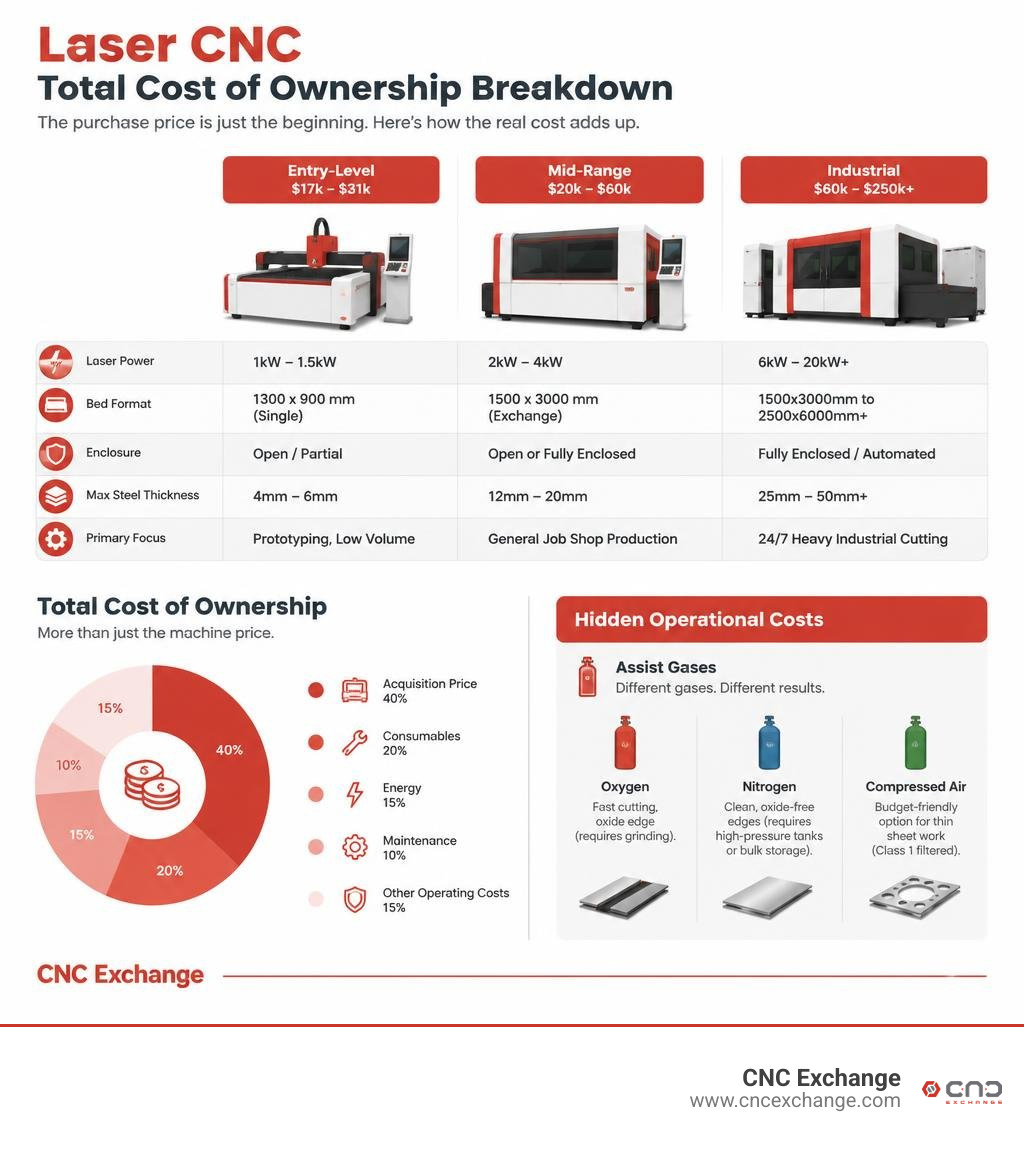
Acquisition price represents only a fraction of lifetime operating costs. Evaluating total cost of ownership (TCO) protects your operational cash flow.
Hidden Operational Costs in Total Laser CNC Machine Price
- Assist Gases: Oxygen promotes an exothermic reaction for rapid mild steel cutting but leaves an oxide edge that requires grinding before paint. High-pressure nitrogen delivers pristine, oxide-free edges on stainless steel and aluminum, though it requires dedicated high-pressure tanks or bulk liquid storage. High-pressure compressed air assist (filtered to Class 1 moisture and oil standards) serves as a budget-friendly option for thin sheet work.
- Electricity & Chillers: Fiber lasers operate at high electrical efficiency, drawing significantly less wall power than legacy equipment. A 500W YAG laser, for instance, maintains operating costs around $4.80 to $6.40 per hour, whereas an equivalent CO2 unit costs $24.00 to $38.40 per hour due to massive power and gas usage. Industrial high-tonnage water chillers run continuously to protect the optics and resonator cavity.
- Consumables & Optical Maintenance: Budget for copper cutting nozzles, ceramic rings, and protective cover slides. Cover slides protect sensitive focusing lenses from weld spatter and require routine inspection in cleanroom-style environments.
Freight, Customs, and Factory Floor Installation
Rigging heavy machinery requires careful logistics planning:
- Freight & Rigging: Moving a machine frame weighing between 3,000 kg and 12,000 kg requires specialized flat-rack containers, flatbed transport, and heavy-duty machinery riggers.
- Import Tariffs & Customs: Port clearance, customs brokerage fees, and import duties can add 5% to 25% over base FOB pricing.
- Shop Infrastructure: A proper installation requires a dedicated, level concrete slab (isolated from stamping press vibrations), a three-phase electrical drop (e.g., 480V 60Hz), dry compressed air lines, and an exhaust duct network for fume extractors.
ROI Analysis and Shop Floor Productivity
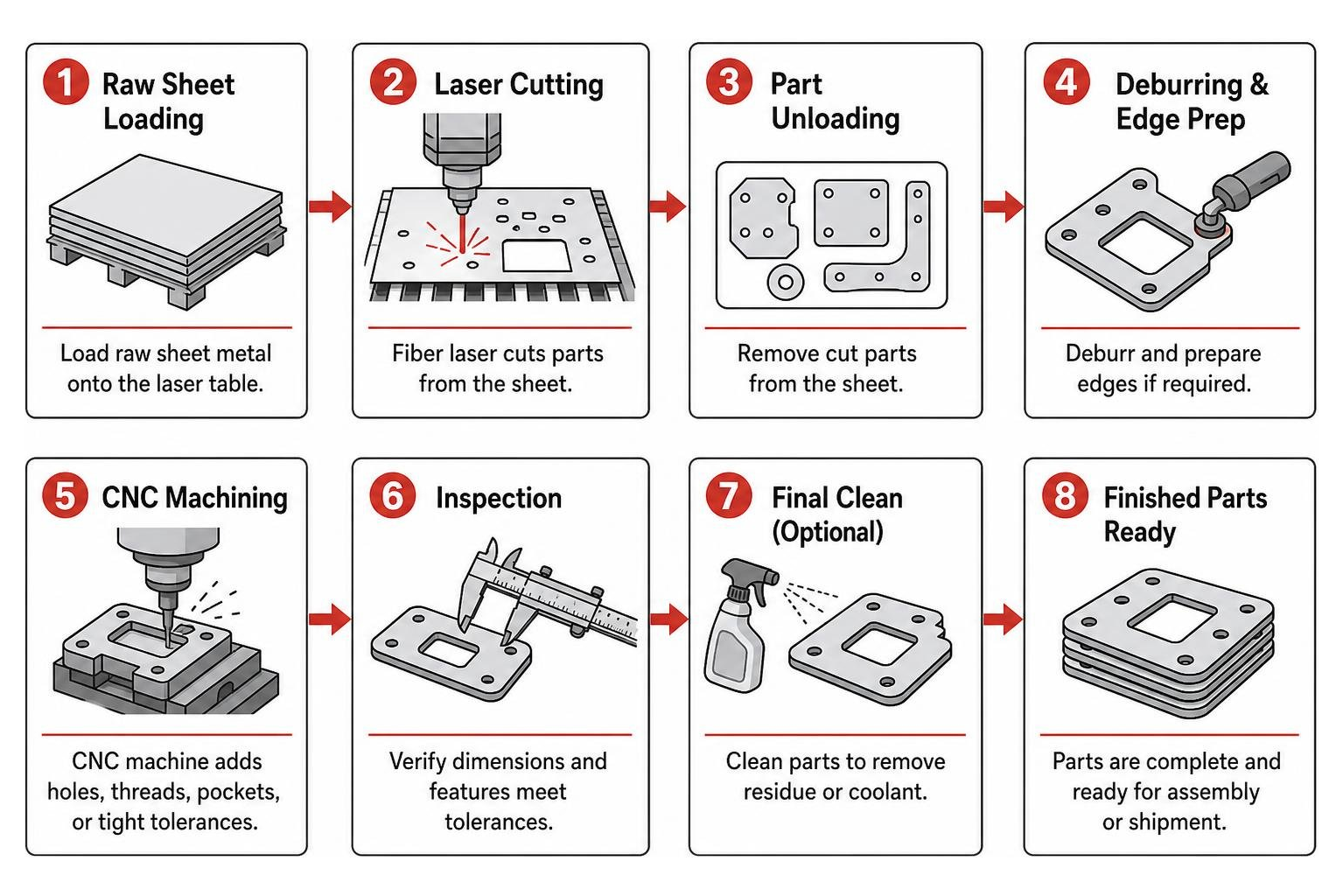
Investing in a laser CNC cutter generates fast returns by collapsing cycle times and eliminating secondary finishing labor.
Cycle Time Reductions and Pallet Exchange Platforms
Traditional manual loading forces the laser to sit idle while operators retrieve raw sheets and remove skeleton scrap. An automated electrical exchange platform swaps loaded beds in ≤25 seconds, keeping the beam firing continuously.
In real-world fabrication environments, moving to a 3kW exchange-table fiber system regularly yields a 35% increase in total shop output, cutting sheet change overhead from several minutes down to seconds and achieving full ROI within 9 to 12 months.
Complementing Laser Cutting with Precision Machining
A laser cutter produces 2D profiling quickly, but modern component manufacturing often requires secondary operations like tapping, counterboring, precision bearing bore boring, and turning.
Integrating laser flat-pattern cutting with downstream CNC machines maximizes shop capacity:
- Use profile laser cutting for near-net blanks, then transfer them to high-speed vertical machining centers to mill tight-tolerance pockets, chamfers, and tapped holes.
- Combine laser-cut sheet plates with precision turned shafts finished on high-output CNC lathes for welded subassemblies.
- For high-volume multi-sided parts, transfer laser-cut structural brackets to automated horizontal machining centers or compact drill/tap centers.
- Balance complex turned-and-milled parts across dynamic turning centers and multi-axis 5-axis machining centers, routing simple 2D shapes away from costly mill time and over to the laser table.
Frequently Asked Questions About Laser CNC Costs
What is the typical ROI timeframe for a new fiber laser cutter?
For most active fabrication job shops, the ROI timeframe ranges between 9 and 18 months. Payback speed depends on current outsourcing expenses, scrap reduction via intelligent nesting software, and the elimination of manual grinding or sawing operations.
How much does it cost per hour to operate a fiber laser vs. CO2?
A standard fiber laser typically costs between $4.80 and $12.00 per hour to operate (factoring in electrical consumption, nitrogen/oxygen assist gas, and wear parts). Legacy CO2 lasers generally run between $24.00 and $38.40 per hour due to higher electrical demands, optical gas usage, and frequent mirror maintenance.
Is a premium laser source worth the additional cost over standard sources?
For high-uptime facilities running multi-shift operations, a premium source (such as IPG) offers superior beam stability, reliable field-service modularity, and an operating lifespan exceeding 100,000 hours. For single-shift, light-gauge fabricators, cost-effective alternatives from Raycus, MAX, or JPT provide solid reliability at an accessible purchase price.
Conclusion
Selecting the right laser CNC system requires balancing raw beam power against machine rigidity, optical automation, assist gas infrastructure, and long-term operating costs. While an entry-level machine gets you cutting for under $30,000, production shops requiring high throughput will see rapid returns from mid-range or industrial platforms equipped with dual-pallet shuttles.
Whether you are expanding your metal fabrication capabilities or retooling your shop floor, we can help you navigate the used and surplus machinery marketplace to maximize your capital investment. Explore our complete selection and browse available machinery to upgrade your production floor with vetted CNC assets.