
Affordable Benchtop CNC Mills That Can Actually Cut Steel
A benchtop CNC mill for steel should have a rigid metal frame, precision ball screws, a spindle with useful low-RPM torque, and a secure way to contain chips and coolant. The most affordable machines can mill mild steel in light passes, while heavier professional-grade benchtop mills can also take on stainless, alloy steels, and some hardened steels at slower feed rates.
For a buyer focused on value, start with these priorities:
- Buy rigidity before size. A heavier cast-iron or heavily reinforced machine usually beats a large, router-style platform for steel.
- Look for ball screws and minimal backlash. Steel cutting forces expose loose drive systems fast.
- Match the machine to the work. Small parts, brackets, fixtures, engraving, and prototype runs are realistic jobs for compact mills. Large or deep steel cuts may require a floor-standing VMC instead.
- Budget for the full setup. Carbide tooling, workholding, coolant, an enclosure, and electrical installation matter as much as the machine price.
Steel is possible on a desktop-scale CNC, but it is not forgiving. A true CNC mill uses a stiffer structure and more suitable spindle and motion system than a typical CNC router, helping it resist vibration, hold tolerances, and preserve cutting tools.
I am Jared Gray, and I have spent more than 12 years buying, selling, brokering, and evaluating CNC chip-making equipment for shops at every stage of growth. In this guide, I will help you compare what a benchtop CNC mill for steel can realistically do, where affordable options make sense, and when buying heavier used equipment may deliver better long-term value.
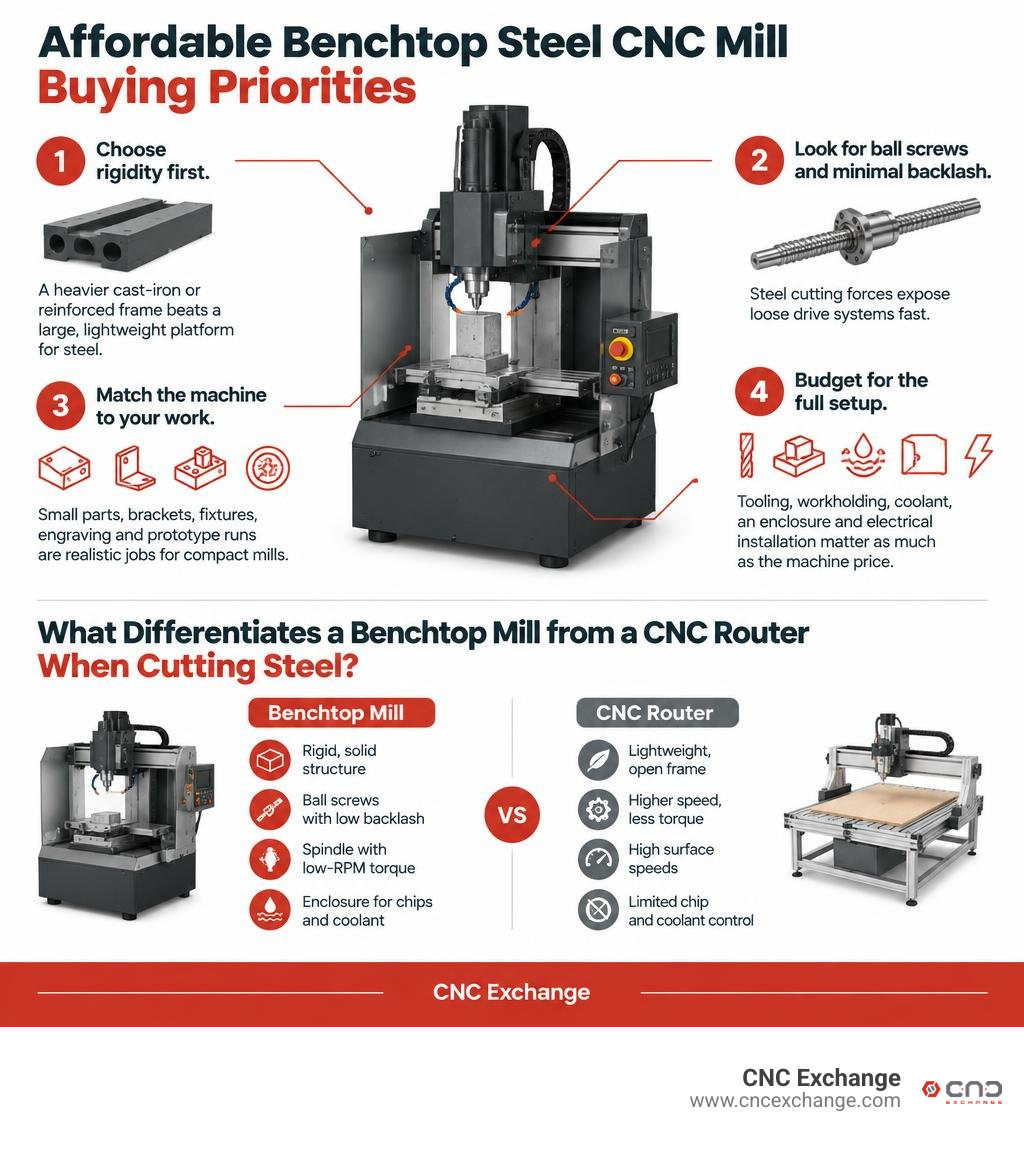
What Differentiates a Benchtop Mill from a CNC Router When Cutting Steel?
When working with dense ferrous metals, machine design choices dictate your success. A standard CNC router is engineered for high surface speeds in wood, plastics, and non-ferrous sheets like aluminum. Attempting to cut structural alloy or stainless steel on a standard lightweight router quickly highlights the structural limits of open-gantry architecture.
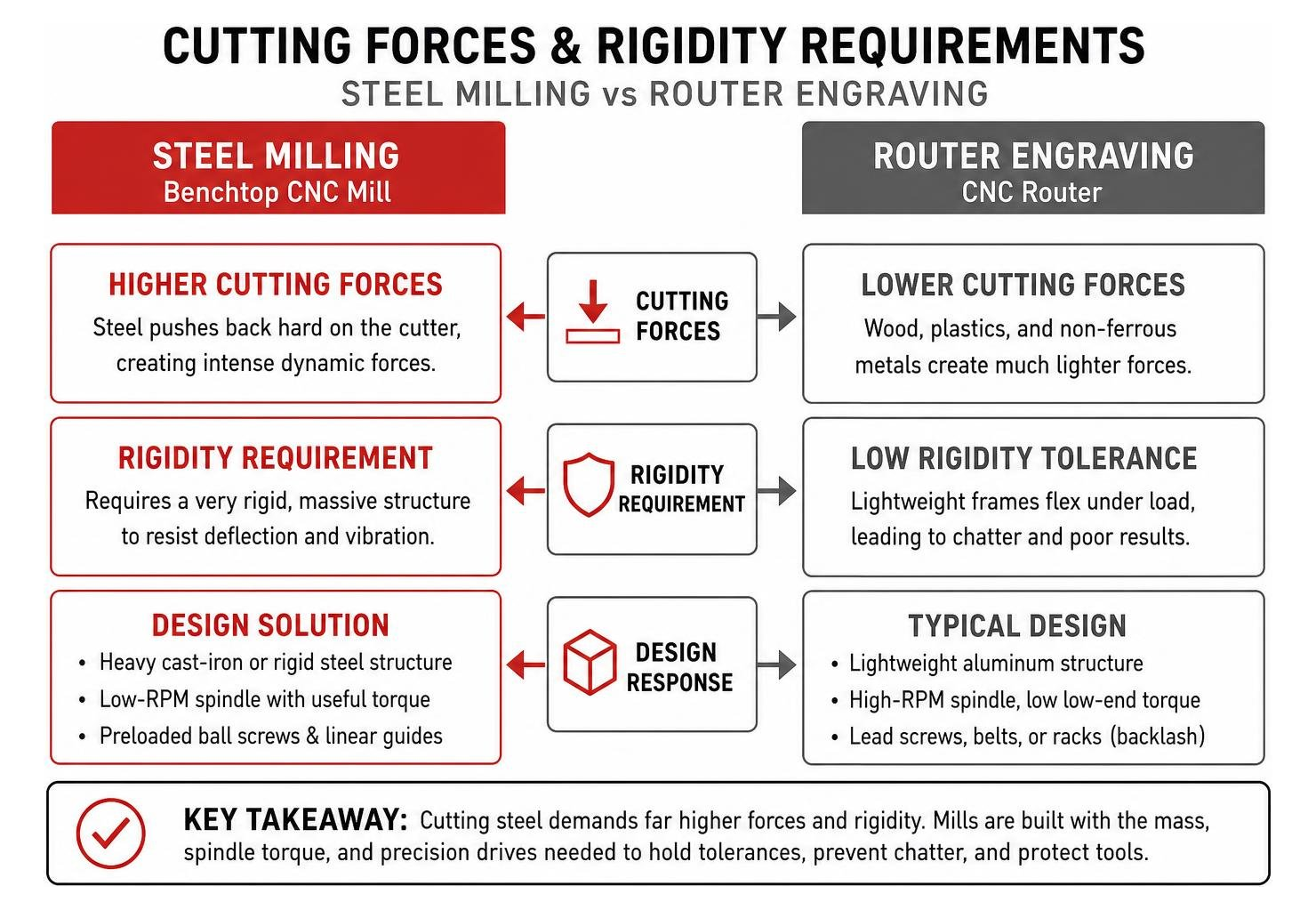
Cutting steel produces intense pushback forces against the cutter. These dynamic cutting forces demand three structural qualities that set mills apart from routers:
- Mass and Frame Rigidity: A true milling platform uses solid cast-iron construction, heavy steel weldments, or mineral casting. This mass dampens harmonic vibration and prevents tool chatter. Routers made of lightweight extruded aluminum flex under heavy loads, which instantly dulls or snaps fragile carbide flutes.
- Low-End Spindle Torque: Routers rely on high-RPM spindles (typically 10,000 to 24,000+ RPM) with minimal torque at lower speeds. Machining ferrous alloys requires lower surface footage (SFM) and substantial low-RPM torque to maintain a high chip load without stalling or burning the cutter flutes.
- Backlash Elimination and Preloaded Drives: Router tables often use lead screws, belts, or rack-and-pinion systems that introduce backlash. Steel milling requires preloaded ground or rolled ball screws combined with linear guide rails or scraped dovetail ways to eliminate axis deflection during aggressive directional changes.
Even beginner-friendly CAM toolpath strategies, such as adaptive clearing, cannot compensate for physical machine deflection. Machining ferrous alloys reliably requires a dedicated milling structure designed to hold its geometry under sustained mechanical strain.
Critical Specifications in a Benchtop CNC Mill for Steel
Evaluating compact CNC machines requires looking closely at core mechanical specifications. Marketing sheets often highlight rapid feed rates or high maximum RPMs, but cutting steel depends far more on build weight, drive stiffness, and usable low-speed torque.
Evaluating Frame Material and Machine Rigidity
Structural mass acts as a shock absorber. When an end mill contacts a block of 4140 chromoly or 304 stainless steel, each tooth impact introduces cyclic shockwaves.
Cast-iron castings offer natural dampening capacity due to free graphite flakes in the metal microstructure that dissipate vibration as microscopic heat. Without sufficient dampening, harmonic resonance travels through the spindle into the tool edge, resulting in rapid micro-chipping of carbide tools, rough surface finishes, and lost tolerances.
Beyond frame material, pay close attention to:
- Spindle Power & Curves: Look for continuous horsepower ratings rather than peak marketing numbers. A 1.5 kW to 2 kW spindle backed by vector drive control or gear/belt reduction delivers torque where steel demands it: between 1,000 and 5,000 RPM.
- Drive Mechanics: Preloaded ball screws on every axis prevent climb-milling cuts from pulling the table into the cutter.
- Axis Travel and Clearance: Compact platforms generally feature working envelopes from 8" x 4" x 6" up to 37" x 26" x 9", handling stock thicknesses from 1/4" sheet up to solid 1" blocks.
Entry-Level vs Professional Benchtop CNC Mill for Steel Pricing
Understanding price tiers helps balance budget constraints against shop production requirements:
| Machine Category | Typical Price Range | Typical Frame Construction | Drive System | Target Steel Use Cases |
|---|---|---|---|---|
| Micro / Entry Desktop | $4,500 – $7,000 | Lightweight Cast Iron / Billet Aluminum | Rolled Ball Screws / Precision Leadscrews | Micro-tooling, jewelry, shallow engraving, mild steel prototyping |
| Mid-Range Benchtop Mill | $8,000 – $12,000 | Solid Cast Iron / Heavy Column | Precision Ball Screws & Steppers/Servos | 1018 mild steel, bracket production, fixture plates, tool steel components |
| Pro-Grade Compact VMC | $14,000 – $22,000+ | Heavy Cast Iron Base & Column (1,000+ lbs) | Ground Ball Screws & Closed-Loop Servos | Stainless steel, hardened alloys, production batches, tight aerospace tolerances |
Entry-level platforms provide an accessible entry point for learning CNC fundamentals, prototyping brackets, or fine engraving. However, stepping up to heavier cast-iron platforms delivers higher material removal rates, tool longevity, and consistent dimensional accuracy.
Top Affordable Desktop and Benchtop CNC Mills Capable of Cutting Steel
Finding a balance between floor space, utility power, and rigid performance narrows down the field to several proven platform styles.

Cast-Iron Benchtop Milling Machines
Cast-iron benchtop mills remain the gold standard for machinists cutting tough alloys on a budget. Platforms like the Tormach 1100M CNC Milling Machine (starting around $14,995) combine a rigid cast-iron frame with a 2 hp spindle running up to 7,500 RPM. This platform runs on single-phase 208–240V power and can cut tough materials like titanium, stainless steel, and hardened tool steels.
For tighter shop spaces, compact units like the PCNC 440 (starting at $8,995) provide a 42" x 36" footprint with a cast-iron construction capable of cutting aluminum, steel, and titanium.
On the ultra-compact side, the 10" Tabletop Mill - CNC-Ready - Sherline Products weighs just 30 lbs and features a 70 to 2,800 RPM speed range, offering a low-cost, precise platform for small steel clockwork, model engineering, and miniature fittings.
High-Accuracy Micro and 5-Axis Desktop Mills
For high-precision, miniature parts, micro 5-axis mills offer multi-sided machining capabilities. The Pocket NC V2-10 (starting at $6,900) provides 5-axis simultaneous positioning with an accuracy of 0.001 inches (25.4 microns) and a 10,000 RPM spindle.
While its cutting envelope is compact (4.3" x 5.0" x 3.5"), it allows dental, jewelry, and medical device developers to create intricate steel prototypes without requiring secondary clamping setups.
Heavy-Duty Ballscrew-Driven Benchtop Platforms
Large-format benchtop units bridge the gap between routers and traditional mills by using reinforced steel gantry designs. The Benchtop PRO 2436 2' x 3' CNC Machine | Avid CNC (starting at $7,781) and the Benchtop PRO 3624 3' x 2' CNC Machine | Avid CNC offer expansive work areas up to 37.6" x 26" with repeatable precision of ±0.001".
Equipped with dual-drive ball screws, heavy steel supports, and optional 4 HP or 8.7 HP spindles, these platforms can machine sheet and plate steel when programmed with conservative chip loads and modern adaptive milling strategies.
Practical Workshop Requirements: Tooling, Safety, and Operation
Installing a CNC mill in a residential garage, maker lab, or prototype workshop requires planning beyond unpacking the crate.
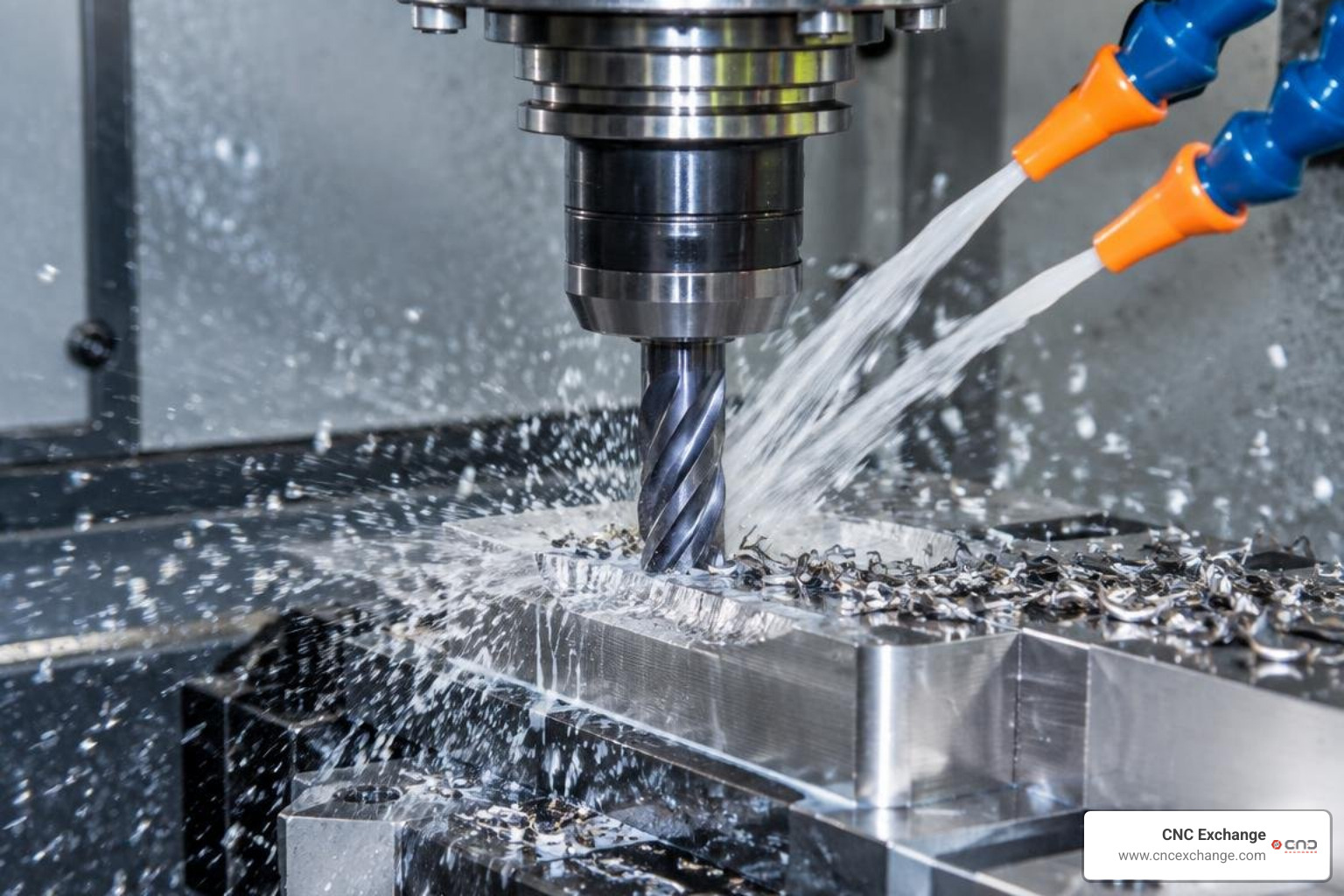
Essential Tooling and Coolant Setup for a Benchtop CNC Mill for Steel
Cutting steel generates intense friction and high heat right at the shear zone. Managing tool life requires the right tooling and cooling methods:
- Solid Micrograin Carbide: High-speed steel (HSS) end mills dull quickly on smaller CNC setups. Solid carbide tools maintain edge sharpness at higher cutting temperatures.
- Advanced Tool Coatings: Use end mills treated with Aluminum Titanium Nitride (AlTiN) or Titanium Aluminum Nitride (TiAlN). These coatings create an aluminum oxide thermal barrier under heat, protecting the cutting edge.
- Coolant Delivery: While flood coolant is ideal for flushing chips and cooling parts, Minimum Quantity Lubrication (MQL) mist systems paired with high-pressure air blasts work well on benchtop units. Clearing chips instantly prevents recutting, which is a leading cause of broken miniature end mills.
- Safety Enclosures: Hot, sharp steel chips fly off the tool with considerable force. A full polycarbonate enclosure protects your workspace, contains coolant spray, and reduces cutting noise.
Machining Feeds, Speeds, and Steel Material Grades
Machining parameters vary widely depending on the specific steel alloy:
- Mild Steels (AISI 1018, A36): Highly forgiving for beginners. Use moderate surface speeds (200–350 SFM with coated carbide) and steady feed rates to prevent work hardening.
- Alloy Steels (4140, 4340 Annealed): Tougher shear resistance. Reduce surface speed (180–250 SFM), maintain rigid tool engagement, and use high-pressure air or mist to clear chips.
- Austenitic Stainless (304, 316): Prone to rapid work hardening. Never let the tool dwell or rub against the workpiece. Keep surface speeds low (120–200 SFM), maintain positive chip load per tooth, and apply generous lubrication.
- Tool Steels (D2, O1, A2 Annealed): High abrasive wear. Use specialized multi-flute coated carbide end mills, shallow step-downs, and trochoidal dynamic toolpaths to distribute wear evenly along the tool flutes.
Frequently Asked Questions About Desktop Steel Machining
What types of steel can a benchtop CNC mill cut?
A well-built benchtop CNC mill can cut mild carbon steel (1018, 1045), structural alloy steel (4140, 4340), stainless steels (303, 304, 316), and annealed tool steels (O1, A2, D2).
Cutting parameters must be adjusted based on the hardness of the material. Keep radial depth of cut shallow, use trochoidal clearing paths, and use rigid carbide tooling to prevent tool deflection.
What are the power and space requirements for a home workshop CNC mill?
Smaller micro-mills often plug directly into standard 120V 15A circuits. Mid-range to heavy-duty benchtop mills (like 1.5 kW to 2 kW platforms) usually require a dedicated 208–240V single-phase 20A circuit to handle continuous spindle torque and motion loads.
Plan for a reinforced, vibration-damped workbench capable of supporting between 300 and 1,200 lbs, plus clearance around the machine for chip cleanup and maintenance.
Can a desktop CNC mill engrave serial numbers and detailed patterns on hardened steel?
Yes. Using micro-diameter solid carbide engraving tools, 60°/90° V-bits, or diamond drag tools, a desktop mill can engrave fine text, serial tags, and logos into hardened steels.
High-RPM spindles running shallow step-downs (0.001" to 0.005" per pass) provide crisp, clean edges on stainless and tool steel plates.
Finding the Right Steel-Cutting Machine for Your Shop
A compact milling machine opens up significant prototyping and small-batch production possibilities without requiring a massive industrial footprint. Whether you choose an ultra-compact micro-mill or a heavy cast-iron platform, matching machine rigidity to your intended materials is the key to reliable steel cutting.
If your machining needs expand beyond desktop envelopes into higher production volumes, exploring the used industrial market can provide access to heavy-duty cast-iron vertical machining centers at accessible price points. Browse our marketplace for CNC machinery and metalworking equipment to explore used commercial CNC mills, compare models, and find the right platform for your production floor.