
Evaluating the Best 14 Bandsaw Designs: Cast-Iron C-Frame vs. Steel-Frame Cabinets
When selecting the best 14-inch bandsaw for your workshop, the most fundamental design choice comes down to the frame: traditional cast-iron C-frame construction or modern welded steel-frame cabinet styling. Both have cut millions of board feet over the decades, but their engineering philosophies differ significantly in how they handle load, stress, and workspace ergonomics. For most shops, the top picks are the Grizzly G0817 and Shop Fox W1849 for heavy resawing, the Laguna 14-Twelve for precision work, and Rikon models for value.
Traditional cast-iron C-frame saws feature a two-piece design where the upper and lower wheel housings are bolted to a central cast spine. These machines excel at vibration dampening thanks to the sheer mass of gray iron. However, cast iron has lower tensile strength than structural steel. When subjected to the immense tension required by modern wide resaw blades, C-frames can flex. Historically, these saws offered a standard 6-inch vertical resaw depth, which woodworkers expanded to 12 inches by inserting an aftermarket riser block into the column.
Modern steel-frame cabinet bandsaws use heavy-gauge plate steel welded into a rigid, continuous box beam. This unibody design delivers superior torsional stiffness, allowing users to apply high tension to wider blades (such as 5/8-inch or 3/4-inch bands) without distorting the frame. While industrial pattern shops often rely on massive production vertical band saws for continuous cutting runs, modern 14-inch steel-frame units pack similar rigidity into a footprint practical for small commercial shops and dedicated home craft spaces.
Structural Rigidity, Tensioning, and Resaw Capacity Differences
The key distinction between these frame styles lies in how they handle blade tension. Wide resaw blades require substantial beam strength to resist deflection when pushing dense stock like hard maple or white oak through the cut.
- Cast-Iron C-Frames: Adding a riser block extends the cut height to 12 inches, but introduces a mechanical joint that can flex under heavy spring loads. The guide post on a modified C-frame can also be harder to align across the entire 12-inch stroke.
- Welded Steel Frames: Steel-frame models come standard with 12 to 14 inches of built-in resaw height straight out of the box. The unified column ensures that the rack-and-pinion guide post stays parallel to the blade throughout its travel.
- Tension Mechanisms: Steel-frame units typically feature heavy-duty coil springs and robust tension indicators capable of handling wider carbon steel and carbide blades without bottoming out.
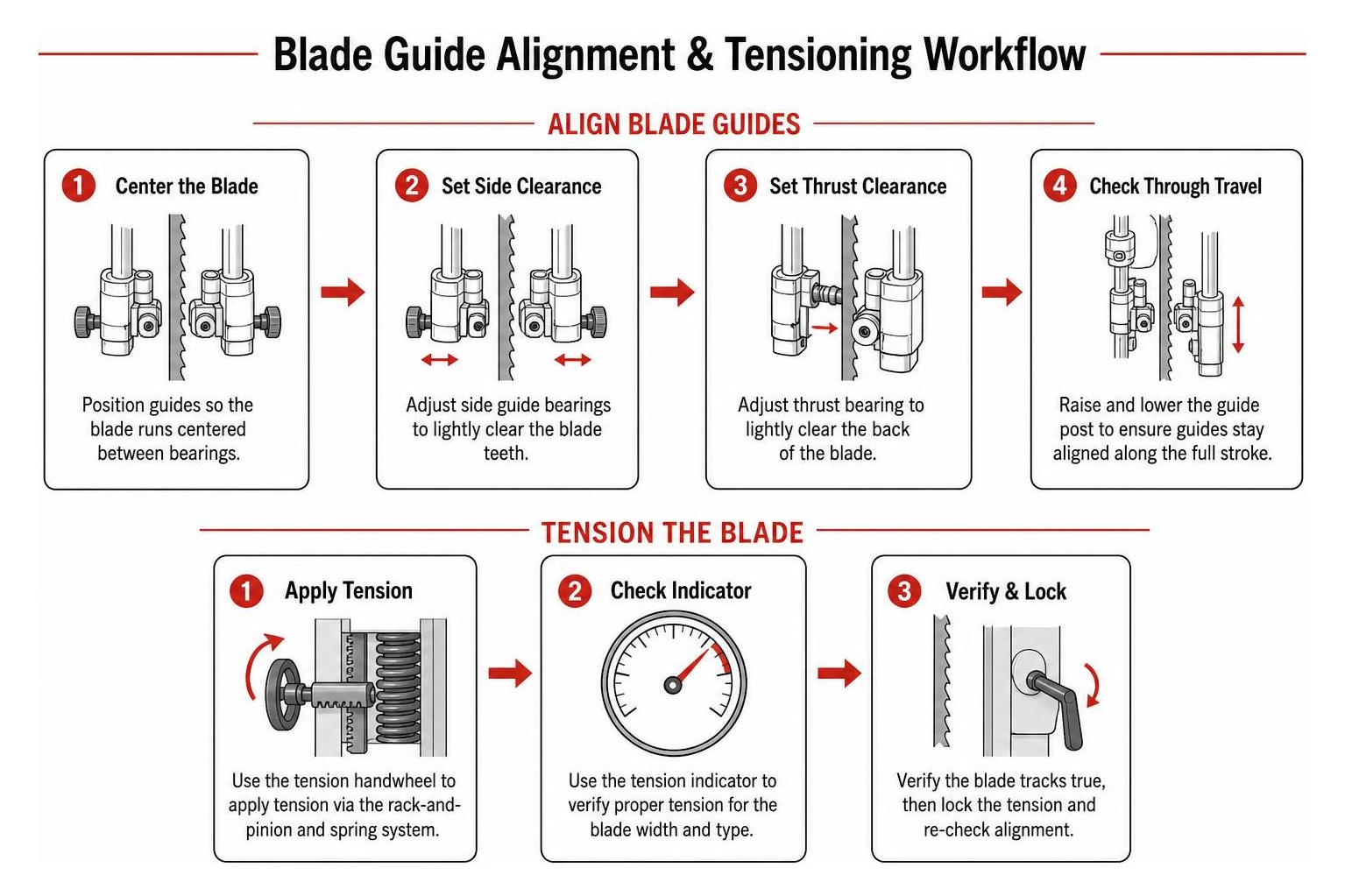
Blade Guide Systems: Ball-Bearing vs Ceramic vs Steel Discs
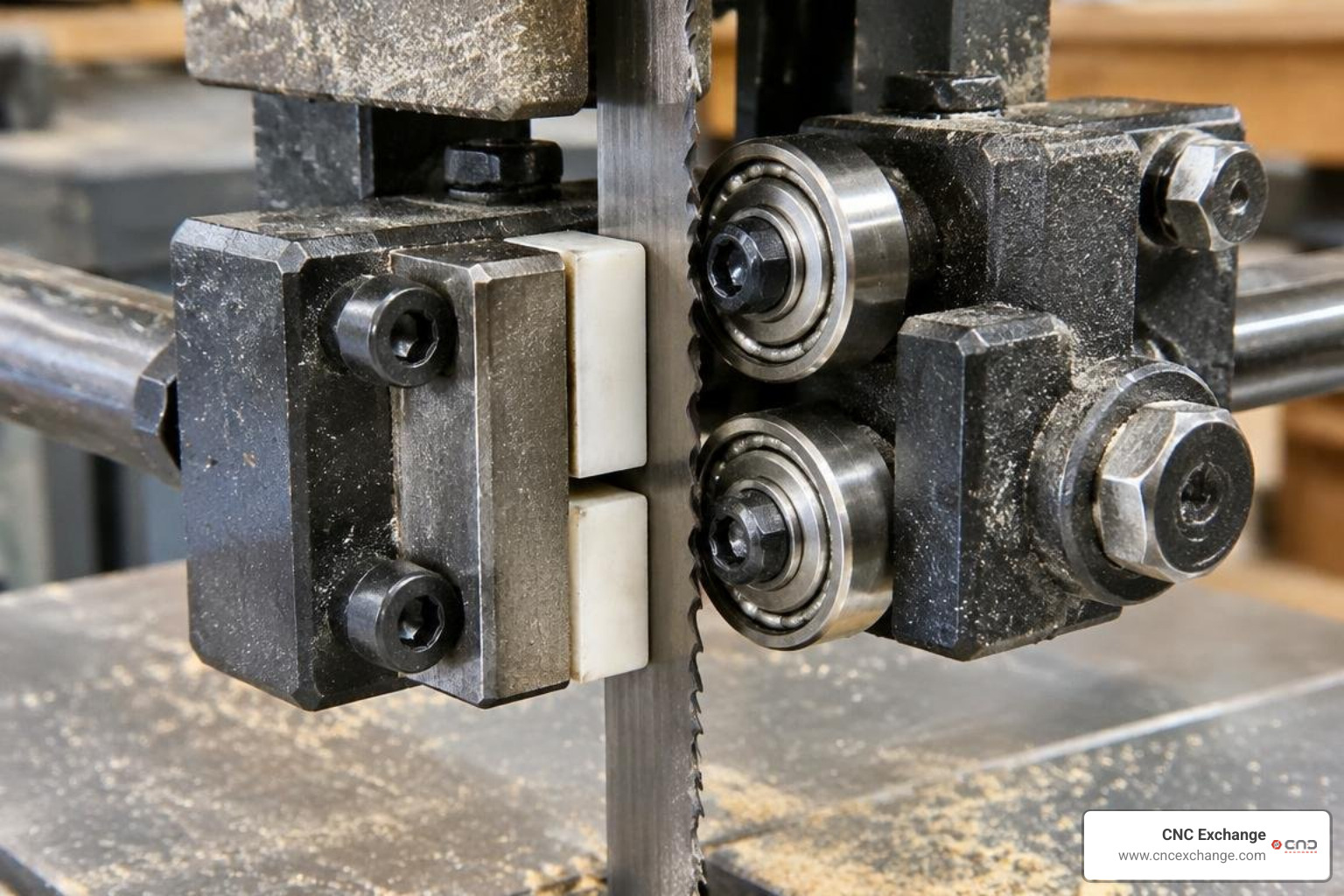
Blade guides support the blade directly above and below the table, preventing twisting and lateral deflection. The three primary guide types found on 14-inch bandsaws each offer distinct trade-offs:
- Ball-Bearing Guides: Found on saws like the Jet JWBS-14SFX and Grizzly models, these utilize rolling bearings that contact the sides and rear thrust edge of the blade. Ball bearings handle high blade speeds (up to 3,000 SFPM) well and run cool, though sawdust can occasionally pack into the races if dust extraction is poor. Models with tool-free, cam-style adjusters make setup fast and painless.
- Ceramic Guide Blocks: Popularized by Laguna's ceramic system, these blocks provide 10-point contact around the blade. Ceramic dissipates heat quickly, exhibits virtually zero wear over years of use, and stabilizes wide resaw blades effectively. Because they run in direct sliding contact, they can produce a slight hissing sound during operation.
- Steel Discs and Cool Blocks: Traditional Euro-style steel discs and phenolic "cool blocks" sandwich the blade closely. Phenolic blocks allow you to set the guides directly against the blade teeth (ideal for fine scrolling with 1/8-inch or 1/4-inch blades), though steel discs require regular micro-adjustments using hex keys to prevent friction heating.
Top Contenders: Head-to-Head Comparison for Power, Accuracy, and Value
Choosing between top-rated machines requires looking at raw power, cutting tolerances, and overall build quality. The table below outlines how the leading 14-inch contenders stack up across essential shop specifications.
| Model | Frame Type | Motor (HP / Voltage) | Resaw Capacity | Guide Type | Typical Resaw Deviation | Base Weight |
|---|---|---|---|---|---|---|
| Grizzly G0817 | Welded Steel | 2.0 HP (110V/220V) | 14.0 in. | Ball Bearing (Cam) | < 0.010 in. | 312 lbs |
| Shop Fox W1849 | Welded Steel | 2.0 HP (110V/220V) | 14.0 in. | Ball Bearing | < 0.010 in. | 310 lbs |
| Laguna 14-Twelve | Welded Steel | 1.75 HP (115V/230V) | 12.0 in. | Ceramic System | < 0.015 in. | 266 lbs |
| Jet JWBS-14SFX | Welded Steel | 1.75 HP (115V/230V) | 13.0 in. | Ball Bearing | < 0.030 in. | 272 lbs |
| Rikon 10-326 | Welded Steel | 1.75 HP (115V/230V) | 13.0 in. | Tool-less Bearing | < 0.020 in. | 280 lbs |
| Powermatic PWBS-14CS | Cast-Iron C-Frame | 1.5 HP (115V/230V) | 6.0 in. (12" w/ riser) | Dual Bearing | ~ 0.125 in. | 205 lbs |
| Grizzly G0555XH | Cast-Iron C-Frame | 1.5 HP (110V/220V) | 12.0 in. (Built-in) | Ball Bearing | < 0.010 in. | 247 lbs |
Best 14-Inch Bandsaw for Resaw Capacity and Hardwood Performance
For aggressive resawing through wide exotic hardwoods and thick lumber, the Grizzly G0817 and Shop Fox W1849 lead the category. In comparative shop testing, both saws powered through continuous 14-inch-wide cuts without bogging down the motor or losing blade speed.
Cutting accuracy on both machines proved exceptional, exhibiting total thickness deviations of less than 0.010 inches across full-height veneer slices. The Grizzly G0555XH also demonstrated impressive accuracy below 0.010 inches, while workpieces cut on the Jet JWBS-14SFX remained within 0.030 inches (less than 1/32 of an inch). Conversely, traditional setups like the Powermatic PWBS-14CS with extended riser blocks showed wider resaw variations of up to 0.125 inches (1/8 inch) when pushed hard through dense stock. Detailed breakdowns in recent 14-inch bandsaw testing data reinforce that rigid, high-capacity steel columns maintain significantly flatter cuts under heavy feed pressure.
Best 14-Inch Bandsaw for Hobbyists Under $1,000
Finding a capable machine under the $1,000 threshold requires balancing cost against core features. In this price tier, the Rikon 10-324 stands out as a reliable entry point for garage woodworkers, offering solid frame construction and dependable blade tracking.
For buyers willing to stretch slightly beyond base budgets or watch seasonal promotions, stepping up to models like the Rikon 10-326 provides spring-loaded, tool-free guide adjustments and cast-iron wheels that dampen vibration during curved work. Budget-conscious woodworkers should also consider legacy hybrid options like the Steel City 50155G (originally priced at $699.99), which introduced 12-inch resaw depths to entry-level shops.
Premium Mid-Range and Precision Contenders
Woodworkers looking for refined fit, finish, and repeatable adjustments gravitate toward mid-range production machines:
- Laguna 14-Twelve: Known for its ceramic guide system, massive 21 x 16-inch table, and balanced cast wheels. It offers 12 inches of resaw capacity and runs smoothly on standard 115V 15A circuits.
- Jet JWBS-14SFX: Offers an expansive 360-square-inch performance-coated cast-iron table, a rigid aluminum fence system, a deep 13-inch resaw throat, and dual 4-inch dust extraction ports powered by a stout 1.75 HP motor designed for demanding shop routines.
- Oliver 4620: Delivers 13 inches of resaw height with an integrated 1.5 HP motor and heavy cast trunnions, providing industrial build quality for dedicated small shops.
Essential Features for Precision Resawing and Workshop Usability
Beyond the frame and motor, day-to-day productivity depends on ergonomic design choices that simplify maintenance and blade setup. If high-volume cutting across thick steel or heavy timber is a standard part of your facility's workload, exploring heavy-duty vertical sawing equipment gives helpful context on how industrial production machinery handles continuous mechanical loads.
Motor Power: Why 1.75 HP to 2 HP Matters for Heavy Hardwoods
Motor rating dictates feed rate and cut quality:
- 1.0 HP Motors: Suitable for general 4-inch to 6-inch ripping and scroll cuts in softwoods. They easily bog down when resawing 8-inch or wider hardwoods.
- 1.5 HP Motors: Handle occasional 8-to-10-inch resawing if paired with a sharp, low-TPI blade and a slow feed rate.
- 1.75 HP to 2.0 HP Motors: The gold standard for modern 14-inch saws. Saws equipped with 1.75 HP (drawing ~15A on 115V) or 2.0 HP (often wired for 230V) maintain blade speed through 12-to-14-inch cuts of kiln-dried walnut, oak, and maple without stalling.
Fence Adjustability, Blade Drift Correction, and Quick Blade Changes
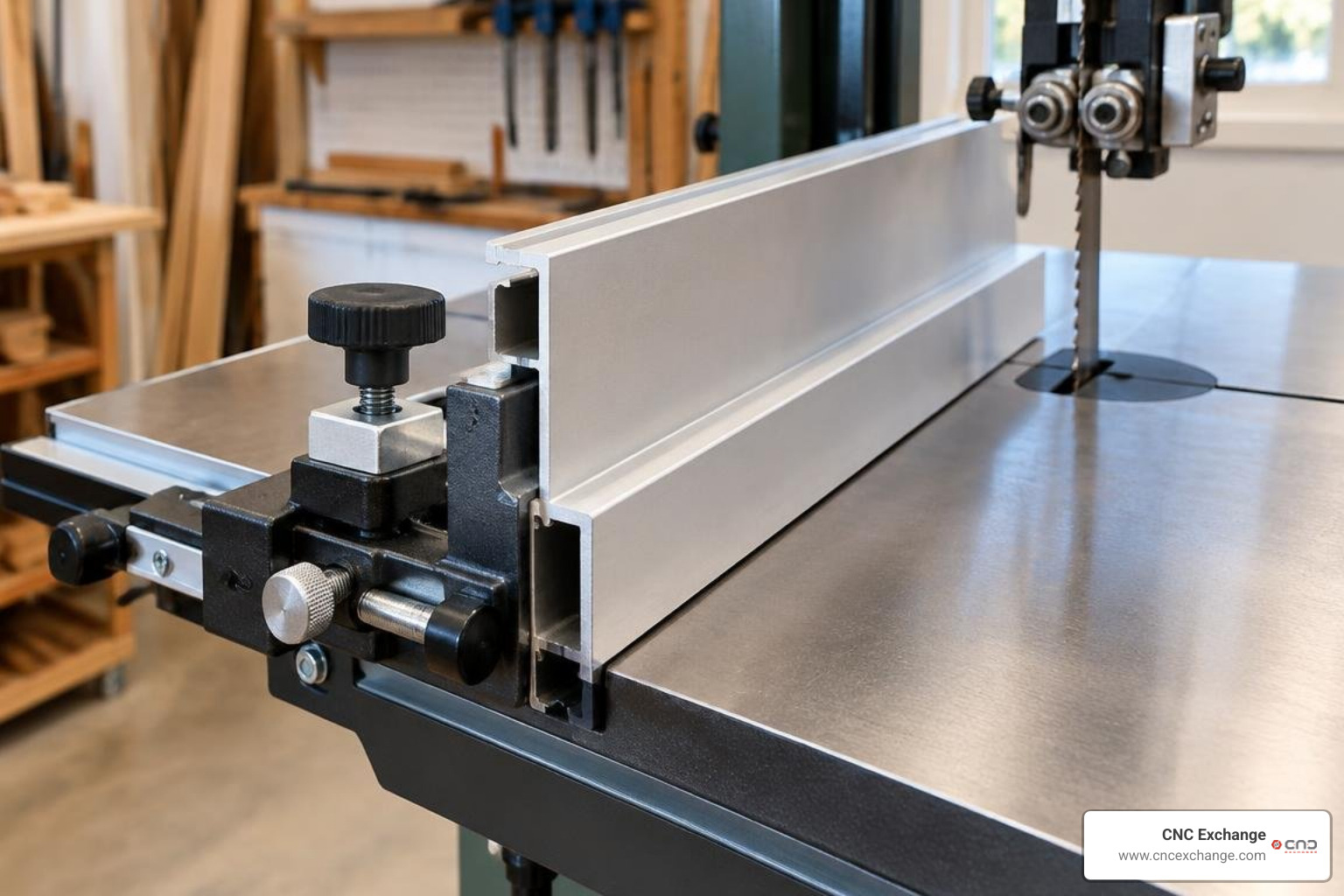
A high-performance bandsaw fence must lock parallel to the miter slot while allowing micro-adjustments to compensate for blade drift. Premium fences feature a dual-position aluminum extrusion: a high 4-to-6-inch face for supporting tall resaw boards, and a low profile face that flips flat to clear blade guides during narrow rips.
Blade setup speed varies significantly between models. In workshop evaluations, the Grizzly G0555XH proved the fastest to set up, requiring only 11 minutes for a complete blade change and guide realignment. By comparison, saws with complex lower guide guards or sliding lower brackets (like the Jet SFX) can take more than twice as long to dial in. Look for quick-release blade tension levers that fully de-tension the band in one smooth motion without hitting the upper guide post.
Dust Extraction Requirements, Wheel Brushes, and Safety Features
Resawing wide boards generates substantial sawdust. Saws with single 2.5-inch ports quickly clog lower housings. Look for:
- Dual 4-Inch Dust Ports: One located directly below the lower blade guides to catch dust at the source, and a second at the base of the lower wheel cabinet.
- Airflow Demands: High-capacity resawing requires a dust collector supplying at least 400 CFM to prevent buildup on lower guide bearings.
- Wheel Cleaning Brushes: Continuous-contact nylon brushes sweep the lower tire, preventing compacted sawdust from throwing off blade tracking.
- Safety Switches & Brakes: Magnetic safety switches prevent accidental restarts after power outages, while integrated mechanical foot brakes stop spinning wheels in under two seconds.
Choosing the Right Blades for Ripping, Resawing, and Curve Cutting
Even the most powerful bandsaw will wander, drift, or burn lumber if fitted with the wrong blade. Matching blade width, tooth count, and tooth geometry to your specific cut ensures clean results.
Optimal Blade Widths and TPI for Deep Resaw Cuts vs Fine Curves
- Deep Resawing (8" to 14" stock): Use a 1/2-inch or 3/4-inch wide blade with 2 to 3 Teeth Per Inch (TPI) in a Hook or Skip-tooth profile. Deep gullets carry waste out of the cut before it packs around the blade, preventing friction heat and blade wandering.
- General Ripping & Tenons (2" to 6" stock): A 3/8-inch or 1/2-inch blade with 4 to 6 TPI provides a balanced combination of feed speed and surface finish.
- Intricate Curve Cutting:
- 1/4-inch blade (6 to 10 TPI): Cuts curves down to a 5/8-inch radius.
- 1/8-inch or 3/16-inch scroll blade (10 to 14 TPI): Cuts tight radii down to 3/16 of an inch for decorative scrolling.
Frequently Asked Questions About 14-Inch Bandsaws
Can a 14-inch bandsaw run efficiently on a standard 110V circuit?
Yes. Most 1.5 HP and 1.75 HP bandsaws (such as the Laguna 14-Twelve and Jet JWBS-14SFX) are pre-wired for 115V operation. They draw between 12.5 and 15 amps under standard conditions. However, connecting to a dedicated 20-amp circuit with heavy-gauge wiring is recommended to avoid nuisance breaker trips during heavy hardwood startup. Saws with 2.0 HP motors run most efficiently when wired to a 220V/240V supply.
How do I eliminate blade drift during deep resawing cuts?
Blade drift occurs when a blade cuts at a slight angle rather than parallel to the fence. To eliminate it:
- Ensure the blade tracks centered on the crowned wheel tires.
- Apply sufficient blade tension (use the 1/4-inch deflection test).
- Set side guide bearings within 0.002 to 0.004 inches of the blade body, positioned just behind the tooth gullets.
- Align your fence parallel to the blade's natural cutting line using adjustable fence mounting bolts.
- Replace dull blades, as unevenly worn teeth pull cuts to one side.
Is it worth adding a riser block to a 6-inch capacity bandsaw?
Adding a riser block is a cost-effective way to double the cutting height of an existing cast-iron C-frame saw. However, if buying new, purchasing a factory-built steel-frame saw with 12 to 14 inches of integrated resaw height is generally preferable. Dedicated steel-frame saws offer superior beam rigidity, easier guide-post adjustments, and stronger tension springs without the alignment hurdles of an intermediate column joint.
Conclusion
Finding the right 14-inch bandsaw comes down to matching frame rigidity, motor power, and blade support to your workshop's cutting demands. If deep resawing and wide veneer production top your priority list, rigid steel-frame models like the Grizzly G0817, Shop Fox W1849, Laguna 14-Twelve, and Jet JWBS-14SFX provide the power and stability needed to keep cuts flat and accurate. For general shop tasks, curve cutting, and light furniture work on a tight budget, modern entry-level steel units offer tremendous capability without the heavy footprint of industrial equipment.
At CNC Exchange, we help woodshops, fabrication facilities, and manufacturing plants source dependable production equipment and upgrade their machinery lineups. When you are ready to expand your shop's cutting, milling, or shaping capabilities, browse quality woodworking machinery on our marketplace to find high-performance tools that fit your production goals and budget.