
How to Compare Woodworking Machines for Your Shop
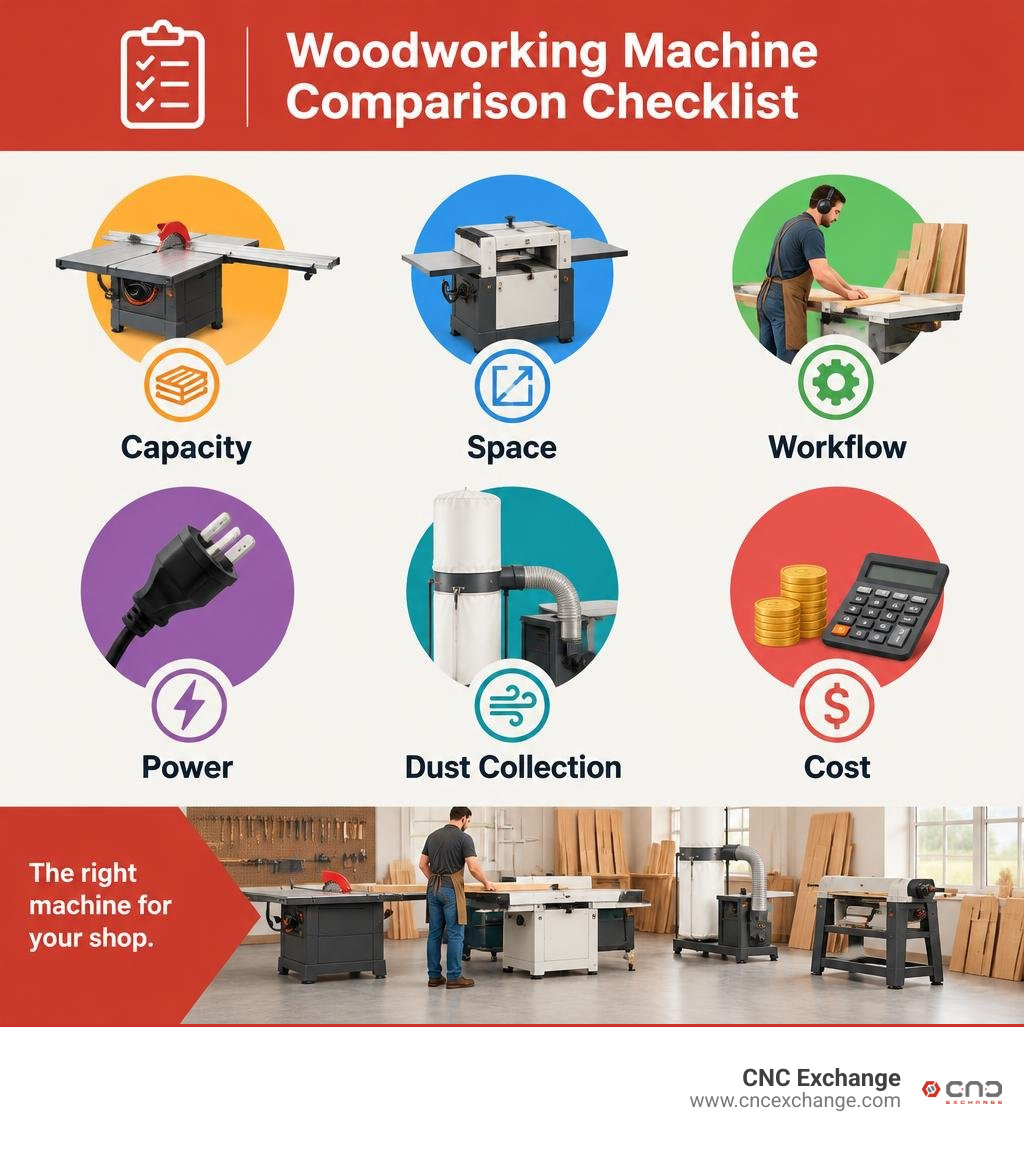
Start with the work you need to produce. Match each machine's cutting capacity, accuracy, and output to your materials and order volume. Then check the space needed to feed stock, the power and dust collection your shop can supply, and the time it takes to switch tasks.
A combination machine can save floor space and upfront cost, but changeovers can slow a busy shop. Separate machines let workers run tasks at the same time. If you are considering a CNC router, compare its working area, spindle, controls, and workholding before comparing prices.
I'm Jared Gray. I've spent more than 12 years buying, selling, and brokering manufacturing equipment, with a focus on CNC machines. I'll use that experience to help you weigh woodworking machines against your shop's workflow and budget.
Core Types of Woodworking Machines: Standalone vs. Combination Units
Every woodworker faces the classic shop dilemma: invest in individual, dedicated tools or opt for an integrated universal system. Choosing the right machinery requires balancing floor footprint, capital expenditure, and daily operational rhythm.
Dedicated standalone machines—such as an independent cabinet saw, a long-bed jointer, a stationary planer, and a stand-alone shaper—offer the ultimate workflow speed. Multiple operators can mill, cut, and shape parts simultaneously without waiting for a machine teardown. However, standalone equipment requires substantial floor space, separate dust collection drops, and higher electrical infrastructure investments.
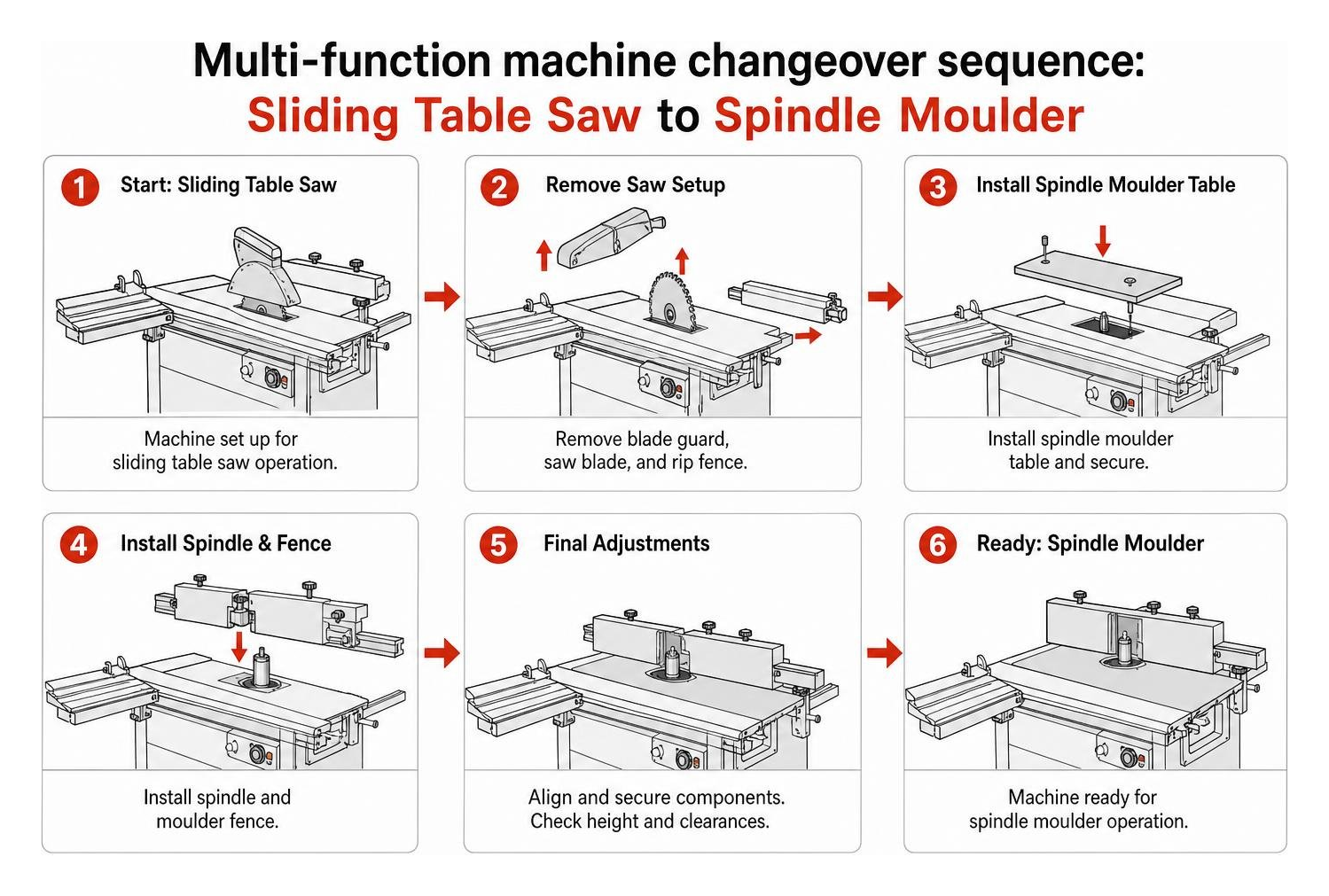
In contrast, universal combination systems combine up to five core functions (sliding table saw, scoring blade, spindle moulder/shaper, jointer, and planer) into a single cast-iron chassis. Industrial-grade European combos, such as the Minimax CU 410ES universal combination machine, pack an 86-inch (2200 mm) jointer bed, a 16-inch (410 mm) cutterhead, an 8 HP three-phase motor group, and a 2600 mm squaring stroke into a remarkably compact footprint. The trade-off lies in changeover time: transitioning between jointing and thickness planing, or dropping a shaper fence to use the sliding saw, requires thoughtful job batching.
| Machine Configuration | Floor Space Impact | Initial Capital | Workflow Bottlenecks | Operator Concurrency |
|---|---|---|---|---|
| Dedicated Standalone Units | High (Requires 600–1,000+ sq. ft.) | Higher (4–5 separate machines) | Low (Zero setup changeovers) | High (Multiple operators work simultaneously) |
| Multi-Function Combination Systems | Low-Medium (200–400 sq. ft.) | Moderate (One high-precision platform) | Moderate (Requires task batching) | Low (Single operator per station) |
Evaluating Multi-Function 5-in-1 and Saw-Shaper Combos
If a 5-in-1 universal system feels like too much of a compromise on daily milling setups, split combos offer a practical middle ground. Many commercial shops pair a dedicated jointer/planer with a sliding saw/spindle moulder combo.
A premier example is the Felder KF 500 professional saw/spindle moulder. It incorporates a 315 mm main blade offering a 102 mm cut height, an independent scoring blade for chip-free panel cuts, a rip capacity between 800 mm and 1250 mm, and a multi-speed spindle moulder operating at 3000, 6000, 8000, and 10,000 RPM. Supported by patented wear-resistant X-Roll sliding table guides, this configuration provides sheet-goods sizing and custom architectural moulding without cluttering the shop floor.
For high-volume milling, specialized end-profiling, and panel sizing, operations often integrate automated systems like the Friulmac FN5 1300 Wood into their production lines to streamline heavy cross-cutting and tenoning tasks.
Benchtop vs. Stationary Planer/Jointer Woodworking Machines
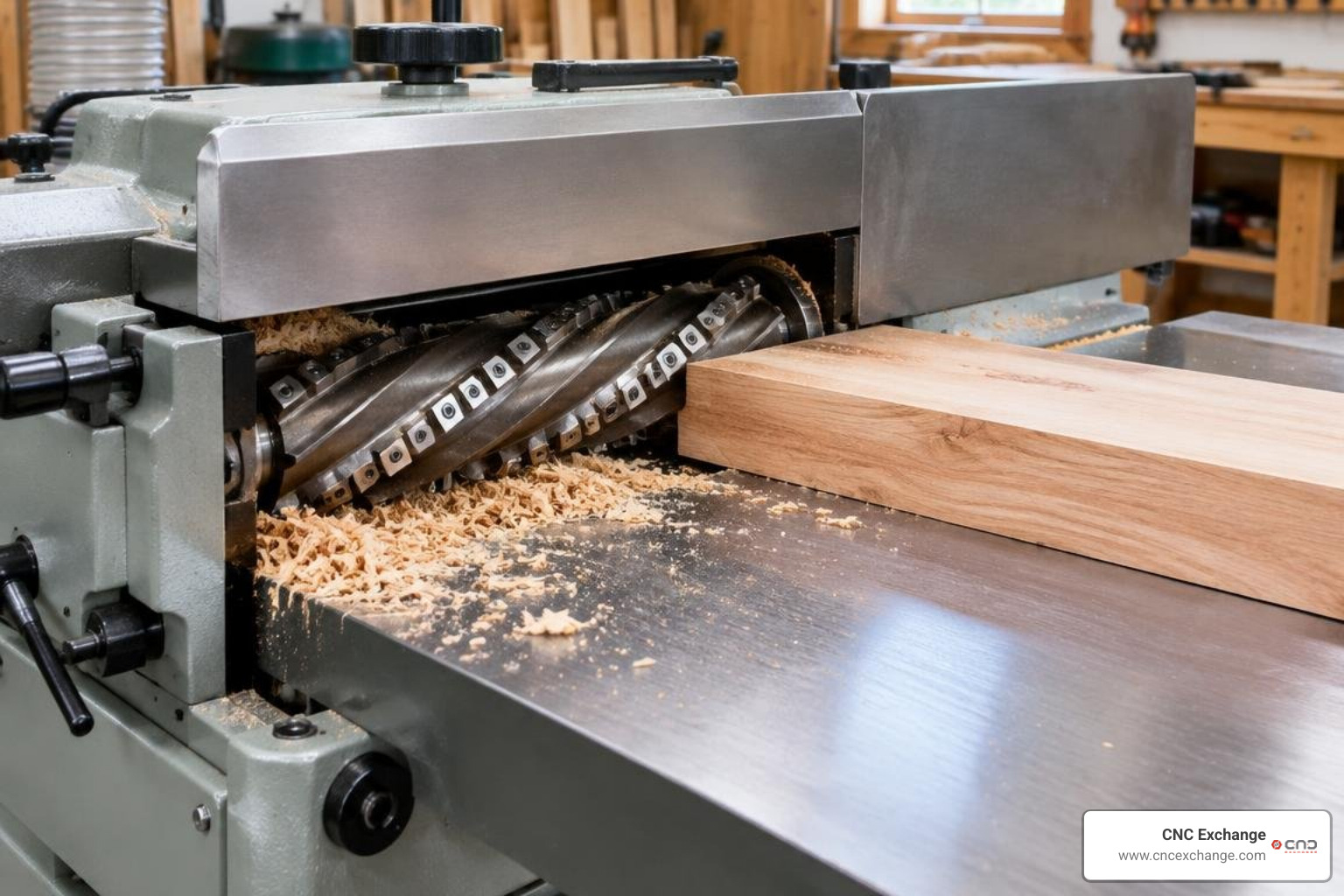
When narrowing down flattening and thicknessing machinery, shop owners must decide between lightweight benchtop units and heavy cast-iron stationary platforms.
Benchtop combo units, such as the Grizzly G0959 12" combo planer/jointer, cater to small-scale artisans, job-site contractors, and compact workshops. Weighing around 95 lbs and drawing 15A on a 120V circuit, the G0959 features a 1-1/2 HP motor running at 8,500 RPM with a 28-insert helical cutterhead. It handles standard lumber leveling in garages and light prototyping shops with ease.
Conversely, floor-standing heavyweights like the Grizzly G0634X 12" 5 HP planer/jointer weigh approximately 750 lbs. With a 220V, 25A single-phase 5 HP motor, massive cast-iron tables, an end-mounted fence that can sit flush against a wall, and a maximum stock thickness capacity of 8 inches, stationary units absorb vibration, maintain flat tolerances across wide hardwood slabs, and prevent table deflection under 10-foot rough-sawn boards.
| Feature / Metric | Benchtop Combo (e.g., G0959) | Floor-Standing Stationary (e.g., G0634X) |
|---|---|---|
| Motor Power & Voltage | 1.5 HP, 120V, 15A Single-Phase | 5.0 HP, 220V, 25A Single-Phase |
| Machine Weight | ~95 lbs (High portability) | ~750 lbs (Vibration dampening) |
| Cutterhead Insert Count | 28 Indexable Carbide Inserts | 48 Indexable Carbide Inserts (V-Helical) |
| Max Stock Planing Thickness | ~6 Inches | 8 Inches |
| Table Bed Rigidity | Sheet metal / light cast aluminum | Precision-ground heavy cast iron |
| Typical Target Use | Jobsite, prototyping, hobbyist shops | High-throughput professional furniture/cabinetry |
Cutterhead Technology: Helical, V-Helical, and Straight Knives
Cutterhead engineering has evolved dramatically over the past two decades. The days of spending hours adjusting high-speed steel (HSS) straight knives with dial indicators are fading fast in production environments.
Traditional straight-knife heads use two to four long blades that strike the wood parallel to the grain. This slamming impact creates significant noise, increases the risk of tearout on figured woods (like curly maple or quarter-sawn oak), and requires full blade replacement or regrinding if you nick a blade on an embedded staple or knot.
Helical and V-helical cutterheads use rows of four-sided, solid tungsten carbide inserts arranged in a spiral pattern. These inserts strike the workpiece at a shear angle, slicing through the grain rather than chopping it.
- Tearout Elimination: Shear cutting handles interlocking and figured grain with minimal tearout, drastically reducing downstream wide-belt sanding time.
- Noise Dampening: The continuous, staggered contact reduces acoustic resonance by 5 to 10 dB compared to straight knives, making for a much quieter shop.
- Maintenance Simplicity: If an insert is nicked, you simply loosen the Torx screw, rotate the insert 90 degrees to an unused sharp edge, and tighten it down. The Grizzly G0634X incorporates 48 indexable carbide inserts that can be rotated up to 3 times before requiring replacement, virtually eliminating machine downtime.
| Metric | Straight Knife Heads | Standard Helical Cutterheads | V-Helical / Spiral Shear Heads |
|---|---|---|---|
| Finish on Figured Grain | Moderate to Poor (Tearout prone) | High (Smooth surface) | Superior (Clean shear cutting) |
| Noise Levels (Decibels) | High (~90–95+ dBA under load) | Noticeably Lower (~80–85 dBA) | Lowest (~78–82 dBA) |
| Blade Material & Life | HSS (Dulls quickly on hardwoods) | Solid Tungsten Carbide (10x-20x life) | Solid Tungsten Carbide (10x-20x life) |
| Downtime for Nicks | 1–2 hours (Regrind/realign all knives) | 2 minutes (Rotate individual insert) | 2 minutes (Rotate individual insert) |
| Upfront Machine Cost | Baseline | Moderate premium | Moderate-to-high premium |
Selecting CNC Routers for Small to Mid-Sized Production Shops
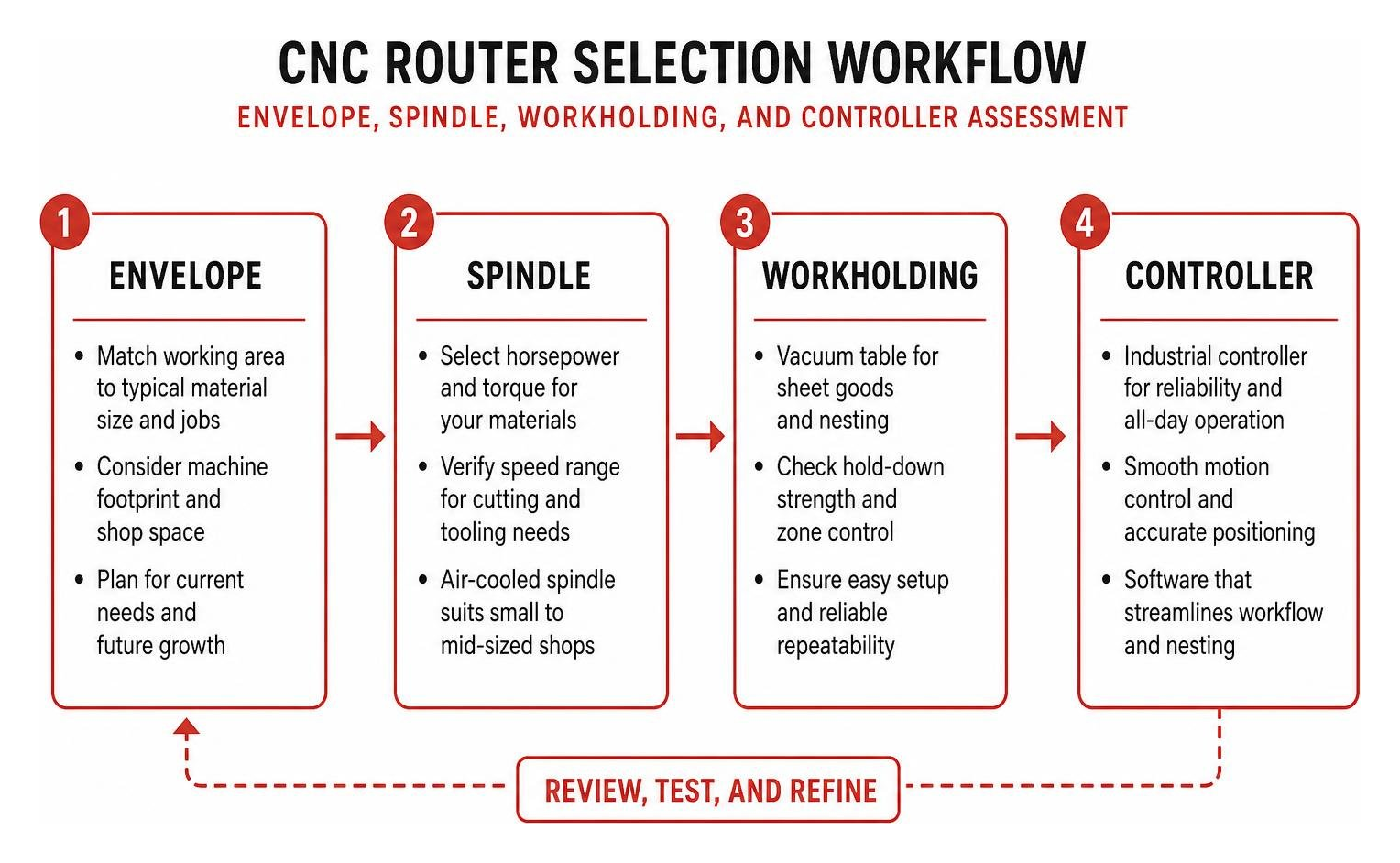
When a shop expands into nested-based cabinetry, 3D carving, or flat-panel processing, manual machines hit a throughput wall. Evaluating CNC routers requires looking beyond bed dimensions to analyze rigid construction, spindle performance, controller architecture, and vacuum clamping systems.
Small to mid-sized shops looking for a compact footprint can explore semi-industrial units like the Professor V2.3 CNC router. This bench-top system features a 23.5” x 35.5” x 8” working area, an industrial 2 HP (1.5 kW) Italian air-cooled HSD spindle, a 750 lb cast-iron base with THK linear rails, and a rapid traverse speed of 315 inches per minute. It bridges the gap between desktop hobby machines and production-floor units.
When production volume demands full 4x8 or 5x10 sheet nesting, investing in a robust commercial CNC platform becomes essential.
- For heavy-duty continuous nesting and secondary routing, machines like the Thermwood C-50 CNC Router provide rigid structural framing and industrial controllers designed to process full sheet goods all day long.
- High-speed panel sizing and nested cabinetry benefit from specialized work centers like the Onsrud Panel Pro 288G16D CNC Router, known for dependable spindle power and rigid gantry designs.
- Operations focused on rapid automation and automated material loading/unloading frequently implement systems such as the CNC Factory Sidewinder XPR CNC Router to maximize throughput per square foot.
Workshop Facility Requirements, Safety Standards, and Feature Valuations

Upgrading your shop's machinery requires ensuring your facility can support the added power and dust extraction demands while keeping your workspace safe.
Certified equipment gives shop managers peace of mind. Look for machines carrying verified safety standards:
- Safety Certifications: CSA (Canadian Standards Association) and CE (Conformité Européenne) marks confirm that electrical enclosures, emergency stop circuits, interlocks, and blade guards meet rigorous industrial health and safety standards.
- Active Safety Mechanisms: Industrial spindle moulders and saws feature mechanical shaft locks, emergency interlocks that cut power instantly, riving knives to eliminate kickback, and micro-adjustable fence hoods that keep hands clear of spinning cutters.
- Feature Valuations: High-end engineering features justify their premium price tags over time. The patented Felder X-Roll linear guide system, backed by a 10-year factory guarantee, uses roller bearings arranged in an 'X' configuration to eliminate contact play and wear under heavy slab loads. Similarly, dedicated scoring saw motors prevent bottom-side veneer chip-out, and quick-change spindle shafts allow tooling changes between 30 mm and 1-1/4" cutters in seconds.
Heavy multi-axis production centers—such as the Motionmaster SB55XT CNC Router—require properly reinforced industrial flooring, isolated electrical drops, and comprehensive safety fencing with light-curtain emergency stops.
Electrical and Dust Extraction Infrastructure for Woodworking Machines
Before signing an equipment purchase order, perform a thorough shop infrastructure audit:
- Electrical Infrastructure:
- Voltage & Phase: Small benchtop tools run on standard 120V single-phase lines (15–20A). Mid-range stationary tools (such as 3–5 HP jointers and table saws) require dedicated 220V/240V single-phase drops (20–30A). Large production systems, 5-in-1 universal combination machines, and commercial CNCs typically demand 208V/230V/460V three-phase electrical connections. If your commercial unit only has single-phase utility power, calculate the cost of adding a rotary phase converter or digital variable frequency drives (VFDs).
- Dust Collection & Extraction:
- Fine hardwood dust is an OSHA health hazard and a combustible dust risk. Connect stationary planers, jointers, and CNC routers to a cyclone dust collector delivering adequate CFM (cubic feet per minute) and static pressure.
- While a 12" benchtop planer can operate on 400 CFM through a 4-inch port, a 16-inch industrial planer or a full-sheet CNC router needs 800 to 1,200+ CFM across 5-inch or 6-inch rigid metal duct drops to clear heavy chips and keep linear rails free of debris.
Frequently Asked Questions About Woodworking Equipment
How much space is required to operate a full combination woodworking machine?
While a multi-function combination unit occupies a compact physical chassis footprint (often just 6 x 8 feet), you must account for the full travel of the sliding table carriage, the crosscut outrigger table extension, and infeed/outfeed board clearances.
To rip and crosscut standard 4x8-foot sheet goods or joint 10-foot hardwood boards comfortably, plan for a dedicated working clearance zone of at least 15 x 20 feet (300 to 400 square feet) around the machine.
Are helical cutterheads worth the higher upfront cost compared to straight knives?
Yes. While a helical cutterhead machine or retrofit adds 15% to 30% to the initial equipment cost, it pays for itself rapidly in professional shops.
Solid carbide inserts last roughly 10 to 20 times longer than traditional high-speed steel knives between rotations. When you factor in the labor savings of eliminating straight-knife alignment, the 2-minute recovery time from a nicked edge, the noticeable reduction in shop noise, and the reduced sanding time on figured timber, helical systems deliver a fast return on investment.
When should a production shop upgrade from manual machinery to a CNC router?
A shop should consider upgrading to a CNC router when manual panel breakdown, mortising, profiling, and repetitive drilling become major production bottlenecks.
If your team spends more than 15 to 20 hours per week cutting cabinet boxes, nested parts, or complex curved profiles on sliding table saws and shapers, a CNC router will dramatically lower labor costs per part, eliminate human measurement errors, optimize material yield through automated nesting software, and free up skilled craftspeople for custom assembly and finishing.
Conclusion
Every equipment decision comes down to matching your production volume, available workspace, and capital budget with the right machine design. Whether you are outfitting a compact workshop with a high-performance 12-inch helical jointer/planer combo, upgrading to a versatile European saw-spindle moulder, or scaling production with an industrial CNC router, choosing precision-built equipment is the key to shop profitability.
At CNC Exchange, we help shops of all sizes navigate these decisions. Operating as an industrial online marketplace, we auction, buy, and sell industrial equipment, making it simple to upgrade your machinery, liquidate surplus equipment, and secure fair market value.
When you are ready to expand your shop's capabilities, browse certified used and new woodworking machinery on our platform or consult directly with our machinery specialists to find the right equipment for your production goals.