
What a Vertical Boring Mill Does
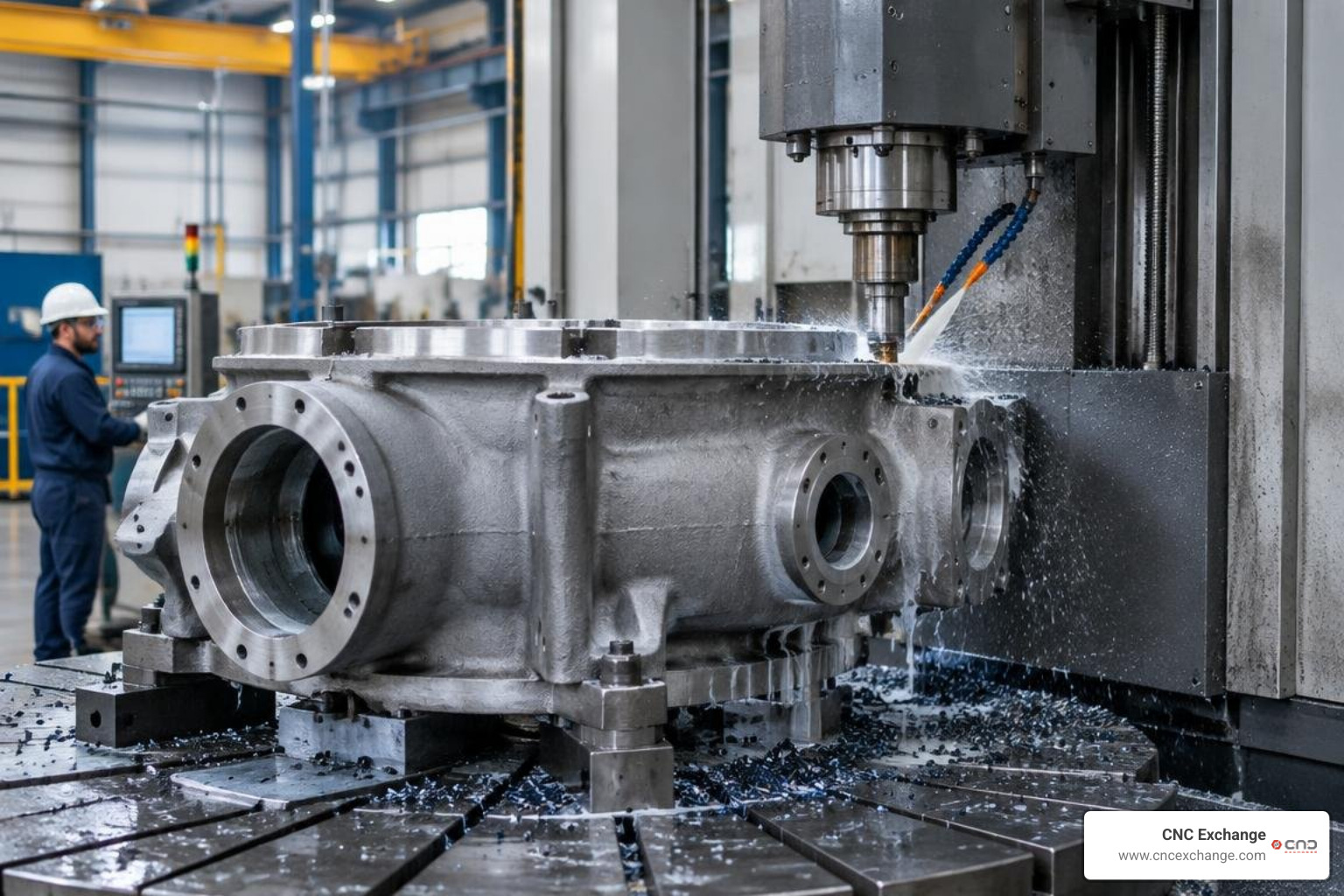
A vertical boring mill machines large, heavy parts that are hard to handle on a standard lathe. On a typical machine, the part sits on a horizontal table that rotates while a cutting tool shapes its bore, inside wall, or outer diameter. This setup is especially useful for wide, heavy parts such as turbine housings and large rings.
The main buying question is simple: Does the machine fit your part and your workflow? Table size, maximum swing, load capacity, and tool travel matter more than the machine's size alone. This guide explains those specs, how vertical mills compare with horizontal ones, and when CNC controls are worth the investment.
I'm Jared Gray. I've spent more than 12 years buying, selling, and brokering manufacturing equipment, and I'll use that experience to help you assess a vertical boring mill.
What Is a Vertical Boring Mill and How Does It Work?
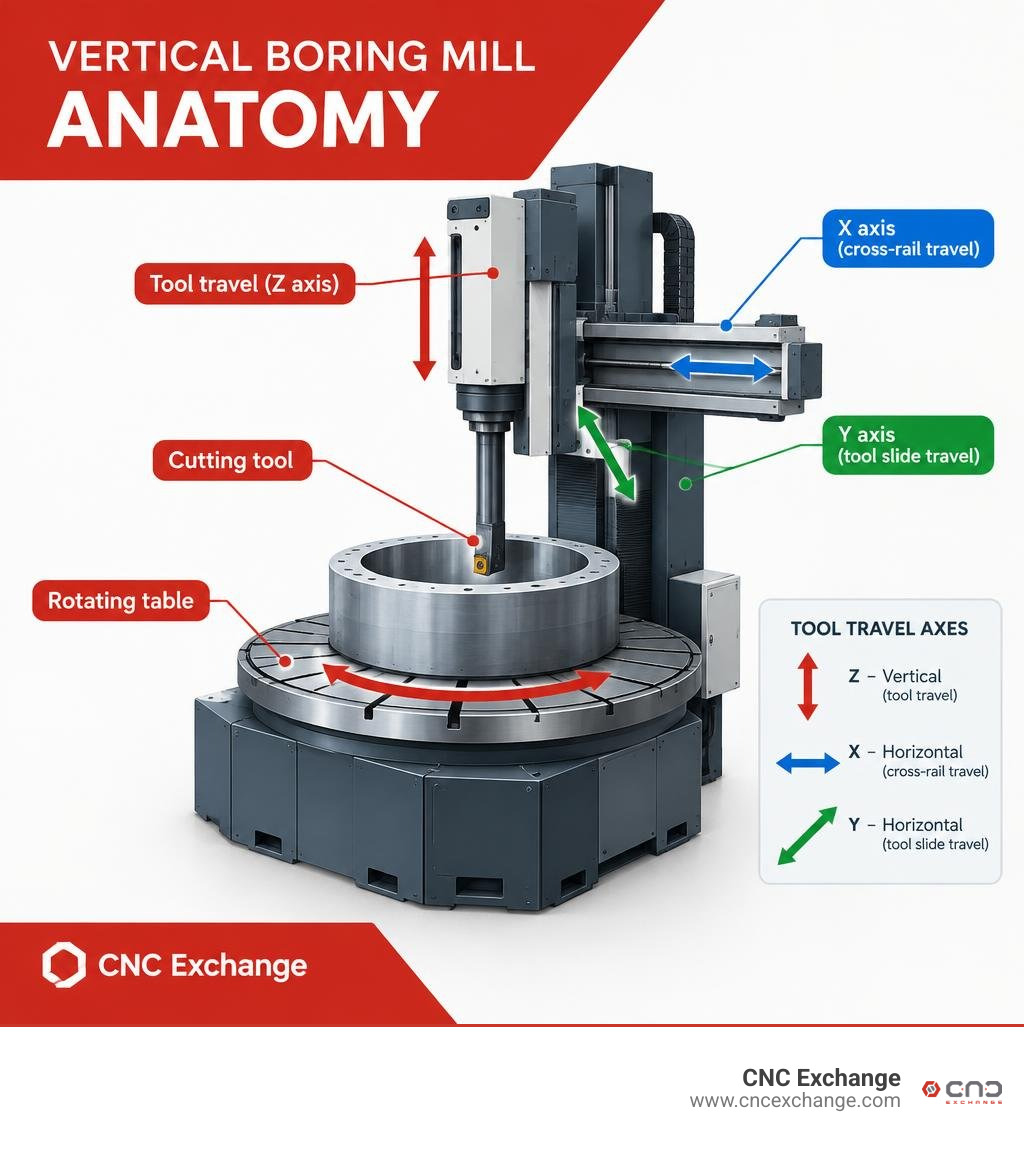
At its core, a vertical boring mill (often abbreviated as VBM) turns the traditional lathe geometry on its side. Instead of suspending a massive, barrel-shaped casting horizontally between headstock and tailstock centers—where gravity constantly works against spindle alignment—the workpiece rests flat upon a heavy-duty circular table. As this table rotates on high-precision thrust bearings, rigid cross-rails and vertical tool rams maneuver non-rotating cutting tools down into bores or across exterior faces.
This mechanical layout provides exceptional concentricity, sizing accuracy, and straightness when shaping deep internal cavities or massive outer diameters. Whether you need internal tapering, thread single-pointing, or wide-diameter facing, the vertical architecture ensures that heavy cutting pressures transfer straight downward into the machine foundation.
Understanding Vertical Boring Mill Mechanics and Orientation
The defining feature of a vertical boring mill is its reliance on natural gravity. When you set a 20-ton steel ring onto a flat rotary table, gravity immediately stabilizes the part against the table face. Clamping requirements serve primarily to prevent lateral shifting during heavy roughing cuts rather than battling radial sag or deflection.
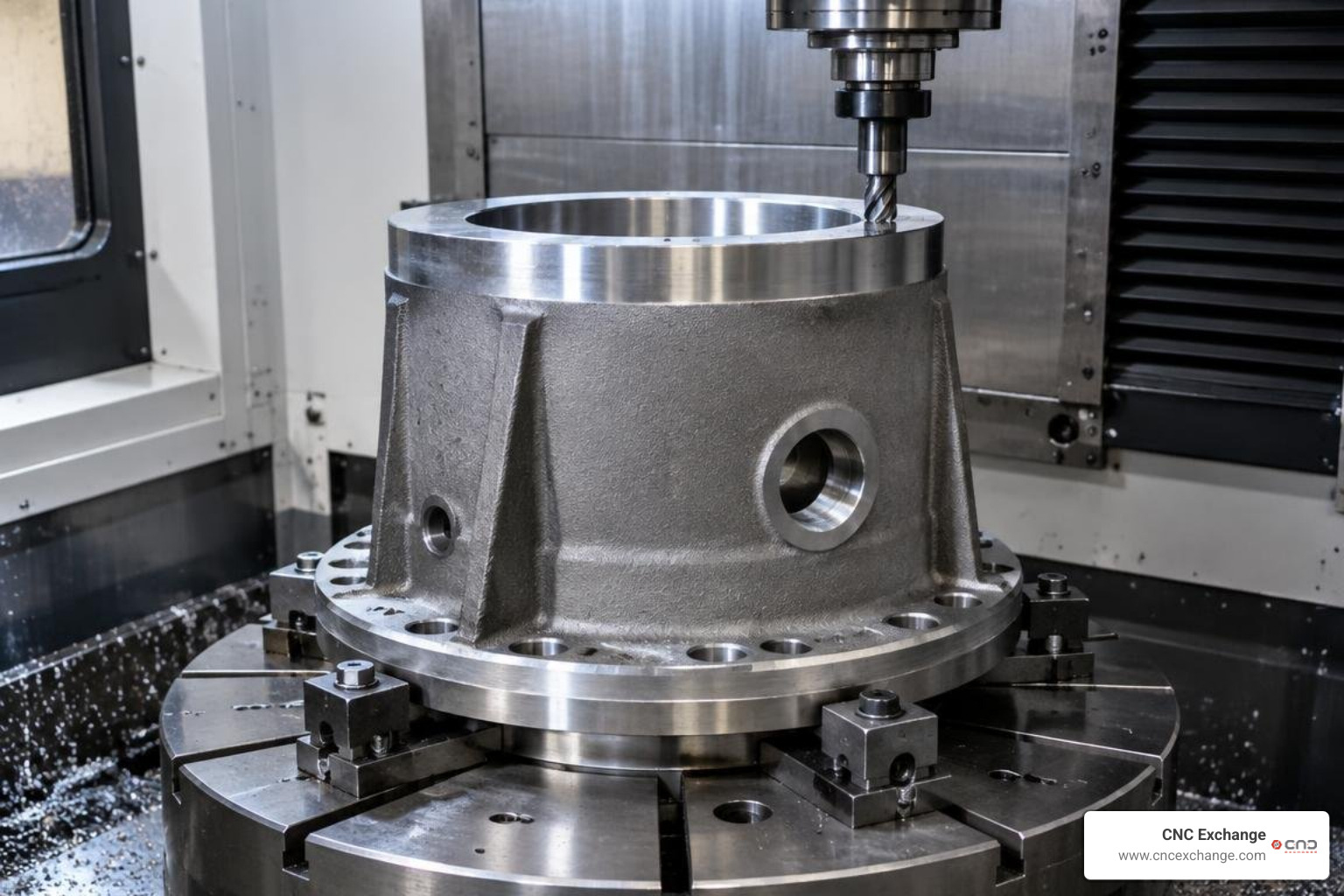
Modern setups, including precision engineered Dorries Scharmann vertical boring mills, employ massive closed-grain cast iron structures with thermal stability close to steel. Combined with dual hydrostatic or precision roller bearings, these machines achieve axial and radial total indicator readings (T.I.R.) as fine as 0.0005 inches. The resulting axial stiffness allows operators to take aggressive depths of cut on difficult alloys without inducing tool chatter or harmonic distortion.
Vertical Boring Mills vs. Horizontal Boring Mills
Deciding between vertical and horizontal configurations comes down to part geometry, weight distribution, and feature location. While a vertical machine rotates the workpiece under a stationary ram, a horizontal boring mill mounts the workpiece to a fixed or indexing table while the spindle spins and extends outward horizontally along the Z-axis.
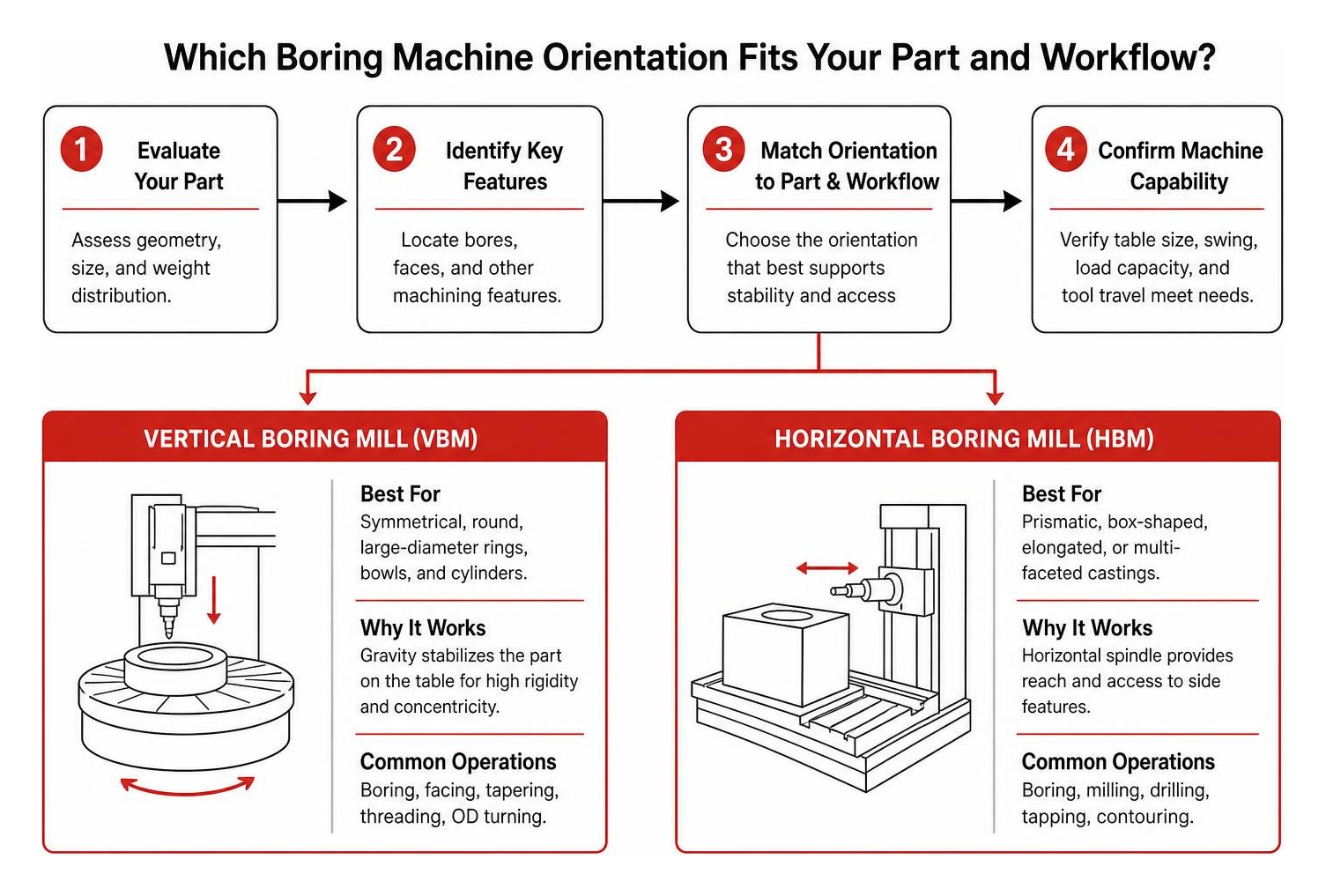
Here is a head-to-head comparison to help you evaluate which orientation fits your shop floor:
| Operational Factor | Vertical Boring Mill (VBM) | Horizontal Boring Mill (HBM) |
|---|---|---|
| Workpiece Geometry | Symmetrical, round, large-diameter rings, bowls, and cylinders | Prismatic, box-shaped, elongated, or multi-faceted castings |
| Spindle/Table Motion | Table rotates workpiece; tool head moves vertically and horizontally | Tool rotates on horizontal spindle; table travels in X/Z or indexes |
| Part Weight Handling | Gravitational self-centering; handles ultra-heavy loads easily | Workpiece clamped sideways; cantilever stress on tall fixtures |
| Chip Evacuation | Chips fall naturally downward; requires clearing from blind internal bores | Chips clear easily out of horizontal bores under gravity |
| Setup & Fixturing | Quick overhead crane loading directly onto the horizontal face | Complex fixturing and angular bracing often required |
| Primary Strengths | Concentric turning, deep internal boring, facing wide diameters | Multi-sided milling, boring across deep prismatic faces in 1 setup |
CNC vs. Conventional Boring Technology and Market Evolution
The heavy machine tool market has shifted decisively toward digital automation. Conventional vertical boring mills—operated via manual levers, handwheels, and digital readout (DRO) pendants—remain dependable workhorses for one-off repair jobs or simple turning work. However, CNC-driven platforms now dominate production environments where tight tolerances and repeatable cycle times drive shop profitability.
Key Advantages of a CNC Vertical Boring Mill
Modern CNC vertical boring mills eliminate the manual guesswork of profiling complex geometries. Multi-axis CNC interpolation allows seamless transitions between contour turning, taper threading, and face groove milling without stopping the table.
Key performance benefits of modern CNC models include:
- Enhanced Precision: High-resolution optical linear scales and backlash-free ball screws deliver positional accuracies between +/- 0.003 mm and 0.005 mm, holding part-to-part repeatability to within 0.003 mm.
- Superior Surface Quality: Programmable feed rates and constant surface speed (CSS) controls achieve smooth surface finishes down to Ra 0.4 micrometers.
- Cycle Time and Labor Reductions: Automated tool changers (ATC) and multi-tool indexing turrets cut setup times by up to 38% and lower direct labor costs by roughly 42%.
- Smart Factory Integration: Modern CNC platforms, such as those found on retrofitted and contemporary Giddings and Lewis vertical boring mills, support Industry 4.0 monitoring, tool wear tracking, and predictive maintenance protocols.
Global Industry Trends, Market Size, and Regional Demand
The global market for vertical boring machinery reflects this push for automation and high-capacity manufacturing. Valued at $4.8 billion in 2025, the global vertical boring machine sector is projected to reach $7.9 billion by 2034, expanding at a steady compound annual growth rate (CAGR) of 5.7%.
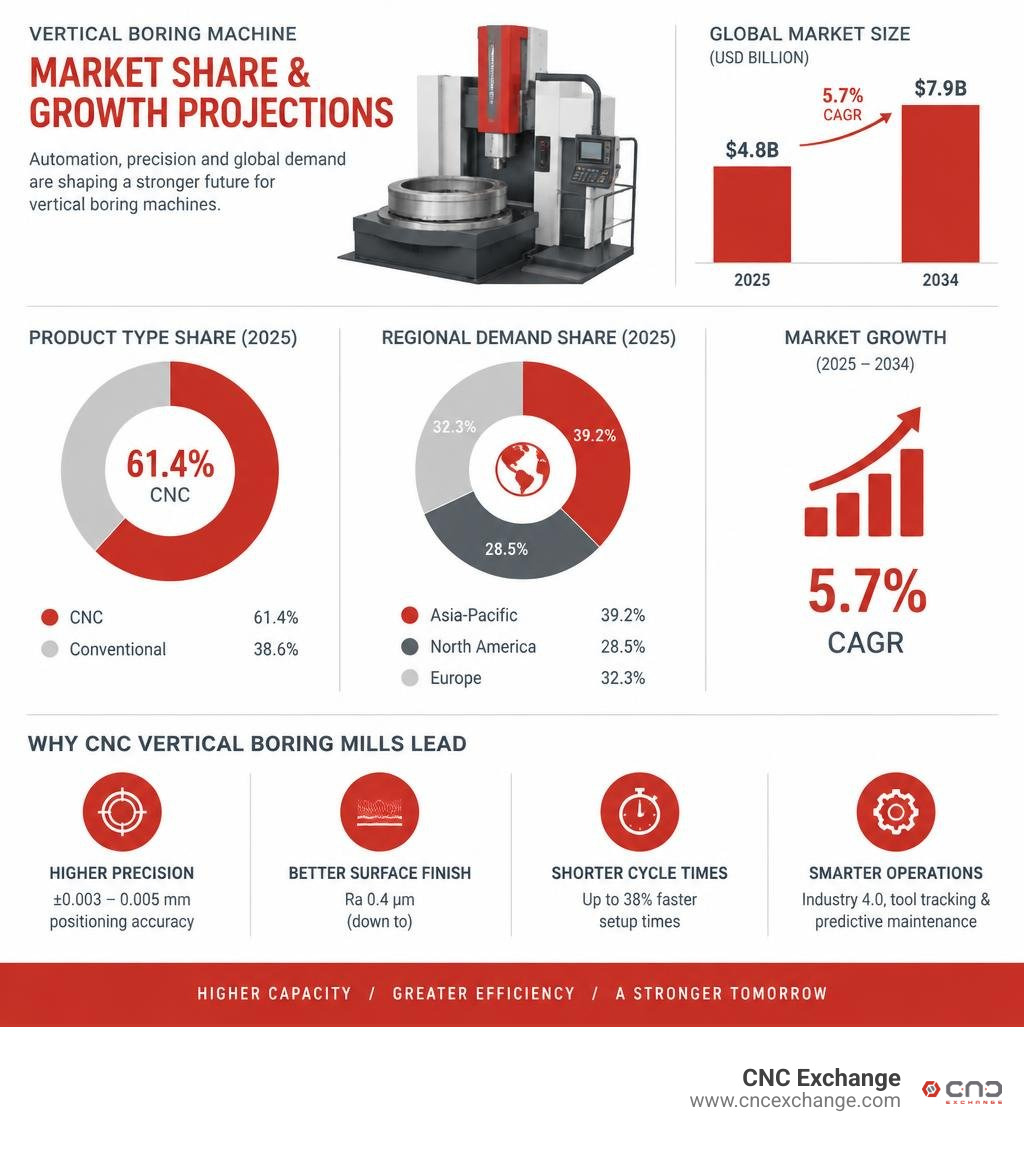
A closer look at the sector highlights key industry patterns:
- CNC Dominance: CNC machines captured a dominant 61.4% product revenue share in 2025, driven by demand for multi-axis multitasking platforms.
- Regional Distribution: The Asia-Pacific region led the global market in 2025 with a 39.2% revenue share, fueled by heavy infrastructure, shipbuilding, and power investments across China and India. North American and European facilities follow closely, focusing their capital expenditure on automated replacements and CNC retrofits.
- Advanced Machinery Platforms: Facilities tackling ultra-large industrial projects frequently turn to specialized builders offering PowerTurn vertical boring mill solutions and portal designs capable of handling parts up to 400 metric tons and swing diameters extending to 14,000 mm.
Industrial Applications Driving Heavy-Duty Demand
Vertical boring mills are essential anywhere that manufacturing failure is not an option. Symmetrical components that operate under extreme pressures, thermal cycling, or massive centrifugal forces rely on the rigidity of vertical boring to prevent balance defects.
Aerospace Turbine and Structural Machining
The aerospace segment represents the fastest-growing end-use market for vertical boring equipment, expanding at a projected CAGR of 6.8% through 2034. Jet engine compressor housings, turbine shroud rings, and structural launch vehicle adapters demand near-flawless concentricity.
Machining exotic superalloys such as Inconel, Waspaloy, and titanium requires high spindle torque at low rotational speeds combined with rigid damping. Shops running legacy Cincinnati Bickford vertical boring mills alongside newer high-pressure coolant machines achieve tight runout targets on thin-walled aero rings without inducing thermal distortion.
Energy Infrastructure, Power Generation, and Heavy Equipment
The energy sector's transition toward larger renewable systems and advanced nuclear reactors has driven component sizes upward:
- Wind Power Generation: Wind turbine rotor hubs, main bearing housings, and massive slew ring gears demand table swings exceeding 4 to 8 meters.
- Hydro and Nuclear Power: Francis turbine runners, steam generator shells, and reactor pressure vessel flanges require continuous deep-profile boring across work envelopes weighing well over 50 tons.
- Heavy Mining and Construction Machinery: Heavy excavator slewing rings, dragline wheel assemblies, and rock crusher bowls benefit from integrated milling and turning platforms that merge high-torque quills with active vibration dampening.
Technical Selection Criteria: Sizing, Capacities, and Features
Selecting the right machine requires matching physical capacities to your present floor space and anticipated part volumes. An undersized machine limits your contract bidding potential, while an oversized machine increases hourly operating and floor footprint overhead.
Critical Machine Specifications and Capacities
When evaluating new or pre-owned heavy-duty vertical boring mills, analyze these core mechanical metrics:
- Table Diameter vs. Maximum Swing: The table diameter determines the supported surface base, while the maximum swing establishes the widest workpiece swing diameter that clears the machine side columns. Standard machines range from compact 48-inch tables up to massive tables spanning 157 inches with swings of 169 inches or more.
- Payload Capacity: Table weight ratings dictate the maximum casting mass the machine can spin safely. Industrial heavyweights comfortably carry 40,000 lbs (around 18 metric tons) on medium-large tables, with massive portal mills engineered for 100 to 400 metric tons.
- Ram Stroke and Vertical Clearance (Z- and W-Axes): Ensure the vertical travel of the ram (Z-axis) and the positioning of the adjustable cross-rail (W-axis) accommodate your tallest parts along with your boring bar stick-out lengths.
- Main Drive Motor Horsepower: Spindle power typically ranges between 50 HP (37 kW) on standard job-shop machines to over 100–150 HP (75–112 kW) on high-stock-removal machines, providing the torque required to hog tough alloy castings.
Multi-Tasking Capabilities and Tooling Configurations
Modern vertical boring configurations often combine multiple operations on a single table. Investing in a machine equipped with a live milling spindle, C-axis rotary table positioning, and high-pressure through-spindle coolant eliminates secondary handling on separate vertical machining centers.
Many large-capacity vertical boring mills feature secondary side heads mounted directly to the vertical column. This allows simultaneous turning of external diameters while the primary vertical ram finishes an internal bore, halving total cycle time on deep-wall cylinders.
Frequently Asked Questions
What is the difference between a vertical boring mill and a vertical turning lathe?
While the terms are often used interchangeably on the shop floor, the technical distinction comes down to size, mechanical structure, and primary use. A vertical turning lathe (VTL) typically refers to smaller, high-speed machines (table sizes under 60 inches) designed primarily for production turning, chucking, and facing operations. A vertical boring mill (VBM) refers to larger, heavy-duty machines featuring massive horizontal rotary tables, bridge-type or open-sided columns, and heavy cross-rails engineered for deep internal boring, heavy facing, and large-diameter asymmetrical or symmetrical castings.
What workpiece dimensions and weight capacities can vertical boring machines handle?
Vertical boring machines cover a wide range of sizes. Medium-sized job-shop models handle parts ranging from 500 mm to 2,000 mm in diameter with weight capacities between 5 and 20 metric tons. Heavy industrial portal-type models can accommodate workpieces spanning 5,000 mm to over 10,000 mm in diameter, with specialized aerospace and energy-sector machines handling payloads exceeding 100 to 400 metric tons.
How does vertical orientation affect chip management and part setup?
The vertical orientation makes part loading much easier because overhead bridge cranes can lower heavy parts directly onto the horizontal table, letting gravity hold them stable during alignment. For chip management, gravity pulls hot metal cuttings downward away from the cutting tool edge. While this keeps the cut interface clear, operators machining deep internal blind bores must use high-pressure through-tool coolant flushes or chip conveyors to prevent hot cuttings from packing tightly into the bottom of the cavity.
Conclusion
A vertical boring mill remains one of the most reliable, rigid, and profitable investments for industrial facilities handling large cylindrical and symmetrical parts. By placing gravity on your side, these workhorses eliminate part sag, streamline heavy setups, and deliver tight bore tolerances across demanding materials.
When planning your next machinery upgrade, balance your shop's component profiles between vertical turning needs and high-performance horizontal boring mills to build a versatile machining floor. At CNC Exchange, we streamline equipment acquisition by helping you buy, sell, and auction surplus machinery to capture fair market value and keep your production lines moving forward.