
Find a Reliable CNC Machine Without Buying Someone Else's Problems
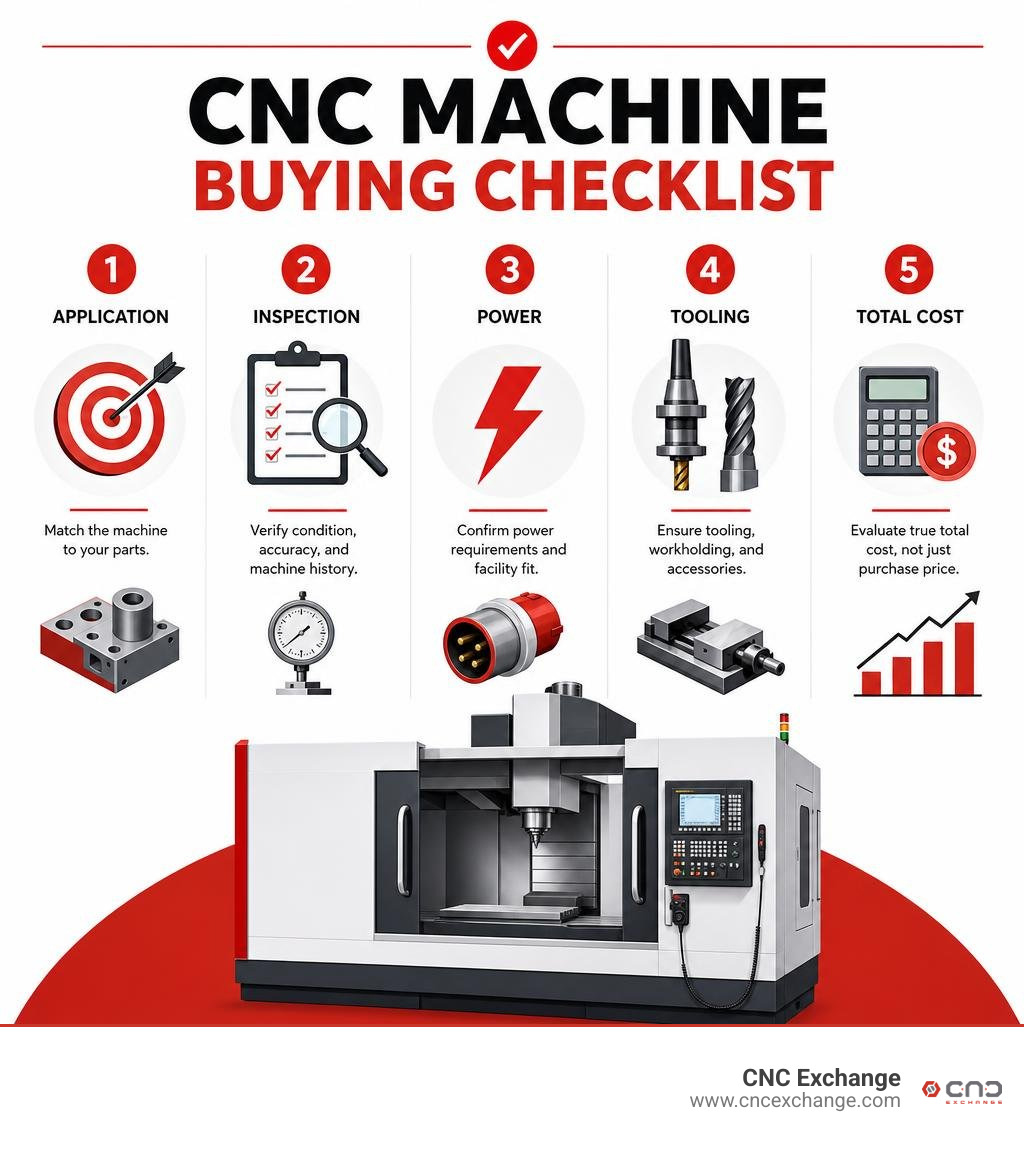
The best place to find a for sale CNC machine is a reputable used-equipment dealer or broker that can provide clear photos, specifications, inspection access, and machine history. Match the machine to your parts first, then confirm its work envelope, spindle type, control, power needs, condition, and total installed cost before you buy.
For many growing shops, a used commercial CNC mill, lathe, router, or machining center delivers far more rigidity and production capacity per dollar than a new hobby-grade machine. But price alone is not value. A low-cost machine with worn ballscrews, a weak spindle, obsolete controls, or missing tooling can quickly become an expensive repair project.
This guide compares practical CNC options for 2026 and explains where to source used equipment with confidence. It also covers the checks that matter most before purchase, from spindle runout and backlash to electrical requirements and service support.
I am Jared Gray, and I have spent more than 12 years buying, selling, and brokering manufacturing equipment, with a focus on CNC chip-making machinery. I help manufacturers assess every for sale CNC machine in the context of its condition, application, transport needs, and realistic value.
Top Industrial and Benchtop CNC Machines Compared
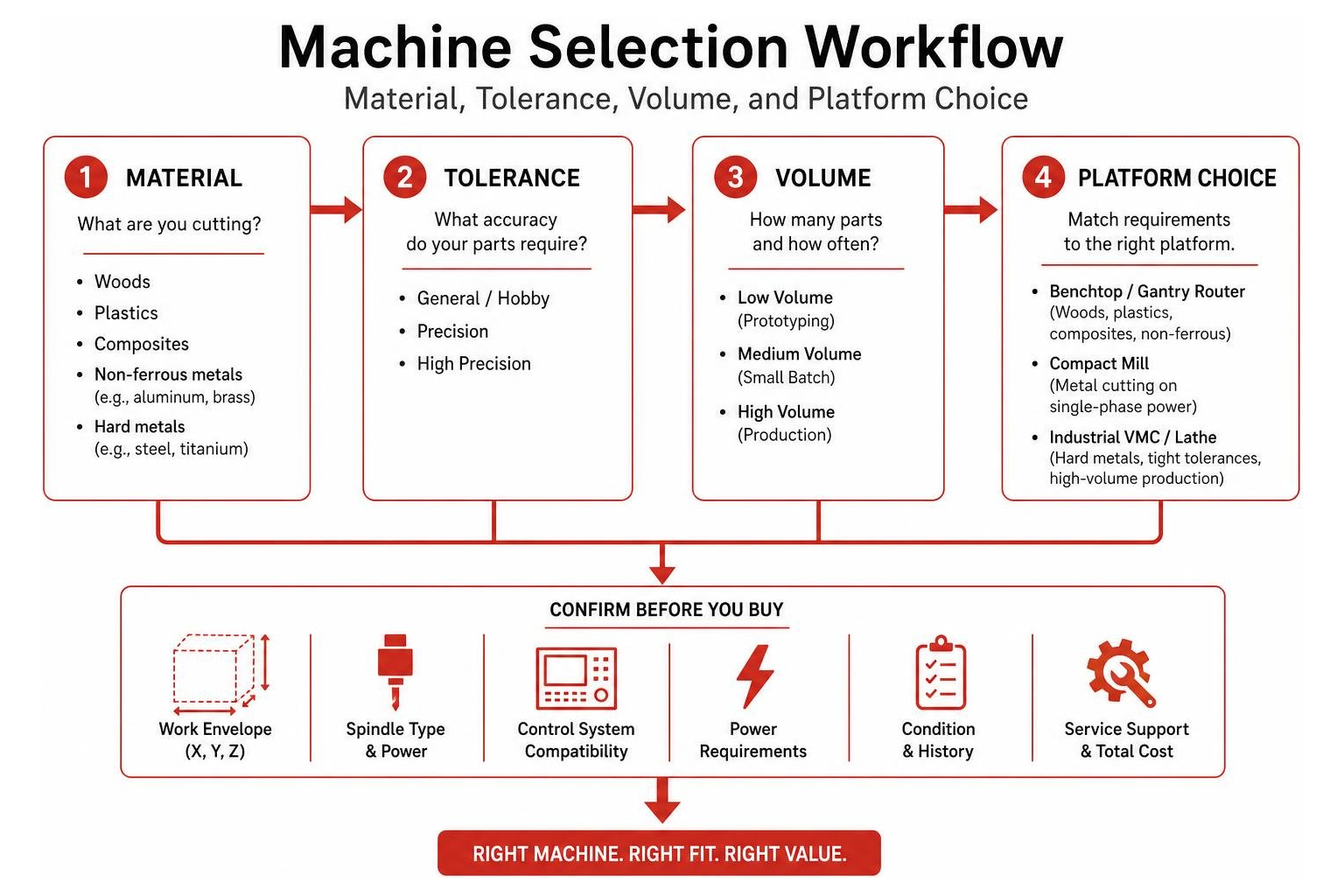
When you begin searching for a computer numerical control system, you will quickly notice a wide divide between heavy industrial iron and modular benchtop machines. Choosing the right platform comes down to the materials you cut, the tolerances your parts demand, and your production volume.
Benchtop and light gantry routers rely on structural aluminum extrusions or fabricated steel plates, making them affordable, lightweight, and easy to fit through standard doorway openings. Industrial vertical machining centers (VMCs), on the other hand, feature heavy cast-iron frames designed to absorb cutting harmonics, minimize vibration, and hold tenths of a thousandth of an inch across hard metals like titanium and tool steel.
| Machine Model | Category | Base Price | Work Envelope (X, Y, Z) | Motion Drive System | Control System | Typical Target User |
|---|---|---|---|---|---|---|
| QueenAnt PRO V2 | Gantry Router Kit | $2,071 - $2,873 | Up to 59" x 59" x 6" | 1610 Ball Screws / Linear Rails | GRBL / Offline DSP / Mach3 | DIY hobbyists, light woodworking, sign makers |
| PwnCNC Dominator Pro | Modular Gantry Router | $7,600 | 50" x 24" (to 4x4) x 8" | Closed-Loop Steppers | Masso Touch | Serious makers, prototyping, small wood/aluminum shops |
| Avid CNC Benchtop PRO | Heavy Benchtop Router | $7,781 | 37.6" x 26" x 6"-9" | Dual Ballscrews / ClearPath Servos | Centroid CNC12 | Prototyping labs, aluminum fabrication, precision wood |
| Tormach 1100MX | Compact Mill | $29,594 | 18" x 11" x 16.25" | Brushless Servos / BT30 Spindle | PathPilot | Machine shops, garage production, vocational schools |
| Used Industrial VMC | Production Machining Center | $20,000 - $60,000+ | 30" x 16" x 20"+ | Ground Ballscrews / Cast Iron Box/Linear Ways | Fanuc / Haas / Okuma OSP | High-volume production, mold making, aerospace parts |
The Tormach 1100MX CNC Mill serves as a bridge for shops that want dedicated metal-cutting capabilities on single-phase electrical power. Starting at $29,594 (with financing options around $604 per month), the 1100MX includes advanced software features valued at over $12,600 as standard—such as high-speed machining ($3,500+ value), rigid tapping ($1,800+ value), conversational programming ($2,700+ value), and coordinate rotation.
High-Performance Benchtop and Gantry Routers
For makers and light production shops working primarily with woods, composites, plastics, and non-ferrous metals like brass and aluminum, modern gantry routers offer exceptional versatility.
The Benchtop PRO 3624 3' x 2' CNC Machine | Avid CNC is engineered specifically for compact production footprints. Starting at $7,781, it provides a work envelope of 37.6" along the X-axis, 26" along the Y-axis, and 6" to 9" on the Z-axis. The machine achieves a repeatability of ±0.001" and positional accuracy of ±0.005" or better. Motion speeds scale depending on your chosen motor package:
- NEMA 23 Stepper Motors: 200 IPM cut speed, 300 IPM rapid traverse.
- NEMA 34 Stepper Motors: 250 IPM cut speed, 400 IPM rapid traverse.
- Teknic ClearPath Servos: 350 IPM cut speed, 500 IPM rapid traverse with closed-loop error recovery.
If you require a square cutting area, the Benchtop PRO 3636 3' x 3' CNC Machine | Avid CNC expands the workspace to 37.6" x 37.6" with a machine weight of 307 lbs (139 kg), providing a rigid foundation for precision milling without requiring heavy industrial rigging.
For budget-conscious builders, the 5075-1515 Black Silver QueenAnt PRO V2 1610 Ball Screw CNC Full kit Linear Rail upgraded precise CNC router Engraving machine from WorkBee QueenBee - YUYONG INDUSTRY delivers impressive mechanical upgrades for $2,071.00 (discounted from $2,873.00). By replacing traditional V-wheels and 8mm lead screws with 16mm diameter (1610 pitch) G7-grade precision ball screws and dual linear guide rails on 12mm thick aluminum plates, it reduces drivetrain friction by 50% and provides 90% to 98% transmission efficiency.
Compact Vertical Machining Centers and Mills
When your operations shift toward heavy steel cutting, production cycle times, and tight tolerances, benchtop routers hit their physical limits. This is where dedicated milling machines take over.
Compact vertical machining centers utilize rigid cast-iron castings to dampen cutting forces. A machine like the Tormach 1100MX utilizes a BT30 spindle taper powered by a 1.5 kW to 2.2 kW motor that supports heavy milling, rigid thread tapping, and spindle orientation for automated 12-pocket tool changers.
For high-duty industrial production, stepping into a commercial machine like a Haas VF-2D Vertical Machining Centers CNC provides a massive step up in chip removal rates, spindle horsepower (typically 20 to 30 HP), and rigid multi-axis casting mass that eliminates deflection under aggressive feeds.
Key Specifications to Check on Any For Sale CNC Machine
Evaluating equipment requires looking past fresh paint and promotional claims. Whether buying new or pre-owned, five core mechanical and electrical specifications dictate actual machine performance:
- Frame Mass and Drivetrain Type: Cast iron provides the best vibration damping, followed by welded steel tubes and reinforced aluminum extrusions. Ball screws and direct-drive servos offer superior positional control compared to lead screws or belt drives.
- True Cutting Envelope and Clearances: Ensure the X, Y, and Z travels accommodate not just the workpiece, but also your vises, fixture plates, tool holders, and drill lengths.
- Spindle Horsepower and Taper: High-RPM router spindles excel at wood and aluminum engraving, while low-RPM, high-torque industrial tapers (CAT40, BT30, HSK) are necessary for steel hogging and deep drilling.
- Tool Management: Manual collet tightening works for one-off prototyping, but high-volume parts require an Automatic Tool Changer (ATC) to maintain low cycle times.
- Shop Power Compatibility: Verify whether the machine runs on 110V/220V single-phase power or requires a dedicated 208V/480V 3-phase industrial drop.
Sizing and Motion Systems for a For Sale CNC Machine
Axis construction directly impacts the finish quality of your parts. On modular machines such as the Dominator Pro – PwnCNC, starting at $7,600.00, structural rigidity is enhanced through reinforced extrusion profiles and closed-loop motor systems.
The Dominator Pro provides 8" of vertical Z-axis travel with a 2" adjustable mounting position, paired with a built-in Z-axis brake to prevent heavy spindle assemblies from dropping during an unexpected power interruption. It also incorporates a 2" front bed overhang, allowing machinists to clamp workpieces vertically for complex end-grain joinery, dovetails, or large tenons. For rotary carving, its 4th-axis bundle can accommodate workpieces up to 15" in diameter and 33" in length.
Positional accuracy is largely governed by drive choice:
- Lead Screws: Inexpensive, but prone to whipping over long spans and subject to backlash wear.
- Precision Ball Screws: High mechanical efficiency (90%+), minimal backlash, and excellent holding torque for metal milling.
- Rack and Pinion: Ideal for massive 4x8 or 5x10 routing tables where ball screws would whip at high travel speeds.
Spindle Power, Tooling, and CNC Control Platforms
The motion controller acts as the brain of your CNC system, transforming CAM toolpaths into physical movement. Understanding your control interface determines ease of programming and operator efficiency:
- Masso Touch: A dedicated, standalone hardware controller requiring no external PC. Immune to operating system crashes and background software updates, it is widely favored on machines like the Dominator Pro for reliable shop-floor operation.
- PathPilot: Tormach's proprietary Linux-based interface. Highly regarded for its intuitive conversational programming screens, allowing operators to mill pockets, drill bolt circles, and face stock without generating external CAM G-code.
- Centroid CNC12: An industrial-grade control engine paired with Avid CNC platforms, supporting advanced tool probing, servo tuning, and macro customization.
- Mach3 / Mach4 & GRBL: Entry-level platforms that run via PC USB/Ethernet or microcontrollers. While cost-effective, they require careful electrical grounding to prevent electromagnetic interference (EMI) from tripping limits.
Spindle selection must also align with your workload:
- Air-Cooled Spindles: Simple to install with no plumbing, ideal for dry routing in dusty wood and plastic shops.
- Liquid-Cooled Spindles: Run whisper-quiet and maintain cool operating temperatures during multi-hour 3D surfacing cycles, though they require pumps, radiators, and coolant monitoring.
- ATC Spindles (Pneumatic Quick-Change): Utilize pneumatic drawbars to swap tool holders in seconds, eliminating manual wrench work and enabling unattended multi-tool operations.
Where to Source Used Commercial CNC Machinery

Purchasing brand-new industrial machinery can tie up substantial capital. For many commercial manufacturing facilities, sourcing pre-owned equipment through vetted marketplaces provides access to premium Japanese, American, and German machine tools at a fraction of initial retail costs.
At CNC Exchange, we streamline this process by buying, selling, and auctioning quality industrial equipment. Located at 75 E Palatine Rd in Prospect Heights, IL, our team helps machine shops find vetted equipment that fits their exact production needs. Whether you need a high-speed milling center or a dedicated used CNC router, sourcing through established channels protects you from the hidden hazards of private liquidations.
If you are planning an equipment expansion or need guidance on sizing machine tools for your facility, you can talk to our machine tool experts today to discuss available inventory, rigging logistics, and tooling packages.
Inspecting a Used For Sale CNC Machine Before Purchase
Before closing on a pre-owned machine, performing a methodical mechanical inspection protects your investment.
Key points to verify during an inspection:
- Spindle Runout and Bearings: Mount a 0.0001" dial test indicator on the machine bed and sweep the inside of the spindle taper. Total runout should be well under 0.0005". Listen across the full RPM range for growling bearing wear.
- Axis Backlash and Linear Guides: Position an indicator against the spindle housing or table, command 0.001" jog steps back and forth, and measure lost motion to identify worn ball nuts or loose thrust bearings.
- Automatic Lubrication Systems: Inspect oil reservoirs and metering valves. Lack of lubrication leads to scoring on linear rails and box ways.
- Control System Health: Boot up the CNC, verify that all axes home cleanly, check the diagnostic screen for servo alarms, and confirm the spindle drive maintains steady RPM under load.
Investing in high-end production units like a Haas VF-3SS Vertical Machining Centers CNC or a rigid Mori Seiki NL2000MC/500 CNC Lathes gives your shop industrial reliability, high rapids, and proven long-term resale value.
Production Turning and Horizontal Machining Options
Different part geometries call for specialized kinematic platforms. While vertical mills handle face work and flat plates, turning centers and horizontal machining centers (HMCs) unlock massive production efficiency:
- Live-Tooling CNC Lathes: Machines like the Okuma Genos L250E CNC Lathes combine turning operations with motorized milling spindles, allowing you to turn, mill flats, drill cross-holes, and tap threads in a single clamping cycle.
- Horizontal Machining Centers: Workhorses like the Makino A66 Horizontal Machining Centers CNC utilize pallet changers and tombstones to mill multiple sides of parts simultaneously. Chips fall away from the cut naturally under gravity, reducing tool wear and re-cutting issues.
For heavy-duty turning work, traditional box-way lathes such as Mori Seiki SL-8F CNC Lathes offer extreme rigidity for deep interrupted cuts in tough alloys. If you require large envelope vertical milling, proven platforms like the Mazak AJV 25/404 Vertical Machining Centers CNC, the Okuma MX-55VB Vertical Machining Centers CNC, or a Mori Seiki MV-40E Vertical Machining Centers CNC deliver production reliability. For high-throughput horizontal production, machines like the Mori Seiki SH-50 Horizontal Machining Centers CNC remain dependable workhorses.
Best Practices for CNC Installation, Power, and Maintenance
Proper installation and preventive maintenance ensure your machine delivers repeatable accuracy for years while preventing costly downtime:
- Electrical Isolation and EMI Management: High-frequency Variable Frequency Drives (VFDs) generate significant electromagnetic noise. Always use shielded cabling on spindle power lines, install ferrite rings on inverter outputs, and run isolated electrical circuits for motion controllers to prevent false limit-switch triggers.
- Phase Conversion and Power Quality: Small benchtop systems run on standard single-phase 110V/220V circuits (the Dominator Pro 2Nm setup requires 110V 20A, while 3Nm configurations run best on 220V 20A). Commercial CNC mills require 3-phase power; if your shop only has single-phase service, install a properly sized rotary phase converter or digital CNC phase generator to prevent voltage dropouts under heavy spindle loads.
- Rigid Leveling and Machine Anchoring: Cast-iron mills and gantry frames must be leveled using precision machinist levels (0.0005" per foot graduation). An out-of-level frame induces structural twist, degrading cutting squareness across long travels.
- Scheduled Way and Ballscrew Lubrication: Clean chips from linear guide wipers and apply manufacturer-recommended lithium or ISO VG 68 way oil weekly. Never unthread a ball nut from its screw during maintenance, as the internal ball bearings will spill from the raceways.
- Periodic Calibration and Tramming: Use a dial indicator to regularly tram the spindle perpendicular to the bed and check squareness between the X and Y axes.
Frequently Asked Questions About CNC Machinery
What is the difference between stepper motors and servo drives?
Standard open-loop stepper motors move in discrete steps without positional feedback; if a cutting tool encounters excessive resistance, the motor can lose steps without the controller knowing, ruining the part.
Closed-loop steppers and brushless servo drives (like Teknic ClearPath) integrate rotary encoders that constantly report the actual shaft position back to the CNC controller. If position error occurs, the servo dynamically increases current to correct it or halts the program safely before scrap is produced. Servos also maintain their rated torque across high RPM ranges, allowing rapid traverse speeds of 500 IPM or higher.
Can commercial CNC mills run on single-phase residential power?
Yes, depending on the machine's design and spindle drive configuration. Compact mills like the Tormach 1100MX are engineered specifically to operate on single-phase power drops, making them ideal for small shops, garages, and educational spaces.
Full-scale industrial machining centers requiring 208V to 480V 3-phase power can be operated in single-phase buildings by installing a rotary phase converter (such as a 20 HP to 40 HP unit) or a dedicated phase-perfect solid-state digital converter to generate balanced three-phase voltage.
What spindle type is best for machining non-ferrous metals?
For cutting aluminum, brass, and copper, a high-frequency liquid-cooled spindle (2.2 kW to 4 kW) with an ER20 or ISO20/BT30 tool taper provides an optimal balance. Aluminum requires high cutting speeds (often 12,000 to 24,000 RPM) paired with strong radial stiffness to eliminate tool chatter. Liquid cooling ensures the spindle bearings maintain thermal equilibrium during long cycle times, preventing heat expansion from shifting your Z-axis zero point.
Conclusion
Finding the right CNC equipment requires balancing your part tolerances, production schedules, and budget against the machine's mechanical rigidity and control capabilities. While modular benchtop machines provide an accessible entry point for prototypes and wood routing, stepping up to pre-owned commercial machine tools gives growing manufacturers the rigidity, horsepower, and speed required for serious metal production.
At CNC Exchange, we take the guesswork out of equipment acquisitions. Whether you are adding your first milling center or upgrading an entire production line, you can browse verified commercial machinery and equipment across our inventory to find dependable, high-performing CNC machinery at fair market value.