
How to Approach a Second-Hand CNC Machine Sale
Before committing to a cnc second hand machine sale, see the machine run, check its spindle and axis movement, and confirm that its controller works with your programs. Ask for maintenance records and proof of ownership. Then compare the asking price with similar machines and budget for tooling, rigging, and freight.
A listing for a 1998 HAAS VF-0 at $9,900 makes the point: its advertised 10,000 RPM spindle may be appealing, but the price alone cannot tell you whether it is a sound buy.
I'm Jared Gray. I've spent more than 12 years buying, selling, and brokering manufacturing equipment, and I'll walk you through the checks that matter in a cnc second hand machine sale.
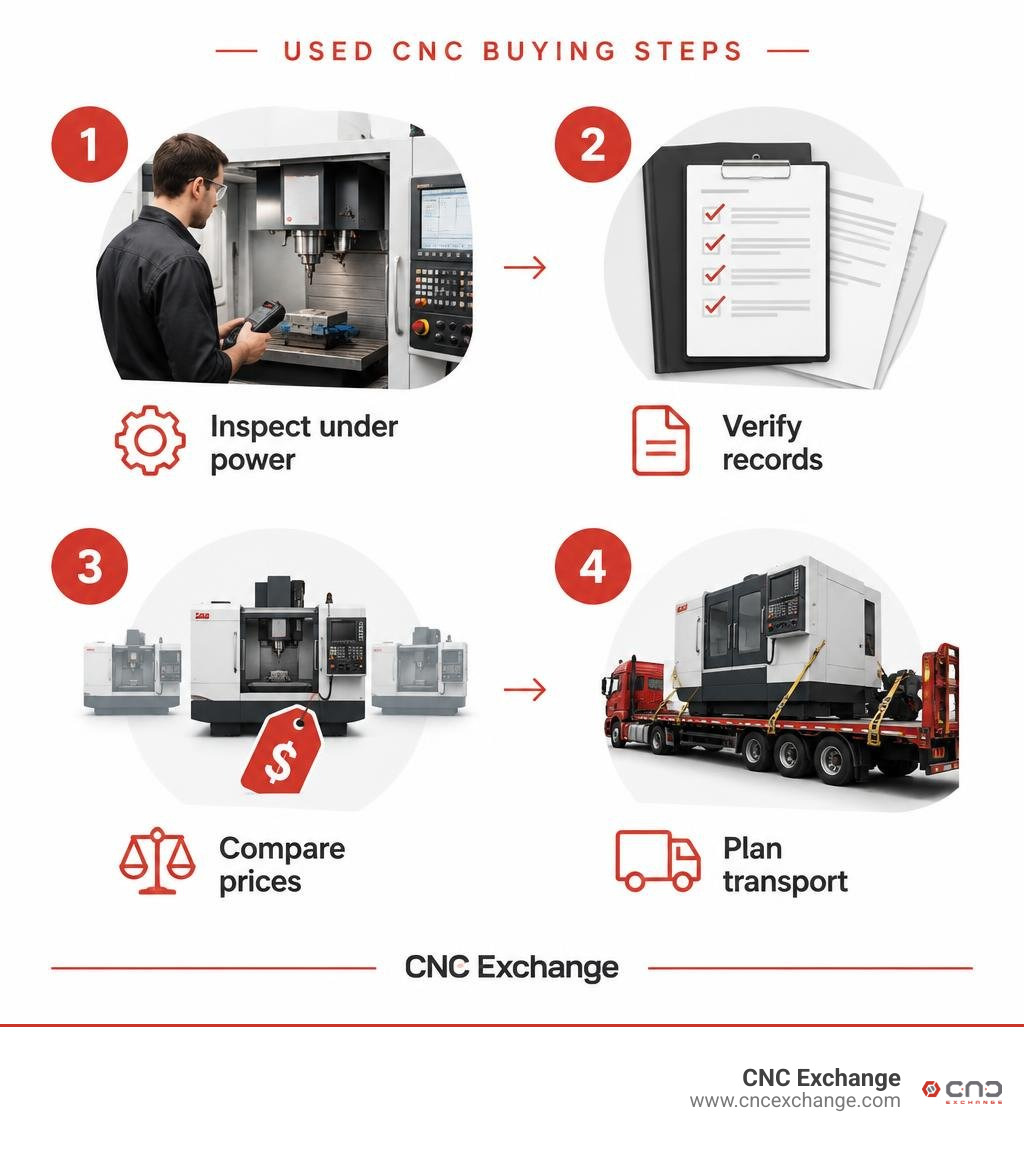
Essential Factors in a CNC Second Hand Machine Sale
Evaluating pre-owned equipment requires a methodical look beneath the sheet metal. When a machine enters the secondary market, its exterior cosmetic condition rarely tells the whole story. A fresh coat of paint can hide worn ways, dried-out lube lines, or an overheating spindle drive.
To make a smart purchase, you must evaluate mechanical condition, geometric accuracy, control stability, and operating history:
- Spindle Health and Runout: The spindle is the heart of any milling center. Measure radial and axial runout at the taper using a precision dial indicator. Listen closely across the entire RPM range for abnormal bearing whine, grinding, or excessive heat buildup.
- Axis Travel and Linear Motion: Inspect the ball screws and linear guides (or box ways) across the full travel of each axis. Check for mechanical backlash, pitting, scoring, or uneven wear that could compromise part tolerances.
- Controller Stability and Firmware: Make sure the CNC control boots reliably, holds parameters in memory, and handles tool changes without throwing random alarms. Check memory capacity and I/O communication options.
- Way Lubrication and Pneumatics: Ensure the automatic lubrication system delivers oil or grease evenly to all carriages and screws. Blocked lube lines cause rapid, catastrophic mechanical failure.
Recognizing critical red flags during pre-owned machine inspections before money changes hands will save your shop thousands of dollars in emergency repairs.
| Purchase Channel | Pricing Level | Inspection Access | Verification & Security | Typical Buyer Profile |
|---|---|---|---|---|
| Private Seller (Craigslist/Classifieds) | Often lowest | Variable; seller may lack power connection | High risk; buyer handles all lien checks and rigging | Hobbyists, budget prototyping shops |
| Certified Machinery Dealer | Fair market | High; fully powered and demonstrated | Low risk; clean titles and verified operations | Job shops, tier suppliers, production facilities |
| Industrial Online Auctions | Competitive | Limited inspection windows | Moderate risk; requires rapid removal and strict terms | Expanding manufacturers seeking deals |
Evaluating Used Equipment: A 1998 HAAS VF-0 Case Study
To see how these principles work in practice, let's analyze an actual market listing: a 1998 HAAS VF-0 CNC Vertical MACHINING CENTER Mill - $9,900 (Oxnard).

A machine like this 1998 HAAS VF-0 listed in Oxnard at $9,900 offers an attractive entry point for small job shops, garage startups, or prototype departments. Even in 1998, the VF-0 could spin at 10,000 RPM—fast enough to make a coffee grinder jealous—making it quite capable for high-speed aluminum milling and quick-turn parts.
However, buying older production assets requires careful evaluation. Avoiding common mistakes buyers make when evaluating used CNC machinery means looking past the low initial price to assess total cost of ownership.
Verifying Specifications and Pricing in a Second Hand CNC Machine Sale
A $9,900 price tag for an operational vertical machining center with a 10,000 RPM spindle shows that well-built vintage machines maintain solid market value. But is that specific unit priced right?
When estimating the resale value of pre-owned equipment, several details tip the scales:
- Included Tooling Packages: Does the unit include CAT40 tool holders, pull studs, a machine vise, or a rotary table? Tooling packages can easily represent $2,000 to $4,000 in added value.
- Option Unlocks: Was the control optioned with rigid tapping, high-speed machining, or expanded macro memory?
- Component Age: Has the spindle cartridge or axis drive been recently rebuilt?
If a shop wants to maximize value reselling surplus CNC machines, presenting clean maintenance logs and including baseline tooling helps justify top-tier asking prices.
Overcoming Compatibility and Maintenance Challenges
Older machining centers come with unique operational quirks. A 1998 machine uses legacy control boards, older memory formats, and classic RS-232 serial communication ports rather than modern Ethernet or USB interfaces.
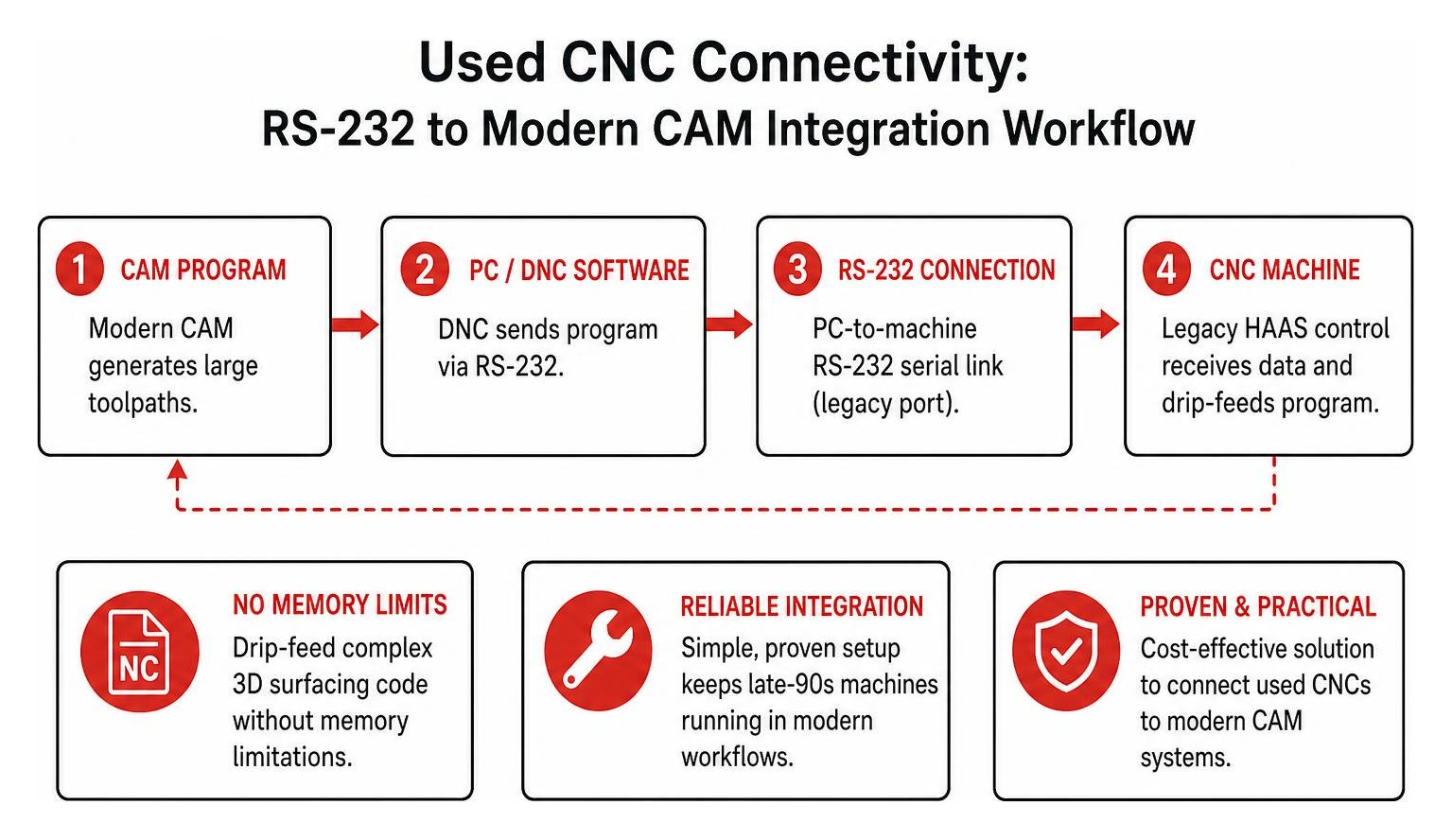
Integrating a late-90s VF-0 into a modern workflow requires simple, proven adaptations:
- DNC Drip Feeding: Modern CAM programs generate large toolpaths that exceed legacy onboard memory. Setting up a reliable PC-to-machine RS-232 connection allows you to drip-feed complex 3D surfacing code without memory limitations.
- Parts Sourcing: HAAS maintains strong parts availability and field support across North America. Many common wear components—including switches, solenoids, way wipers, and drive belts—remain readily available or easily rebuildable.
- Safety Safeguards: Verify that interlocks, chip enclosures, and emergency stop circuits comply with standard workplace regulations, such as eCFR :: 29 CFR 1910.212 -- General requirements for all machines..
Logistics, Documentation, and Safe Buying Practices
Purchasing industrial machinery requires organized logistics from inspection through final placement.

Before releasing payment on any machine, complete these verification steps:
- Power-On Testing: Never buy a CNC blind unless the price reflects pure scrap or core value. Test spindle acceleration, tool changes, and rapid axis travels.
- Backlash and Tram Checks: Mount an indicator to the spindle nose and measure table play along X and Y. Sweep the table to confirm perpendicularity.
- Proof of Ownership & Lien Releases: Verify the seller holds a clear title without outstanding financing liens or tax attachments.
- Professional Rigging: Hire insured machinery movers. Dropping a vertical machining center off forklift tines turns an operational asset into scrap metal in an instant.
Taking these steps ensures you avoid buying the wrong used CNC lathe machine or milling center for your facility.
Red Flags and Due Diligence in a CNC Second Hand Machine Sale
Buying directly from private online classifieds presents specific risks. Wire fraud, hidden mechanical defects, and unverified ownership can catch unwary buyers off guard.
When evaluating unverified listings:
- Never Send Untraceable Deposits: Avoid wire transfers or non-refundable cash deposits before seeing the machine in person or working through an established machinery broker.
- Inspect Service Records: A well-kept machine will have documented fluid changes, axis recalibrations, and replacement part receipts.
- Consider Professional Representation: If sourcing machinery across state lines, utilizing professional machine tool brokering helps secure clear title transfers, arrange third-party inspections, and safeguard your capital.
- Compare Against Market Avenues: Weigh private listings against verified options when identifying high-value auction listings or looking for specialized tools on wanted machinery registries.
Frequently Asked Questions About Used CNC Purchases
Is a 1998 HAAS VF-0 still viable for production in 2026?
Yes. When properly maintained, a 1998 HAAS VF-0 remains a capable workhorse for small shops, prototyping, secondary operations, and general aluminum or mild steel machining. While modern machines offer faster rapid moves and conversational touchscreen controls, a vintage VF-0 with a 10,000 RPM spindle still produces accurate parts reliably at a fraction of new-machine capital cost.
What documentation is required when buying a CNC machine from a private seller?
You should secure an itemized bill of sale detailing the machine make, model, serial number, and included accessories, along with written confirmation that the equipment is sold free and clear of all liens, loans, or encumbrances. Original electrical schematics, operating manuals, and maintenance logs are also essential.
How should buyers budget for CNC rigging and freight transport?
Budgeting for machine transport involves several distinct costs:
- Professional Rig-Out: Typical rigging fees to disconnect, skate, and load a medium vertical mill range from $800 to $2,000 depending on building access.
- Dedicated Flatbed Freight: Dedicated air-ride flatbed transport costs vary by distance, escort requirements, and fuel surcharges.
- Offloading and Placement: Local rigging at your destination facility to place and rough-level the machine generally costs an additional $800 to $1,500.
Conclusion
Securing dependable industrial equipment on the secondary market provides your shop with high-level manufacturing capacity while protecting your cash flow. By thoroughly testing mechanical assemblies, verifying software compatibility, confirming clear ownership titles, and budgeting accurately for logistics, you can invest with confidence.
At CNC Exchange, we help machine shops, job shops, and manufacturing facilities across the country buy and sell high-grade equipment at transparent, fair market prices. Whether you are expanding your milling department or upgrading turning capacity, you can browse verified inventory for your next CNC second hand machine sale or explore our wide selection of machinery for sale.
Have questions about an upcoming machine acquisition or surplus appraisal? Talk to our machine tool experts today to help power your shop's growth.