
VMC Machine Use: What It Does and When to Use It
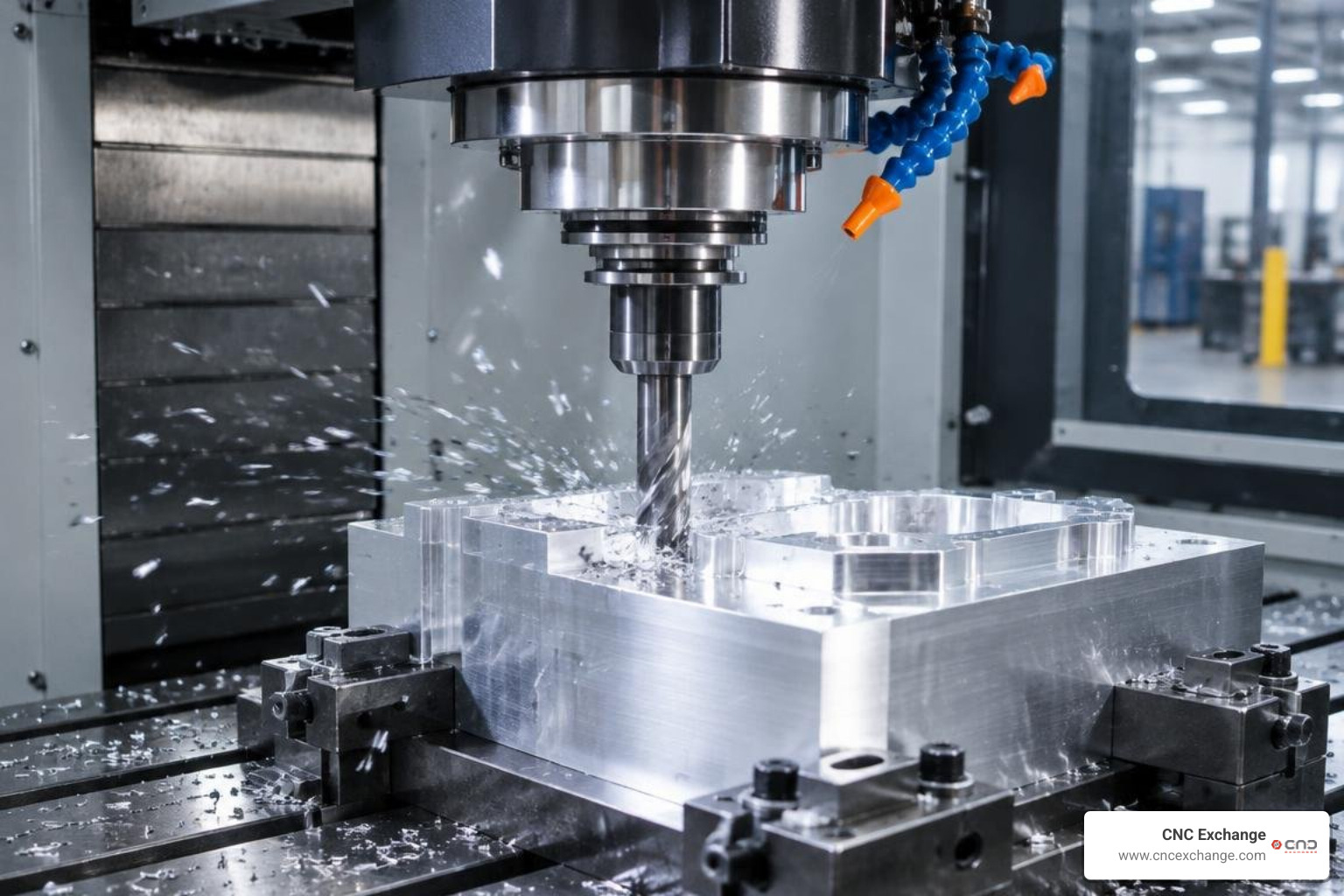
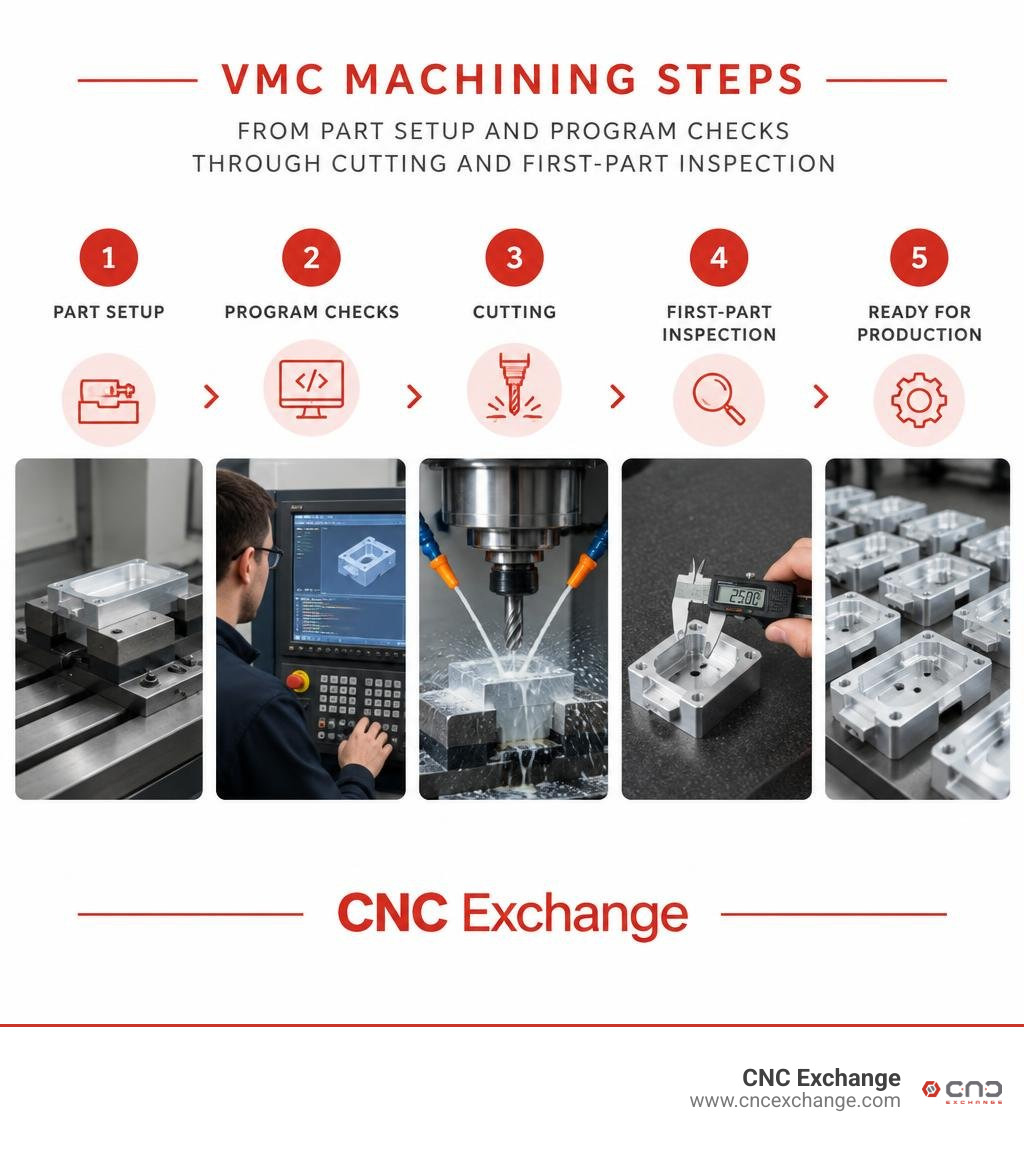
VMC machine use is a good fit for parts that need top-down milling, drilling, or tapping, such as brackets, plates, and housings. To make a part, clamp the material to the table, load a checked cutting program and tools, set the tool positions, then cut and inspect the first piece before running the rest.
A VMC can handle many jobs in one machine, but the right setup depends on your part's shape, material, and production volume. Those details also help you decide which machine features are worth paying for.
I'm Jared Gray, and I've spent over 12 years buying, selling, and brokering CNC equipment, including vertical machining centers. That experience shapes how I explain vmc machine use: start with the parts you need to make, then choose the machine to match.
Core Capabilities and Industrial VMC Machine Use
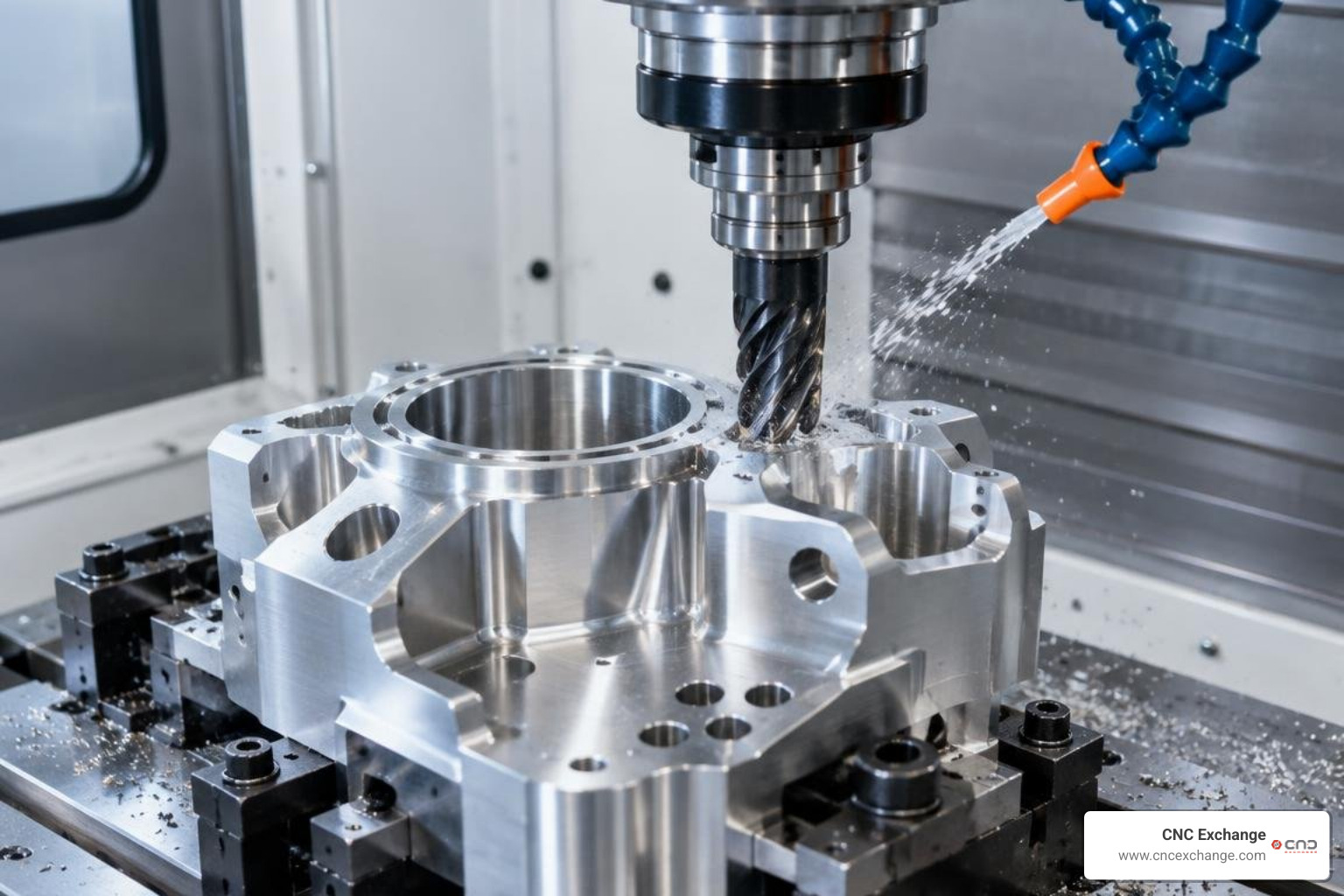
At its heart, a Vertical Machining Center (VMC) is an enclosed, highly automated milling machine where the spindle is oriented vertically along the Z-axis. Unlike basic manual knee mills or open-bed CNC routers, modern VMCs combine computer numerical control, high-pressure flood coolant enclosures, automated tool changers (ATCs), and rigid structural casting. This vertical orientation lets gravity assist the coolant in washing down over the cut while giving the machinist a clear, wide field of vision directly through the safety enclosure window.
The versatility of vertical milling centers has made them the primary workhorse across machine shops worldwide. They excel at producing prismatic parts—components characterized by flat faces, tapped mounting patterns, bored bearing housings, and contoured pockets. In high-demand precision manufacturing hubs across the Midwest, shops frequently rely on advanced setups for precision CNC machining services, delivering parts with complex geometric tolerances.
Industrial applications span several major sectors:
- Aerospace Manufacturing: Structural airframe brackets, wing ribs, avionics enclosures, and control surfaces. VMCs deliver the rigid cutting performance required to carve large pockets out of solid billets while maintaining exact wall thicknesses.
- Automotive Production: Engine cylinder heads, intake manifolds, transmission adaptors, suspension knuckles, and fluid pump housings.
- Medical Device Fabrication: Surgical instruments, bone plates, diagnostic equipment housings, and titanium orthopedic implants where surface finish and dimensional precision are critical.
- Die and Mold Making: Core and cavity inserts, stamping dies, injection molds, and precision fixtures requiring mirror-like surface finishes and sub-micron positioning.
Modern vertical centers routinely achieve precision levels ranging from ±0.005 mm to ±0.02 mm, depending on machine design, rail configuration, and thermal stability. Fast-cycling vertical units such as FANUC ROBODRILL machines achieve tool-to-tool change times as fast as 0.9 seconds and provide cutting torque up to 100 Nm, allowing high-speed drilling and tapping lines to run at peak throughput.
Material Applications and Heavy-Duty VMC Machine Use
A VMC's capability is directly tied to how its spindle, motor, and frame handle varying cutting forces. Machining soft aerospace aluminum demands high spindle speeds and rapid feed rates, whereas cutting tough alloys requires raw low-end torque, vibration dampening, and extreme structural rigidity.
For heavy-duty mold steels and exotic alloys, premium machines like Makino V77 vertical machining centers provide massive cast-iron bases, direct-drive spindles, and core-cooled ball screws. These elements dampen the harmonic chatter that ruins carbide tooling when taking deep cuts in hard metals. When clearing large volumes of chips from deep pockets, high-pressure through-spindle coolant flushes debris directly out of the cut zone, preventing tool recutting and catastrophic cutter breakage.
Expanding VMC Machine Use with 4th and 5th Axis Rotary Tables
While a standard 3-axis VMC operates on linear X (table left/right), Y (saddle forward/back), and Z (spindle up/down) axes, complex components often require cuts on multiple faces. Rather than manually unbolting, flipping, and reclamping the workpiece—which introduces human error and increases cycle time—shops equip their machines with 4th-axis rotary tables or 5th-axis trunnion tables.
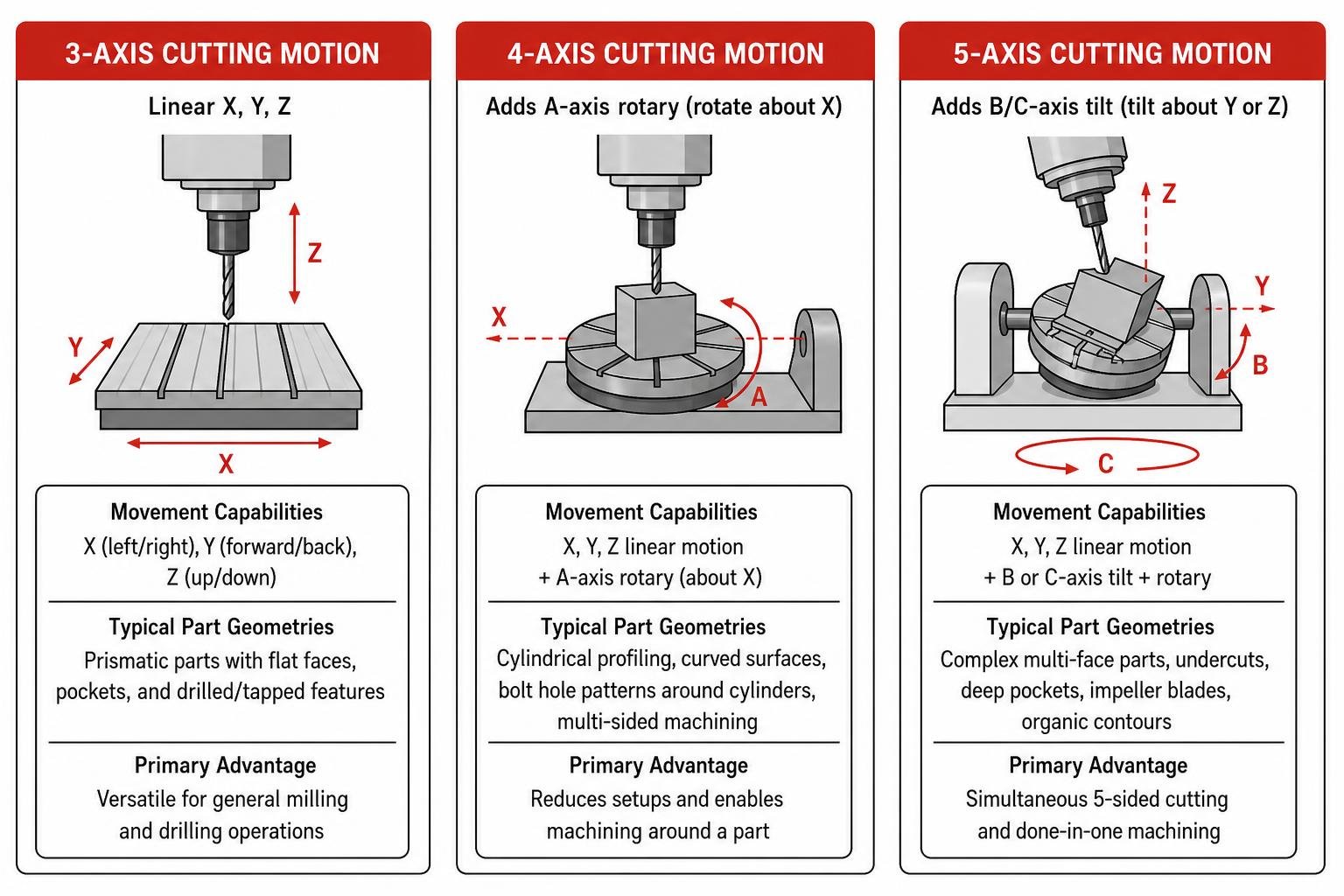
A 4th-axis rotary table introduces an A-axis, rotating the part horizontally along the X-axis. This setup is widely utilized for cylindrical profiling, bolt hole patterns along curved pipes, and multi-sided machining. In specialized production environments, experienced machinists manage complex part setups and setup & 4th axis VMC operations to execute complex contours without secondary fixturing.
Adding a 5th axis (tilting rotary table or B/C trunnion) unlocks simultaneous 5-sided cutting and complex multi-axis profiling. Systems such as Matsuura Cublex-42 multi-axis centers allow the cutter to reach undercut geometries, deep impeller veins, and organic aerodynamic sweeps in a single clamping setup ("done-in-one" machining).
| Axis Configuration | Movement Capabilities | Typical Part Geometries | Primary Advantage |
|---|---|---|---|
| 3-Axis (X, Y, Z) | Linear movement in three perpendicular planes | Flat plates, brackets, simple housings, mold bases | Lowest equipment cost, simple programming, rapid setup |
| 4-Axis (X, Y, Z + A) | 3 linear axes + horizontal part rotation | Camshafts, splines, cylinders, multi-sided prismatics | Eliminates manual part flips; continuous indexing |
| 5-Axis (3 Linear + 2 Rotary) | 3 linear axes + tilt and rotation (A/C or B/C) | Impellers, turbine blades, organic medical implants | Machines complex undercut geometries in a single setup |
Step-by-Step VMC Workflow and Equipment Selection
Operating a vertical machining center efficiently requires a standardized, repeatable workflow. Bypassing steps or rushing a setup often leads to broken cutters, ruined raw stock, or spindle crashes.

- CAD Modeling & CAM Post-Processing: The workflow begins with a precise 3D CAD model. The programmer imports the geometry into CAM software, selects cutting tools, defines toolpaths (adaptive roughing, semi-finishing, and contouring passes), and specifies feeds and speeds. The CAM system posts this out as standardized G-code tailored to the machine’s specific controller.
- Workpiece Fixturing: The raw billet is secured to the VMC table using precision machine vises, custom vacuum plates, chucks, or modular hydraulic clamps. The clamping force must hold the stock rigid against heavy cutting loads without bowing the material.
- Work Coordinate Offsets (WCS): Using an edge finder, 3D mechanical taster, or optical touch probe (such as Renishaw), the operator locates the part origin (X0, Y0) and records the offset values (G54 through G59) in the control.
- Tool Loading & Height Offsets: Cutters are loaded into balanced tool holders (BT40, CAT40, CAT50, or HSK63) and placed into the Automatic Tool Changer (ATC) magazine. Each tool's height is measured against a tool setter to establish its exact Z-offset.
- Dry Run & Program Verification: Before cutting raw metal, the operator runs a graphical simulation or executes a dry run in single-block mode with the Z-axis offset raised above the workpiece to verify clearance paths.
- Machining Cycle: The CNC control runs the G-code, engaging flood coolant nozzles, activating high-speed spindle rotation, and cycling through roughing, drilling, and finishing passes automatically.
- First-Article Quality Inspection: Once the cycle finishes, the operator deburrs the component and verifies critical features using digital calipers, micrometers, bore gauges, or a Coordinate Measuring Machine (CMM).
When establishing a versatile milling cell, selecting reliable vertical machining centers CNC provides the foundation for consistent, repeatable part runs across varying production schedules. Rugged legacy designs like Kitamura Mycenter-3 vertical machining centers showcase how rigid casting and precision box ways deliver tight tolerances through decades of continuous shop use.
Comparing VMC vs. HMC Architectures
One of the most important decisions a manufacturing engineer faces is choosing between a Vertical Machining Center (VMC) and a Horizontal Machining Center (HMC). While both perform multi-axis milling, drilling, and tapping, their mechanical layouts create distinct production advantages.
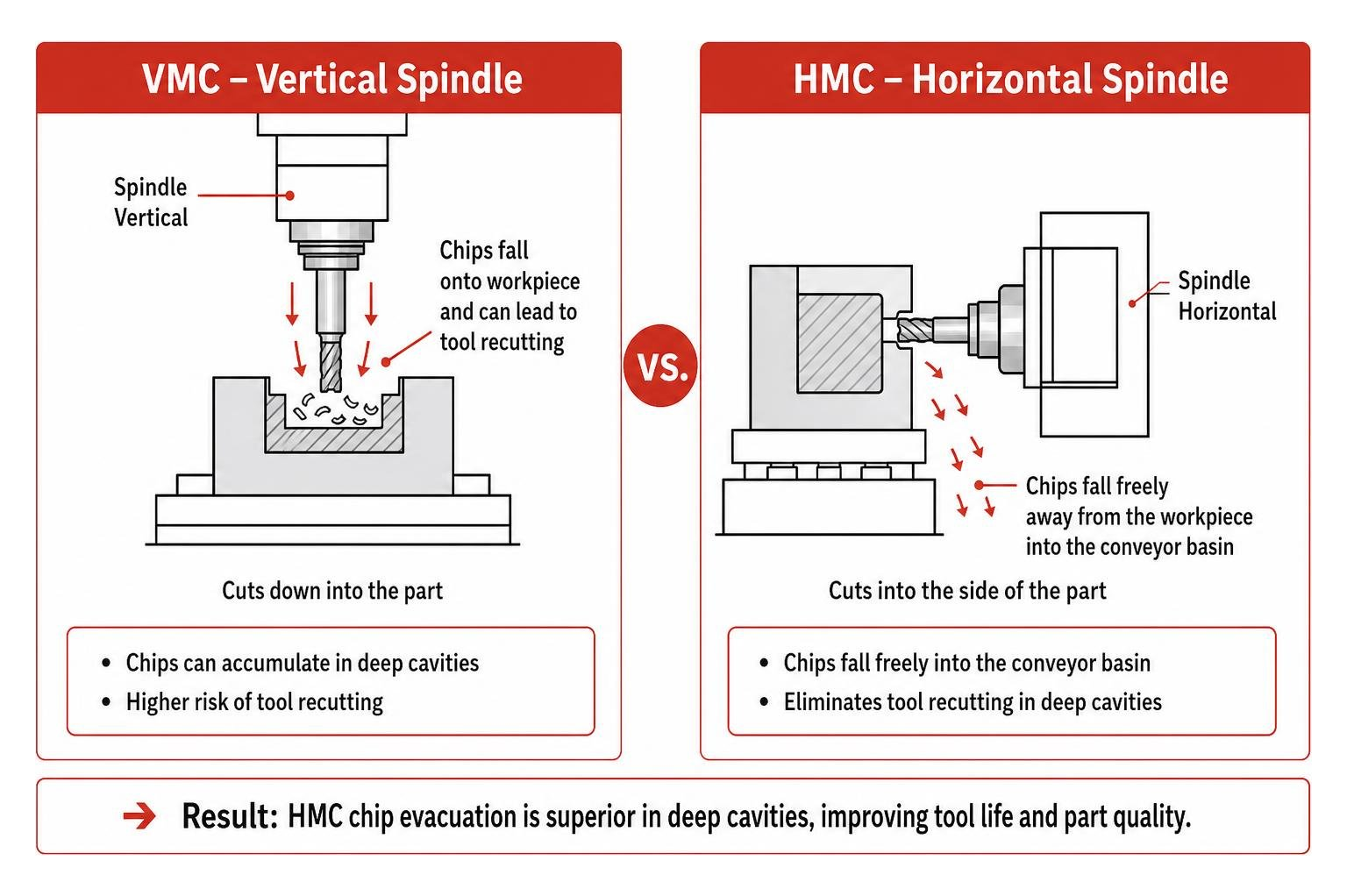
In a VMC, the spindle sits vertically, cutting down into the part. In an HMC, the spindle is horizontal, cutting into the side of the part. Because of this orientation, chips generated on an HMC fall freely away from the workpiece into the conveyor basin below, eliminating tool recutting in deep cavities. Additionally, HMCs almost always incorporate dual pallet changers and rotary tombstones, allowing operators to load parts on one pallet while the spindle cuts parts on the other.
However, HMCs require significantly larger floor space, complex programming workflows, and roughly two to three times the initial capital investment of an equivalent VMC.
| Feature / Metric | Vertical Machining Center (VMC) | Horizontal Machining Center (HMC) |
|---|---|---|
| Spindle Orientation | Vertical (Z-axis top-down) | Horizontal (Z-axis side-in) |
| Floor Footprint | Compact; fits easily in small to medium shop floors | Large; requires dedicated space for pallet changers |
| Initial Acquisition Cost | Budget-friendly to moderate | High (often 2× to 3× the cost of a comparable VMC) |
| Chip Evacuation | Relies on high-pressure coolant wash | Gravity-assisted; chips fall naturally into trough |
| Part Setup Visibility | Excellent; direct line-of-sight through front door | Restricted; operator views tombstone sideways |
| Production Style | Prototyping, small-to-medium batches, flat plates | High-volume production, multi-face structural parts |
| Pallet Integration | Standard single table (rotary/pallet pools optional) | Built-in dual-pallet rotary tombstone systems |
Traveling-column vertical mills such as Mazak VTC-16B vertical machining centers offer a middle ground: their stationary tables allow long workpieces to be divided into two distinct machining zones, mimicking pallet-changer efficiency on a vertical platform.
Criteria for Selecting the Right Machine Configuration
Choosing the right vertical machining center requires matching your shop's component portfolio to machine specifications:
For high-speed production shops balancing rapid cycle times and quick tool changes, machines like Haas VF-4SS vertical machining centers deliver high-speed direct-drive spindles with accelerated rapids. Meanwhile, cost-conscious operations starting out or running legacy short runs often find immense value in proven workhorses like Fadal VMC20 vertical machining centers, which offer straightforward controls, wide parts availability, and low maintenance overhead.
Operator Skillsets, Maintenance, and Future Trends in VMC Technology
A high-performance machining center is only as productive as the machinist commanding it. Modern VMC operators combine mechanical skill with computational literacy. Key competencies include:
- Blueprint & GD&T Reading: Interpreting complex engineering drawings, geometric dimensioning, datum reference frames, and critical fit limits.
- Precision Metrology: Mastery of digital micrometers, vernier height gauges, bore micrometers, and gauge block stacks.
- Feed and Speed Optimization: Adjusting spindle RPM, chip load per tooth, and depth of cut on the fly to eliminate chatter and maximize tool life.
- Preventative Maintenance: Daily monitoring of pneumatic pressure gauges, checking way lube reservoir levels, clearing chips from ballscrew wipers, and inspecting hydraulic tool release mechanisms.
Versatile shop-floor systems like Milltronics VM30IL vertical machining centers streamline these tasks by integrating conversational programming interfaces right alongside standard Fanuc-style G-code editing.
Emerging Technological Trends in Modern VMCs
Vertical machining centers continue to evolve alongside digital manufacturing:
- Direct-Drive Spindle Architecture: Eliminating drive belts reduces vibration and backlash, allowing direct-drive spindles to hit 20,000 to 30,000 RPM while producing mirror finishes.
- IoT & Smart Shopfloor Telemetry: Modern VMCs integrate Industrial Internet of Things (IIoT) sensors that continuously track spindle vibration, motor temperature curves, and power consumption. These data streams feed predictive maintenance platforms that alert maintenance crews before bearing failure occurs.
- Dynamic Thermal Compensation: Machine frames expand and contract as ambient shop temperatures fluctuate. Real-time thermal sensors on spindle castings and ball screws automatically offset coordinate values in software, maintaining sub-micron accuracy all day.
Frequently Asked Questions About VMC Machines
What is the primary difference between a standard CNC mill and a VMC?
While all VMCs are CNC milling machines, not all CNC mills are Vertical Machining Centers. A basic CNC mill may have an open frame, manual tool changes, and no integrated coolant containment. A VMC is a fully enclosed production unit equipped with an Automatic Tool Changer (ATC), high-volume flood/through-spindle coolant systems, high rapid traverse rates, and full chip enclosure panels.
When should a machine shop choose a VMC over an HMC?
A shop should choose a VMC when budget, floor space, and part setup flexibility are top priorities. VMCs require a significantly lower upfront capital investment, offer an intuitive top-down viewing angle, and set up quickly for single-face parts, prototypes, and short-to-medium production volumes.
What machining tolerances can modern vertical machining centers achieve?
Standard industrial VMCs holding tight calibration routinely hold positional tolerances between ±0.005 mm and ±0.015 mm (0.0002" to 0.0006"). High-end mold-making centers featuring linear scales, direct-drive axes, and active thermal compensation can repeat within ±0.002 mm (0.00008").
Conclusion
From everyday mounting brackets to life-saving titanium bone plates, vertical machining centers remain the cornerstone of modern manufacturing. Their balance of affordable capital investment, compact floor footprints, setup simplicity, and precision makes them an indispensable asset for machine shops of every scale.
At CNC Exchange, we help machine shops and manufacturers optimize their production lines and maximize their capital. Whether you are looking to expand your shop floor with an advanced 5-axis vertical milling cell or liquidate surplus equipment for top dollar, our online marketplace provides an open, trusted platform to buy and sell quality CNC machinery.