
How Wire EDM Cuts Metal Without a Blade
With cut wire edm, a thin, moving wire cuts electrically conductive material using controlled sparks, not a blade. The wire follows a programmed path to make precise through-cuts in materials such as hardened steel, titanium, and carbide. Because the wire does not touch the part, it can cut delicate shapes without the force of a milling tool.
The tradeoff is speed: wire EDM usually removes material more slowly than milling. It also cannot cut nonconductive materials or make blind cavities. This guide explains how the process works and when it is worth considering.
I'm Jared Gray. I've spent more than 12 years buying, selling, and brokering manufacturing equipment, experience I bring to evaluating cut wire edm equipment and its place in a CNC shop.
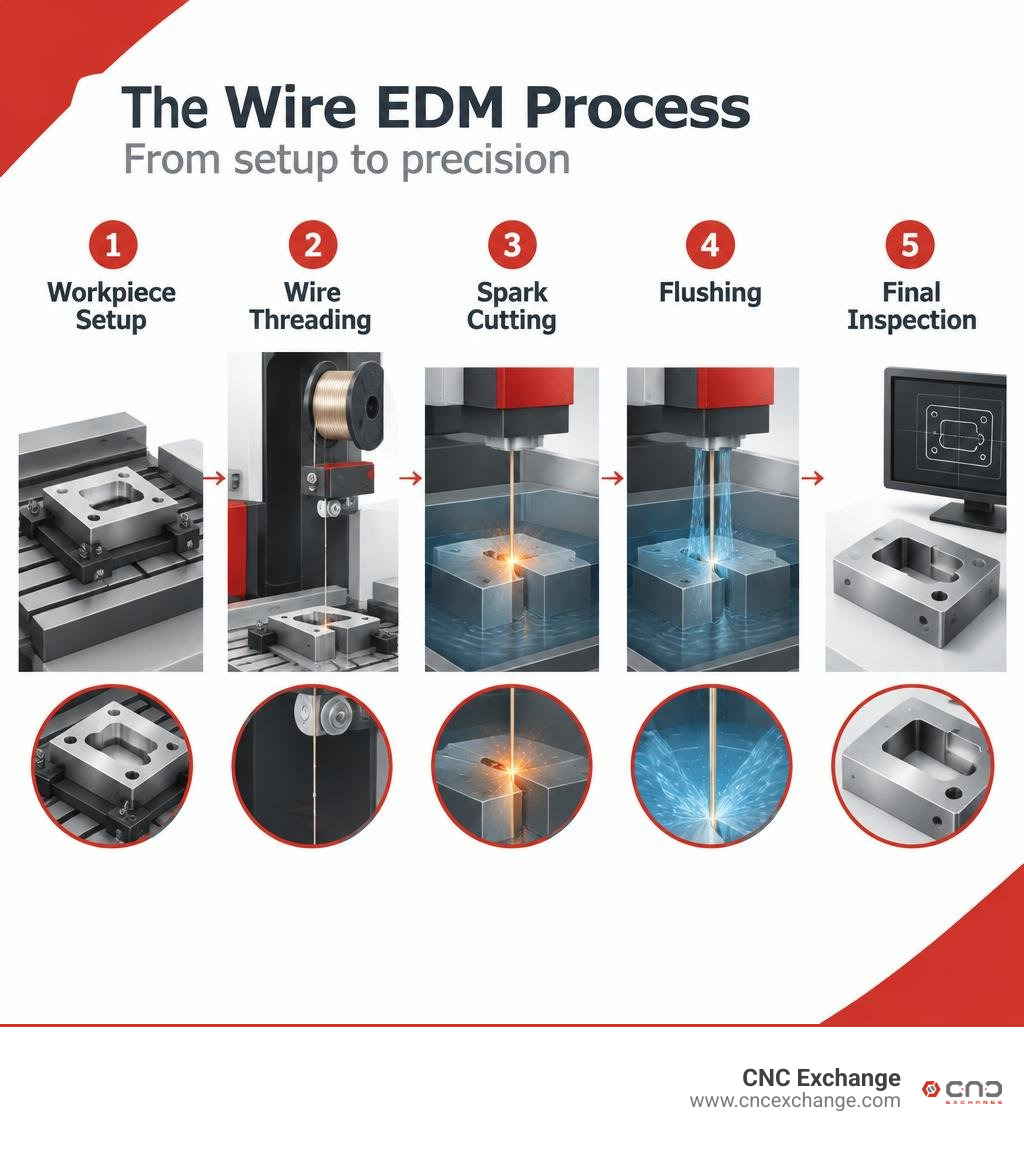
Cut wire EDM: how the process works
What does cut wire EDM mean?
Wire-cut electrical discharge machining, usually called wire EDM or WEDM, shapes a conductive workpiece with a thin moving wire electrode. A programmed CNC path guides the wire through the material. Sparks jump the small gap between the wire and workpiece, eroding material without direct contact.
Wire EDM is mainly used for through-cut profiles: the wire enters from an outside edge or passes through a start hole, then follows the programmed contour. The cut travels through the workpiece’s full thickness. For an introduction to the wider process, see the EDM fundamentals in SME’s study guide.
How does cut wire EDM work?
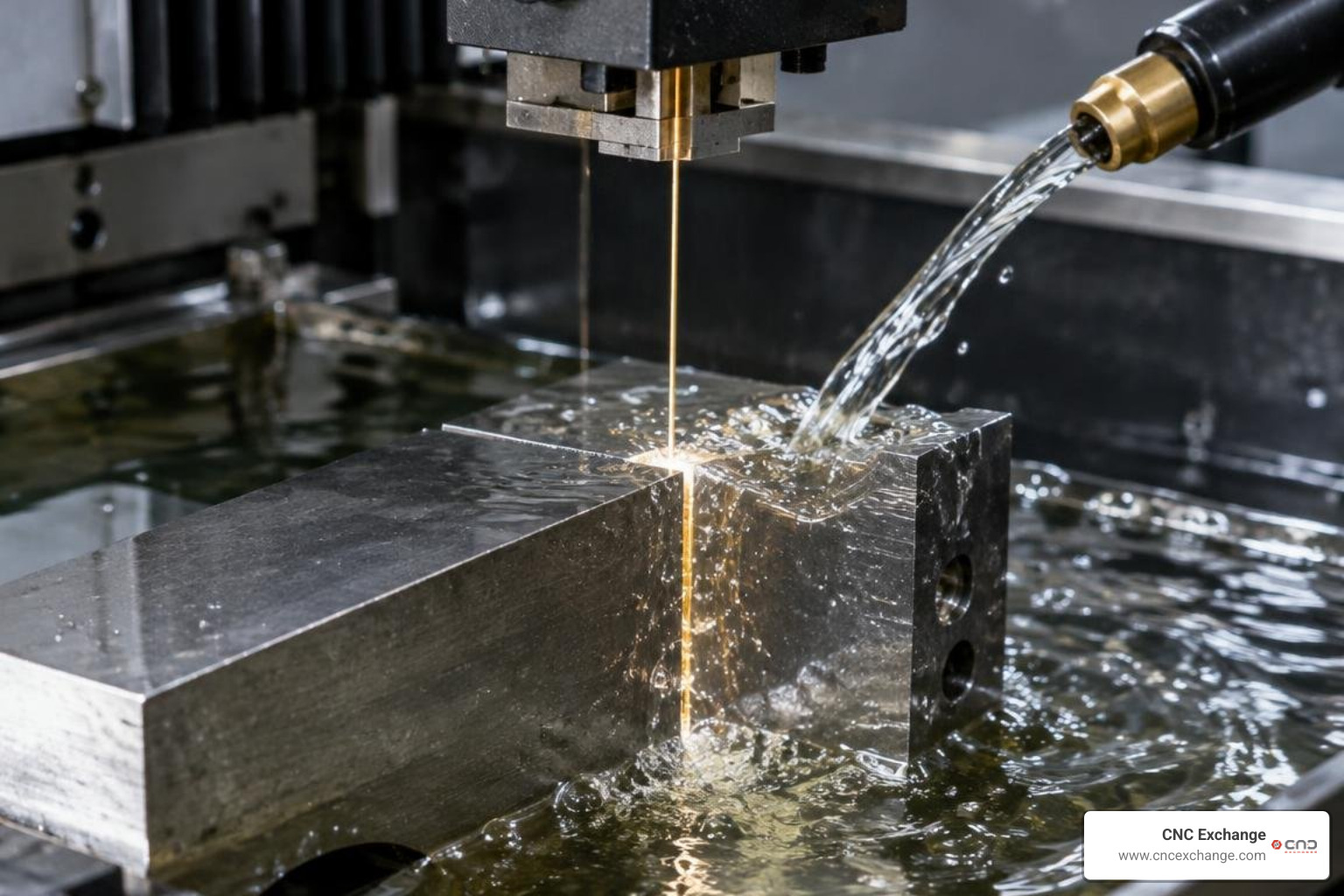
The machine supplies pulsed electrical current to the wire and workpiece. When conditions in the small gap are right, a spark crosses it and creates a tiny, hot plasma channel. The heat melts and vaporizes a small amount of material. Repeated discharges create the cut.
The CNC system moves the wire along the planned path while controls maintain the spark gap. Dielectric fluid flows through the cutting area to cool it and carry away eroded particles. The wire is continuously fed so fresh electrode material reaches the cut.
How to cut with wire EDM, step by step
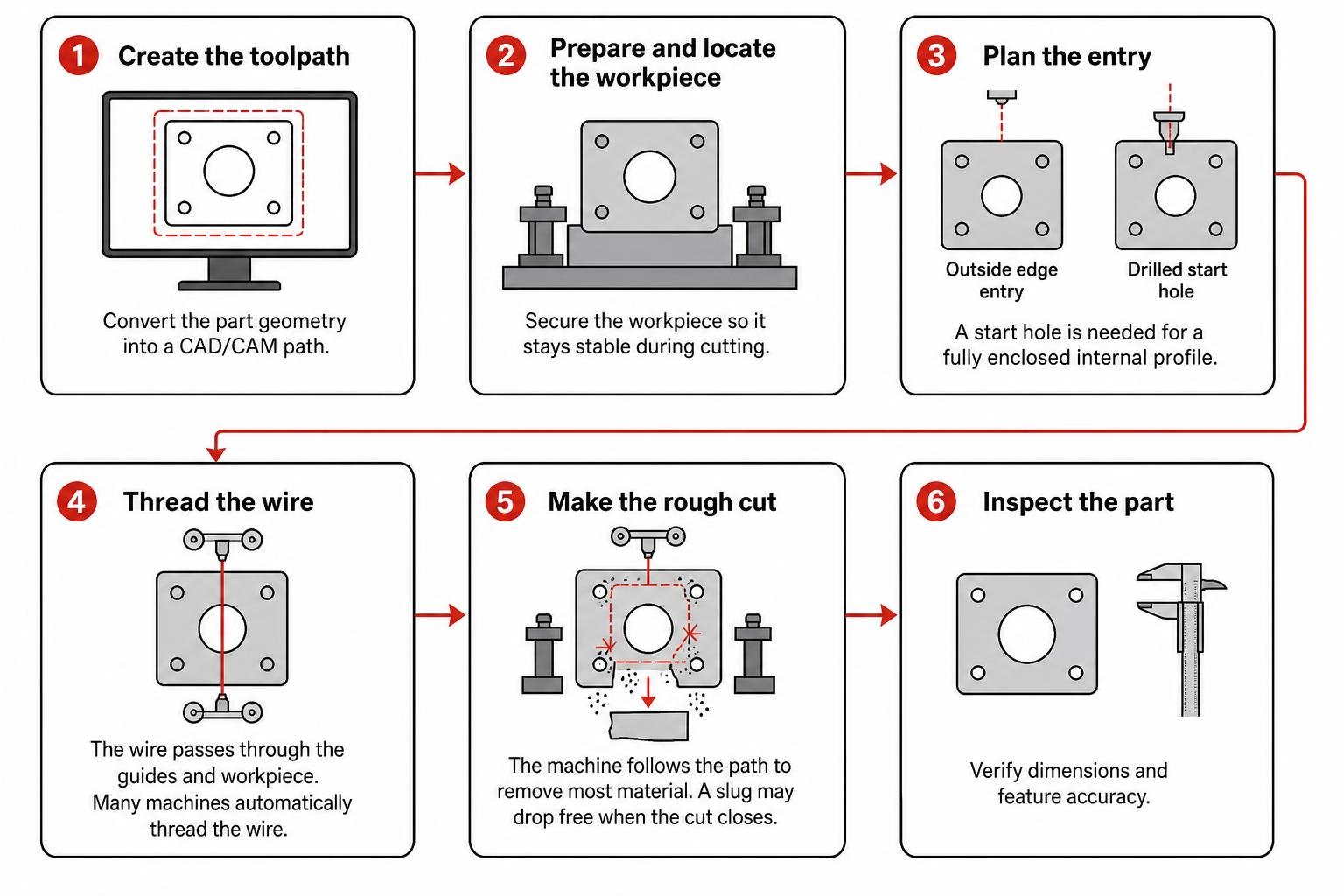
- Create the toolpath. Convert the part geometry into a CAD/CAM path, accounting for the wire diameter, spark gap, kerf, and required offsets.
- Prepare and locate the workpiece. Secure it so it stays stable as the wire cuts. Workholding and setup are important for accuracy, especially for thin or stress-sensitive parts.
- Plan the entry. The cut can begin at an outside edge or through a drilled start hole. A start hole is needed for a fully enclosed internal profile.
- Thread the wire. The wire passes through the guides and workpiece. Many machines can automatically thread it, which can help with unattended jobs and restarting after a break.
- Make the rough cut. The machine follows the programmed path to remove most of the material. A slug or scrap section may drop free when the cut closes, so it must be supported or managed safely.
- Add skim passes if needed. One or more finishing passes remove small amounts of material to improve dimensional accuracy and surface finish.
- Inspect the part. Check the profile, dimensions, and finish against the drawing. If the design calls for tapered walls or different top and bottom profiles, the program and setup must account for them.
Four-axis machines can tilt the wire to produce tapers and changing profiles through a part. The achievable angle and thickness depend on the machine and setup.
Wire electrodes and dielectric fluid
Brass is a common general-purpose wire because it offers a practical balance of conductivity, strength, and cost. Zinc-coated and stratified wires are options for particular cutting conditions; wire selection depends on the required speed, finish, thickness, and machine capability. Molybdenum wire is used in some fast-wire systems that reuse wire rather than consuming it in a single pass.
Typical precision wire diameters range from about 0.05 to 0.30 millimeters. A finer wire can support smaller features, but it may be more sensitive to tension, flushing, and breakage. Wire tensile strength matters too: if tension or cutting conditions are unsuitable, the wire can break and interrupt the job.
Wire EDM typically uses filtered deionized water as its dielectric fluid. The fluid helps maintain the electrical conditions needed for sparking, cools the cutting zone, and flushes away debris. Filtration and control of water conductivity help keep the process stable. Poor flushing or unsuitable settings can contribute to wire breaks, unstable cutting, or inconsistent results.
Wire EDM vs sinker EDM
Both processes remove conductive material with electrical discharges, but they use different electrodes and make different kinds of features.
Wire EDM uses a moving wire to cut through a workpiece, making it well suited to profiles, slots, and other through-features. Sinker EDM uses a shaped electrode that moves into the workpiece to form a matching cavity. It can produce blind cavities and complex three-dimensional shapes that wire EDM cannot make.
Sinker EDM requires a suitable electrode to be designed and prepared for the feature. Its electrode also wears during use. Wire EDM continuously feeds fresh wire, but the wire is still a consumable. In short: choose between them based on the geometry, not simply because both use sparks.
Materials, precision, applications, and tradeoffs
What materials can you cut with wire EDM?
Wire EDM can cut materials that conduct electricity, including hardened tool steel, carbide, titanium, Inconel and other conductive superalloys, and copper alloys. Because cutting does not depend on a conventional tool shearing through the material, hardness alone does not rule out a material after it has been heat-treated.
Electrical conductivity is essential. Plastics and untreated, electrically insulating ceramics generally cannot be cut by standard wire EDM. Some ceramic materials are made conductive through composition or treatment, but their suitability depends on the specific material and machine process. Confirm material compatibility before planning a job.
Accuracy, surface finish, kerf, and part thickness
Published capability figures vary because results depend on the machine, material, part size, thickness, setup, temperature, wire, and number of finishing passes. A practical tolerance range is roughly ±0.002 to ±0.01 millimeters for suitable work. High-end equipment may approach ±0.0025 millimeters under tightly controlled conditions; a ±0.002-millimeter result should be treated as an application-specific capability, not a default guarantee.
Surface finishes can range from about Ra 0.05 to 0.8 micrometers, depending on the settings and finishing strategy. Roughing removes material faster, while skim passes refine the cut. More finishing passes can improve finish and accuracy, but they add time.
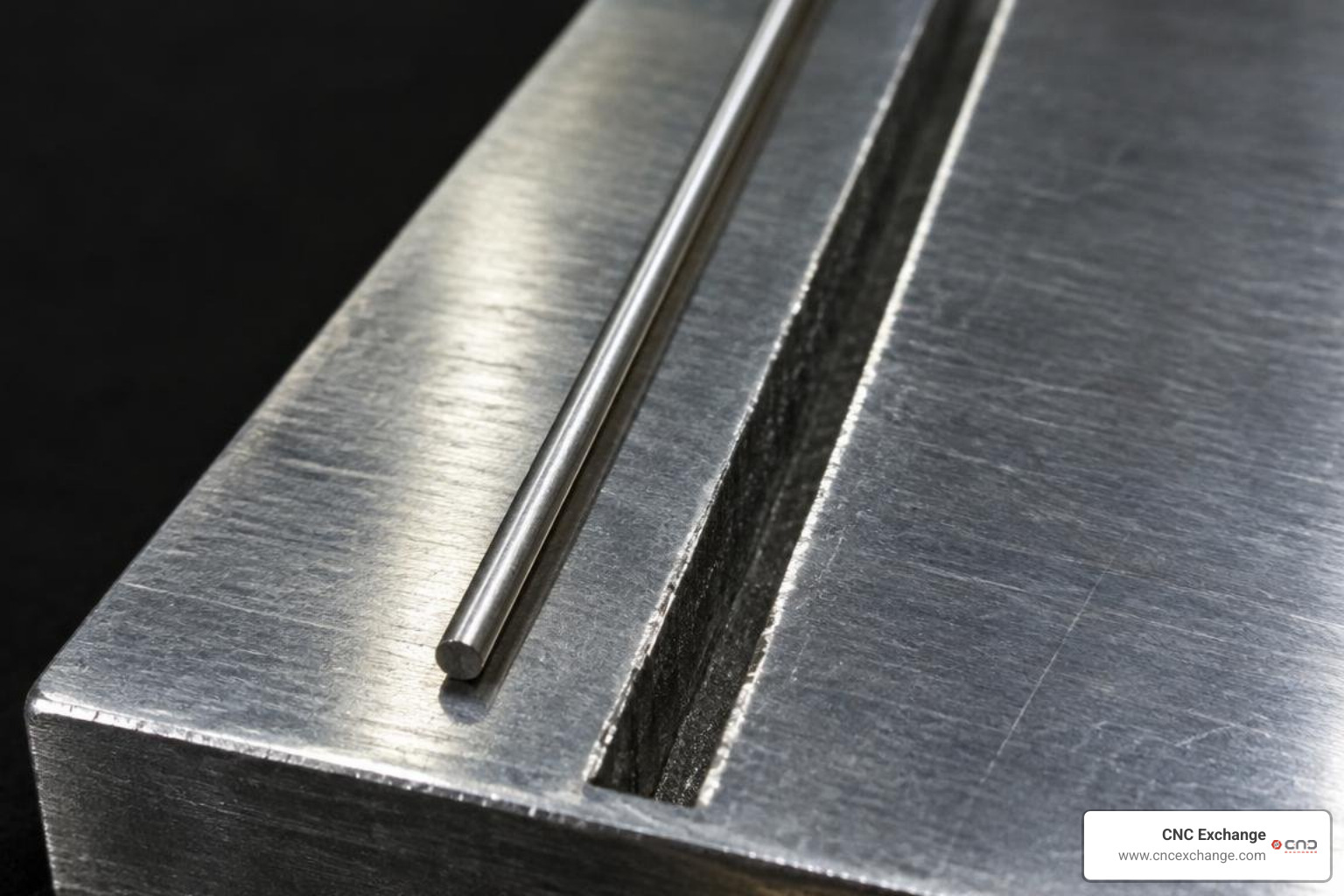
Kerf is the width of material removed. It is wider than the wire because sparks also erode material around it. The CNC toolpath accounts for this offset. A reported kerf as small as 0.021 millimeters is an exceptional result using very fine wire; typical cuts vary with wire diameter and cutting conditions.
Some wire EDM machines are specified for workpieces up to about 300 millimeters thick, but that is not a universal capacity. Check the specific machine’s work envelope, taper capability, and cutting limits.
Industries and common applications
Wire EDM is used where conductive materials, detailed profiles, and close dimensional control come together. Common applications include:
- Tool and die: stamping punches, blanking dies, extrusion dies, and hardened tooling.
- Aerospace: precision profiles in turbine components and difficult-to-machine alloys.
- Medical devices: intricate parts and small features where minimizing mechanical cutting forces can help.
- Automotive and electronics: connectors, precision components, and production tooling.
- General precision manufacturing: gears, keyways, internal splines, narrow slots, and thin-walled parts.
Wire EDM is also used to make straight cuts for contour-method residual-stress measurement. In that application, careful fixturing and finishing settings help limit cutting-related effects on the measurement.
Advantages, limitations, and design considerations
The main advantage is that wire EDM cuts without the mechanical forces of a milling cutter. That makes it useful for hardened materials, delicate sections, and intricate contours that could be difficult to machine conventionally. The process can produce precise profiles with little burr formation, though secondary finishing may still be needed for some requirements.
There are important limits. Wire EDM is slower than many chip-removal processes, works only with conductive materials, and generally makes through-cuts rather than blind cavities. Internal corners cannot be perfectly sharp: the minimum radius depends in part on wire diameter and the spark gap. The process also creates a thin recast layer and heat-affected zone at the cut surface. If surface integrity is critical, include the requirement in the process plan and verify the result.
When designing a part for wire EDM, consider entry access, start-hole location, cut order, slug support, wire radius, taper, and the number of finishing passes. Support the part so it remains stable as material is removed and internal stresses relax. Plan enough clearance for the wire and its path, particularly where a small internal radius or taper is required.
When is cut wire EDM the right process?
Wire EDM vs CNC milling, Swiss machining, and sinker EDM
These processes solve different geometry and production problems. The best choice depends on the feature, material, quantity, and required finish.
| Process | Geometry | Material fit | Setup and speed | Main cost drivers | Good fit |
|---|---|---|---|---|---|
| Wire EDM | Through-cut profiles; tapers and limited contour variation | Conductive materials, including hardened metals | Programming and workholding are needed; cutting can be slow | Cut length, thickness, wire, skim passes, machine time | Precise profiles, narrow slots, hard materials, low-force cutting |
| CNC milling | 2D and 3D features, pockets, and surfaces | Many machinable materials | Flexible, with speed depending on material and geometry | Tooling, setup, cycle time, finishing | Bulk removal and parts needing multiple 3D features |
| Swiss machining | Small, often long turned parts and rotational features | Materials suited to turning | Efficient for suitable repeat production; setup depends on part and tooling | Setup, tooling, cycle time, batch size | Small precision components with turned geometry |
| Sinker EDM | Blind cavities and complex 3D forms | Conductive materials | Requires electrode preparation; cutting time depends on cavity and finish | Electrode design and wear, machine time, finishing | Molds, dies, and cavities that wire EDM cannot reach |
Wire EDM may reduce mechanical distortion and avoid some tool-making steps, but it is not automatically the least expensive option. Milling or Swiss machining may be more efficient when the part geometry suits those processes.
Cost, speed, and production planning
Wire EDM cost is influenced by more than the machine’s hourly rate. Programming and setup, cut length, workpiece thickness, material properties, wire consumption, and the number of skim passes all affect job time. Complex threading, careful fixturing, inspection, or difficult flushing conditions can add more time.
For larger batches, automatic threading and unattended operation may help make production more efficient, depending on part design and machine configuration. For a one-off part, programming and setup can account for a larger share of total cost. Compare the complete part plan, including any required finishing and inspection, rather than judging by cutting speed alone.
Choosing and evaluating wire EDM equipment
When evaluating a machine, start with the work you expect it to perform. Check the work envelope, axis travel, taper capability, automatic threading, power supply, controller, and dielectric system, including filtration. Confirm that the machine can accommodate the part size, thickness, and tolerance requirements.
For used equipment, review its specifications alongside its maintenance history and current condition. Check the machine’s operating and service records where available, and confirm that the control and key systems suit your intended work. We list a wire EDM machine configuration as one example of the equipment available for evaluation.
Frequently asked questions about wire EDM
Does wire EDM cut nonconductive materials or make blind cavities?
Standard wire EDM needs an electrically conductive workpiece and cuts through the material from an edge or start hole. It does not make a conventional blind cavity. Sinker EDM, which uses a shaped electrode, is designed for blind cavities and other features that wire EDM cannot reach.
How accurate is wire EDM, and how wide is the cut?
Typical tolerances can fall around ±0.002 to ±0.01 millimeters, with tighter results possible on suitable machines and applications. Surface finish and accuracy depend on the setup, machine condition, material, and finishing passes.
The kerf is wider than the wire because sparks remove material on both sides. A fine-wire application may achieve a very narrow kerf, but the actual width should be confirmed for the machine and job. CNC compensation accounts for the kerf when programming the final profile.
Is wire EDM faster or cheaper than milling?
Not usually for bulk material removal. Milling can be faster when the part geometry and material allow efficient cutting. Wire EDM can make more sense for a hard material, intricate through-profile, or delicate part where milling forces or tooling would create difficulties. The lower-cost process depends on setup, batch size, cycle time, finishing, and the total cost of producing an acceptable part.
Conclusion
Wire EDM uses sparks and a moving wire to make precise through-cuts in conductive materials, including hardened metals that can be challenging to machine with conventional cutting tools. Its strengths are intricate profiles, low mechanical force, and fine finishes; its limits include slower cutting, the need for electrical conductivity, and the requirement for through-cut access.
When choosing a process or evaluating equipment, match the machine’s capabilities to the part geometry, material, thickness, and tolerance. We make it easier to explore available EDM machinery and equipment through CNC Exchange, an online marketplace for buying, selling, and auctioning CNC machines.