
How a CNC Router Works and What It Can Cut
A cnc router operates on the standard Cartesian coordinate system, utilizing three primary axes of movement: X (left to right), Y (front to back), and Z (up and down). Advanced commercial models may also feature 4th (rotary) or 5th axes to tilt and swivel the cutting head for complex 3D contouring.
The heart of the system is the spindle, which spins cutting bits (end mills, router bits, or diamond grinders) at high rotational speeds, typically between 6,000 and 24,000 RPM. Rather than relying on manual guiding, the unit receives its precise movement instructions from G-code—a standardized machine language that tells the spindle where to travel, how deep to plunges, and how fast to move (feed rate).
Because routing is a subtractive manufacturing process, the machine selectively removes material from a solid block or flat sheet to reveal the finished part. Integrating modern CNC Fabrication & Technology into your workshop bridges the gap between digital CAD designs and physical products, streamlining production runs with zero loss in accuracy.
Material Compatibility and Cutting Capabilities
One of the greatest strengths of a cnc router is its versatility across non-ferrous and composite materials:
- Wood and Sheet Goods: Hardwoods (oak, maple, walnut), softwoods, plywood, and medium-density fiberboard (MDF) are the most common substrates.
- Plastics and Composites: Acrylics, polycarbonate, HDPE, PVC, and specialized composites like carbon fiber or G10 fiberglass.
- Non-Ferrous Metals: Soft metals including aluminum plate, brass, and copper can be milled easily when using appropriate cooling systems and single-flute end mills.
- Foams: Polyurethane foam (up to 8lb density) and rigid Styrofoam used for architectural models or packaging inserts.
- Stone and Solid Surface: Marble, granite, engineered stone, and solid surfacing materials (such as Corian) can be shaped using diamond-sintered grinding bits paired with continuous water cooling.
Key Applications Across Industrial Sectors
Because these platforms can process flat sheet goods as rapidly as 3D block contours, their industrial utility spans several major sectors:
- Custom Cabinetry and Architectural Millwork: Automated nested-based manufacturing allows cabinet shops to cut drawer fronts, carcass panels, and shelf pin holes from whole sheets in minutes.
- Sign Making and Decorative Lettering: Precise vector carving makes quick work of 3D dimensional lettering, backlit acrylic signs, and carved wooden plaques.
- Plastic Thermoforming Trimming: Industrial vacuum-formed plastics require rapid edge trimming and hole pattern routing, replacing laborious hand-trimming tools.
- Musical Instrument Fabrication: Acoustic and electric guitar bodies, necks, bridge components, and fretboards require extreme dimensional accuracy that routing automation provides.
- Prototyping and Production Parts: Rapidly machining structural brackets, housings, and custom jigs out of plastic or aluminum stock.
Machine Sizes, Structural Configurations, and Components
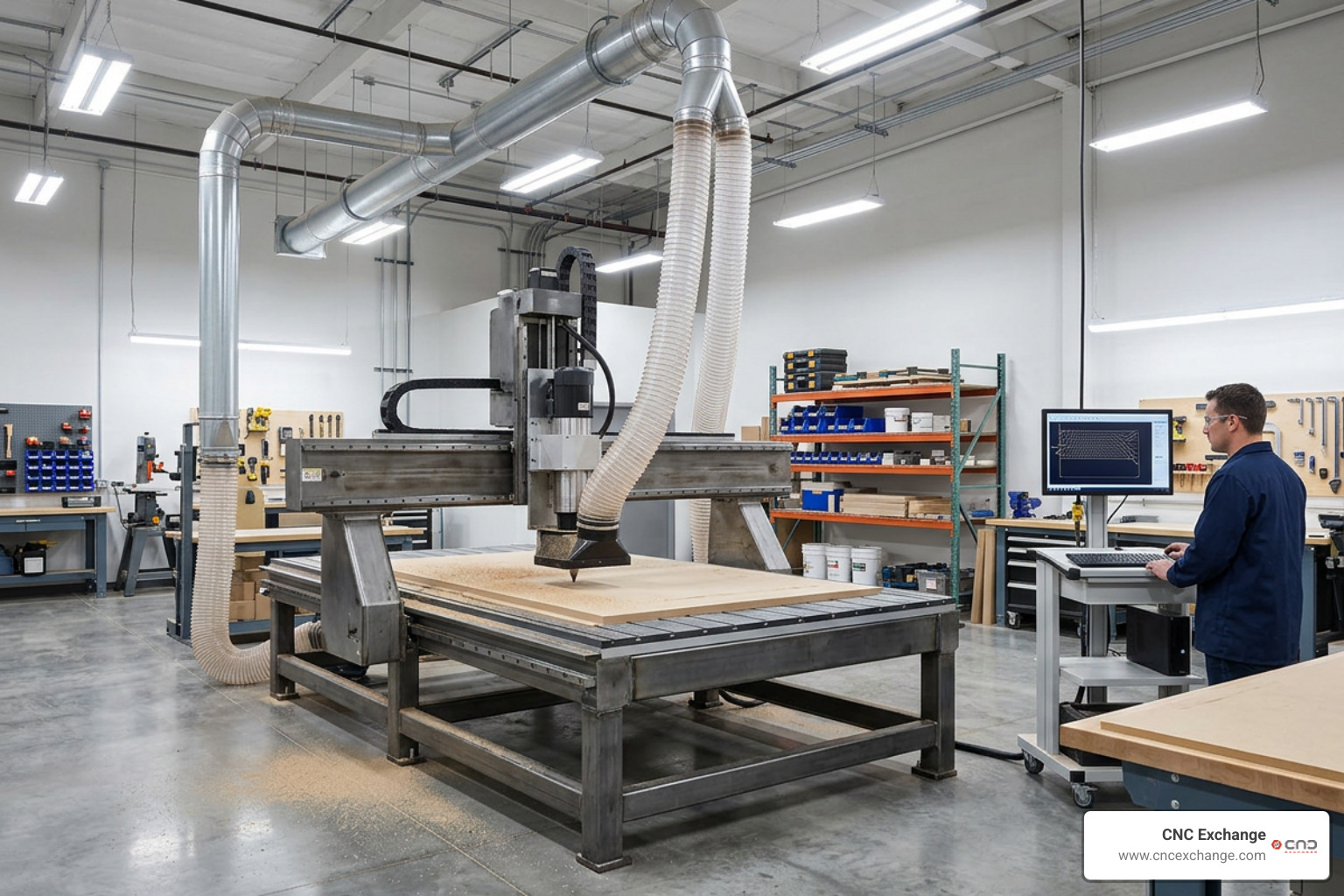
When selecting equipment, matching the physical footprint to your raw material inventory prevents unnecessary pre-cutting step labor.
| Machine Configuration | Work Envelope Dimensions | Primary Bed Type | Ideal Applications |
|---|---|---|---|
| Compact / Benchtop | 24" x 24" to 24" x 48" | T-slot Aluminum Bed | Prototyping, small crafts, PCB milling |
| Mid-Size Workshop | 48" x 48" (4x4 ft) | T-Slot / Grid Hybrid | Guitar making, small signage, small shop spaces |
| Standard Industrial | 48" x 96" (4x8 ft) | Vacuum Hold-Down Table | Full sheet plywood, cabinet making, sign production |
| Oversized Production | 60" x 120" (5x10 ft) | Multi-zone Vacuum Bed | Commercial architectural panels, non-ferrous sheets |
Workholding is critical. Standard T-slot beds rely on mechanical hold-down clamps, making them excellent for thick timber or custom jigs. Conversely, industrial production tables use high-volume vacuum pumps to suction whole sheets flat against a spoiler board. Powerful platforms like the CR Onsrud F148E15 CNC Router utilize high-capacity vacuum pumps to keep thin sheet stock firmly anchored during fast multi-pass pocketing operations.
Key Machine Components and Structural Elements
Understanding the individual mechanical components helps you gauge built-in durability:
- Spindle: Rated in horsepower (HP) or kilowatts (kW), ranging from 2.2kW air-cooled spindles up to heavy-duty 10+ HP liquid-cooled units designed for continuous 24/7 duty cycles.
- Drive Mechanisms:
- Lead Screws / Ball Screws: 1605 or 1620 precision ball screws offer superior positional accuracy and backlash control, perfect for Z-axes and high-precision tables.
- Rack and Pinion: Heavy-duty helical rack and pinion drives power long X and Y axes (4x8 ft and larger), preventing axis flex while delivering rapid traverse speeds up to 25,000 mm/min.
- Linear Guide Rails: Heavy steel linear rails (such as HG-15 or HG-20 style) maintain rigid tracking across the table without dynamic deflection.
- Gantry Frame Rigidity: Heat-treated, stress-relieved steel or heavy wall aluminum extrusions maintain structural squareness over years of high-speed direction changes.
- Automatic Oil Lubrication Systems: Timed lubrication pots deliver oil to linear guide trucks and drive bearings, prolonging component lifespan up to 10 years or more.
Desktop vs Heavy-Duty Industrial CNC Router Platforms
Benchtop units offer an entry point for small spaces, but production shops demand heavy welded steel bases to absorb structural vibration. Industrial 3-axis systems process massive volumes of flat sheet goods, while full 5-axis machines swing the spindle around contoured blocks for aerospace trimming or mold making.

Workhorses like the Thermwood 4x8 CNC Router showcase how dedicated welded frames maintain high accuracy without frame deformation under continuous industrial production.
Software Options, Cost Factors, and Price Ranges

A cnc router requires three software layers to turn an idea into a physical part:
- CAD (Computer-Aided Design): Software used to draw vector artwork or model 3D parts.
- CAM (Computer-Aided Manufacturing): Software that imports CAD vectors, calculates cutter paths, applies feed rates, and outputs formatted G-code.
- Machine Motion Controller: Software or hardware interface that interprets G-code line-by-line and sends step pulses to motor drivers.
Essential CAD/CAM and Motion Control Software
Popular software packages suit different workflow requirements:
- 2D Vector & Decorative Design: Vectric VCarve (Desktop or Pro) and Easel Pro excel at decorative carving, cabinet joinery, sign making, and nested sheet layouts.
- 3D Engineering & Complex Milling: Autodesk Fusion 360 handles complex 3D surface modeling, parametric design, and multi-axis CAM generation.
- Industrial Motion Control Systems: Masso Touch, NCStudio, RichAuto DSP hand pendants, or Mach3/Mach4 manage coordinate systems, touch-off Z-probes, spindle speed overrides, and emergency stop monitoring.
Price Ranges and Investment Allocation
When planning your machinery budget, balance the initial purchase price with necessary accessories:
- Entry-Level / Hobbyist ($2,000 – $6,000): Smaller light-duty frames, stepper motors, basic T-slot tables, and air-cooled trim routers.
- Mid-Tier / Business Prosumer ($6,000 – $15,000): Closed-loop stepper motors, heavy aluminum/steel frames, 3.5kW industrial spindles, and 4x4 or 4x8 sheet capacity.
- Commercial Industrial ($15,000 – $50,000+): Heavy welded steel gantries, high-flow vacuum tables, Automatic Tool Changers (ATC), rapid drive systems, and multi-zone vacuum pumps.
Don't forget peripheral expenses! Allocate funding for high-capacity dust collection systems, compressed air lines, initial tooling packages (V-bits, compression end mills, surfacing bits), and dedicated CAM software licensing. Machinery platforms like the Laguna Smart Shop 2 CNC Router show how investing in a mid-to-high tier industrial frame pays off through faster execution, tool changer capabilities, and lower per-part labor costs.
How to Select the Ideal Equipment for Your Workshop
Selecting the right machine requires an honest review of your shop floor parameters:
- Evaluate Shop Floor Space: Measure physically available square footage. A 4x8 ft cutting table requires extra perimeter room—often a total 8x12 ft footprint—for loading sheet goods, housing dust collectors, and accessing electrical enclosures. Compact shops can look into parking the machine gantry against one side so the bed doubles as a secondary assembly surface.
- Match Sheet Goods Inventory: If your primary raw materials are standard 48" x 96" plywood, 49" x 97" MDF, or 60" x 60" Baltic Birch, buying a smaller bed forces you to pre-cut every sheet manually, burning valuable time.
- Define Duty Cycle & Material Types: Machining daily runs of dense hardwoods or aluminum demands high-torque spindles (5+ HP) and closed-loop motor drivers to prevent missed steps under heavy chip loads.
- Consider Future ATC Needs: Automatic Tool Changers (ATC) allow the router to switch between roughing bits, finishing cutters, and drill bits mid-program without operator interaction—drastically increasing overall throughput.
Units like the Komo VR510 CNC Router represent powerful commercial options built for heavy sheet processing. Alternatively, gantry-style table systems like the high-capacity Haas GR-712 CNC Router offer ultra-wide travel for specialized aluminum and composite plate manufacturing.
Machine Safety and Operating Guidelines
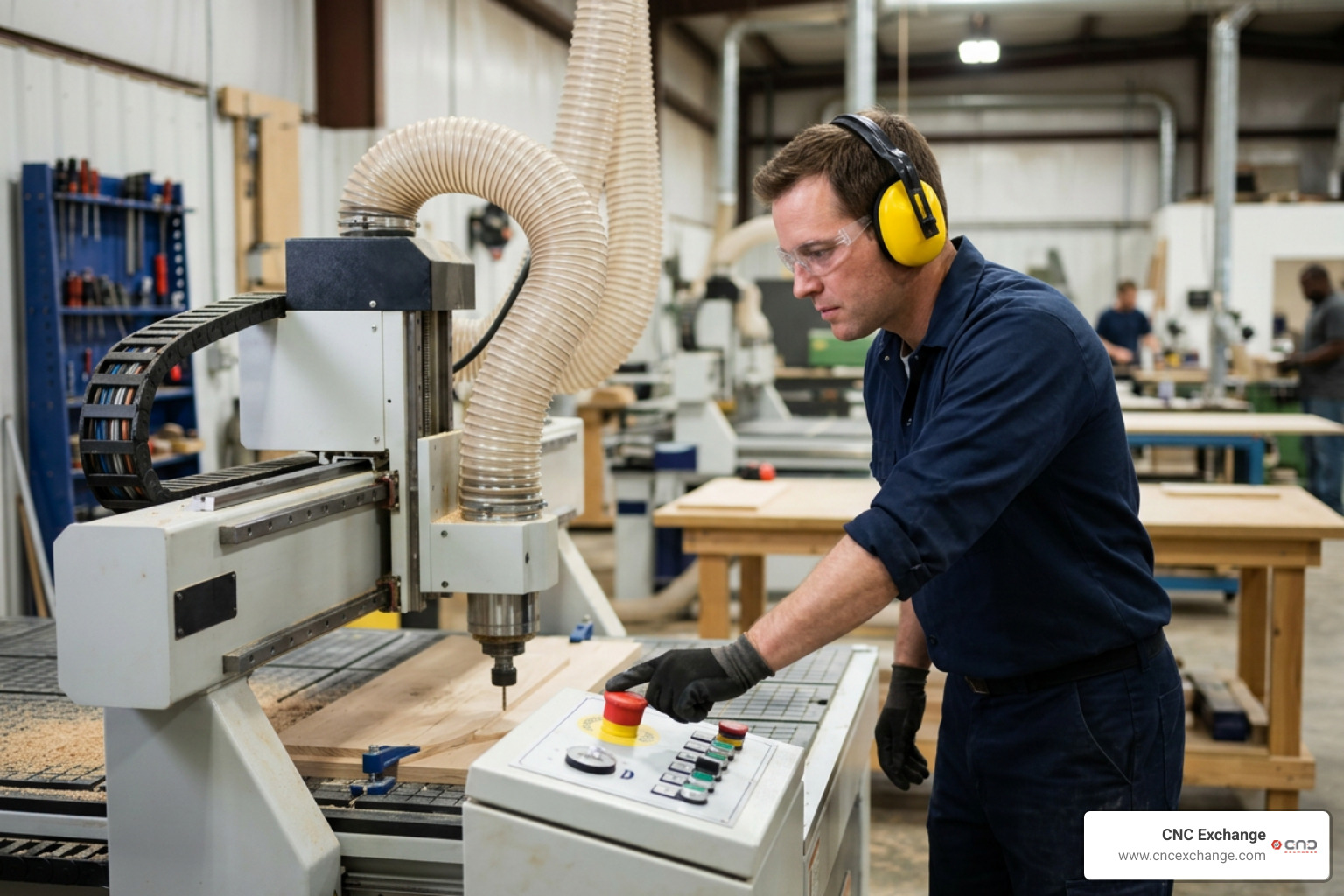
Operating high-speed cutting spindles requires strict shop safety protocols:
- Eye and Hearing Protection: High-RPM spindles cutting sheet goods frequently exceed 85 dB; always wear rated hearing protection and impact-resistant safety glasses.
- Emergency Stop Systems: Ensure physical E-stop buttons are within quick reach at the main controller console and around the machine perimeter.
- Dust Shoes and Vacuum Extraction: High-speed wood and composite routing generates fine breathable airborne particles. Always fit a brush-ring dust shoe connected to a dedicated high-CFM dust collector.
- Workholding Security: Double-check vacuum pressure gauges or physical hold-down clamp clearances before launching G-code to prevent part movement or flying debris.
Essential Maintenance Practices for Your CNC Router
Regular preventative maintenance ensures operational consistency and prevents costly repairs:
- Daily: Vacuum dust and chips from linear rails, rack teeth, and ball screws. Wipe down the spindle collet cone to remove trapped dust that causes bit runout.
- Weekly: Check automatic oil reservoirs or manually grease linear guide trucks using appropriate lithium grease. Inspect dust collector filters and drop canisters.
- Monthly: Inspect main drive belts for correct tension, check gantry tram/squareness, clean vacuum pump intake air filters, and inspect all power cable tracks for wire chafe.
Frequently Asked Questions
What size machine is needed to process standard 4x8 sheets?
To process standard 4x8 foot sheet goods without manual pre-cutting, you need a machine with a minimum active cutting area of 48 inches by 96 inches (1300mm x 2500mm, commonly designated as a 1325 model). Many industrial tables offer slightly larger travel (like 49" x 97") to accommodate oversized commercial MDF and melamine panels effortlessly.
Can non-ferrous metals like aluminum be processed?
Yes, a cnc router can process soft non-ferrous metals like aluminum, brass, and copper. Achieving clean cuts requires using rigid machine frames, single-flute carbide end mills designed for aluminum, optimized feeds and speeds (higher feed rates to generate real chips instead of rubbing), and a alcohol mist cooling or air blast system to flush chips out of deep cuts.
What software is needed to run standard G-code programs?
You need three main software components: a CAD program to design the part (e.g., Fusion 360, Vectric VCarve, or AutoCAD), a CAM program to translate vector paths into executable G-code toolpaths, and a motion control software package (e.g., Masso, Mach4, NCStudio, or RichAuto) running on the machine to parse the G-code into motor movements.
Conclusion
Whether you are expanding a custom woodworking shop, stepping up plastic thermoforming output, or adding high-speed sheet milling to your manufacturing floor, choosing the right cnc router comes down to matching machine work envelopes, drive rigidity, spindle horsepower, and workholding configurations to your daily production realities.
At CNC Exchange, we help machine shops and manufacturers buy, sell, and trade high-quality manufacturing equipment at fair market value. Buying pre-owned industrial routing platforms is one of the smartest ways to secure top-tier brand rigidity and ATC output while keeping capital investment low.
Ready to upgrade your workshop floor? Browse Lathes and Turning Centers Equipment to inspect our inventory, or Talk to Our Machine Tool Experts Today to discuss your machinery requirements.