
Key Capabilities of a Large Horizontal Boring Mill
To handle massive workpieces effectively on a large horizontal boring mill, shops must isolate part weight using stationary floor plates or high-capacity rotary tables, establish a single-setup datum scheme with 360-degree indexing, and leverage extendable W-axis quills with right-angle attachments to access deep bores without re-clamping. When machining heavy castings or welded fabrications, this horizontal boring architecture prevents bed flex and geometric deflection while providing the clearance and Z-axis depth needed for extreme components.
The primary advantage of these platforms comes from their axis layout. Beyond the standard X-axis (column or table cross travel), Y-axis (vertical headstock travel), and Z-axis (column in-and-out or table longitudinal travel), boring mills feature an extendable quill, known as the W-axis. A 6-inch spindle diameter with extensive W-axis stroke allows cutting tools to reach deep into structural cavities while maintaining maximum cutting rigidity.
When looking at table payload limits, heavy-duty configurations regularly support massive setups. High-capacity tables can handle up to 88,000 lbs in a single clamping without causing axis bind or guideway deflection. This structural stability is supported by solid Meehanite casting construction, which dampens harmonic chatter during heavy roughing cuts. Understanding why heavy-duty shops rely on horizontal boring mills comes down to this balance: long reach, high payload capacity, and rigid axis alignment that maintains micron-level tolerances over long operating shifts.
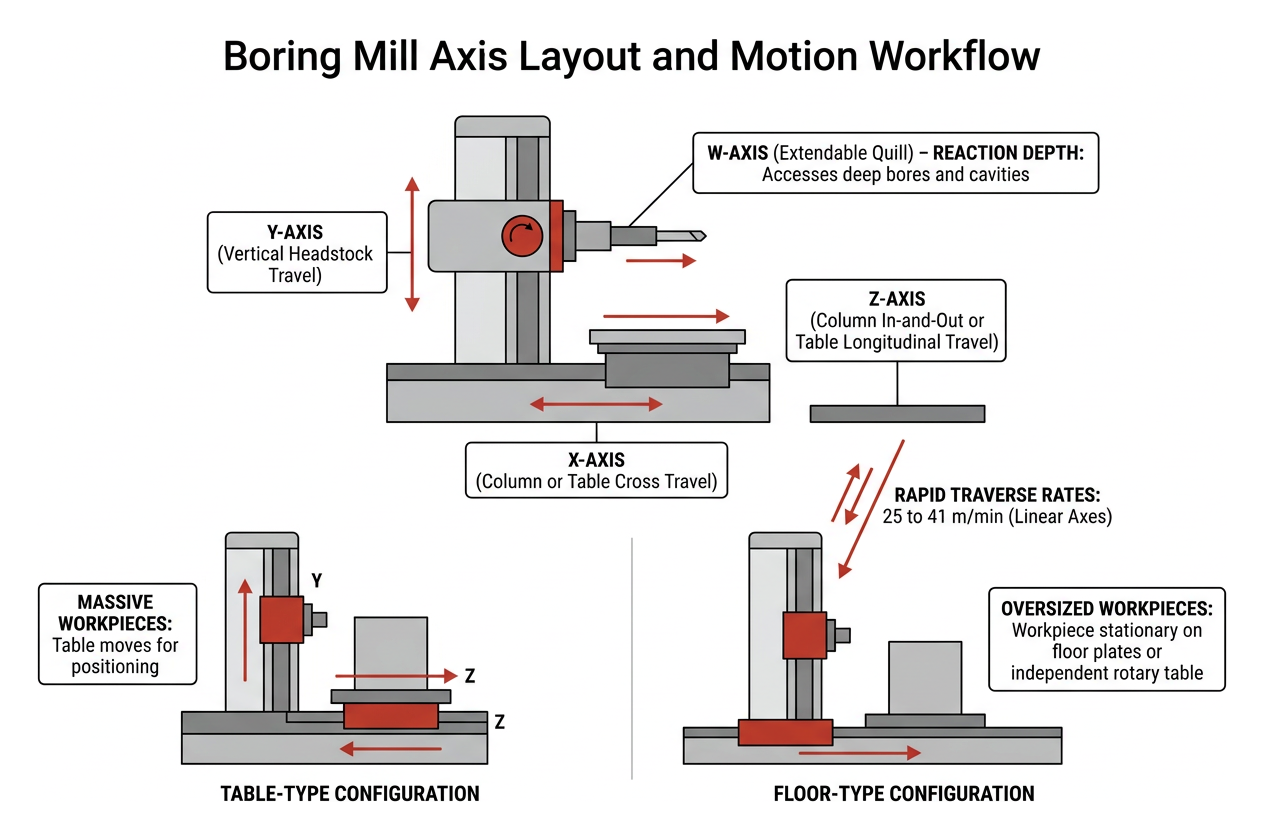
Modern designs also balance this massive cutting power with rapid traverse rates reaching 25 to 41 m/min on linear axes, drastically cutting down non-cutting cycle times during complex toolpath repositioning.
Structural Differences in a Floor-Type Large Horizontal Boring Mill
As workpiece scale increases beyond standard table dimensions, machine architecture shifts from moving-table configurations to floor-type designs. In a floor-type boring mill, the workpiece remains stationary, bolted directly to heavy T-slotted floor plates or an independent rotary table, while the machine column moves along a dedicated X-axis bed.
This moving-column setup isolates the weight of the workpiece from the machine's geometric alignments. On standard table machines, loading an 80,000-pound component onto the saddle can introduce microscopic bed flex. Floor-type designs eliminate this risk entirely. For ultra-massive fabrications, floor-type machines can weigh between 240,000 and 349,800 lbs, anchored into specialized concrete foundations to provide unyielding vibration damping.
Heavy industry has long relied on these floor-plate architectures. Well-maintained legacy systems such as classic Giddings & Lewis horizontal boring mills continue to prove the longevity of heavy cast iron construction in high-load industrial environments. Paired with hydrostatic rotary tables that float heavy payloads on a thin film of oil, floor-type machines deliver near-zero friction and virtually zero mechanical wear under maximum loading.
Selecting a Large Horizontal Boring Mill for Extreme Part Weights
When choosing equipment for extreme part weights, machine capacity must match both the geometric footprint and the physical weight distribution of your parts. Overloading a table or unevenly distributing weight can cause bed deflection, leading to tapered bores and misaligned face milling passes.
Key criteria for evaluating weight capacity include:
- Workpiece Swing and Height Clearance: Ensure maximum workpiece swing diameter (often requiring 2,300 mm to 3,200 mm or more) clears the column guards and way covers during full 360-degree rotation.
- Rotary Table Weight Limits: Check both static and dynamic load limits. While a table may hold 50,000 lbs statically, rapid indexing requires robust drive gearing and hydrostatic clamping to prevent rotational backlash.
- Spindle Horsepower and Torque: Deep-hole boring through tough alloys demands high torque at low RPMs. High-output 100 HP spindle motors provide the cutting force needed to drive large boring heads and multi-insert tools through steel forgings.
For operations machining heavy industrial frames, workhorse systems like heavy-duty Lucas Precision horizontal boring mills and CNC platforms like Toshiba CNC horizontal boring solutions highlight how purpose-built boring heads maintain deep-bore alignment across long travel strokes.
Comparative Analysis of Heavy-Duty Boring and Milling Platforms
To see how modern machinery handles large-format machining, it helps to compare the core specifications of floor-type boring mills, hybrid boring centers, and high-speed horizontal milling platforms.
| Machine Series / Platform | Machine Type | Spindle Power / Speed | Key Travel Limits (X / Y / Z / W) | Table / Workpiece Capacity | Rapid Traverse Rates |
|---|---|---|---|---|---|
| Johnford FBMC Series | Floor-Type Boring Mill | 100 HP (75 kW) 10 – 2,200 RPM |
X: 236" – 591"+ Y: 118" – 197" Z/W: Long stroke quill |
1,024 – 2,200 lbs/sq. ft. (Up to 110,000 lbs rotary) |
Heavy feed rates for extreme cuts |
| Niigata HN-S BAR Series | Hybrid HMC / Boring Mill | 50 HP (37 kW standard) 3,500 RPM |
X: 2,030 – 3,050 mm Y: 1,500 – 2,050 mm W: 555 mm BAR stroke |
Workpiece swing up to φ3,200 mm Height up to 3,000 mm |
Up to 41 m/min (X, Y, Z) |
| DMG MORI NHC 10000 | High-Speed Heavy HMC | 74 HP (55 kW) High-speed PowerMASTER |
X: 1,700 mm Y: 1,400 mm Z: 1,510 mm |
3,000 kg (6,614 lbs) Max workpiece dia: 2,000 mm |
50 m/min (X, Y, Z) |
| Nidec MAF-E II / MAF Series | Large Horizontal Boring Mill | High-torque heavy spindle options | Configurable multi-meter column travel | Extreme tonnage floor-plate setups | Balanced heavy-duty rapid rates |
As shown in the table, platform selection depends on matching your shop's primary cutting needs. Floor-type giants like the Johnford FBMC Series - Floor-Type Horizontal Boring Mills offer virtually unlimited X-axis modular expansion for structural weldments, while nidec large horizontal boring mill series (such as the MAF-E II, MAF-S, MAF-R, and MAF-C) provide specialized, heavy-duty configurations for demanding manufacturing setups. Meanwhile, shops needing high-torque heavy cutting in classic job-shop footprints regularly rely on high-performance Shibaura boring mills to deliver dependable boring accuracy.
Hybrid Machining Centers with Integrated Boring Bars
Hybrid machine tools bridge the gap between high-speed horizontal machining centers and traditional boring mills. A prime example is the Multi-function horizontal machining centers HN1000-S BAR / HN1250-S BAR / HN1600-S BAR | Niigata Machine Techno Co., Ltd., which incorporates a built-in extending boring spindle into a high-speed machine framework.
These hybrid machines utilize a BAR spindle with a φ130mm diameter and a 555mm W-axis stroke—the largest in its class. This integrated bar design allows standard face milling, pocketing, and deep-hole internal boring on the same machine without using long, vibrating tool holders. As detailed in the Niigata, Inc. | HN1000-S-BAR Hybrid HMC with Boring Function, Long Stroke platform, the machine employs a hybrid guideway structure:
- Roller Guides on X and Z Axes: Provide rapid acceleration and fast feed motion up to 41 m/min.
- Angled Boxway Slide on the Y Axis: Delivers maximum cutting rigidity and vibration absorption during heavy vertical boring cuts.
- Center-Mounted Spindle: Sits centrally within the column casting to eliminate off-center thermal distortion and torsional twisting.
For shops looking for similar multi-axis versatility, precision Nomura horizontal boring equipment illustrates how rigid quill support enables deep internal boring in pump housings, gearboxes, and large injection mold end plates.
High-Speed Automation and Multi-Axis Processing
When massive parts require both deep boring and high-volume surface milling, automation and rapid axis response become essential. The NHC 10000 - Horizontal Milling - DMG MORI shows how heavy-format platforms handle multi-axis processing at high velocity.
Featuring Box-in-Box column construction, the NHC 10000 achieves rapid traverse rates of 50 m/min while supporting workpieces up to 2,000 mm in diameter and 3,000 kg (6,614 lbs) in weight. The 55 kW PowerMASTER spindle combines roughing torque with the high RPMs needed for fine surface finishing.
Modern automation packages help eliminate operator guesswork on these large footprints:
- Sensorless Tool Monitoring: Automated load monitoring systems learn tool force limits during cutting passes, immediately retracting the spindle if an insert chips or tool load spikes.
- Dynamic Feed Adaptation: Control cycles adjust feed rates in real time based on actual table weight loading, preventing axis lag and optimizing surface finishes.
- Automated Pallet Changers (APC): Enable operators to set up the next 6,000-lb casting on an external station while the machine spindle continues cutting inside the enclosure.
When integrated into flexible manufacturing cells, platforms like versatile TOS horizontal boring systems and automated HMCs reduce non-productive setup time, keeping large spindles running continuously across multiple shifts.
Essential Setup and Tooling Strategies for Oversized Components
Machining massive components requires careful setup planning. When a single raw casting can cost tens of thousands of dollars, mistakes during setup or tool deflection during a deep boring pass can ruin an entire workpiece.
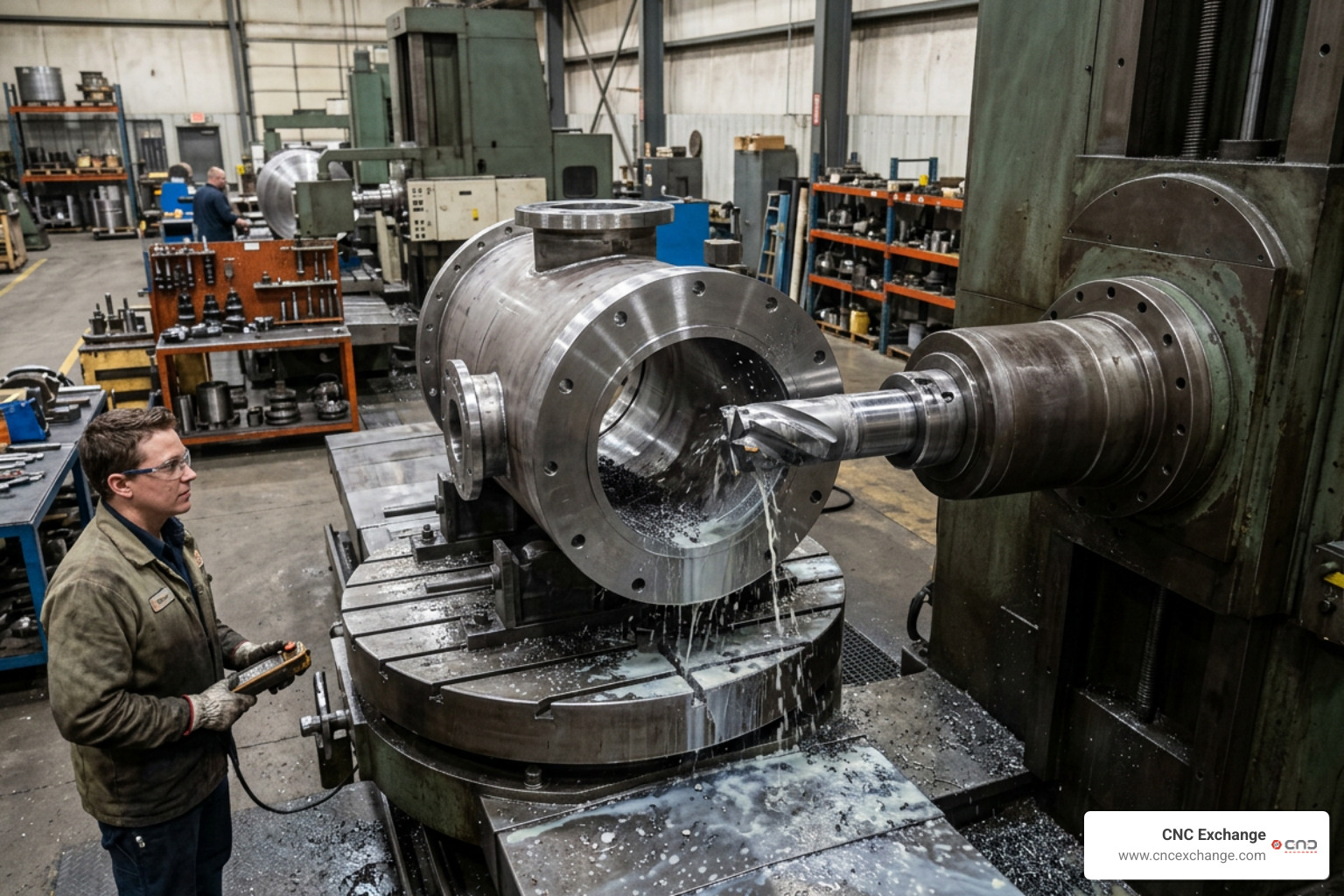
A critical practice in heavy boring is establishing a reliable single-setup datum scheme. Re-clamping a 50,000-lb part to access different sides introduces alignment errors. Utilizing precision rotary tables with 360-degree continuous indexing allows the spindle to access four sides of a part, along with top surfaces via right-angle milling heads, in a single clamping.
For deep-bore internal features, managing tool deflection is essential:
- High-Pressure Through-Spindle Coolant: Coolant pressures up to 1,000 to 3,000 PSI blast chips out of blind bores, preventing re-cutting that damages surface finishes and dulls carbide inserts.
- Circle Interpolation of Large Bores: Rather than using heavy, single-point boring heads for every diameter, modern CNC controls use circle interpolation with end mills to rough large openings before final precision finishing with the boring bar.
- Right-Angle and Universal Milling Attachments: Automatic attachment changers allow the horizontal spindle to swap from a straight quill to an articulated head, machining internal flange bolt circles and cross-holes without moving the part.
Thermal Compensation and Structural Rigidity
Thermal growth is a major cause of dimensional errors when machining large workpieces. Over an extended machining cycle, ambient shop temperature changes and heat from the spindle motor can cause the machine column and workpiece to expand unevenly.
Modern heavy boring mills address this issue using symmetric double-column castings, cooled ball screws, and chiller lines routed directly through the headstock casting. Symmetrical casting designs ensure that any minor thermal growth expands evenly along the centerline axis rather than twisting the spindle out of square.
In addition, smart CNC controls monitor spindle thermistors and adjust axis coordinate offsets in real time, ensuring that critical bore diameters and center-to-center distances stay within tolerance from the first roughing cut to the final finishing pass.
Multi-Surface Machining in a Single Clamping
Maximizing productivity on large-format machine tools requires finishing as many operations as possible in one setup. When setting up a multi-surface workflow:
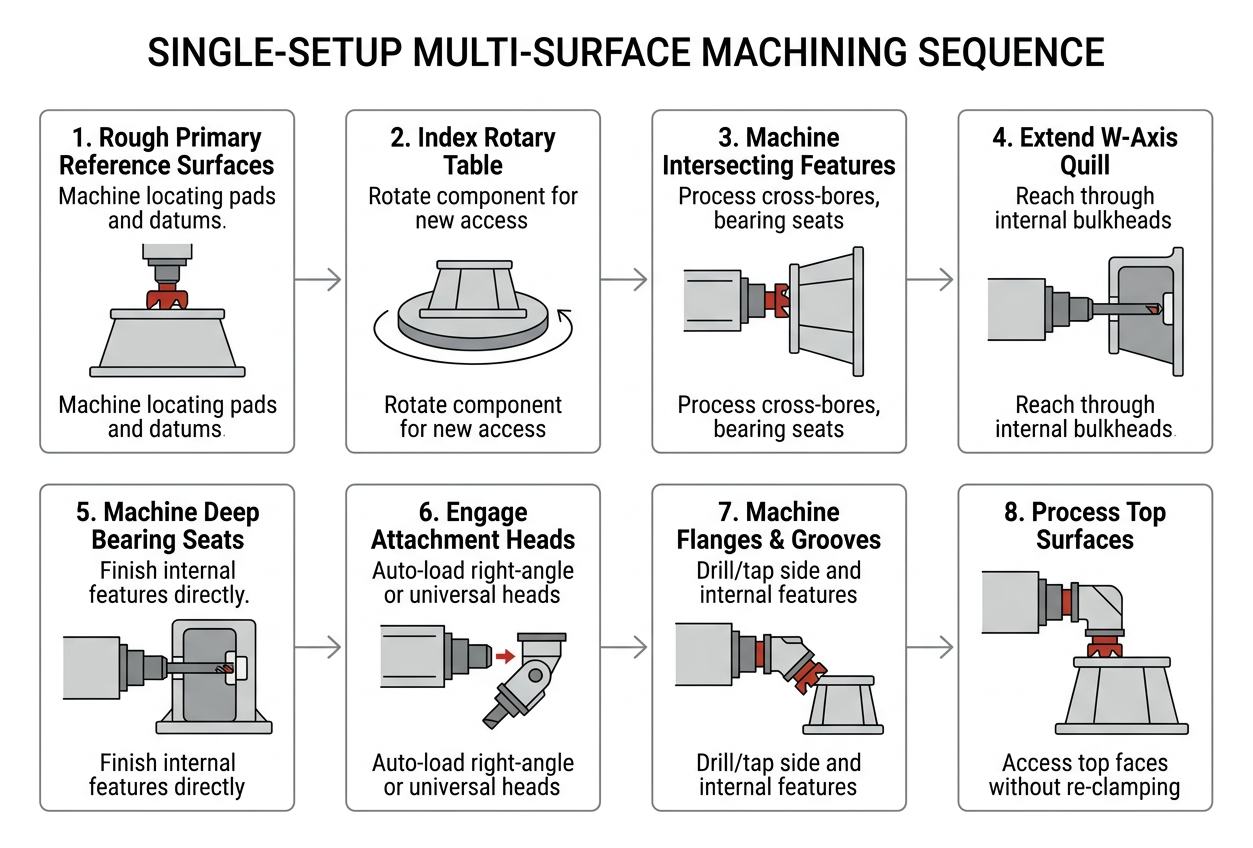
- Roughing Primary Reference Surfaces: Machine primary locating pads and reference datums using high-torque face mills with the spindle quill fully retracted for maximum stiffness.
- Indexing Rotary Table: Rotate the component to machine intersecting cross-bores, bearing seats, and side mounting faces.
- Extending W-Axis Quill: Extend the boring bar through interior bulkheads to machine deep bearing seats without requiring ultra-long, vibrating tool extensions.
- Engaging Attachment Heads: Automatically load right-angle heads to drill and tap side flanges, internal retaining grooves, and top-facing surfaces.
Elevated operator cabins mounted to moving columns give machinists an unobstructed view of the cutting zone, allowing them to closely monitor chip formation and bore engagement even when cutting deep inside massive fabrications.
Frequently Asked Questions About Heavy Horizontal Machining
What is the difference between table-type and floor-type horizontal boring mills?
Table-type horizontal boring mills feature a built-in bed and saddle that moves the workpiece table along the X and Z axes while the column remains fixed or moves longitudinally. They are ideal for compact, heavy parts up to roughly 40,000 to 88,000 lbs.
Floor-type horizontal boring mills mount the workpiece to independent, stationary floor plates while the column travels alongside the part on an extended runway. Floor-type machines are built for extremely long or heavy workpieces (such as ship engine blocks, turbine housings, and wind towers) that exceed standard table limits and require travels beyond 500 inches.
How do hybrid boring mills combine rapid traverse with heavy cutting rigidity?
Hybrid boring mills combine two different way technologies. They use high-speed linear roller guides on the X and Z axes to enable rapid traverse speeds (up to 41–50 m/min) for fast tool repositioning, paired with hardened and ground boxways on the vertical Y-axis headstock.
The boxway slide dampens cutting vibrations during heavy milling and deep internal boring, while the linear roller axes minimize positioning cycle times.
Which industrial sectors rely most on large-capacity horizontal boring equipment?
Large-capacity horizontal boring equipment is essential across several heavy manufacturing sectors:
- Energy & Power Generation: Machining steam and gas turbine casings, generator frames, and nuclear reactor pressure vessels.
- Oil & Gas: Boring forged valve bodies, blowout preventers (BOPs), and heavy pump housings.
- Aerospace & Defense: Milling structural wing spars, missile launch platforms, and landing gear components.
- Heavy Construction & Mining: Boring boom arms, excavator frames, track frames, and crusher housings.
- Wind Energy: Machining large cast iron rotor hubs, main bearing housings, and tower base sections.
Sourcing High-Capacity Horizontal Boring Equipment
Investing in heavy boring machinery is a major capital decision. Whether your facility needs a moving-column floor-type machine with multi-meter travel or a high-speed hybrid HMC with an integrated boring bar, finding the right machine configuration ensures high productivity and long-term part accuracy.
At CNC Exchange, we help machine shops, tier-one suppliers, and heavy manufacturing facilities acquire, sell, and trade high-capacity machine tools. We manage an extensive marketplace of pre-owned CNC machinery, giving you access to dependable chip-making equipment at competitive market pricing.
If you are planning to expand your heavy machining capabilities, evaluate used equipment condition, or liquidate surplus assets, our technical team is ready to assist. Talk to Our Machine Tool Experts Today to discuss your part drawings, travel requirements, and spindle specifications, or browse available horizontal boring mills to find the right high-capacity platform for your shop floor.