
Core Categories of CNC Plasma Tables for Sale
When searching for the right plasma cutting system, categorizing machines by footprint, structural build, and duty cycle simplifies your decision. CNC plasma tables generally fall into three tiers: entry-level compact units, modular mid-range systems, and heavy-duty industrial workhorses.
Each design addresses different shop workflows. A light-gauge artistic shop needs high contouring agility on thin sheet, while a structural fabrication facility requires massive weight capacities and continuous piercing power.
| Feature / Category | Entry-Level & Compact | Modular & Mid-Range | Industrial Heavy-Duty |
|---|---|---|---|
| Typical Cutting Area | 2' x 2' to 4' x 4' | 4' x 4' to 5' x 10' | 5' x 10' to 6' x 12'+ |
| Drive Mechanism | Standard Steppers (NEMA 23) | NEMA 34 Steppers or Hybrid | AC Brushless Servos w/ Planetary Gears |
| Base Price Range | $4,199 – $6,000 | $8,500 – $15,500 | $20,000 – $35,000+ |
| Rapid Traverse Speeds | 150 – 300 IPM | 400 – 800 IPM | 1,000 – 1,500+ IPM |
| Weight Capacity | Up to 450 lbs (1/4" plate) | 1,000 – 2,500 lbs (1" plate) | 3,000 – 6,000+ lbs (2"–3" plate) |
| Frame Construction | Bolt-together aluminum/light steel | Hybrid welded tube & extrusion | Fully welded, stress-relieved heavy steel |
| Primary Use Case | Prototypes, brackets, hobbyist art | Job shops, custom fabrication, HVAC | Multi-shift production, structural steel |
If you are exploring the pre-owned market to stretch your budget, reviewing our comprehensive guide to buying used equipment helps you evaluate machine structural integrity, drive backlash, and controller reliability before purchasing.
Entry-Level and Compact Workshop Systems
Entry-level tables, typically sized at 2' x 2' or 4' x 4', are designed for prototyping, maintenance departments, small automotive garages, and light fabrication.
These units prioritize affordability and compact footprints. For example, a complete table like the Eastwood Versa-Cut 4x4 CNC Plasma Table with 60 Amp Cutter Kit comes priced at $5,299.96 (or $4,199.99 for the table alone). These compact designs provide cutting envelopes around 49.2" x 43.3", offer a movement accuracy of ±0.2mm and cutting accuracy of ±0.5mm, and handle up to 450 lbs of material weight.
Entry-level systems often include integrated standalone touchscreen controllers with USB file transfer, eliminating the need to dedicate an external computer to the harsh cutting environment. While their mechanical gantries and NEMA 23 stepper motors are optimized for thinner sheet cutting (typically up to 1/4" or 3/8" steel), they offer an accessible entry point into automated shape cutting.
Modular and Mid-Range CNC Plasma Tables for Sale
Mid-range modular machines bridge the gap between hobbyist setups and heavy factory machinery. Built around standard 4' x 8' and 5' x 10' metal sheet dimensions, modular systems allow growing fabricators to process full raw stock without pre-shearing.
A prominent example is the Avid CNC PRO4896 4' x 8' CNC Plasma Machine, which starts at $11,240.00. Offering a 49.5" x 98.75" work area and a solid 616 lb machine weight, it allows fabricators to select between high-torque NEMA 34 stepper configurations and high-speed servo upgrades. Modular tables can achieve cut speeds up to 600 inches per minute (IPM) and rapid traverse rates up to 1,200 IPM.
Many fabrication shops running mid-range plasma systems also pair them with a dedicated CNC router for secondary non-ferrous, composite, or wood profiling work.
Industrial Heavy-Duty CNC Plasma Tables for Sale
For multi-shift production facilities cutting structural plate, heavy equipment components, or continuous high-volume nested parts, industrial tables are essential. Hypertherm notes that the realistic entry point for an industrial-grade plasma table begins around $20,000, extending upwards based on automated gas consoles and drive technology.
At this level, machines such as the Arclight Dynamics Arc Max Ultra 6' x 12' (priced at $29,295.00) deliver a total machine weight of 3,000 lbs, a massive 420-gallon integrated water pan, and a positioning accuracy of .001". Heavy industrial tables easily support 2" to 3" thick solid steel plate.
When your parts demand tight tolerances beyond standard plasma capabilities, facilities often balance their workflow across complementary systems like laser cutters for thin precision sheet or waterjet cutters for thick, heat-sensitive alloy components.
Technical Specifications: Motion Systems, Power, and Software
Understanding the underlying mechanical and electronic architecture ensures that your table performs reliably under demanding shop conditions.

Stepper vs. Servo Drive Systems
The motion system dictates acceleration, edge smoothness, and dimensional repeatability when cutting intricate corners or tight bolt holes.
- Stepper Motors (Open-Loop or Closed-Loop): Common in entry-to-mid-tier tables, steppers move in fixed angular increments (steps). While cost-effective and reliable for straight cuts and moderate speeds (150–400 IPM), open-loop steppers can lose position if the torch collides with tipped-up scrap, ruining the workpiece. Closed-loop steppers mitigate lost steps but have reduced torque at high RPMs.
- AC Brushless Servo Motors: Standard on industrial tables, servos utilize continuous encoder feedback to track precise position and torque thousands of times per second. Coupled with 5:1 or 10:1 planetary gearboxes, servo systems eliminate mechanical backlash, achieve acceleration rates exceeding 40–50 mg, and allow rapid traverse speeds over 1,200 IPM. This acceleration ensures crisp internal corners and precise hole circularity on thin and thick materials alike.
Plasma Power Supplies and Cutting Capacities
The plasma power supply represents the cutting engine of your machine. Matching amperage to your primary plate thickness is critical for production throughput:
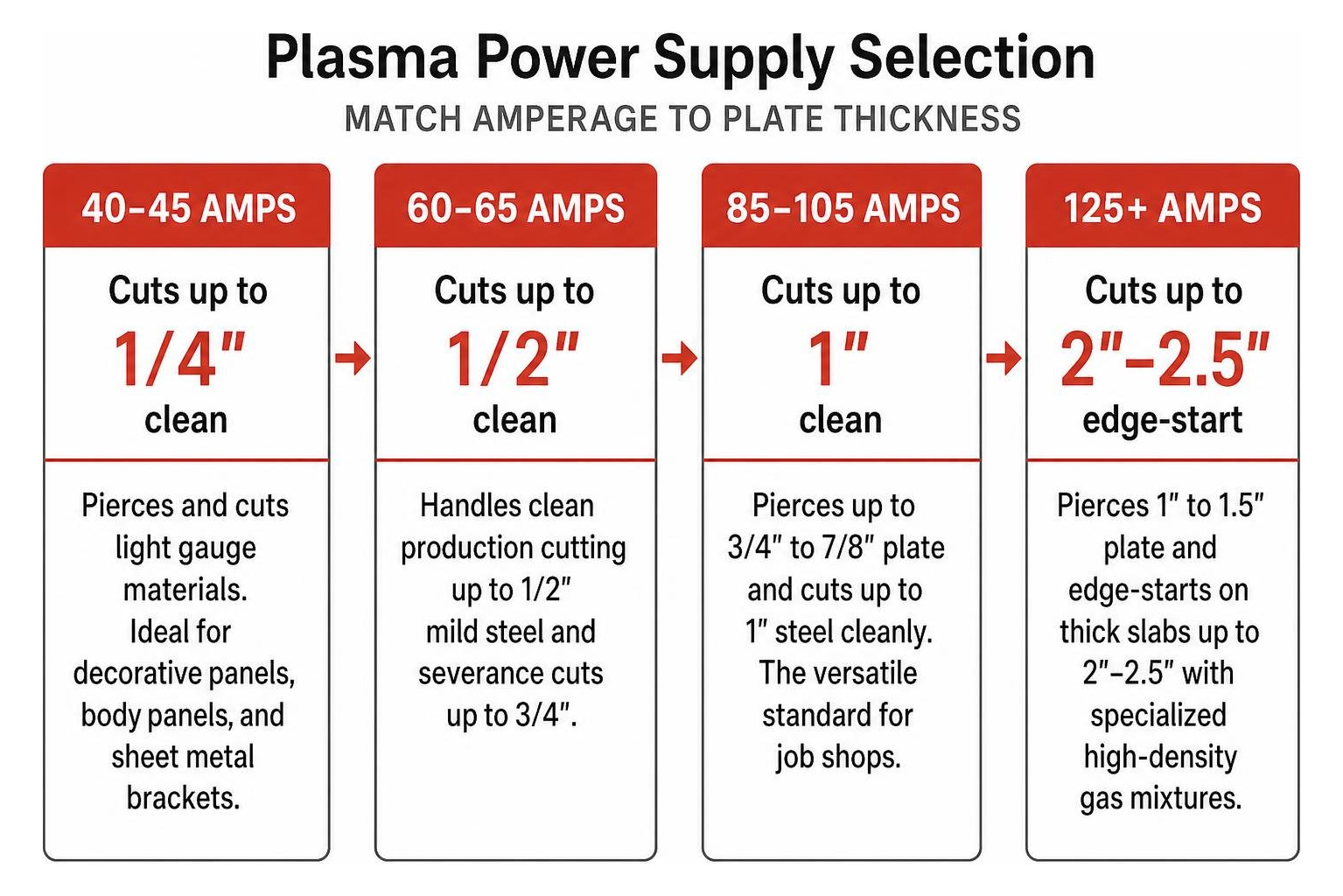
- 40–45 Amps: Pierces and cuts light gauge materials up to 1/4" clean. Ideal for decorative panels, body panels, and sheet metal brackets.
- 60–65 Amps: Handles clean production cutting up to 1/2" mild steel and severance cuts up to 3/4".
- 85–105 Amps: The versatile standard for job shops, piercing up to 3/4" to 7/8" plate and cutting up to 1" steel cleanly.
- 125+ Amps (Industrial High-Definition / XPR): Pierces 1" to 1.5" plate and edge-starts on thick slabs up to 2"–2.5" with specialized high-density gas mixtures.
For parts requiring precise hole arrays and knockouts without secondary reaming, some shops also cross-utilize CNC punch equipment alongside their plasma tables to balance production bottlenecks.
CAD, CAM, and Torch Height Control Software
Operating a CNC plasma table involves a streamlined digital toolpath:
- CAD (Design): Creating or importing DXF/SVG geometry in programs like QCAD, AutoCAD, or SolidWorks.
- CAM (Nesting & Toolpaths): Software like SheetCAM or ProNest converts 2D profiles into optimized G-code, applying kerf compensation, lead-ins/lead-outs, and multi-part nesting algorithms to minimize scrap.
- CNC Controller & Torch Height Control (THC): The controller reads G-code while an active THC monitors arc voltage. Because metal sheet warps under thermal stress, active THC automatically raises or lowers the Z-axis in real time (sampling voltage at millisecond intervals) to maintain a consistent cut height. This prevents torch crashes, extends consumable life, and ensures square bevel-free edges.
Essential Accessories, Bed Types, and Shop Requirements
Operating an automated plasma arc generates extreme ultraviolet radiation, high heat, fine metallic dust, and hazardous fumes. Managing these elements requires planning your table bed and shop infrastructure.
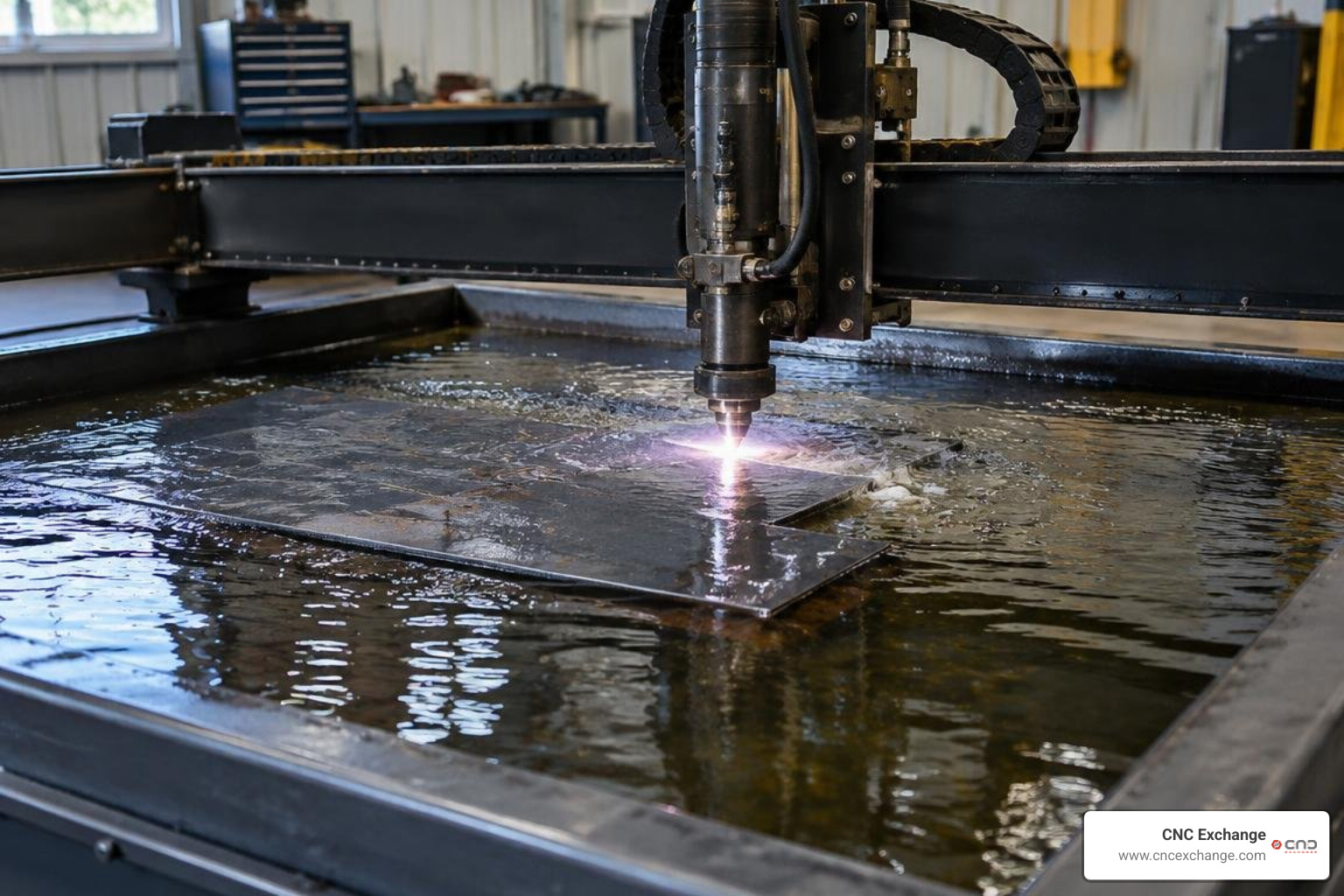
Water Tables vs. Downdraft Fume Extraction
Choosing between a water table and a dry downdraft table depends on shop space and maintenance preferences:
- Water Tables: Submerging or floating the plate just above water captures roughly 90–95% of airborne smoke and metal dust instantly while cooling the workpiece to prevent thermal warping. For instance, compact tables use a 33-gallon waterbed, while large 6' x 12' tables feature 420-gallon reservoirs. Water tables require anti-rust and anti-bacterial chemical additives and periodic sludge cleanout.
- Downdraft Tables: High-volume exhaust fans draw fumes downward through zoned internal dampers into outdoor ducting or commercial cartridge filtration systems. Downdraft tables leave cut parts dry and eliminate rust risks, but they require substantial electrical power for blowers (5–15 HP) and duct routing.
Workshop Utilities: Electrical, Compressed Air, and Space Planning
Before taking delivery of a plasma table, verify your shop utilities:
- Compressed Air Delivery: Clean, bone-dry compressed air is vital. Plasma torches require a steady 6 to 15+ CFM at 90–120 PSI depending on torch amperage. Any oil or moisture in the air supply destroys consumables rapidly and causes erratic arc behavior. Install a 3-stage filtration system including a refrigerated air dryer and coalescing oil filter.
- Electrical Supply: Separate the controller electronics from the plasma unit to prevent electromagnetic interference (EMI). Standard tables require a 110V/120V 15A circuit for the computer and motion controllers, while the plasma power supply generally demands 220V–240V single-phase (30–60A) or 480V 3-phase power for high-amperage industrial units.
- Floor Footprint & Handling: Ensure at least 4 to 5 feet of perimeter clearance around the machine footprint for crane, forklift, or plate-loading access and scrap bin management.
High-Value Add-Ons: Rotary Tube Cutters and Dual-Head Tooling
To maximize table versatility, consider high-value modular upgrades:
- Rotary 4th-Axis Attachments: Positioned along the side or through the gantry drop-frame, rotary chucks allow synchronous cutting and coping of round, square, and rectangular tubing.
- Pneumatic Scribes & Plate Markers: Air-driven diamond or carbide scribes etch part numbers, bend alignment lines, and weld layout marks directly onto plates prior to torch cutting.
- Dual-Head Tooling: Combining an oxyfuel torch for cutting slabs thicker than 2 inches, or mounting a secondary router spindle for light face milling, maximizes the versatility of a single frame.
Frequently Asked Questions About CNC Plasma Tables
How thick of a metal plate can a standard CNC plasma table cut?
Cutting capacity depends on power supply amperage and whether the cut begins with an internal pierce or an edge start. A standard 60-amp system cleanly pierces up to 3/8" mild steel and can edge-start on 1/2" material. An 85- to 105-amp system routinely pierces 3/4" to 7/8" plate. Industrial power supplies (125A–300A+) pierce 1" to 1.5" steel and severance cut plates exceeding 2" to 2.5" thick.
What is the difference between stepper and servo motors on a plasma table?
Stepper motors move in discrete, indexed mechanical steps without position feedback. They are economical and work well for standard speeds, but can lose synchronization if the gantry meets resistance. Brushless AC servo motors use high-resolution encoders to continuously report real-time position to the controller, offering higher acceleration, smoother arc motion on tight radii, and maximum rapid traverse speeds up to 1,200–1,500 IPM.
What are the ongoing maintenance and consumable costs?
Primary operating costs stem from plasma torch consumables (electrodes, nozzles/tips, swirl rings, shields, and retaining caps) and electrical consumption. Consumable life depends heavily on air cleanliness and pierce height control; dirty or wet air can ruin an electrode in minutes, while dry air allows hundreds of pierces per set. Regular machine maintenance involves lubricating linear guide rails, checking rack-and-pinion gear engagement, and cleaning table waterbeds or downdraft drop trays.
Conclusion: Choosing the Right Machine for Your Shop
Selecting the ideal CNC plasma table balances current metal cutting demands with room for future shop growth. While entry-level and modular tables provide accessible, budget-conscious solutions for light fabrication and custom prototyping, heavy-duty industrial systems deliver the structural rigidity, servo acceleration, and high-amperage capacity required for continuous production.
If you are ready to expand your shop's cutting capacity, explore our extensive inventory of CNC machinery for sale. Whether you are sourcing a heavy-duty plasma table, buying pre-owned equipment, or trading in existing machines, we provide the machinery and guidance you need to keep your production moving forward.