
What Are Cash Purchases?
Cash purchases are transactions paid in full at the time of purchase or delivery, without borrowing from the seller or creating an accounts payable balance. In business accounting, "cash" does not always mean physical currency. A wire transfer, company card, or cashier's check can also be a cash purchase when payment is immediate.
For a manufacturing business, this can mean paying outright for a used CNC machine, tooling, replacement parts, or shop supplies rather than financing the cost over time.
| Cash purchase | Financed or credit purchase |
|---|---|
| Payment is made immediately | Payment is made over time |
| No lender or supplier balance remains | Buyer owes a lender or vendor |
| Avoids interest and many financing fees | May preserve working capital |
| Reduces cash on hand right away | Creates scheduled payments and possible interest |
Cash buying can make an offer more certain and speed up a transaction. It can also create room to negotiate, especially when a seller values a simple closing. But paying upfront ties up liquid funds that may be needed for payroll, repairs, inventory, or the next production opportunity.
The accounting is just as important as the payment method. A cash purchase generally records a debit to an expense, inventory, or equipment account and a credit to cash. The purchase does not automatically mean an immediate expense, however: a major machine is usually recorded as a fixed asset and expensed gradually through depreciation.
I am Jared Gray, and I have spent more than 12 years buying, selling, brokering, and inspecting manufacturing equipment, with a focus on CNC chip-making machinery. That experience has shown me that smart cash purchases depend on more than price: buyers need clear records, careful equipment review, and enough working capital left after the deal.
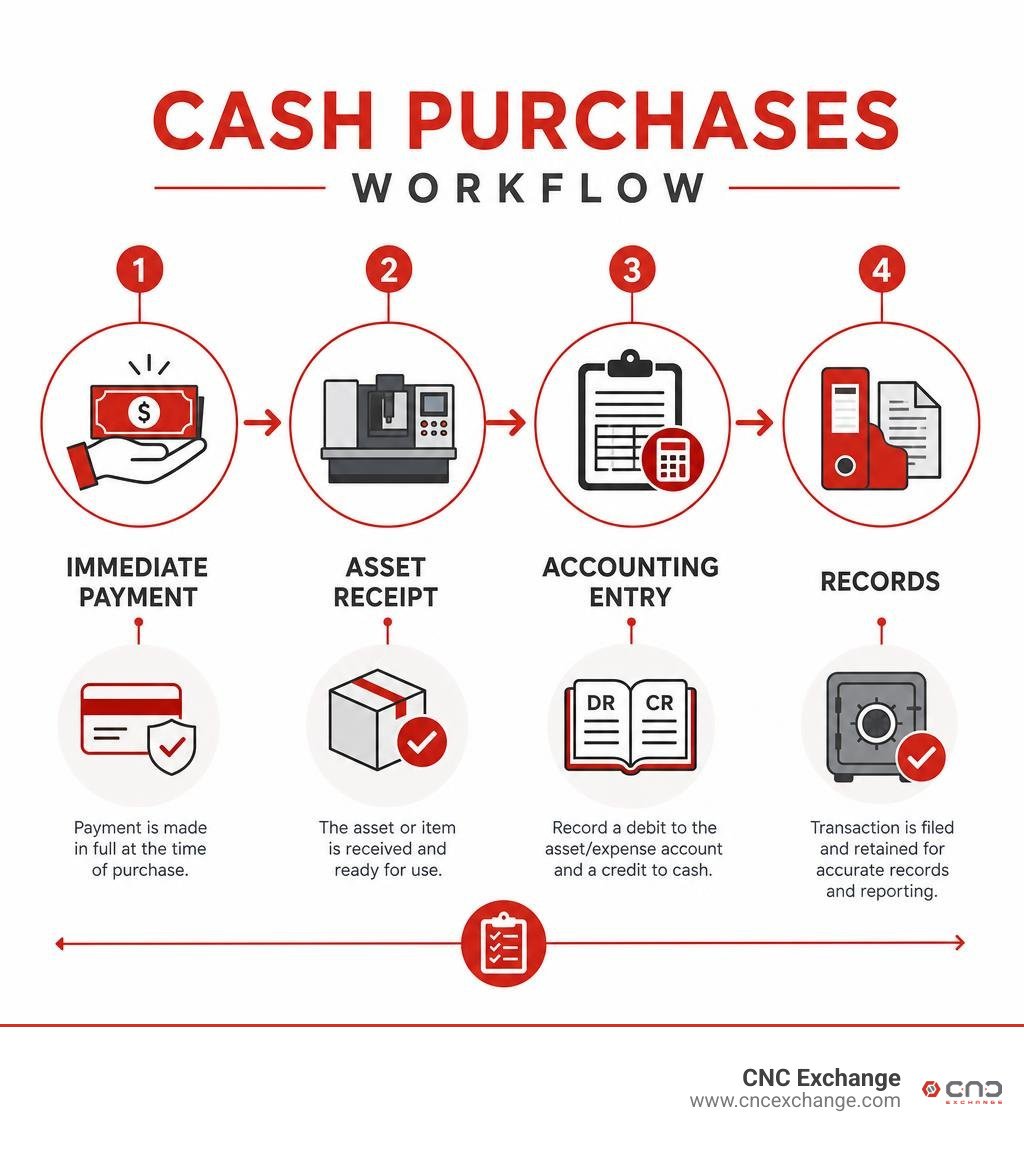
Defining Cash Purchases and Key Organizational Policies
At its core, a cash purchase occurs whenever an asset, service, or commodity is acquired with immediate settlement. In corporate and institutional environments, managing cash outlays requires clear guidelines to keep spending under control and preserve financial reporting accuracy.
While individual retail transactions often involve physical paper currency or debit cards, institutional transactions treat electronic funds transfers, immediate bank wires, corporate purchasing cards (PCards), and cashier's checks as cash equivalents because they eliminate credit extension. In Illinois, recent legislation mandates that most brick-and-mortar retailers accept physical cash for consumer purchases under $500, highlighting the legal standing of physical currency alongside digital settlement channels.
Organizing organizational guidelines around immediate outlays typically means setting clear boundaries. Most institutional spending frameworks establish strict policy rules on sub-$500 cash purchases. Under these rules, immediate out-of-pocket cash transactions are designated as a last resort behind pre-negotiated vendor contracts and centralized procurement systems.
Key organizational governance controls include:
- Strict spending caps: Setting maximum limits (frequently $500 per transaction) for out-of-pocket employee spending.
- Prohibition of artificial transaction splitting: Expressly forbidding buyers from breaking a single $1,200 purchase into three $400 cash orders to circumvent formal purchase order thresholds.
- Sales tax exemption compliance: Requiring buyers operating on behalf of tax-exempt institutions to present a State Sales Tax Exemption Letter at the point of sale. If an employee fails to present the exemption certificate and pays sales tax out of pocket, corporate financial policy dictates deducting the tax amount directly from their reimbursement check.
- Itemized receipt documentation: Mandatory submission of original itemized receipts showing date, unit price, merchant name, and item descriptions.
Comparing Cash Purchases vs Financed Transactions
Deciding whether to execute a cash purchase or secure third-party financing requires weighing immediate equity against future liquidity. When we buy industrial machinery or operational inventory outright, we secure full title ownership on day one. Financing, on the other hand, leaves a lender's lien attached to the title until the final loan installment clears.
The principal financial benefits of buying with cash include:
- Elimination of interest expenses: Avoiding financing charges lowers the total cost of asset acquisition over time.
- Reduced overhead fees: Skipping lender loan origination fees, credit check surcharges, and underwriting administration costs.
- Transaction speed and certainty: Sellers, asset auctioneers, and liquidators often prefer cash buyers because there are no loan approval contingencies or appraisal delays.
- Depreciating asset protection: Paying cash for assets that lose value over time prevents paying high interest on a declining asset.
However, the primary trade-off is opportunity cost. Sinking $150,000 into a machine or asset reduces liquid working capital. If that cash reserve is needed later for emergency facility repairs, raw materials, or unexpected payroll demands, a cash-starved business may face operational strain.
Managing Corporate Petty Cash Purchases
For low-value, day-to-day operational needs—such as emergency hardware store runs, local delivery fees, or minor shop supplies—companies use petty cash funds or employee expense reimbursements.
To manage petty cash without creating accounting loopholes, financial departments enforce a standardized reimbursement workflow:
- Pre-authorization: The department unit head verifies that no existing vendor contract or corporate card was available for the item.
- Expense report filing: Employees submit an expense report (such as via Emburse software) backed by original, unadjusted store receipts.
- Tax adjustment audit: The accounting office verifies sales tax handling. Under state rules, such as those governed by the Illinois Department of Revenue, improper tax payments or uncollected use taxes are adjusted prior to issuing reimbursement.
- Restocking the vault: Petty cash drawers are reconciled periodically by matching remaining physical cash against filed receipt vouchers.
Accounting for Cash Purchases in Business Financial Statements
Understanding how a cash purchase impacts a company's financial records starts in the general ledger. Unlike credit purchases that route through Accounts Payable (AP), immediate cash outlays bypass supplier credit subaccounts entirely.
When a company executes a cash purchase, double-entry bookkeeping requires balancing entries:
- Debit: Expense Account (for consumable operational supplies) or Asset Account (for equipment or raw material inventory).
- Credit: Cash / Bank Account.
Because the Accounts Payable ledger is bypassed, supplier credit balances—such as vendor credit memos from prior product returns—cannot be automatically applied to a cash transaction. If a business needs to apply existing vendor credits, the transaction must be processed as a standard purchase invoice rather than a cash sale.
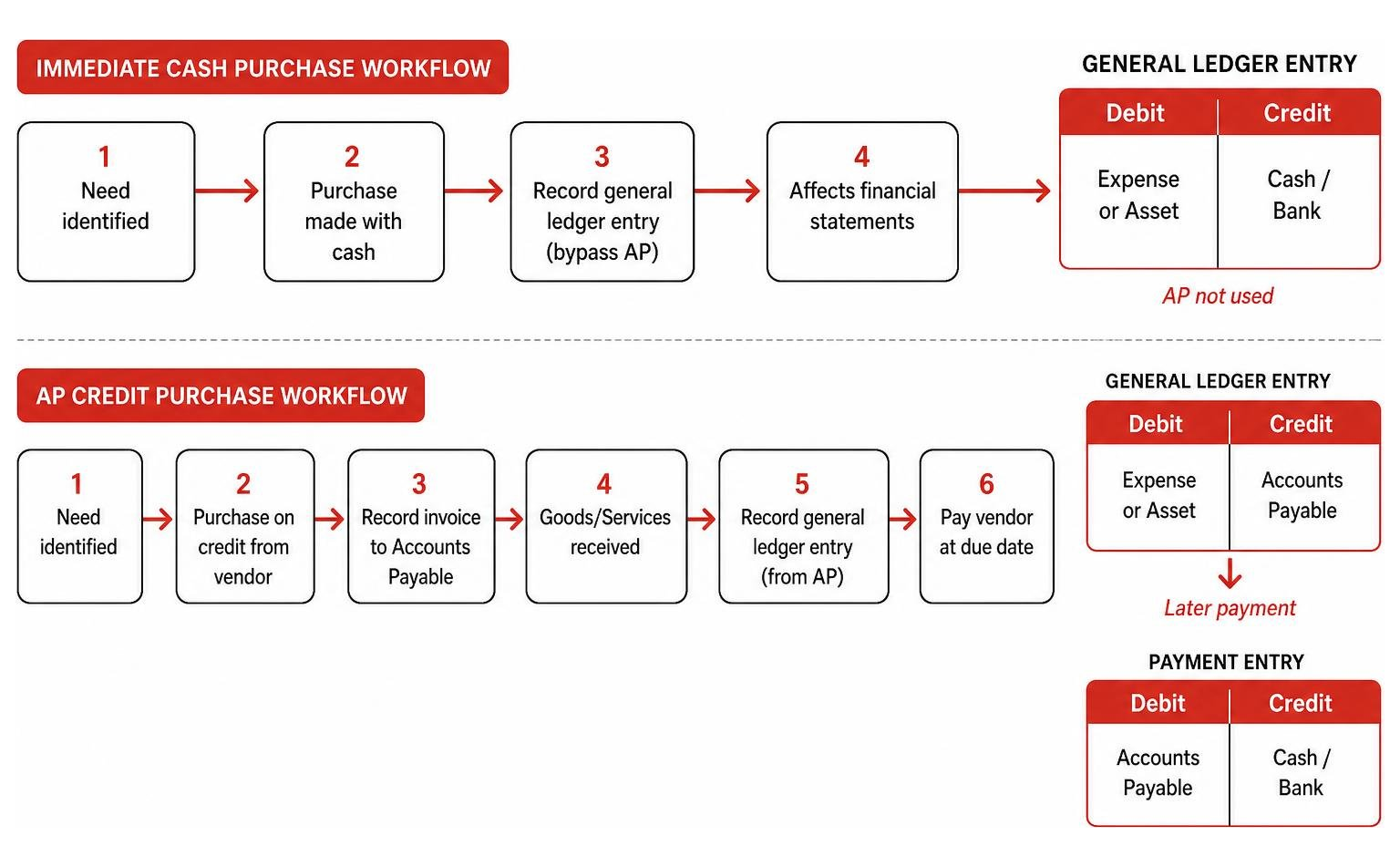
The effect of cash purchases flows across all three primary financial statements:
1. The Income Statement
Cash purchases are not itemized as individual transactions on an income statement. Instead, operational cash purchases are aggregated into total operating expenses (such as Cost of Goods Sold, Supplies, or Maintenance) for the reporting period. Major capital acquisitions made in cash—like buying a commercial lathe or milling machine—do not hit the income statement immediately as a lump-sum expense. Instead, they are capitalized on the balance sheet and reflected on the income statement over time through annual depreciation expenses.
2. The Cash Flow Statement
Every cash purchase causes an immediate movement of money reported on the Cash Flow Statement:
- Operating Activities: Reflects cash spent on day-to-day items like raw materials, utility bills, and minor tools.
- Investing Activities: Tracks capital expenditures (CapEx), such as buying heavy machinery, commercial vehicles, or real estate outright.
3. The Balance Sheet
For capital equipment or inventory, a cash purchase represents a balance sheet asset shift: liquid Cash (a current asset) decreases, while Property, Plant, and Equipment (a fixed asset) or Inventory increases by an identical amount. Overall net assets remain constant at the time of purchase.
| Financial Statement | Operational Cash Purchase (e.g., Supplies) | Capital Cash Purchase (e.g., CNC Machine) |
|---|---|---|
| General Ledger | Debit: Supplies Expense / Credit: Cash | Debit: Machinery Fixed Asset / Credit: Cash |
| Accounts Payable | Bypassed completely | Bypassed completely |
| Income Statement | Immediately increases Operating Expenses | No immediate direct expense; expensed over time via depreciation |
| Cash Flow Statement | Outflow under Cash Flow from Operating Activities | Outflow under Cash Flow from Investing Activities (CapEx) |
| Balance Sheet | Cash decreases; Retained Earnings decrease via expense | Cash decreases; Fixed Assets increase equally |
IRS Compliance, Reporting Rules, and Tax Implications
Because large cash payments can be used to hide income or launder money, the federal government maintains strict regulatory oversight on high-value cash transactions. Any trade or business that receives more than $10,000 in cash in a single transaction or two or more related transactions within a 12-month period must file IRS Form 8300 within 15 calendar days of receiving the funds.
Understanding what legally constitutes "cash" under IRS reporting rules is critical for businesses and equipment dealers:
For detailed guidance on vehicle and asset paperwork, review the official IRS reporting rules for large transactions. Private individuals selling personal property outside of a trade or business are generally exempt from filing Form 8300, but commercial dealers, landlords, machinery liquidators, and universities are strictly bound by it.
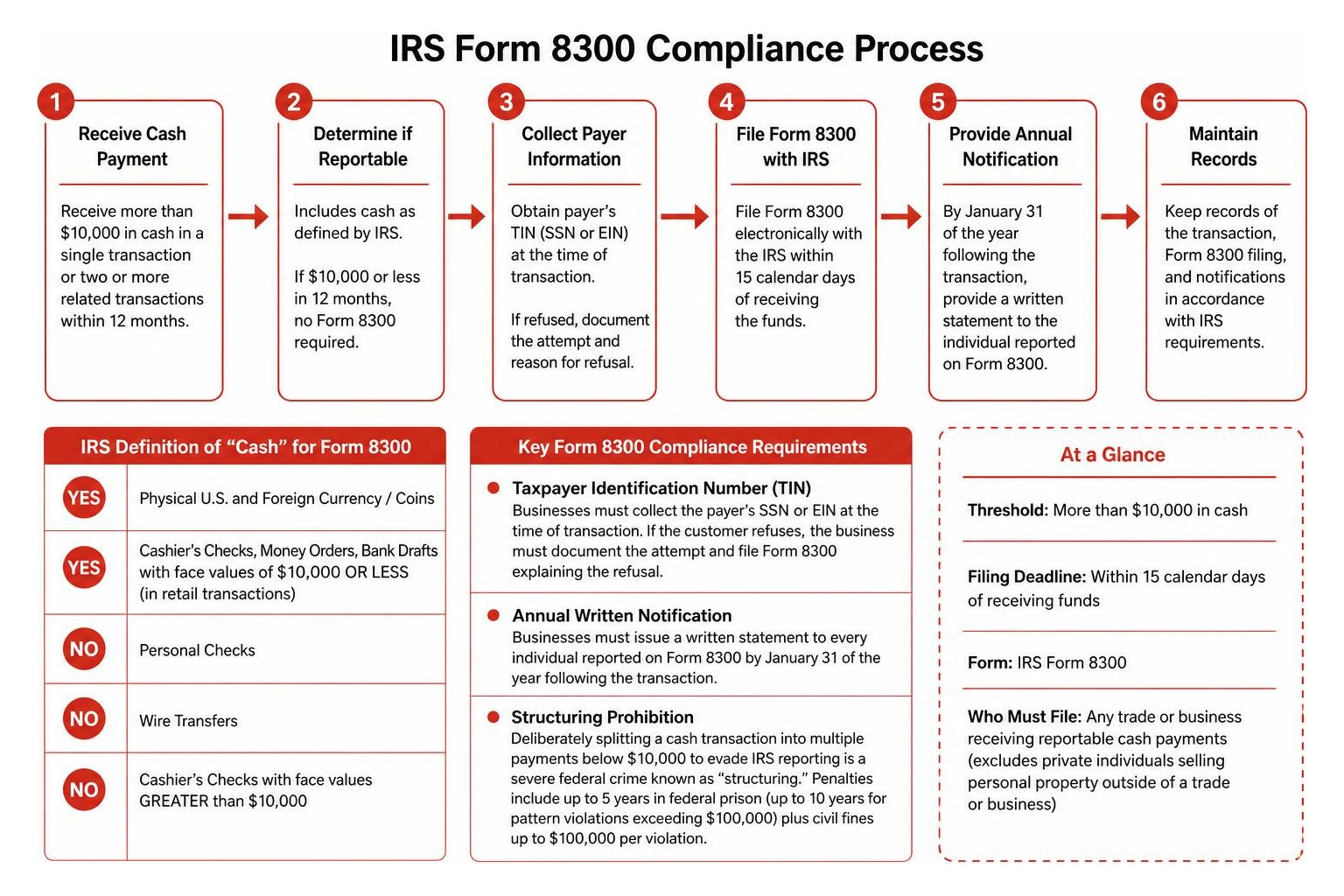
Key Form 8300 Compliance Requirements:
- Taxpayer Identification Number (TIN): Businesses must collect the payer's Social Security Number (SSN) or Employer Identification Number (EIN) at the time of transaction. If the customer refuses, the business must document the attempt and file Form 8300 explaining the refusal.
- Annual Written Notification: Businesses must issue a written statement to every individual reported on Form 8300 by January 31 of the year following the transaction.
- Structuring Prohibition: Deliberately splitting a cash transaction into multiple payments below $10,000 to evade IRS reporting is a severe federal crime known as "structuring." Penalties for structuring include up to 5 years in federal prison (up to 10 years for pattern violations exceeding $100,000) plus civil fines up to $100,000 per violation.
Tax Trade-Offs of Paying Cash
When buying assets outright, tax handling changes compared to financed purchases:
- Loss of Interest Deductions: Paying cash eliminates interest expenses, meaning the business cannot claim tax deductions for loan interest.
- Section 179 Capital Deductions: For business equipment, cash buyers can still take advantage of IRS Section 179 first-year write-offs and bonus depreciation, expensing qualifying machinery up to full federal limits in the year of purchase.
Navigating Major Asset and Real Estate Cash Acquisitions
When buying major assets—whether acquiring commercial shop facilities or high-value metalworking equipment—cash buyers follow specific steps to protect their investment.

In real estate, all-cash buyers represent a major segment of the market. According to recent industry statistics, roughly one-third (32.8%) of home sales in the first half of 2025 were paid for in all cash. Furthermore, cash transactions consistently close much faster than financed deals—often in 7 to 14 days compared to 30 to 60 days for mortgage-backed offers.
Whether buying real estate or heavy industrial machinery outright, buyers must complete essential due diligence:
- Proof of Funds (POF): Sellers require official bank statement verification or a signed POF letter showing liquid funds available for the full purchase price. Financial institutions usually look for 60 to 90 days of "fund seasoning" to confirm the money is legitimate and accessible.
- Earnest Money Escrow: Placing 1% to 3% of the purchase price into a secure escrow account demonstrates commitment while legal paperwork is finalized.
- Independent Equipment Verification: When purchasing pre-owned industrial assets, skipping mechanical evaluation can lead to costly foundation or spindle repairs. Before buying, review essential steps before participating in an equipment auction and learn how to evaluate used industrial machinery to avoid hidden defects.
- Machine Testing and Alignment: For CNC lathes and mills, buyers should know how to verify used CNC lathe accuracy before releasing final wire payments.
- Title Searches and Closing Costs: Cash buyers still need clear property title transfers and owner's title insurance to safeguard against existing liens. Even without mortgage fees, cash buyers should budget 1% to 3% of the purchase price for closing costs, recording fees, transfer taxes, and legal retainers.
At CNC Exchange, we regularly assist manufacturers who prefer to deploy liquid capital directly into operational equipment. Browsing active listings for pre-owned equipment on machineryforsale lets shop owners acquire high-caliber machinery without long financing delays.
Frequently Asked Questions About Cash Purchases
Does a cash purchase bypass accounts payable in accounting software?
Yes. A direct cash purchase records payment immediately against the selected expense or inventory asset account, bypassing Accounts Payable subledgers completely. Because AP subaccounts are not used, existing vendor credits or debit notes cannot be automatically applied to cash purchases.
What counts as cash under IRS Form 8300 reporting rules?
Under IRS Form 8300 rules, "cash" includes U.S. and foreign physical currency, as well as cashier's checks, bank drafts, traveler's checks, and money orders with face amounts of $10,000 or less used in designated retail sales. Personal checks, bank wire transfers, and cashier's checks with face values greater than $10,000 do not count as cash for Form 8300 purposes.
What are the legal risks and penalties for structuring cash payments?
Structuring—deliberately breaking down cash transactions over $10,000 into smaller amounts to bypass IRS reporting thresholds—is a federal crime under 31 U.S. Code Section 5324. Penalties include civil fines up to $100,000, asset forfeiture, and federal imprisonment ranging from 5 to 10 years depending on the scale of the violation.
Conclusion
Understanding how cash purchases work allows business leaders to strike the right balance between operational agility, working capital preservation, and regulatory compliance. Paying outright offers undeniable benefits: zero interest fees, complete asset ownership from day one, faster closing timelines, and stronger position during contract negotiations.
However, smart cash management requires maintaining adequate emergency liquid reserves, keeping meticulous accounting records in the general ledger, and adhering strictly to IRS Form 8300 reporting rules. When acquiring major capital equipment outright, thorough due diligence—including mechanical inspections and title clearance—ensures your cash investment delivers long-term productivity.
If you are evaluating capital equipment acquisitions or looking to trade in current equipment for fair market value, our team at CNC Exchange is ready to help. You can explore industrial fabrication machinery to view reliable, high-performance equipment suited to your shop's needs.