
How to Choose a Used CNC Milling Machine That Pays Off
Compare used CNC milling machines in production by fit, condition, and total cost, not asking price alone. Check that the machine has enough travel and spindle capability for your parts. Then review its maintenance records, inspect it under power, and budget for tooling, transport, installation, and repairs.
A pre-owned mill can lower the cost of adding capacity. The better buy is the one that can make your parts reliably without turning a low purchase price into costly downtime.
I'm Jared Gray. For over 12 years, I've bought, sold, and brokered used CNC milling machines in manufacturing, helping buyers weigh machine condition against cost.
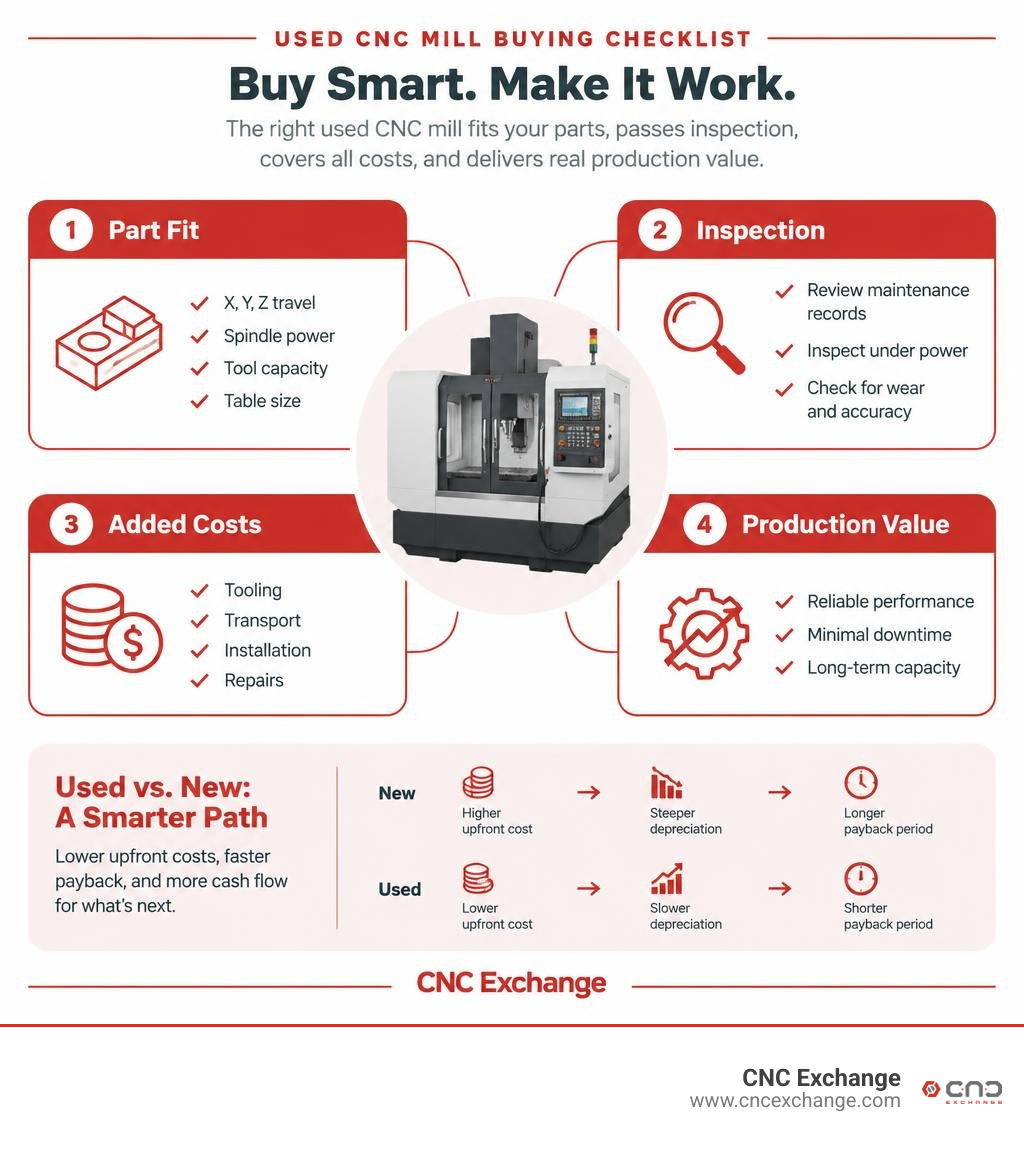
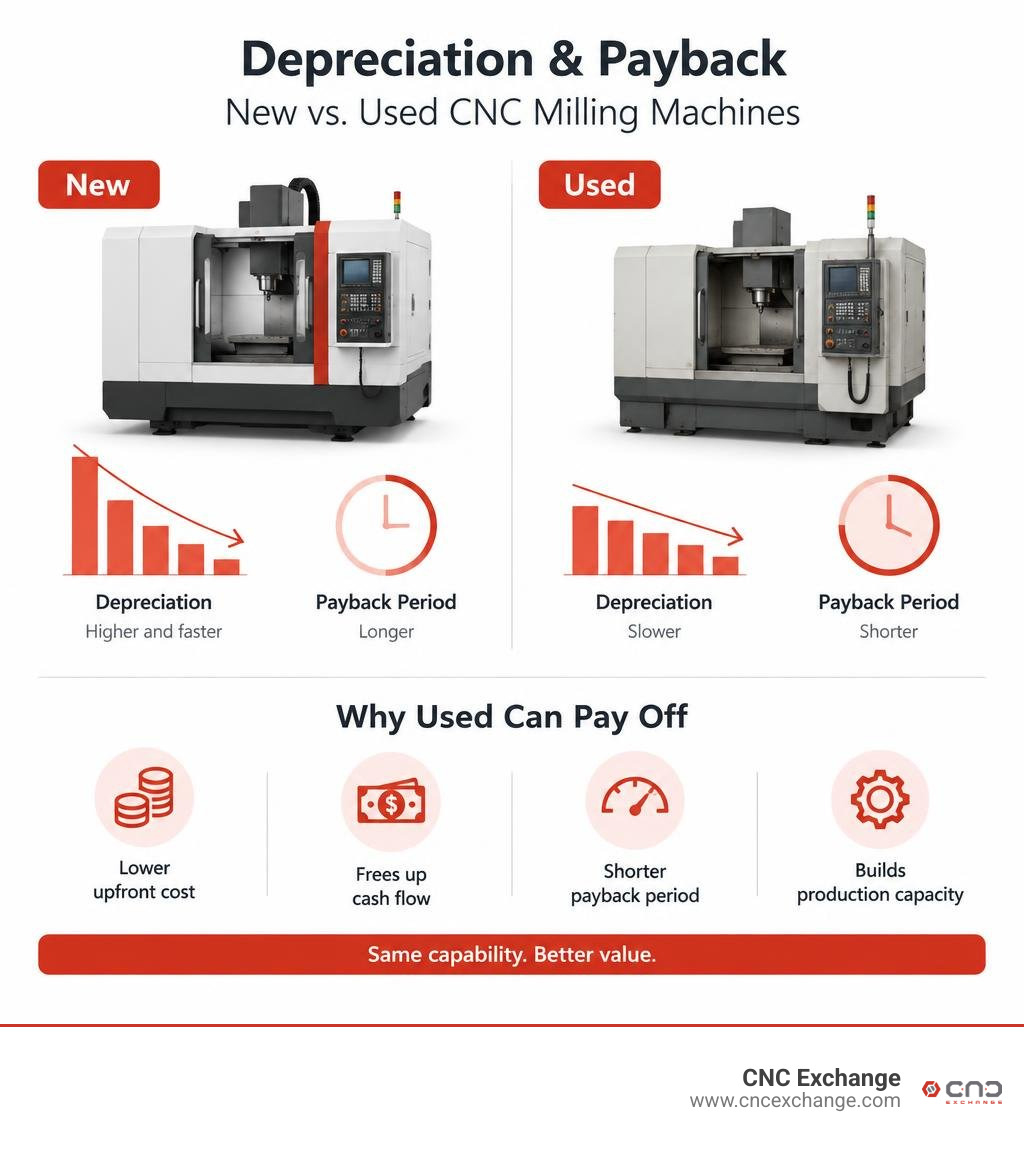
Scaling a machine shop requires balancing capital expenditures against precision performance. Investing in brand-new equipment often ties up credit lines and forces operations to absorb steep initial equipment depreciation curves. Sourcing machinery from the secondary market frees up cash flow, shortens the payback period, and delivers top-tier manufacturing capacity.
Core Capabilities of CNC Milling Machines Used in Industrial Manufacturing
At its core, CNC milling is a subtractive metalworking process where rotary cutting tools remove material from a stationary or multi-axis workpiece to produce custom geometries. Modern vertical machining centers (VMCs) and horizontal machining centers (HMCs) maintain standard dimensional tolerances of ±0.010 mm to ±0.025 mm across standard production runs, with tight-tolerance setups hitting ±0.005 mm.
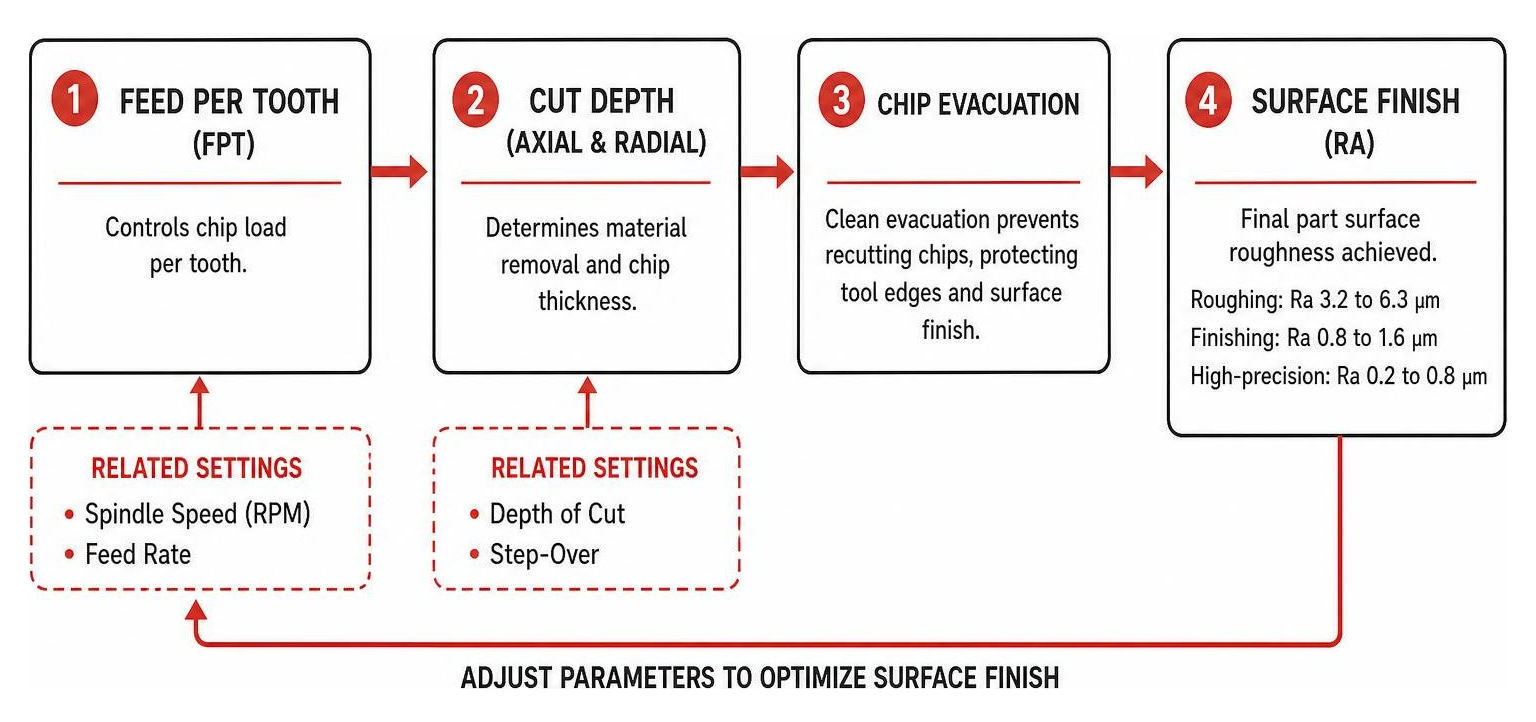
Surface finishes are equally controllable. While roughing passes operate in the Ra 3.2 to 6.3 µm range to maximize material removal rates, a dedicated finishing pass brings surface roughness down to Ra 0.8 to 1.6 µm. In moldmaking or medical manufacturing, high-precision profiling can achieve Ra 0.2 to 0.8 µm. Understanding which operation matches your geometry is critical for cycle time and part finish, as detailed in this guide to types of milling operations.
| Milling Operation | Primary Application | Material Removal Rate (MRR) | Achievable Tolerance | Typical Surface Finish (Ra) |
|---|---|---|---|---|
| Face Milling | Large, flat surface generation | High | ±0.020 to ±0.050 mm | 1.6 to 3.2 µm |
| End Milling | Pockets, steps, flat-bottom cavities | Medium | ±0.010 to ±0.025 mm | 0.8 to 1.6 µm |
| Slot Milling | Keyways, T-slots, deep channels | Medium to High | ±0.015 to ±0.030 mm | 1.6 to 3.2 µm |
| Profile Milling | 3D contoured surfaces, complex molds | Low | ±0.005 to ±0.015 mm | 0.2 to 0.8 µm |
| Peripheral Milling | Heavy side-wall finishing, large steps | High | ±0.020 to ±0.040 mm | 1.6 to 3.2 µm |
Achieving these specifications requires balancing spindle speed, feed rate, chip load per tooth, depth of cut, and step-over distance. When feed rate and step-over are dialled in, chip evacuation dynamics work cleanly to prevent recutting chips, protecting both tool edges and surface finish.
Distinguishing Milling from Turning, Drilling, and Grinding Processes
CNC mills differ fundamentally from other metalworking equipment based on cutter motion and workpiece manipulation. Turning holds a workpiece in a spinning chuck while a stationary single-point tool profiles cylindrical components. Milling, by contrast, uses a spinning, multi-flute cutting tool moving along multiple linear and rotary axes against a fixtured workpiece.
Understanding these distinctions helps shops avoid forcing parts onto the wrong machine architecture. Foundational resources on metal machining fundamentals show that while CNC mills can drill, tap, bore, and ream holes to high dimensional accuracy, high-volume cylindrical pins belong on a lathe. Similarly, ultra-precision flat surfaces requiring sub-micron finishes and tight flatness call for secondary surface grinding rather than extended milling passes.
3-Axis Machining Centers vs. High-Precision 5-Axis Platforms
The choice between a standard 3-axis mill and a 5-axis platform comes down to part complexity, setup time, and positioning accuracy.
A traditional 3-axis vertical machining center moves along X, Y, and Z axes. If a part requires machining on five distinct sides, an operator must manually flip, align, and reclamp the workpiece between 3 and 4 times. Each manual repositioning introduces cumulative human setup error and increases machine downtime.
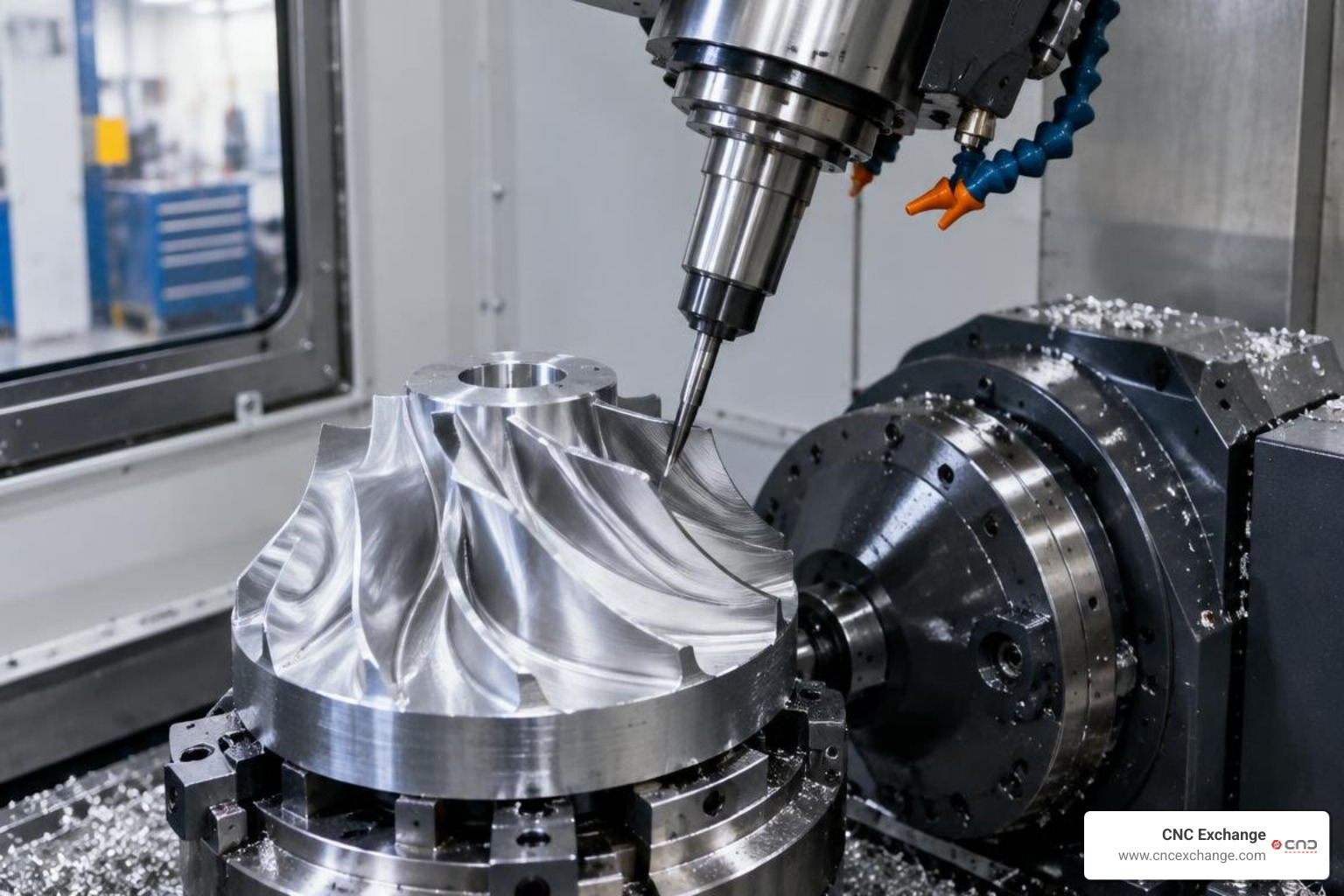
A 5-axis machine introduces rotary motion along the A, B, or C axes. This setup uses either 3+2 positional milling (orienting the tool at fixed angles before executing standard 3-axis cuts) or simultaneous 5-axis toolpaths. Simultaneous multi-axis control allows short, rigid cutting tools to trace deep pockets and complex undercuts without chatter.
For complex components like aerospace impellers and turbine blades, 5-axis platforms achieve centering accuracies of ±0.002 mm while reducing total cycle times by up to 40%. Investing in high-precision 5-axis vertical machining centers eliminates multi-op bottlenecks by finishing complete parts in a single clamping.
The Economic and Operational Case for Pre-Owned Machining Centers
The industrial machinery marketplace features distinct price tiers:
- Desktop Mills: $2,000 to $10,000 (suitable for hobbyists, light prototyping, and plastics)
- Commercial Machining Centers: $20,000 to $100,000 (production-grade vertical machining centers for small-to-midsize contract shops)
- Heavy Industrial / Production Systems: $100,000 to several million dollars (automated multi-pallet horizontal systems, heavy bridge mills, and high-end 5-axis cells)
Acquiring new commercial or industrial milling machines hits your balance sheet immediately with a 30% to 40% initial depreciation loss within the first two years. By purchasing pre-owned equipment, you bypass this steep drop, securing heavy, rigid cast-iron frames, proven CNC controllers, and high-performance spindles at true fair market value.
Understanding how pre-owned CNC equipment savings improve margins lets you deploy two or three pre-owned machines for the cost of a single new machine. However, calculating the true financial upside requires accounting for freight, rigging, site power upgrades, tooling packages, and immediate fluid changes, as outlined in our breakdown of calculating the true cost of used CNC machinery.
Popular VMC Models and Industrial CNC Milling Machines Used in Production
Industrial machine shops rely heavily on workhorse vertical machining centers for everyday contract manufacturing.
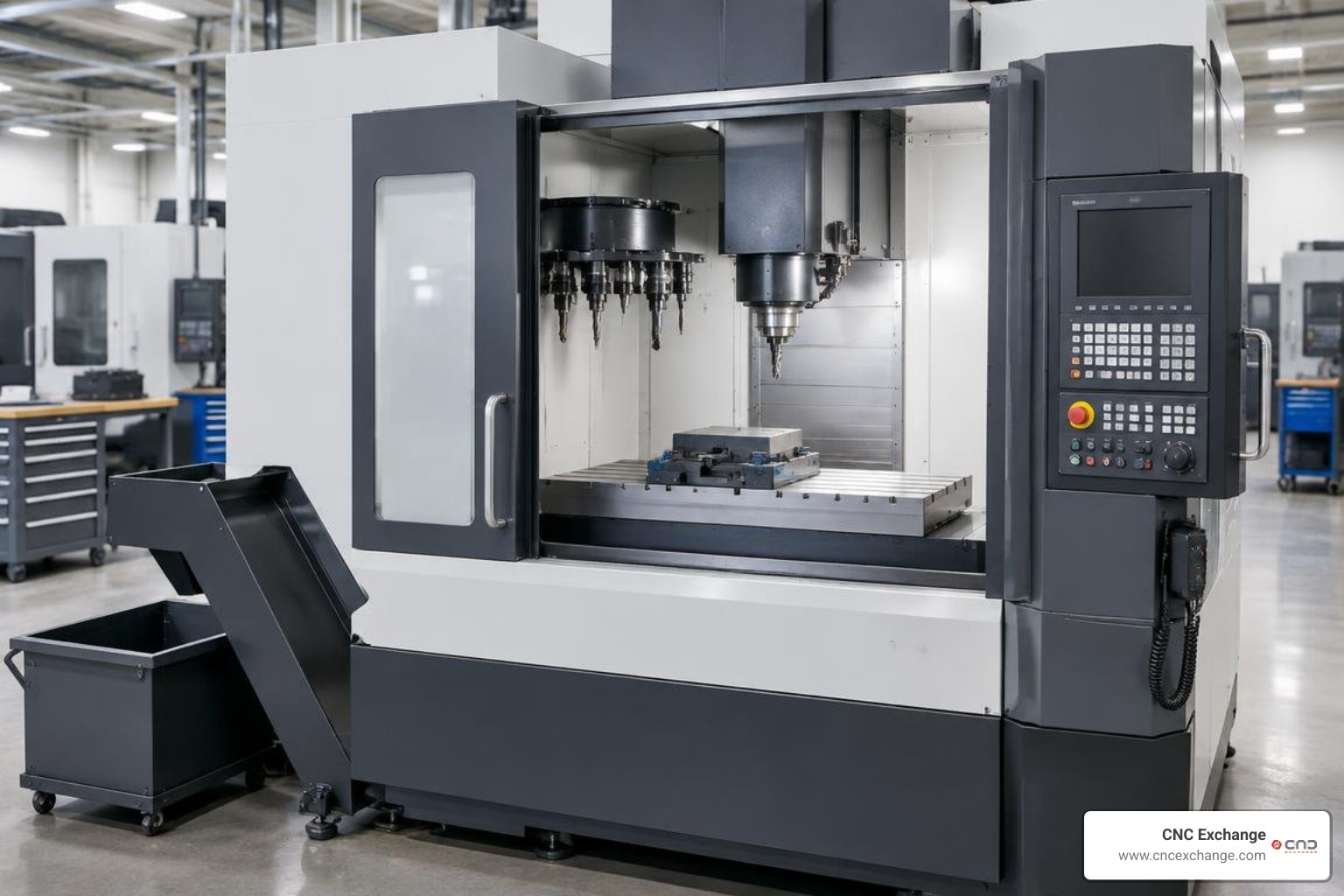
Among the most common platforms are reliable Haas VF-2 vertical machining centers, which offer a versatile 30" × 16" × 20" travel envelope, rigid Meehanite cast-iron beds, and user-friendly controls. For shops running high-volume aluminum components, mold contours, or thin-wall aerospace housings, high-speed Haas VF-4SS vertical machining centers provide larger table travels, 12,000 RPM inline direct-drive spindles, and rapid tool changers.
Beyond standard vertical mills, shops targeting mass-production automotive and fluid-power components often deploy horizontal machining centers (HMCs) with twin-pallet changers. These allow operators to load raw stock onto fixture tombstones while the spindle cuts inside the enclosure, keeping chip-to-chip times minimal. For large castings, heavy structural frames, and energy components, horizontal boring mills offer long-travel spindle extension (quill/ram) to reach deep internal bores.
Optimizing Tooling, Materials, and Batch Economics
Maximizing return on a pre-owned mill depends on matching tool selections and cutting parameters to specific raw materials:
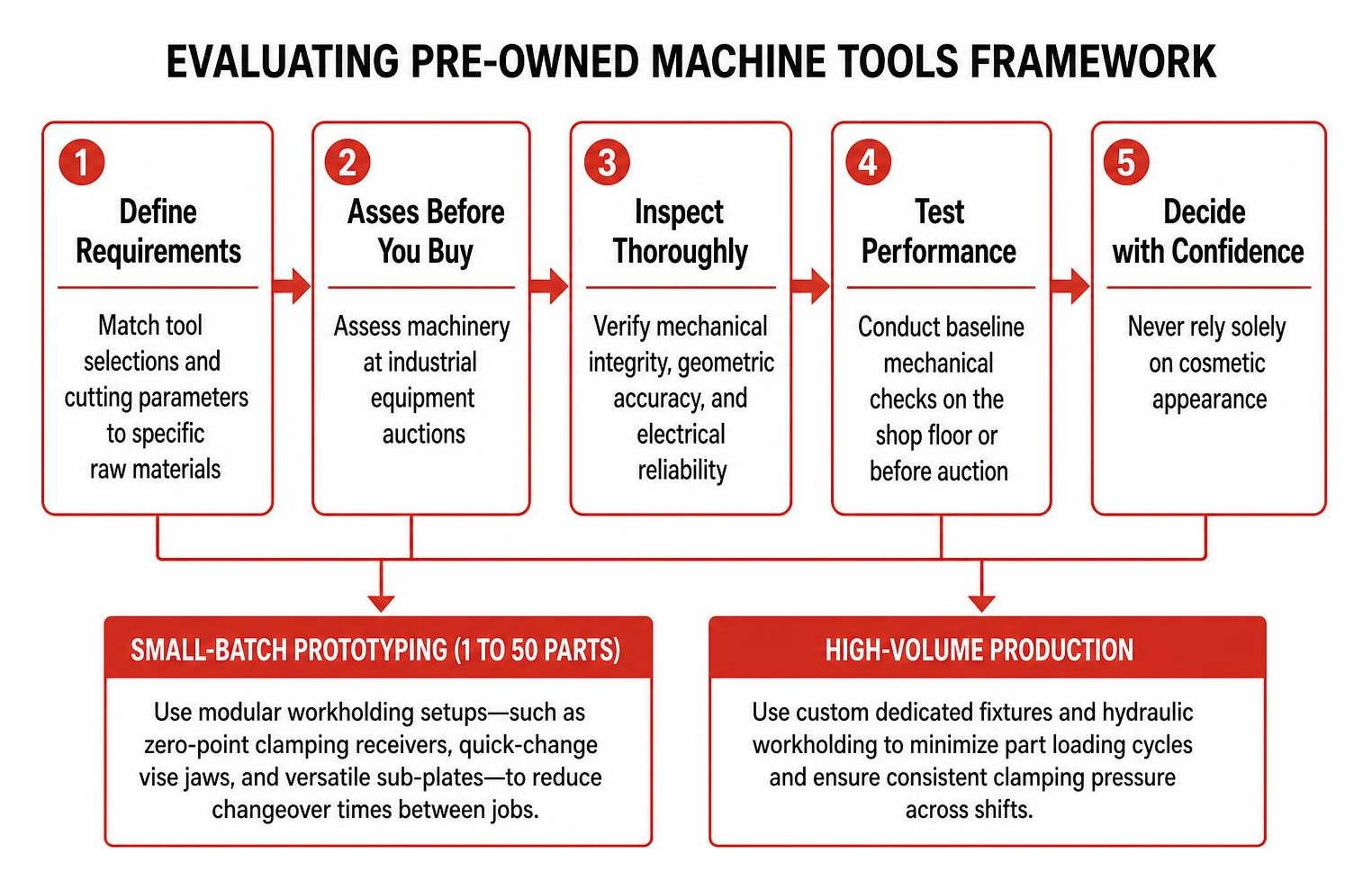
Small-batch prototyping (1 to 50 parts) requires modular workholding setups—such as zero-point clamping receivers, quick-change vise jaws, and versatile sub-plates—to reduce changeover times between jobs. For high-volume production runs, custom dedicated fixtures and hydraulic workholding minimize part loading cycles and ensure consistent clamping pressure across shifts.
Comprehensive Buyer Evaluation and Machine Inspection Framework
Evaluating a pre-owned machine tool requires verifying mechanical integrity, geometric accuracy, and electrical reliability. Never rely solely on cosmetic appearance; clean paint can easily hide worn ways and spindle runout.
When buying machinery through auctions or direct listings, follow a structured process for assessing machinery at industrial equipment auctions before committing capital.
Inspection Protocol for CNC Milling Machines Used in Heavy Manufacturing
When inspecting a pre-owned CNC mill on the shop floor or before an auction, conduct these baseline mechanical checks:
- Spindle Taper and Runout: Mount a high-precision dial test indicator (0.0001" / 0.002 mm resolution) onto the table and sweep the inner spindle taper. Runout should not exceed 0.0002" (0.005 mm). Run the spindle across its full RPM range and listen for bearing whine, excessive vibration, or thermal buildup.
- Drawbar Clamping Force: Use a drawbar force gauge to confirm that the internal retention springs apply correct clamping force on the tool holder pull stud. Low force leads to chatter, poor surface finish, and premature tool wear.
- Backlash and Ballscrews: Affix a magnetic dial base to the casting and indicate off the machine table while commanding micro-jog increments (0.0001") back and forth along the X, Y, and Z axes. Backlash greater than 0.0005" (0.012 mm) indicates worn ballscrew thrust bearings or degraded ball nuts.
- Linear Guideways and Box Ways: Inspect way covers for damage. Check bearing trucks, linear guide rails, and turcite-coated box ways for scoring, uneven wear, or lubrication starvation.
- Electrical Cabinet and CNC Controller: Inspect internal cabinet wiring for heat discoloration, scorched relay blocks, or damaged cooling fans. Ensure the CNC controller boots up cleanly without encoder, drive, or communication alarms.
Performing a thorough auction day machine inspection gives you the technical data needed to bid with confidence.
Safe Setup, Preventative Maintenance, and Operating Troubleshooting
Once a machine arrives at your facility, follow proper installation and preventative maintenance procedures to protect long-term machining accuracy:
- Leveling and Foundation Isolation: Use precision machinist levels (0.0005" per foot graduation) on the table surface. Leveling pads must distribute weight evenly to eliminate bed twist, which causes geometric binding across full axis travels.
- Safety and Interlocks: Inspect enclosure door interlocks, internal shatter-resistant polycarbonate safety glass, and emergency stop circuits. Machine operators must follow standard PPE guidelines, keeping safety doors closed during operation and avoiding compressed air for clearing chips from blind holes.
- Coolant and Lubrication Maintenance: Check the automatic way-lube pump daily to confirm it reaches proper operating pressure. Clean coolant sumps periodically to prevent bacteria growth and maintain concentration levels between 7% and 10% on a refractometer.
- Troubleshooting Common Errors: Address common alarms like axis-following errors, tool-changer misalignment, or thermal drift using our guide to resolving common Haas mill operating problems.
Frequently Asked Questions About Used CNC Milling Machines
How much do pre-owned commercial and industrial CNC milling machines cost?
Pre-owned commercial VMCs typically sell between $20,000 and $75,000, depending on age, spindle hours, tool capacity, and controller generation. Larger high-speed industrial machines, twin-pallet horizontal machining centers, and 5-axis systems generally range from $80,000 to $250,000+. Total pricing reflects spindle condition, included options (like 4th-axis tables, high-pressure through-spindle coolant, and tool probe systems), and documented maintenance history.
What materials can be cut, and how do they impact cutting tool wear?
CNC milling machines cut soft plastics (Delrin, PEEK), structural aluminum alloys (6061, 7075), carbon and alloy steels (1018, 4140), stainless steels (304, 316), and heat-resistant superalloys (Titanium Ti-6Al-4V, Inconel 718). Harder, heat-resistant materials require lower cutting speeds, rigid tool holding, high-pressure coolant, and wear-resistant coatings (like AlTiN or TiAlN) to control thermal breakdown at the cutting edge.
How are automation and smart retrofits extending the life of pre-owned mills?
Adding modern aftermarket retrofits can breathe new life into older, mechanically sound CNC frames. Machine shops regularly integrate modular robotic pallet pool loaders, collaborative robotic arm part-tenders, high-resolution wireless workpiece probing systems, and IoT vibration sensors. These upgrades enable legacy pre-owned machines to run lights-out unattended shifts with modern reliability.
Summary of Buying Used CNC Milling Machines
Acquiring pre-owned CNC milling machines lets machine shops scale production capacity and take on complex customer orders while managing capital risk. By inspecting spindle runout, axis backlash, and controller health, you can secure reliable machining platforms that produce tight-tolerance parts for years to come.
Whether you need to expand your spindle capacity or replace an older unit, we can help. Talk to our machine tool experts today or explore our current marketplace listings to find quality pre-owned CNC machinery for sale.