
Why Buying a Used CNC Vertical Mill Could Be Your Smartest Production Decision Yet
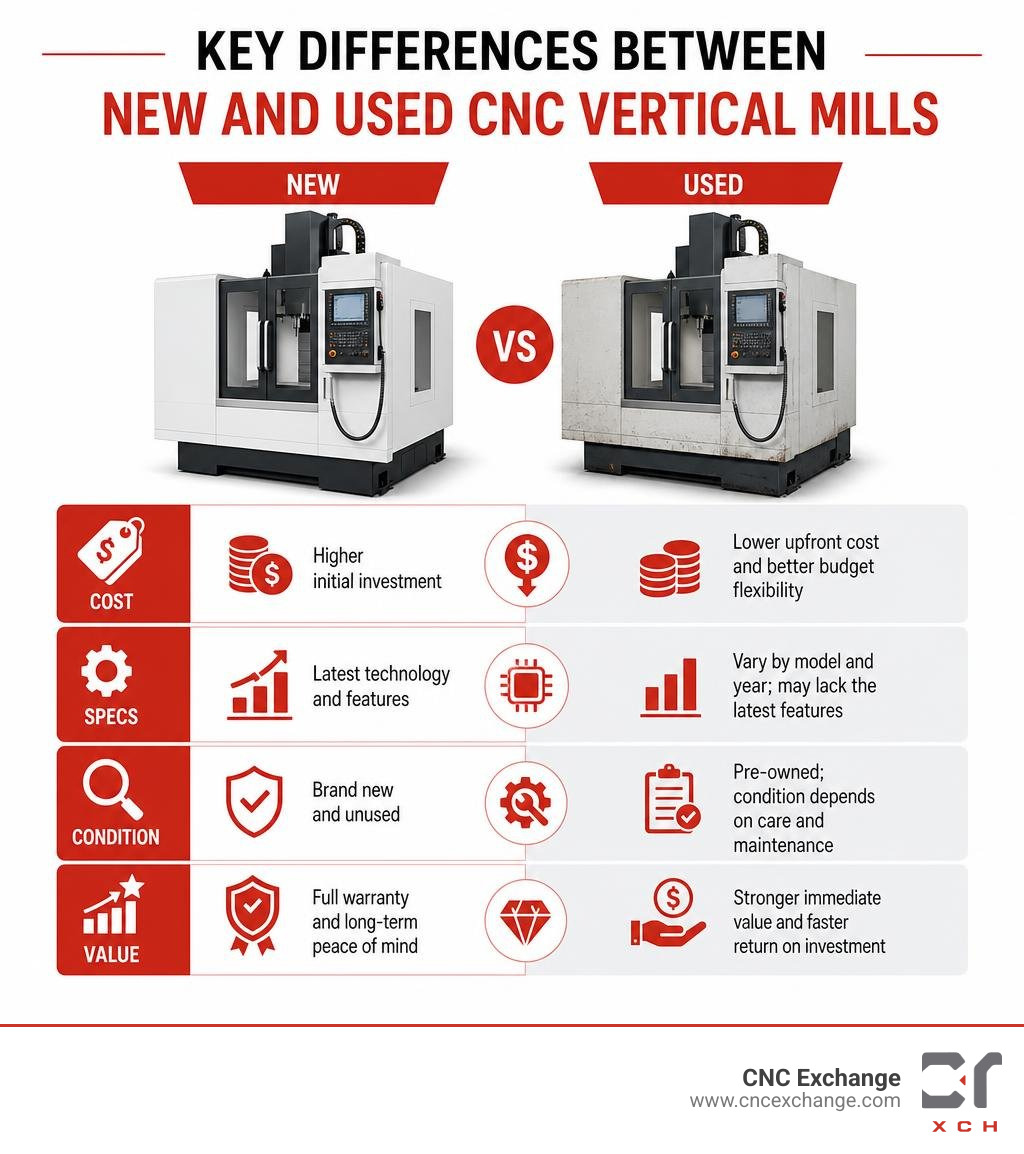
Buying a used CNC vertical mill is one of the most cost-effective ways to add serious machining capability to your shop — without paying new-machine prices.
Quick answer: What is a used CNC vertical mill?
- A CNC vertical mill (also called a VMC — vertical machining center) is a machine tool with a vertically oriented spindle controlled by a computer (CNC/PLC system)
- It cuts, drills, and shapes metal or other materials on 3 to 5 axes
- A used VMC is a pre-owned machine, typically sold by dealers or previous owners, often at 40–70% less than new
- Common use cases include aerospace parts, medical components, automotive work, and general job shop production
If you run a manufacturing business, you already know the problem: new CNC equipment is expensive, lead times are long, and outdated machines are killing your throughput. A quality used VMC can close that gap — if you know what to look for.
The used market is large and active. Inventories across major dealers can include hundreds of machines at any given time, spanning compact 3-axis mills all the way up to full 5-axis simultaneous configurations. Brands like Haas, Mazak, Mori Seiki, and Fadal dominate the used market, with Haas consistently being the most available brand.
The challenge isn't finding a used VMC. It's finding the right one — at the right price, in real working condition, with enough service life left to justify the investment.
This guide walks you through exactly how to do that.
Understanding the Used CNC Vertical Mill: Definition and Core Benefits
At its most fundamental level, a vertical machining center is a power tool that uses a rotating cutter to remove material from a workpiece. The "vertical" part simply means the spindle axis is oriented vertically. Your work sits on a table below the spindle, and the cutting tool moves down along the Z-axis to carve out features, while the table moves along the X and Y axes.
Modern vertical mills rely on Programmable Logic Control (PLC) and advanced CNC software to coordinate these movements with micro-inch precision. While manual knee mills require a machinist to crank handles, a CNC VMC executes a pre-programmed "G-code" file. This allows for rapid, repeatable, and highly complex cutting paths that would be physically impossible by hand.
When shopping for a used CNC vertical mill, you will encounter configurations ranging from simple 3-axis setups to full, simultaneous 5-axis machines. A 3-axis machine moves in X, Y, and Z. A 4-axis machine adds a rotary table (often called an indexer or A-axis), allowing you to rotate the part to machine multiple sides. A 5-axis machine, such as a trunnion-style mill, adds two rotational axes, letting the spindle reach almost any angle of the workpiece in a single setup.
The decision of which configuration to buy always comes down to a balance of cost versus capability. While a 5-axis mill reduces setup times and handles ultra-complex aerospace geometries, it comes with a steeper learning curve and a higher price tag. For many job shops, a solid, rigid 3-axis VMC is the bread-and-butter machine that pays the bills. By purchasing a pre-owned model, you can secure high-end capabilities—like high-speed spindles, side-mount tool changers, and through-spindle coolant—for a fraction of what a bare-bones new model would cost.
If you are ready to explore your options, you can browse our updated inventory of Used Vertical Mills for Sale - CNC Exchange.
Key Specifications to Evaluate Before Buying
Before you start looking at specific machines, you need to establish your technical baseline. Not all vertical mills are built for the same tasks. A mill designed to rapidly cut aluminum aircraft brackets is very different from a heavy-duty box-way machine built to chew through hardened tool steel.
To help you compare your options, let's look at a few of the most critical specifications:
| Feature / Specification | CAT40 Taper | BT40 Taper | HSK 63 Taper |
|---|---|---|---|
| Spindle Speed Range | 8,000 to 15,000 RPM | 8,000 to 15,000 RPM | 15,000 to 40,000+ RPM |
| Tool Holder Standard | ANSI (American) | JIS (Japanese) | DIN (German / High-speed) |
| Rigidity & Pull Force | High (Standard) | High (Standard) | Extremely High (Dual-contact) |
| Common Applications | General job shops, steel, aluminum | High-precision, heavy milling | High-speed machining, mold making |
Beyond the spindle taper, you must evaluate:
- Axis Travel (X, Y, Z): This defines the physical envelope of the parts you can make. Ensure the machine has several inches of clearance beyond your largest planned workpiece to account for workholding and tool clearance.
- Table Load Capacity: Heavy steel blocks or large fixtures can easily overload a light-duty mill. Exceeding the maximum table load will cause excessive wear on the guideways and ball screws, leading to geometric inaccuracies.
- Tool Changer Capacity (ATC): Carousel-style tool changers are simpler but slower, while side-mount "umbrella" or dual-arm changers swap tools in a matter of seconds. Ensure the machine has enough tool stations (typically 20 to 30+) to run your parts without constant manual tool changes.
- CNC Control System: The control is the brain of the machine. Fanuc, Haas, Mazatrol, and Mitsubishi are among the most common. A control system that your operators already know will eliminate weeks of training and programming downtime.
No matter which machine you choose, safety must remain your top priority. OSHA's guidance on machine guarding is a useful external reference when reviewing guarding, interlocks, and operator protection. To prepare your shop floor for your new addition, read our comprehensive guide on How to Stay Safe When Operating a CNC Vertical Machining Center.
Top Brands and Models in the Used Market
Choosing the right brand is about more than just the logo on the sheet metal. It dictates how easily you can source replacement parts, find qualified service technicians, and eventually resell the machine down the road.
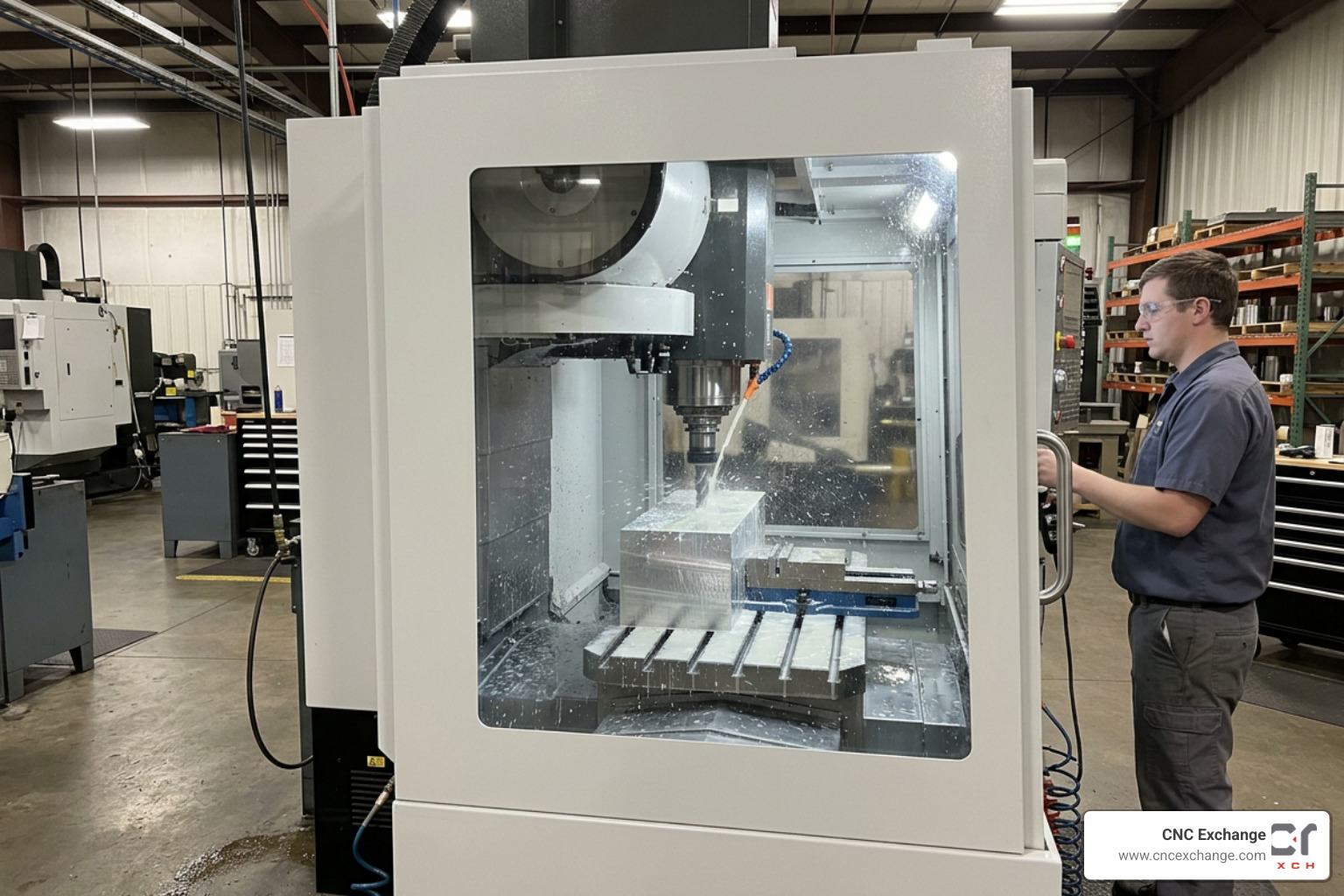
In the used market, brand reputation is closely tied to machine reliability and long-term resale value. Let's look at the most popular brands and models that consistently deliver excellent value.
Popular Haas and Fadal Models
Haas Automation revolutionized the manufacturing world in 1987 when they introduced the VF-1, the first American-made vertical machining center priced under $50,000. Today, Haas remains the most represented brand in the used VMC market. Shop owners love Haas machines for their user-friendly controls, easy programming, and widely available, affordable spare parts.
If you are looking for a reliable workhorse, the Haas VF2B Vertical Machining Center offers a classic, rigid platform. For high-speed operations and rapid cycle times, the Haas VF-2SS Vertical Machining Center (Super Speed) features a high-RPM spindle and lightning-fast tool changes. If space is tight but you still need modern speed, the Haas Super Mini Mill 2 Vertical Machining Center delivers excellent performance in a compact footprint.
On the budget-friendly side, Fadal is legendary for its simple, rugged construction. The Fadal VMC 6030 Vertical Machining Center is a massive, box-way machine that continues to be a favorite for heavy cutting in job shops across North America.
High-Performance Mazak and Mori Seiki Options
For shops targeting high-volume production, tight tolerances, or advanced automation, Japanese builders like Mazak and Mori Seiki are the gold standard.
Mazak is famous for its conversational Mazatrol control, which allows operators to program complex parts directly at the machine. They are also industry leaders in thermal compensation and lights-out manufacturing. For high-end, multi-axis production, the Mazak Variaxis i-300 AWC Vertical Machining Center combines simultaneous 5-axis machining with an Auto Work Changer for unmanned operation.
Mori Seiki (now DMG Mori) is synonymous with heavy-duty box ways, incredible structural rigidity, and superb spindle engineering. The Mori Seiki Duravertical Vertical Machining Center is a highly reliable 3-axis machine designed to hold tight tolerances over decades of continuous use.
Versatile Bridgeport Series I
If you run a toolroom, R&D lab, or prototype shop, you might not need a massive enclosed machining center. This is where the manual-to-CNC knee mill shines.
The Bridgeport Series I Vertical Machining Center and its CNC-retrofitted variants offer unmatched versatility. They allow operators to quickly set up one-off jobs, make manual modifications, or run simple 2-axis and 3-axis CNC programs without the setup overhead of a fully enclosed VMC.
How to Inspect and Assess a Used CNC Vertical Mill
Buying a used machine without a proper inspection is like buying a used car with the hood welded shut. You must look past the fresh coat of paint and evaluate the actual mechanical and electrical health of the machine.
Step-by-Step Inspection of a Used CNC Vertical Mill
When you or an inspector evaluate a used CNC vertical mill, follow this step-by-step checklist:
- Check the Spindle Runout: Place a dial indicator) in the spindle taper and rotate it slowly by hand. Runout should ideally be under 0.0002 inches. Excessive runout means the spindle bearings are worn and will require an expensive rebuild.
- Test for Backlash: Check the play in the X, Y, and Z ball screws. Use an indicator to measure how much the table moves before the ball screw engages. While modern controls can compensate for minor backlash), excessive play indicates worn ball screws or thrust bearings.
- Inspect the Guideways: Look for scratches, scoring, or wear on the linear guides or box ways. Ensure the automatic lubrication system is working perfectly; dry ways will quickly destroy a machine's accuracy.
- Review the Maintenance Logs: A well-documented machine is a safe bet. Look for regular oil changes, filter replacements, and any history of spindle rebuilds or crash repairs.
- Verify the Cutting Hours: Do not just look at the power-on hours. Check the actual "spindle time" or "cutting time" in the control parameters to understand how hard the machine was pushed.
To guide you through this process, we recommend working with trusted industry experts. If you want a smooth, verified transaction, you can buy directly through our platform at CNC Exchange | Used CNC Machine Sales.
Red Flags to Avoid When Sourcing a Used CNC Vertical Mill
Keep an eye out for these warning signs that could signal a money pit:
- Excessive Spindle Noise: A high-pitched whine or grinding sound at high RPMs means the spindle bearings are on their last legs.
- Rusty or Dry Ways: If the ways are dry or showing rust, the previous owner likely neglected basic maintenance.
- Missing Control Parameters: If a machine loses backup battery power, it can lose its system parameters. Replacing these from the manufacturer can be a logistical nightmare.
- Undocumented Repairs: Beware of welded castings or non-OEM wiring modifications.
Frequently Asked Questions
What is the typical lifespan of a used CNC vertical mill?
With proper maintenance, a high-quality VMC can easily run for 20 to 30 years. The lifespan is determined by duty cycles rather than calendar age. A machine that ran light aluminum prototypes in a clean lab will last much longer than one that cut cast iron 24/7 in a dusty foundry. Spindle rebuilds and ball screw replacements are normal mid-life maintenance items that can reset the clock on a machine's service life.
How much does it cost to ship and install a used VMC?
Shipping and rigging a CNC machine is not a DIY job. Depending on the size of the machine and the distance, rigging and freight can range from $2,000 to over $10,000. You must also factor in the cost of preparing your shop floor (ensuring the concrete slab is thick enough), running appropriate 3-phase power, and hiring a technician to level, calibrate, and anchor the machine.
Can I upgrade the control system on an older vertical mill?
Yes, retrofitting is a popular option, especially for older box-way machines that are mechanically rock-solid but have outdated controls. Upgrading to a modern system (like a Centroid or new Fanuc control) can give you USB connectivity, larger memory capacity, and faster processing speeds. However, you must weigh the cost of the retrofit (often $10,000 to $20,000+) against the cost of simply buying a slightly newer used machine.
Conclusion
Securing a quality used CNC vertical mill is all about aligning your production needs with your budget. By focusing on proven brands, thoroughly inspecting the mechanical components, and calculating the true cost of shipping and installation, you can add massive capability to your shop floor while keeping your overhead low.
At CNC Exchange, we make the buying, selling, and upgrading process simple, secure, and transparent. If you are ready to find your next machine or have questions about logistics, Talk to Our Machine Tool Experts Today . You can also explore our complete, daily updated inventory of CNC Machinery for Sale to find the perfect fit for your shop.