
What Are CNC Grinders — and Which Type Do You Actually Need?
CNC grinders are computer-controlled machines that remove material from a workpiece using a rotating abrasive wheel, achieving tolerances and surface finishes that no other machining process can match.
If you need a quick answer, here's how the main types break down:
| Type | Best For | Typical Tolerance |
|---|---|---|
| Cylindrical (OD) | Shafts, rollers, pins | < 0.0001 in |
| Centerless | High-volume round parts | ~1 micron |
| Internal (ID) | Bores, holes, sleeves | < 0.0001 in |
| Compound (OD + ID) | Complex, multi-face parts | < 0.0001 in |
| Tool & Cutter (5-axis) | End mills, drills, hobs | ±0.0001° |
| Surface | Flat faces, slots | Sub-micron |
The right CNC grinder depends on your part geometry, production volume, and tolerance requirements. A shop grinding high-volume automotive pins has completely different needs than a tool room regrinding carbide end mills.
Choosing the wrong machine — or buying one without understanding the specs — leads to scrapped parts, missed tolerances, and expensive downtime. That's exactly the kind of problem this guide is built to help you avoid.
I'm Jared Gray, and I've spent over 12 years sourcing, brokering, and evaluating manufacturing equipment — including CNC grinders of every type and price range, from Japanese and Swiss precision machines to Taiwanese and Chinese value options. In that time, I've seen what separates a smart purchase from a costly mistake, and I'll walk you through it all here.
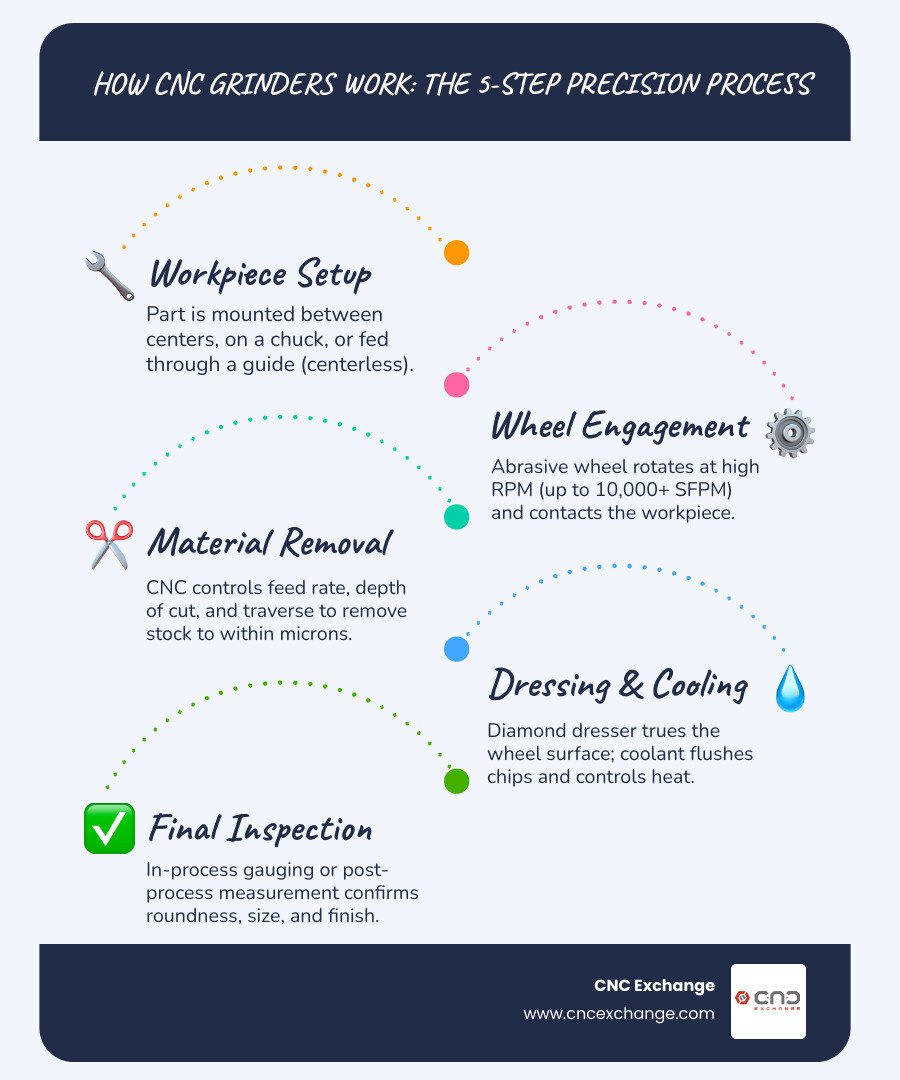
Comparing the Main Types of CNC Grinders
To choose the best machine for your shop, we first need to understand the structural and operational differences between the major categories of cnc grinders. While they all use abrasive wheels to remove material, their mechanical configurations are tailored to vastly different geometries.
If you are currently deciding between flat and round workpieces, our guide on Cylindrical & Surface Grinders: Are You Flat Out Better or Just Rolling With It? goes deeper into those foundational differences. For round parts, however, the choice comes down to how the part is held and which surfaces are being ground.
For inner diameters, shops rely on specialized Internal Grinders to finish bores, sleeves, and bearing races. But when your parts require multiple operations, things get more interesting.
Cylindrical and Compound cnc grinders
Traditional cylindrical grinding processes the outer diameter (OD) of a workpiece supported between centers or held in a chuck. However, modern manufacturing often demands both OD and internal diameter (ID) work on a single part. This is where compound grinding machines shine.
A compound grinder combines independent spindles to perform both OD and ID grinding without requiring the operator to re-clamp the workpiece. Consolidating these setups ensures near-perfect concentricity because the part never leaves its original workholding.
For example, the KG-500LE CNC Internal External Cylindrical Compound Grinding Machine | Guan Yu is engineered specifically for this type of high-accuracy, multi-face processing. It features a versatile grinding diameter range of Ø 4 to Ø 320 mm and a maximum grinding depth of 200 mm. By housing both OD and ID spindles on a single platform, it allows shops to complete complex multi-stage tasks in a single, continuous cycle.
Centerless and Tool/Cutter cnc grinders
While cylindrical machines hold parts at their centerpoints, centerless grinders support the workpiece on a work rest blade between a high-speed grinding wheel and a slower regulating wheel. This setup is ideal for rapid, high-volume production of straight or profiled cylindrical parts. Centerless grinding operates using two primary methods:
- Through-feed grinding: Designed for straight cylindrical parts without shoulders. The parts pass axially between the wheels in a continuous stream.
- In-feed grinding: Used for parts with heads, shoulders, or complex profiles. The workpiece is placed on the blade and fed laterally into the grinding wheel.
On the other end of the spectrum are 5-axis CNC tool and cutter grinders, which are built for complex geometries rather than simple cylindrical profiles. These machines are the workhorses of tool rooms, used to manufacture and regrind end mills, drills, reamers, and hobs.
High-performance models, such as the norma NGC 750 - SCHNEEBERGER (en), feature robust designs like a 46 kW peak spindle power and a 750 mm X-stroke. This enables them to process tools up to 600 mm in cutting length with ease. Similarly, the Huffman HS-65 5-Axis CNC Tool Grinder offers the dynamic multi-axis movement required to grind intricate medical bone saws, industrial knives, and aerospace turbine components.
Critical Specifications and Bearing Technologies
Selecting the right CNC grinder requires looking past the brand name and evaluating the core mechanical specifications. The machine's wheel size, spindle type, control system, and axis configuration dictate what materials you can run, how quickly you can remove stock, and how long the machine will hold its accuracy.
The heart of any grinder is its spindle bearing design. The table below compares the three primary bearing technologies used in modern grinding spindles:
| Bearing Type | Load Capacity | Heat Generation | Maintenance Level | Best Used For |
|---|---|---|---|---|
| Hydrostatic | Extremely High | Low (minimal friction) | Low (no metal contact) | Ultra-precision, heavy-duty OD/ID grinding |
| Hydrodynamic | High | Moderate | Medium (requires steady rotation) | Standard cylindrical and centerless production |
| Ball Bearing | Moderate | High (at high speeds) | High (subject to wear) | High-speed tool grinding, smaller wheel setups |
Spindle Bearing Technologies and Performance
The choice between hydrostatic, hydrodynamic, and ball bearings directly impacts your grinder's accuracy and longevity.
Hydrostatic bearings rely on an external pump to deliver high-pressure oil to the spindle, keeping the shaft floating on a continuous oil film. Because there is no metal-to-metal contact, friction is virtually non-existent, resulting in high thermal stability and zero mechanical wear.
This technology is highly visible in precision centerless systems like the JHC-CNC Centerless Grinder - Jainnher Machine Co., Ltd., which utilizes a high-pressure hydrostatic device operating at a set work pressure of 20 kg/cm². To protect these sensitive systems, manufacturers integrate pressure detect switches. If the oil pressure drops below the safe threshold, the spindle automatically shuts down, preventing catastrophic bearing damage.
Hydrodynamic bearings, by contrast, generate their oil film through the rotation of the spindle itself. While highly effective and cost-efficient for steady, single-direction rotation, they do not offer the same level of instant thermal stability at startup as hydrostatic options. High-precision ball bearings remain popular for smaller, high-speed spindles where rapid acceleration and agility are required, though they do wear over time and require eventual replacement.
Control Systems and Axis Configurations
Modern CNC grinders rely on advanced control systems to coordinate multi-axis movements down to the nanometer. The Fanuc 31i-B5 is a gold standard for 5-axis tool grinders, offering the processing speed needed to manage complex helical paths.
For profile and form grinding, systems like the Chevalier FMG-1632CNC HD Profile Grinders combine heavy-duty castings with advanced control interfaces to execute precise wheel dressing and grinding passes. Meanwhile, specialized machines like the Koepfer KFS 100.5 CNC Grinder utilize dedicated control configurations designed specifically for high-precision gear and thread grinding. High-resolution glass scales, closed-loop servo motors, and precision-ground ball screws are critical across all these platforms to translate control commands into flawless physical movements.
Production Efficiency: Centerless vs. Cylindrical Grinding
When planning a high-volume production line, choosing the right grinding method is a critical step. While cylindrical grinders offer incredible flexibility for a wide variety of parts, centerless grinders are built for pure throughput and speed.
To understand this efficiency gap, we can look at a direct process comparison:
Advantages of Centerless Systems
Centerless grinding eliminates the need to drill center holes in the workpiece or spend time clamping parts into a chuck. Because the workpiece is supported along its entire length by the work rest blade and regulating wheel, there is virtually no part deflection. This makes it possible to grind long, thin shafts that would easily bend under the force of a standard cylindrical wheel.
High-precision machines like the CNC Centerless Grinder (such as the Smith CNC100) showcase what is possible with this setup. This machine can hold roundness tolerances as tight as 1 micron (0.001 mm) and achieve surface finishes down to Ra 0.16 µm.
For shops processing thousands of automotive shafts, hydraulic valves, or medical pins daily, centerless systems deliver rapid cycle times and consistent quality. However, if your shop runs a wider variety of low-volume parts with complex shoulders, step-downs, or internal features, a universal cylindrical machine like the Cincinnati 15120 CNC Grinder remains the more versatile choice.
Automation and Unattended Operation
To maximize the ROI on a CNC grinder, incorporating automation is essential. Modern grinding platforms are highly adaptable to unattended "lights-out" manufacturing. Common automation upgrades include:
- Robotic Loaders: Articulated arms can pick raw stock, load it into the workholding, and place finished parts into trays.
- Gantry Systems: Overhead gantry systems are ideal for transferring heavy shafts or cylindrical parts quickly between stations.
- Bar Feeders and Receivers: Often paired with centerless grinders for continuous, high-speed bar stock processing.
- Tandem Linkage: Connecting multiple centerless grinders in series so that parts feed continuously from rough grinding straight through to final finishing.
Achieving Low-Stress Grinding and High Precision
Grinding is a high-energy process that generates significant friction and heat. If this heat is not managed correctly, it can cause thermal damage, introduce tensile residual stresses, or even crack the workpiece. Achieving "low-stress grinding" is critical for high-performance aerospace, automotive, and medical components.
Machine Design and Coolant Systems
Low-stress grinding starts with the physical foundation of the machine. High-grade, normalized FC-30 cast iron is the industry standard for machine beds. Cast in resin cores and heavily ribbed, these beds provide excellent vibration damping and absorb the mechanical shocks of heavy grinding passes.
Equally important is the coolant delivery and filtration system. To keep temperatures low at the point of contact, shops must use high-pressure, high-flow coolant systems with dedicated chilling units. Keeping the grinding fluid fresh, clean, and at a stable temperature prevents the workpiece from expanding during the cycle, which is essential for maintaining sub-micron accuracy.
Regular wheel dressing is also vital; a sharp, well-dressed wheel cuts cleanly, whereas a dull, loaded wheel generates excessive friction and heat.
Regional Manufacturer Comparison
When sourcing a CNC grinder, geographic origin often reflects the machine's design philosophy, price point, and performance tier:
- Swiss Precision (e.g., Studer, Kellenberger, Schneeberger): Widely regarded as the pinnacle of high-precision grinding. These machines are engineered for shops that need to hold a "fraction of a tenth" (under 0.0001 inches) all day long. They feature advanced thermal stabilization, superior software, and top-tier hydrostatic systems, but they carry a premium price tag.
- Japanese Reliability (e.g., Toyoda, Shigiya, Okuma): Renowned for their incredible durability and trouble-free operation. Many shop owners report running Japanese grinders six days a week for close to a decade with nothing more than routine fluid and battery maintenance. They offer an exceptional balance of ultra-high precision and long-term reliability.
- American Durability (e.g., Landis, Campbell Grinder): Known for heavy-duty, robust designs built to handle massive workpieces and continuous, high-volume production. While many historic brands are now part of global parent groups, they remain staples of heavy industrial manufacturing.
- Taiwanese and Chinese Value (e.g., Jainnher, Guan Yu): Highly competitive options that offer a strong balance of performance and affordability. Modern Taiwanese and Chinese grinders incorporate high-quality components, like Japanese servo motors and hydrostatic spindles, making them excellent choices for shops looking to maximize their ROI without paying top-tier European prices.
Frequently Asked Questions about CNC Grinding
What are the key maintenance requirements for CNC grinders?
To keep a high-precision CNC grinder running reliably for years, we recommend focusing on three primary maintenance tasks:
- Fluid Management: Keep grinding fluids clean, well-filtered, and fresh. Contaminated coolant ruins surface finishes and accelerates wear on machine slides and spindles.
- Control Battery Replacement: Regularly replace the CNC control batteries. Proactively changing these batteries prevents the loss of critical machine parameters and avoids unexpected downtime.
- Lubrication and Filtration: Ensure automatic lubrication systems are filled with the correct oil grade, and regularly clean or replace the hydrostatic and hydraulic system filters.
How does compound grinding improve efficiency?
Compound grinding improves efficiency by combining multiple grinding spindles (such as OD and ID) onto a single machine. This allows the system to perform continuous, multi-face processing on complex parts without requiring the operator to unclamp and re-setup the workpiece. Consolidating these steps reduces overall cycle times and eliminates setup errors, ensuring excellent concentricity between the inner and outer diameters.
What is the difference between hydrostatic and hydrodynamic bearings?
The main difference lies in how the supporting oil film is pressurized:
- Hydrostatic bearings use an external pump to deliver continuous high-pressure oil to the bearing pocket. This keeps the spindle floating even when idle, resulting in zero startup wear, high stiffness, and minimal heat deformation.
- Hydrodynamic bearings rely on the rotation of the spindle shaft itself to generate the oil film. While highly effective for continuous, single-direction operations, they do not offer the same level of static stiffness or thermal stability at startup.
Conclusion
Choosing the right CNC grinder is a balancing act between your part geometry, production volumes, and budget. Whether you need the high-volume throughput of a centerless system, the multi-face capability of a compound grinder, or the extreme flexibility of a 5-axis tool grinder, understanding these core technologies ensures you make the right investment.
As your production needs evolve, upgrading your machinery shouldn't be a headache. At CNC Exchange, we make it simple to buy, sell, and auction high-quality industrial equipment, helping you get fair market value for your trade-ins so you can upgrade your shop floor seamlessly.
If you're ready to find your next high-precision machine, Explore Universal Cylindrical Grinders on our marketplace today, or contact our team in Prospect Heights, Illinois, to discuss your specific grinding requirements.